Abstract & Article Details
Research Article • Vol.6, Issue 4 • ISSN: 2766-2276 • Open Access • CC BY 4.0
Long-Term Efficacy of a Single Intravenous MSC Infusion on HbA1c Reduction in Type 2 Diabetic Mellitus
Abstract
Background: Mesenchymal Stem Cell (MSC) therapy has garnered increasing attention as a novel therapeutic strategy for Type 2 Diabetes Mellitus (T2DM), owing to its immunomodulatory and regenerative properties. However, the long-term efficacy of a single intravenous MSC infusion on glycemic control remains insufficiently explored.
Objective: This study aimed to evaluate the long-term impact of a single intravenous infusion of MSCs on HbA1c reduction in patients with moderate and severe T2DM and to investigate potential dose-dependent responses.
Methods: A total of 61 patients diagnosed with T2DM (HbA1c ≥ 6.2%) were enrolled. Patients received a single intravenous infusion of MSCs derived from umbilical cord tissue, bone marrow, or adipose tissue, with doses ranging from 100 million to 2 billion cells, tailored to individual clinical conditions. Patients were categorized into moderate (HbA1c 6.2-8%) and severe (HbA1c > 8%) diabetes groups. Follow-up assessments were conducted over a median duration of 35 months (range: 6-68 months), with primary endpoints including changes in HbA1c levels. Statistical analyses were performed using paired t-tests, and correlation analyses evaluated the relationship between MSC dose and glycemic outcomes.
Results: The mean baseline HbA1c level was 7.49%, which significantly decreased to 6.7% post-treatment (p < 0.0001). In the moderate diabetes group, the mean HbA1c reduction was 0.58% (p < 0.0000002), while the severe diabetes group exhibited a more pronounced mean reduction of 1.55% (p = 0.0122). Subgroup analysis suggested a trend toward greater HbA1c reduction in patients receiving higher MSC doses (≥1 billion cells), though this did not reach statistical significance. No serious adverse events were reported during the follow-up period.
Conclusion: A single intravenous infusion of MSCs resulted in significant and sustained HbA1c reduction, particularly in patients with severe diabetes, with effects persisting for over three years. These findings highlight the potential of MSC therapy as a disease-modifying intervention in T2DM management. Further randomized controlled trials are warranted to validate these results and optimize dosing strategies.

Research Topics
How to Cite
Article Information
| Journal | Journal of Biomedical Research & Environmental Sciences (JBRES) |
|---|---|
| ISSN | 2766-2276 |
| DOI | DOI 10.37871/jbres2087 |
| Volume / Issue | Vol. 6, Issue 4 |
| Published | April 15, 2025 |
| Article Type | Research Article |
| Pages | 320-327 |
| License | CC BY 4.0 — Open Access |
| Publisher | SciRes Literature LLC, Sheridan, WY, USA |
| Language | English |

Published under CC BY 4.0 — free to share, copy, adapt, and redistribute with attribution.
Certificate of Publication
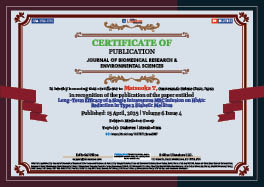
Certificate verifies that this article was peer-reviewed and published in the Journal of Biomedical Research & Environmental Sciences.