Abstract & Article Details
Review Article • Vol.7, Issue 1 • ISSN: 2766-2276 • Open Access • CC BY 4.0
Comparative Evaluation of High-Performance Liquid Chromatography versus Total Organic Carbon Analysis for Cleaning Validation in Pharmaceutical Manufacturing: A Critical Review
Abstract
Background: Cleaning validation is a critical component of pharmaceutical manufacturing quality assurance, ensuring the prevention of cross-contamination between production batches. Two predominant analytical techniques, High-Performance Liquid Chromatography (HPLC) and Total Organic Carbon (TOC) analysis, are widely employed for residue detection, yet the optimal selection between these methodologies remains a subject of ongoing debate within the industry.
Objective: This narrative critical review evaluates the comparative advantages, limitations, and application contexts of HPLC and TOC analysis in pharmaceutical cleaning validation programs based on published literature, providing evidence-based guidance for method selection.
Methods: A comprehensive literature-based review was conducted examining peer-reviewed publications, regulatory guidance documents, and industry case studies from 2010 to 2025. Selection criteria included studies comparing analytical performance, regulatory compliance, and practical implementation considerations. All numerical values reported, including limits of detection and analysis times, are sourced from published literature and do not represent original experimental data.
Results: Based on the reviewed literature, HPLC is generally reported to demonstrate superior specificity for Active Pharmaceutical Ingredient (API) quantification with detection limits typically ranging from 0.1-10 µg/mL, while TOC analysis is reported to offer advantages in non-specific organic contamination detection with broader applicability and faster analysis times (Typically 3-8 minutes versus 15-60 minutes for HPLC). Regulatory guidance from the FDA and EMA supports both methodologies when appropriately validated, with the selection dependent on the specific cleaning validation objectives.
Conclusions: Based on the evidence reviewed, neither technique appears to be universally superior; rather, the optimal choice depends on the validation objective, equipment characteristics, product portfolio complexity, and regulatory requirements. A risk-based approach combining both methodologies may provide the most comprehensive cleaning validation strategy for multi-product facilities.

Research Topics
How to Cite
Article Information
| Journal | Journal of Biomedical Research & Environmental Sciences (JBRES) |
|---|---|
| ISSN | 2766-2276 |
| DOI | DOI 10.37871/jbres2260 |
| Volume / Issue | Vol. 7, Issue 1 |
| Published | January 24, 2026 |
| Article Type | Review Article |
| Pages | 1-12 |
| License | CC BY 4.0 — Open Access |
| Publisher | SciRes Literature LLC, Sheridan, WY, USA |
| Language | English |

Published under CC BY 4.0 — free to share, copy, adapt, and redistribute with attribution.
Certificate of Publication
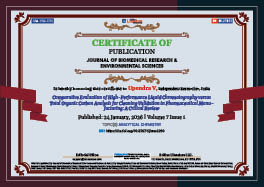
Certificate verifies that this article was peer-reviewed and published in the Journal of Biomedical Research & Environmental Sciences.