Abstract & Article Details
Original Article • Vol.4, Issue 1 • ISSN: 2766-2276 • Open Access • CC BY 4.0
Is Anosmia-Ageusia in COVID-19 Patients Associated with Neuro-Philic Virus Mutant and Mild Respiratory Involvement?
Abstract
Introduction and Objective: In COVID-19, sudden onset anosmia-ageusia can be observed in patients, regardless of other rhinologic symptoms or prominent nasal symptoms.
In our clinical follow-ups, it has drawn our attention that patients presenting with anosmia-ageusia have milder pulmonary symptoms and milder progression. It was thought that this group of patients were infected with neurosensitive SARS-CoV-2 and the study was planned based on this hypothesis. We present our results to contribute to the literature because our study may be a practical screening approach in patient follow-up, may provide predictions of disease progression, and isolation period can be determined.
Materials and Methods: The study was conducted in March 2020, by interviewing recorded patients via phone. Patients’ anosmia-ageusia characteristics, hospitalizations, and recorded Thoracic Computed Tomography (CT) reports were evaluated. The reports were analyzed by a single physician and CT positivity was reported and grouped as mild, moderate and severe.
Results: A total of 1438 patients were included in the study. Of the patients, 47.8% were male and 52.0% were male, while the mean age was 44.33 ∓ 16.01 years. In terms of educational levels, patients were found to be elementary (25.6%) and high school (20.7%) graduates at most.
Discussion and Conclusion: Hospitalization rates of patients presenting with anosmia-ageusia were lower and their disease progression were milder. We suggest that there are mainly neuro- or pulmonary-sensitive variants of the virus. This characteristic is of great importance for the long-term follow-up of these patients and predictions of complications. Patients presenting with a sudden development of anosmia-ageusia should be considered as positive patients. Quarantine and isolation periods should be extended in these patients, keeping in mind the prolonged RT-PCR positivity as well. Besides, it should be noted that these patients are more likely to develop central nervous system complications and they should be followed up.

How to Cite
Article Information
| Journal | Journal of Biomedical Research & Environmental Sciences (JBRES) |
|---|---|
| ISSN | 2766-2276 |
| DOI | DOI 10.37871/jbres1654 |
| Volume / Issue | Vol. 4, Issue 1 |
| Published | January 27, 2023 |
| Article Type | Original Article |
| Pages | 104-116 |
| License | CC BY 4.0 — Open Access |
| Publisher | SciRes Literature LLC, Sheridan, WY, USA |
| Language | English |

Published under CC BY 4.0 — free to share, copy, adapt, and redistribute with attribution.
Certificate of Publication
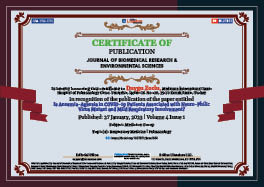
Certificate verifies that this article was peer-reviewed and published in the Journal of Biomedical Research & Environmental Sciences.