Abstract & Article Details
Original Article • Vol.6, Issue 6 • ISSN: 2766-2276 • Open Access • CC BY 4.0
The Abiwaijiwuli-Mufasili Attenuates Cartilage Damage and Ameliorates Osteoarthritis In vivo and In vitro By Regulating Serpina3-Mediated Wnt/b-Catenin Pathway
Abstract
Introduction: Aibiwajiwuli-Mufasili (ABYJ), an ancient classic formula of Uyghur medicine, is used to treat osteoarthritis (OA) in clinical practice in China, yet the underlying mechanism remains obscure. We aimed to propose a novel therapeutic effect of ABYJ on the MIA-induced OA model and ATDC5 cell inflammatory model, and further demonstrated the cartilage renovation of OA through the Serpina3-mediated Wnt/β-catenin pathway.
Methods: In this study, the chemical composition of ABYJ were elucidated using optimized ultrahigh-performance liquid chromatography coupled with quadrupole exactive-orbitrap mass spectrometry (UPLC-Q-Exactive-orbitrap-MS). In an in vivo experiment, rats were randomly divided into 6 groups, the OA model in rats were induced by intraarticular injection with sodium iodoacetate (MIA) solution (60mg·mL-1), behavior of model animals were evaluated by Lequesne MG, and Micro-CT imaging was used for morphological evaluation, Hematoxylin-Eosin (HE) and Safranin O-fast green (SF) staining were used for histology assessment. In addition, 4D Label-free quantification proteomics analysis was used to further explore proteins differentially expressed after different treatment. The expression of Serpina3 and proteins on the Wnt/β-catenin signaling pathway in the rats OA models were determined by Western blot. In vitro, a LPS-induced ATDC5 cells inflammation model was used to validate the possible active ingredients and signaling pathway.
Result: Our studies had shown that a total of 75 active ingredients of ABYJ formula were identified by UPLC-Q-Exactive-orbitrap-MS, Ten marker compounds were identified using orthogonal partial least-squares discrimination analysis, which indicated colchicine and aloin may be the material basis for ABYJ. ABYJ reversed MIA-induced behavioral characteristics, articular inflammatory lesions, the pathological changes and micro structure of knee joint tissue, balance conversion of cartilage cell in rat and reduced the protein expression level of wnt5a, β-catenin and MMP13, while increased Serpina3. A similar rule was demonstrated, the result in vitro suggested ABYJ could inhibit LPS-induced overproduction of pro-inflammatory mediators in ATDC5 cells, including IL-1β, TNF-α and increased the expression level of Serpina3, the increasing expression of Serpina3 would induce [Ca2+] i influx, accordingly, chondrocyte apoptosis was inhibited.
Conclusion: These findings suggest that ABYJ exerts therapeutic effects on joint inflammation and cartilage damage by regulating the wnt5a/β-catenin signaling pathway and modulating the expression of key proteins such as Serpina3, highlighting its potential as a promising candidate for the treatment of joint-related diseases.

Research Topics
How to Cite
Article Information
| Journal | Journal of Biomedical Research & Environmental Sciences (JBRES) |
|---|---|
| ISSN | 2766-2276 |
| DOI | DOI 10.37871/jbres2132 |
| Volume / Issue | Vol. 6, Issue 6 |
| Published | June 30, 2025 |
| Article Type | Original Article |
| Pages | 792-807 |
| License | CC BY 4.0 — Open Access |
| Publisher | SciRes Literature LLC, Sheridan, WY, USA |
| Language | English |

Published under CC BY 4.0 — free to share, copy, adapt, and redistribute with attribution.
Certificate of Publication
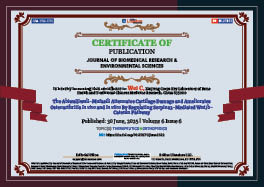
Certificate verifies that this article was peer-reviewed and published in the Journal of Biomedical Research & Environmental Sciences.