Special Issue
Data-Driven Discovery: Biostatistics, Biometrics & Computational Science
Guest Editor: Yingjun Zhao — Department of Intelligent Manufacturing Engineering, Xinjiang University, China
Submission
Covid-19 Research
Safety Profile of COVID-19 Vaccines: Retrospective Analysis of Short, Medium, and Long-Term Side Effects: The Military Hospital Experience – Read more Evaluating the Efficacy of Different SARS-Cov-2 Drug Targets Using the Topo-Geometrical Superposition Algorithm, Molecular Docking and Chemical Reactivity Frameworks – Read more Preventing COVID-19 Infection by Complementary Medicine and Oral Health – Read more Analysis of Body Temperature in Patients with Trauma Visiting a Local Emergency Medical Center during the SARS-CoV-2 Outbreak – Read more N95 Respirator Fit Testing Experience during the Pandemic at a Singapore Tertiary Health Institution: Streamlining Workflow and Improving Respirator Fit Rate – Read more COVID-19 is an Amplifier of Social Inequalities Structural Violence against Students with Special Learning Needs and Low Socio-Economic Status – Read more Interaction between Chronic Influenza and COVID-19: Novel Aspects of Immune System Combat – Read more Daily Life, Fear of COVID-19 and Social Support in the Older Adults in Home Isolation: A Cross-Sectional Study – Read more The Impact of COVID-19 Pandemic on Cardiovascular Diseases in Brazil – Read more Diversity of Non-Influenza Respiratory Viruses Associated with Influenza-Like Illness during 2009 pre and pandemic periods in Sao Paulo, Brazil, a Historical Overview – Read more Cardiovascular Complications of SARS-CoV-2 (COVID-19) in Adults – Read more Impact of COVID-19 Pandemic on the Development of Childrens Executive Functions Implications for School-Based Interventions – Read more The Impact of the COVID-19 Pandemic on Youth Education – Read more Association between Dietary Habits, Lifestyle and Migraine Attacks During Social Isolation in the COVID-19 Pandemic: A Systematic Review of Observational Studies – Read more The Brazilian Increase in Cases of Lung Cancer and COVID-19, Can They be related? – Read more The Possible Therapeutic Application of CO on COVID-19 – Read more Planetary View of COVID Impact vs. IQ & PISA Rank as National Level of Intelligence – Read more Electrophysiological Study in a Patient with Visual Deficit after Severe Coronavirus 2 Pneumonia – Read more A Presentation of Analyses of COVID-19 Vaccine Samples, Blood Samples, Urine Samples, Foot Bath Samples, Sitz Bath Samples, and Skin-Extract Samples – Read more Is Anosmia-Ageusia in COVID-19 Patients Associated with Neuro-Philic Virus Mutant and Mild Respiratory Involvement? – Read more
Home/ All Articles/ Equity of Maintenance Hemodialysis in Myanmar: Cross-Sectional Descriptive Study

Abstract & Article Details

Research Article • Vol.3, Issue 9 • ISSN: 2766-2276 • Open Access • CC BY 4.0

Open Access Research Article Vol.3, Issue 9 September 15, 2022

Equity of Maintenance Hemodialysis in Myanmar: Cross-Sectional Descriptive Study

DOI: 10.37871/jbres1553
Authors
Khin Phyu Pyar*, Win Kyaw Shwe, Kyaw Thu Yein Lwin, San Lin, Aung Zaw Htet, Phyo Mouk Aung, Aung Hlaing Win, Lay Maung Maung, Ye Min Hein, Lynn Htet Aung, Myo Min Thant, Myo Maung Maung, Moe Htun Zaw, Sai Aik Hla, Ye Htook Mg, Zin Zin Aung, Kyaw Zaw Lin, Zar Ni Htet Aung, Nyan Lin Maung, Moe Zaw Myint and Thet Aung
Full Text PDF

Abstract

Background: Maintenance hemodialysis has been the commonest Renal Replacement Therapy (RRT) in Myanmar. The equity is questionable in Myanmar, a developing country, as developed countries reported inequities of dialysis in various aspects.

Methods: A cross-sectional descriptive study was conducted in selected Hemodialysis Centers (HDC) which are under the care of government of Myanmar in August 2022. Data were collected by using standardized forms and analysis was done.

Results:
A total of 168 cases from 5 HDC situated in Yangon (lower part of Myanmar), Nay Pyi Taw (central part of Myanmar), Aung Ban (Eastern part of Myanmar), Lashio (North eastern part of Myanmar) and Kyaing Ton (near Golden Triangle) were included. The age range was 21-79 years; old age was not excluded for maintenance hemodialysis. Male to female ratio was 1:1.2 revealing accessibility of both sex to maintenance hemodialysis. The proportion of ethnic groups was Burmese (139/168), Rakhine (8/168), Karen (7/168), Shan (6/168), Danu (2/168), Paoh (1/168), Chin (1/168), Kachin (1/168), inlay (1/168), Lesue (1/168) and Larhu (1/168); it was in accordance with normal ethnic distribution in Myanmar. Regarding religion, the majority were Buddhist (158/168); Nine patients were Christian. One patient was Islam. It was proportionate with percentage of population by religion in 2014 Census. Only 38 patients were graduates and four patients were illiterate; therefore, illiterates were accessible to maintenance hemodialysis. Ninety-eight percent of patients had comorbidities; and, 5% had 5 comorbid diseases revealing patients with multiple comorbid status were not left behind. Half of the patients were unemployed pointing that the jobless were not excluded for hemodialysis. Median travel time to HD center was 45 minutes (IQR 26-120 minutes). The maximum was 3 hours (180 minutes) in 3 patients. Half of the patients required 60 minutes travel time to HDC. Fifty percent of patients had booster vaccination to COVID-19. Most of the patients, over 90%, were doing their daily routine activity without assistance. Ninety-eight percent of patients were satisfied with treatments in their corresponding HDC.

Conclusion:
There was no difference in age, sex, race, religion, comorbidity, employment status, underlying etiology and education in terms of accessibility to maintenance hemodialysis. Although they were dealing with long travel time of more than one hour in 50% of cases, their attitude was positive. As half of the patients had travel time of more than an hour, we need new HDC in Aung Ban. Resource allocation to renal replacement therapy should be encouraged at ministry level.

Research Topics

How to Cite

Khin Phyu Pyar*, Win Kyaw Shwe, Kyaw Thu Yein Lwin, San Lin, Aung Zaw Htet, Phyo Mouk Aung, Aung Hlaing Win, Lay Maung Maung, Ye Min Hein, Lynn Htet Aung, Myo Min Thant, Myo Maung Maung, Moe Htun Zaw, Sai Aik Hla, Ye Htook Mg, Zin Zin Aung, Kyaw Zaw Lin, Zar Ni Htet Aung, Nyan Lin Maung, Moe Zaw Myint and Thet Aung (2022). Equity of Maintenance Hemodialysis in Myanmar: Cross-Sectional Descriptive Study. Journal of Biomedical Research & Environmental Sciences, 3(9). https://doi.org/10.37871/jbres1553

Article Information

JournalJournal of Biomedical Research & Environmental Sciences (JBRES)
ISSN2766-2276
DOI DOI 10.37871/jbres1553
Volume / IssueVol. 3, Issue 9
PublishedSeptember 15, 2022
Article TypeResearch Article
Pages1045-1053
LicenseCC BY 4.0 — Open Access
PublisherSciRes Literature LLC, Sheridan, WY, USA
LanguageEnglish
Creative Commons BY 4.0

Published under CC BY 4.0 — free to share, copy, adapt, and redistribute with attribution.

Certificate of Publication
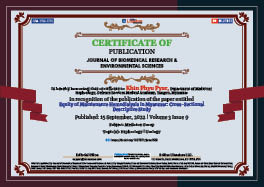
Certificate of Publication — Equity of Maintenance Hemodialysis in Myanmar: Cross-Sectional Descriptive Study

Certificate verifies that this article was peer-reviewed and published in the Journal of Biomedical Research & Environmental Sciences.

Publish with JBRES — Peer-reviewed, multidisciplinary Open Access with rapid review, DOI, and global visibility.
Double-Blind CrossRef DOI Discoverable
