Special Issue
Data-Driven Discovery: Biostatistics, Biometrics & Computational Science
Guest Editor: Yingjun Zhao — Department of Intelligent Manufacturing Engineering, Xinjiang University, China
Submission
Covid-19 Research
Safety Profile of COVID-19 Vaccines: Retrospective Analysis of Short, Medium, and Long-Term Side Effects: The Military Hospital Experience – Read more Evaluating the Efficacy of Different SARS-Cov-2 Drug Targets Using the Topo-Geometrical Superposition Algorithm, Molecular Docking and Chemical Reactivity Frameworks – Read more Preventing COVID-19 Infection by Complementary Medicine and Oral Health – Read more Analysis of Body Temperature in Patients with Trauma Visiting a Local Emergency Medical Center during the SARS-CoV-2 Outbreak – Read more N95 Respirator Fit Testing Experience during the Pandemic at a Singapore Tertiary Health Institution: Streamlining Workflow and Improving Respirator Fit Rate – Read more COVID-19 is an Amplifier of Social Inequalities Structural Violence against Students with Special Learning Needs and Low Socio-Economic Status – Read more Interaction between Chronic Influenza and COVID-19: Novel Aspects of Immune System Combat – Read more Daily Life, Fear of COVID-19 and Social Support in the Older Adults in Home Isolation: A Cross-Sectional Study – Read more The Impact of COVID-19 Pandemic on Cardiovascular Diseases in Brazil – Read more Diversity of Non-Influenza Respiratory Viruses Associated with Influenza-Like Illness during 2009 pre and pandemic periods in Sao Paulo, Brazil, a Historical Overview – Read more Cardiovascular Complications of SARS-CoV-2 (COVID-19) in Adults – Read more Impact of COVID-19 Pandemic on the Development of Childrens Executive Functions Implications for School-Based Interventions – Read more The Impact of the COVID-19 Pandemic on Youth Education – Read more Association between Dietary Habits, Lifestyle and Migraine Attacks During Social Isolation in the COVID-19 Pandemic: A Systematic Review of Observational Studies – Read more The Brazilian Increase in Cases of Lung Cancer and COVID-19, Can They be related? – Read more The Possible Therapeutic Application of CO on COVID-19 – Read more Planetary View of COVID Impact vs. IQ & PISA Rank as National Level of Intelligence – Read more Electrophysiological Study in a Patient with Visual Deficit after Severe Coronavirus 2 Pneumonia – Read more A Presentation of Analyses of COVID-19 Vaccine Samples, Blood Samples, Urine Samples, Foot Bath Samples, Sitz Bath Samples, and Skin-Extract Samples – Read more Is Anosmia-Ageusia in COVID-19 Patients Associated with Neuro-Philic Virus Mutant and Mild Respiratory Involvement? – Read more
Home/ Article Figures/ Image View

Article Figures

View article figures, metadata, abstract and related content from this JBRES publication.
Review Article Vol. 6, Issue 6 2025-06-18
Integrating Environmental, Social, and Governance Factors in Megaproject Front-End Design: A Quantitative Framework with Prediction and Uncertainty Assessment
Henry Efe Onomakpo Onomakpo*
Natural Resource Management Environmental Impacts Ecosystem Science
Integrating Environmental, Social, and Governance Factors in Megaproject Front-End Design: A Quantitative Framework with Prediction and Uncertainty Assessment
jbres2127-g001.webp

Article Figures (1)

Abstract

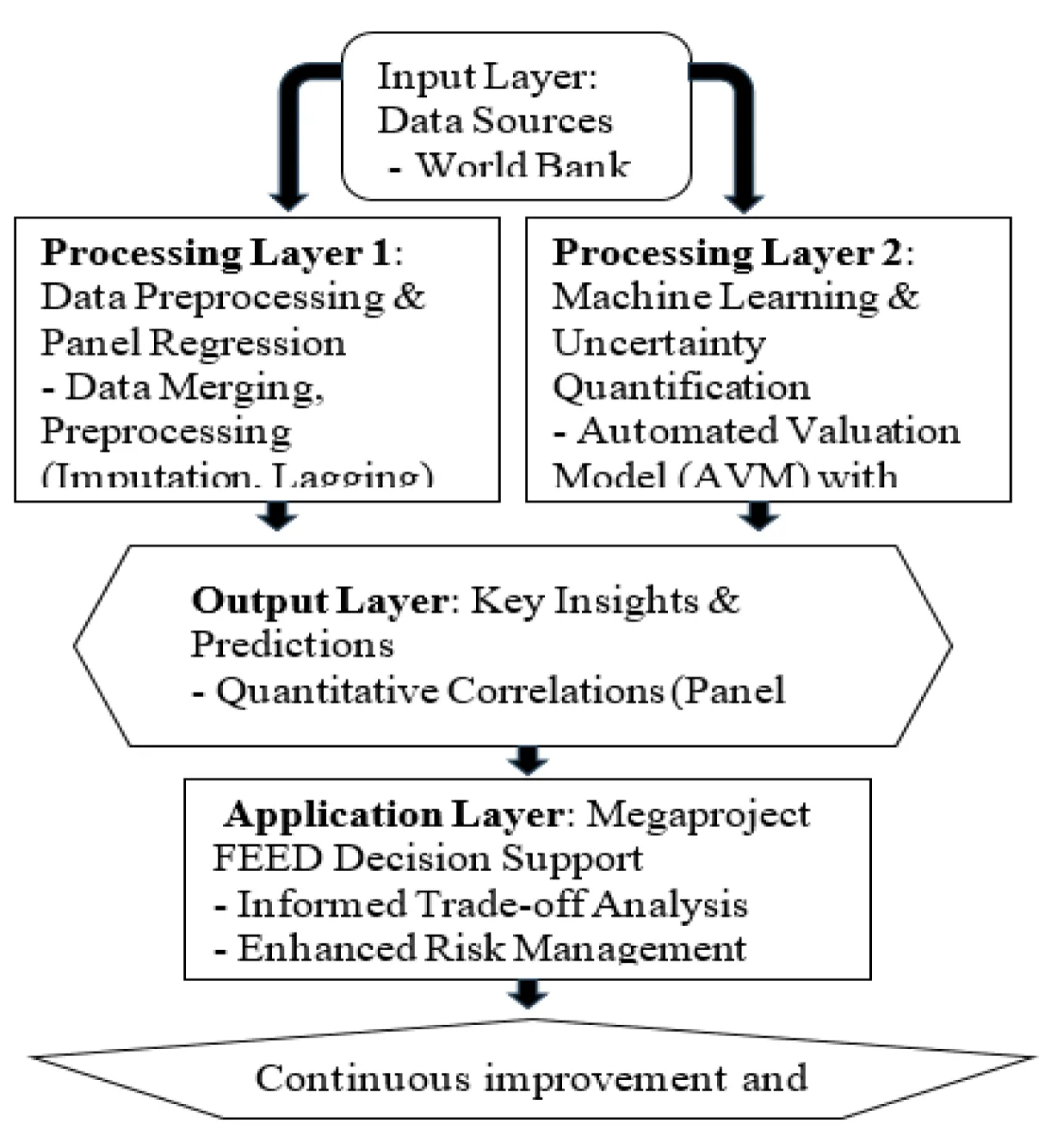
Megaproject Front-End Engineering Design crucially impacts lifecycle value, yet often lacks systematic methods to integrate multi-dimensional value drivers, including Environmental, Social, and Governance factors, using advanced analytics. This research aimed to develop foundational knowledge and a methodological framework to address this gap. This study employed a quantitative approach using panel data (circa 2009-2023), merging country-level Environmental, Social, and Governance indicators from the World Bank and house price indices from Organization for Economic Co-operation and Development countries as an economic performance proxy. Analyses included multicollinearity assessment using the Variance Inflation Factor, panel data regression (Pooled Ordinary Least Squares, Fixed Effects, Random Effects with cluster-robust errors), and the development of a machine learning-based Automated Valuation Model using Random Forest with lagged predictors. Uncertainty quantification for the Automated Valuation Model was performed using Conformal Prediction. The Fixed Effects model (preferred via diagnostic tests; within-coefficient of determination = 0.59) identified significant within-country correlations between house price indices and specific Environmental, Social, and Governance and economic factors (e.g., coastal protection, literacy rate, economic/social rights performance, energy imports/use, internet adoption, demographics). The Random Forest Automated Valuation Model achieved strong predictive performance on test data (coefficient of determination = 0.87, root mean squared error = 6.88), with lagged indicators contributing significantly. Conformal Prediction reliably generated 90% prediction intervals with 90.8% empirical coverage. The study demonstrates the feasibility of a quantitative framework integrating diverse Environmental, Social, and Governance and economic factors using panel regression and machine learning with uncertainty quantification for analysis relevant to megaproject Front-End Engineering Design. This provides essential groundwork for developing future automated, data-driven decision support tools to enhance holistic value assessment.

Article Information

JournalJournal of Biomedical Research & Environmental Sciences (JBRES)
Article TypeReview Article
Published2025-06-18
Volume / IssueVol. 6, Issue 6
DOI10.37871/jbres2127
Pages744-762
LicenseCC BY 4.0 — Free to reuse with attribution
Back to Image Search
Publish with JBRES — Peer-reviewed, multidisciplinary Open Access with rigorous double-blind review, CrossRef DOI, and global visibility.
Double-Blind CrossRef DOI Discoverable