Special Issue
Data-Driven Discovery: Biostatistics, Biometrics & Computational Science
Guest Editor: Yingjun Zhao — Department of Intelligent Manufacturing Engineering, Xinjiang University, China
Submission
Covid-19 Research
Safety Profile of COVID-19 Vaccines: Retrospective Analysis of Short, Medium, and Long-Term Side Effects: The Military Hospital Experience – Read more Evaluating the Efficacy of Different SARS-Cov-2 Drug Targets Using the Topo-Geometrical Superposition Algorithm, Molecular Docking and Chemical Reactivity Frameworks – Read more Preventing COVID-19 Infection by Complementary Medicine and Oral Health – Read more Analysis of Body Temperature in Patients with Trauma Visiting a Local Emergency Medical Center during the SARS-CoV-2 Outbreak – Read more N95 Respirator Fit Testing Experience during the Pandemic at a Singapore Tertiary Health Institution: Streamlining Workflow and Improving Respirator Fit Rate – Read more COVID-19 is an Amplifier of Social Inequalities Structural Violence against Students with Special Learning Needs and Low Socio-Economic Status – Read more Interaction between Chronic Influenza and COVID-19: Novel Aspects of Immune System Combat – Read more Daily Life, Fear of COVID-19 and Social Support in the Older Adults in Home Isolation: A Cross-Sectional Study – Read more The Impact of COVID-19 Pandemic on Cardiovascular Diseases in Brazil – Read more Diversity of Non-Influenza Respiratory Viruses Associated with Influenza-Like Illness during 2009 pre and pandemic periods in Sao Paulo, Brazil, a Historical Overview – Read more Cardiovascular Complications of SARS-CoV-2 (COVID-19) in Adults – Read more Impact of COVID-19 Pandemic on the Development of Childrens Executive Functions Implications for School-Based Interventions – Read more The Impact of the COVID-19 Pandemic on Youth Education – Read more Association between Dietary Habits, Lifestyle and Migraine Attacks During Social Isolation in the COVID-19 Pandemic: A Systematic Review of Observational Studies – Read more The Brazilian Increase in Cases of Lung Cancer and COVID-19, Can They be related? – Read more The Possible Therapeutic Application of CO on COVID-19 – Read more Planetary View of COVID Impact vs. IQ & PISA Rank as National Level of Intelligence – Read more Electrophysiological Study in a Patient with Visual Deficit after Severe Coronavirus 2 Pneumonia – Read more A Presentation of Analyses of COVID-19 Vaccine Samples, Blood Samples, Urine Samples, Foot Bath Samples, Sitz Bath Samples, and Skin-Extract Samples – Read more Is Anosmia-Ageusia in COVID-19 Patients Associated with Neuro-Philic Virus Mutant and Mild Respiratory Involvement? – Read more
Home/ All Articles/ Recent Trends on the use of Infrared Spectroscopy for Soil Assessment

Abstract & Article Details

Mini Review • Vol.4, Issue 11 • ISSN: 2766-2276 • Open Access • CC BY 4.0

Open Access Mini Review Vol.4, Issue 11 November 27, 2023

Recent Trends on the use of Infrared Spectroscopy for Soil Assessment

DOI: 10.37871/jbres1840
Authors
Angelo Jamil Maia*
Full Text PDF

Abstract

Infrared spectroscopy has emerged as a powerful tool to assess soil properties for both environmental science and agriculture. Here, we explore its recent trends and developments for soil assessment. This technique is an alternative that counters the limitations of traditional laboratory methods, offering a cost-effective and non-destructive approach. Here, the latest trends in the innovation landscape of infrared spectroscopy for soil assessment are explored, providing insights on its broad range of applications and into the future trajectory of this technology. Firstly, we delve into its applications in agriculture, highlighting its potential for prediction of many soil attributes. Next, we explore soil carbon assessment, emphasizing the importance of estimating soil organic carbon and soil carbon stock for soil quality. Soil pollution and elemental contents are addressed, focusing on the prediction of potentially toxic elements concentrations in soil, strongly relevant for environmental monitoring. Infrared spectroscopy emerges as a valuable tool for rapid and non-hazardous elemental content assessment. Soil physical properties prediction, traditionally limited to soil texture analysis, is extended through the application of novel approaches, shedding light on the broader potential of this technology for soil quality assessment. The ongoing developments in statistical modeling and technological innovation are also showcased, mainly focused on machine learning methods. Lastly, the importance of soil spectral libraries is emphasized, such as the Global Soil Spectral Calibration Library and Estimation Service, and Brazilian Soil Spectral Library. In conclusion, infrared spectroscopy has become an important tool in soil assessment, offering a multitude of applications across environmental and agricultural contexts. This review underscores the growing potential of this technology in advancing the standardization and reproducibility of sustainable soil assessment procedures, ensuring a brighter future for soil science.

Research Topics

How to Cite

Angelo Jamil Maia* (2023). Recent Trends on the use of Infrared Spectroscopy for Soil Assessment. Journal of Biomedical Research & Environmental Sciences, 4(11). https://doi.org/10.37871/jbres1840

Article Information

JournalJournal of Biomedical Research & Environmental Sciences (JBRES)
ISSN2766-2276
DOI DOI 10.37871/jbres1840
Volume / IssueVol. 4, Issue 11
PublishedNovember 27, 2023
Article TypeMini Review
Pages1618-1623
LicenseCC BY 4.0 — Open Access
PublisherSciRes Literature LLC, Sheridan, WY, USA
LanguageEnglish
Creative Commons BY 4.0

Published under CC BY 4.0 — free to share, copy, adapt, and redistribute with attribution.

Certificate of Publication
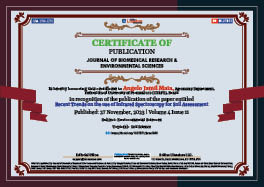
Certificate of Publication — Recent Trends on the use of Infrared Spectroscopy for Soil Assessment

Certificate verifies that this article was peer-reviewed and published in the Journal of Biomedical Research & Environmental Sciences.

Publish with JBRES — Peer-reviewed, multidisciplinary Open Access with rapid review, DOI, and global visibility.
Double-Blind CrossRef DOI Discoverable
