Special Issue
Data-Driven Discovery: Biostatistics, Biometrics & Computational Science
Guest Editor: Yingjun Zhao — Department of Intelligent Manufacturing Engineering, Xinjiang University, China
Submission
Covid-19 Research
Safety Profile of COVID-19 Vaccines: Retrospective Analysis of Short, Medium, and Long-Term Side Effects: The Military Hospital Experience – Read more Evaluating the Efficacy of Different SARS-Cov-2 Drug Targets Using the Topo-Geometrical Superposition Algorithm, Molecular Docking and Chemical Reactivity Frameworks – Read more Preventing COVID-19 Infection by Complementary Medicine and Oral Health – Read more Analysis of Body Temperature in Patients with Trauma Visiting a Local Emergency Medical Center during the SARS-CoV-2 Outbreak – Read more N95 Respirator Fit Testing Experience during the Pandemic at a Singapore Tertiary Health Institution: Streamlining Workflow and Improving Respirator Fit Rate – Read more COVID-19 is an Amplifier of Social Inequalities Structural Violence against Students with Special Learning Needs and Low Socio-Economic Status – Read more Interaction between Chronic Influenza and COVID-19: Novel Aspects of Immune System Combat – Read more Daily Life, Fear of COVID-19 and Social Support in the Older Adults in Home Isolation: A Cross-Sectional Study – Read more The Impact of COVID-19 Pandemic on Cardiovascular Diseases in Brazil – Read more Diversity of Non-Influenza Respiratory Viruses Associated with Influenza-Like Illness during 2009 pre and pandemic periods in Sao Paulo, Brazil, a Historical Overview – Read more Cardiovascular Complications of SARS-CoV-2 (COVID-19) in Adults – Read more Impact of COVID-19 Pandemic on the Development of Childrens Executive Functions Implications for School-Based Interventions – Read more The Impact of the COVID-19 Pandemic on Youth Education – Read more Association between Dietary Habits, Lifestyle and Migraine Attacks During Social Isolation in the COVID-19 Pandemic: A Systematic Review of Observational Studies – Read more The Brazilian Increase in Cases of Lung Cancer and COVID-19, Can They be related? – Read more The Possible Therapeutic Application of CO on COVID-19 – Read more Planetary View of COVID Impact vs. IQ & PISA Rank as National Level of Intelligence – Read more Electrophysiological Study in a Patient with Visual Deficit after Severe Coronavirus 2 Pneumonia – Read more A Presentation of Analyses of COVID-19 Vaccine Samples, Blood Samples, Urine Samples, Foot Bath Samples, Sitz Bath Samples, and Skin-Extract Samples – Read more Is Anosmia-Ageusia in COVID-19 Patients Associated with Neuro-Philic Virus Mutant and Mild Respiratory Involvement? – Read more
Home/ All Articles/ Immune Response towards COVID-19

Abstract & Article Details

Mini Review • Vol.2, Issue 12 • ISSN: 2766-2276 • Open Access • CC BY 4.0

Open Access Mini Review Vol.2, Issue 12 December 20, 2021

Immune Response towards COVID-19

DOI: 10.37871/jbres1372
Authors
Muhammad Akram, Waqas Ahmed, Abolfazl Jafari-Sales, Nilgun Kusculu, Mounir M Bekhit, Prakash Ramakrishnan, El Hadji Seydou Mbaye, Fahad Said Khan, Omer Kilic, Muhammad Amjad Chishti, Aamir Sharif, Gawel Solowski, Muhammad Muddasar Saeed, Waill Elkhateeb* and Ghoson Daba
Full Text PDF

Abstract

Background: As the world witnessed the outbreak of coronavirus illness 2019 (COVID-19), a disorder developed as a result of a novel coronavirus, Severe Acute Respiratory Syndrome Coronavirus 2 (SARS-CoV-2), increasing genetics with healthcare evidence suggest a corresponding leadership to SARS as well as the Middle East Respiratory Syndrome (MERS).

Aim: The aim of this review is to highlight Immune response of human body toward COVID-19.

Materials and methods: This was a narrative review. A comprehensive literature search was done using PubMed, Google Scholar, Scopus, and EMBASE using the keywords, Immune Response; COVID-19; Vaccination; SARS-Cov-2; ACE2; Coronavirus; MERS.

Results: A flow of viral components passes to the body by means of nostrils, mouth and eyes. SARS-CoV-2 is in a position to continue to become unnoticed extended than numerous influenza or coronaviruses. Its proteins can accomplish entry by unlocking the Angiotensin-Converting Enzyme 2 (ACE2) protein in the lung cells; viruses also possess antigens furthermore recognize that these are what cries the immunity into movement via making antibodies. Investigators demonstrate an extensive variety of immune cells respond to COVID-19 along with valuable source retrieval, discovering that might want to notify the manufacturing of a viable vaccination.

Conclusion: The body's natural response to a viral infection is a non-invasive intrinsic response in which macrophages, neutrophils, and dendritic cells limit the virus's progression and may even prevent it by multiplying symptoms. This non-invasive solution is accompanied by an elastic response in which the body produces radicals that primarily adjust to the herpes virus.

How to Cite

Muhammad Akram, Waqas Ahmed, Abolfazl Jafari-Sales, Nilgun Kusculu, Mounir M Bekhit, Prakash Ramakrishnan, El Hadji Seydou Mbaye, Fahad Said Khan, Omer Kilic, Muhammad Amjad Chishti, Aamir Sharif, Gawel Solowski, Muhammad Muddasar Saeed, Waill Elkhateeb* and Ghoson Daba (2021). Immune Response towards COVID-19. Journal of Biomedical Research & Environmental Sciences, 2(12). https://doi.org/10.37871/jbres1372

Article Information

JournalJournal of Biomedical Research & Environmental Sciences (JBRES)
ISSN2766-2276
DOI DOI 10.37871/jbres1372
Volume / IssueVol. 2, Issue 12
PublishedDecember 20, 2021
Article TypeMini Review
Pages1197-1201
LicenseCC BY 4.0 — Open Access
PublisherSciRes Literature LLC, Sheridan, WY, USA
LanguageEnglish
Creative Commons BY 4.0

Published under CC BY 4.0 — free to share, copy, adapt, and redistribute with attribution.

Certificate of Publication
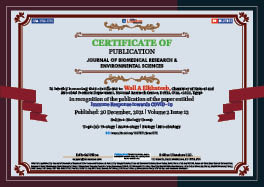
Certificate of Publication — Immune Response towards COVID-19

Certificate verifies that this article was peer-reviewed and published in the Journal of Biomedical Research & Environmental Sciences.

Publish with JBRES — Peer-reviewed, multidisciplinary Open Access with rapid review, DOI, and global visibility.
Double-Blind CrossRef DOI Discoverable
