Article Figures
View article figures, metadata, abstract and related content from this JBRES publication.
Article Figures (1)
Abstract
Objective: This study aimed to identify partial D variants in african black populations living in Africa.
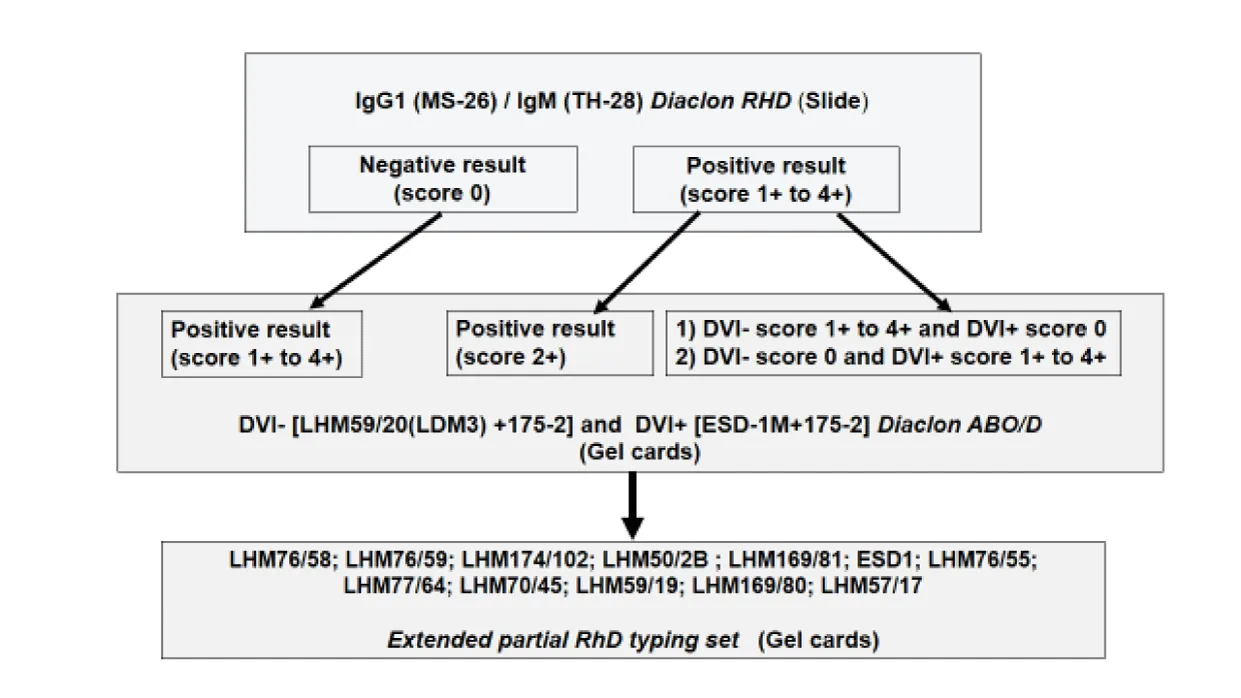
Methods: A cross-sectional study was carried out at the CPC Hematology Laboratory from April 2016 to June 2017. A 5 ml volume of blood was collected in an EDTA tube, from all patients coming for the ABO/D blood grouping. Three Biorad antisera reagents characterized by monoclonal anti-D antibody were used for D antigen testing: IgG (MS-26)/IgM (TH-28) , anti-DVI- [LHM59/20 (LDM3) +175-2] and anti-DVI+ [ESD-1M+175-2] . An extended partial Rh D typing panel of 12 anti-D (LHM76/58; LHM76/59; LHM174/102; LHM50/2B; LHM169/81; ESD1; LHM76/55; LHM77/64; LHM70/45; LHM59/19; LHM169/80; LHM57/17) was used to identify partial D on discrepant results.
Results: Of the 3 439 patients sampled, 1.6% with a median age of 24 years showed discordant results. Men were 2.7 times (1.3-5.5) more likely to have concordant results (p = 0.005) than women. Variant characterization revealed 7.3% of weak D and 87.3% of partial D including 36.4% DFR, 32.7% DV, 14.6% DIII, 1.8% DAR-E, and 1.8% DHK/DAU-4.
Conclusion: The use of anti-D reagents from different cell lines is essential for the detection of D variants. The identification of these variants by larger panels of antisera is highly required and their confirmation with molecular approaches is becoming paramount.
Article Information
| Journal | Journal of Biomedical Research & Environmental Sciences (JBRES) |
|---|---|
| Article Type | Original Article |
| Published | 2025-06-16 |
| Volume / Issue | Vol. 6, Issue 6 |
| DOI | 10.37871/jbres2119 |
| Pages | 652-660 |
| License | CC BY 4.0 — Free to reuse with attribution |