Special Issue
Innovations in Biomedical Research and Clinical Medicine
Guest Editor: Editorial Board — Journal of Biomedical Research & Environmental Sciences
Submission
Covid-19 Research
Safety Profile of COVID-19 Vaccines: Retrospective Analysis of Short, Medium, and Long-Term Side Effects: The Military Hospital Experience – Read more Evaluating the Efficacy of Different SARS-Cov-2 Drug Targets Using the Topo-Geometrical Superposition Algorithm, Molecular Docking and Chemical Reactivity Frameworks – Read more Preventing COVID-19 Infection by Complementary Medicine and Oral Health – Read more Analysis of Body Temperature in Patients with Trauma Visiting a Local Emergency Medical Center during the SARS-CoV-2 Outbreak – Read more N95 Respirator Fit Testing Experience during the Pandemic at a Singapore Tertiary Health Institution: Streamlining Workflow and Improving Respirator Fit Rate – Read more COVID-19 is an Amplifier of Social Inequalities Structural Violence against Students with Special Learning Needs and Low Socio-Economic Status – Read more Interaction between Chronic Influenza and COVID-19: Novel Aspects of Immune System Combat – Read more Daily Life, Fear of COVID-19 and Social Support in the Older Adults in Home Isolation: A Cross-Sectional Study – Read more The Impact of COVID-19 Pandemic on Cardiovascular Diseases in Brazil – Read more Diversity of Non-Influenza Respiratory Viruses Associated with Influenza-Like Illness during 2009 pre and pandemic periods in Sao Paulo, Brazil, a Historical Overview – Read more Cardiovascular Complications of SARS-CoV-2 (COVID-19) in Adults – Read more Impact of COVID-19 Pandemic on the Development of Childrens Executive Functions Implications for School-Based Interventions – Read more The Impact of the COVID-19 Pandemic on Youth Education – Read more Association between Dietary Habits, Lifestyle and Migraine Attacks During Social Isolation in the COVID-19 Pandemic: A Systematic Review of Observational Studies – Read more The Brazilian Increase in Cases of Lung Cancer and COVID-19, Can They be related? – Read more The Possible Therapeutic Application of CO on COVID-19 – Read more Planetary View of COVID Impact vs. IQ & PISA Rank as National Level of Intelligence – Read more Electrophysiological Study in a Patient with Visual Deficit after Severe Coronavirus 2 Pneumonia – Read more A Presentation of Analyses of COVID-19 Vaccine Samples, Blood Samples, Urine Samples, Foot Bath Samples, Sitz Bath Samples, and Skin-Extract Samples – Read more Is Anosmia-Ageusia in COVID-19 Patients Associated with Neuro-Philic Virus Mutant and Mild Respiratory Involvement? – Read more
Home/ All Articles/ Measuring Nitric Oxide, Reversing Disease and Mitigating Restenosis through Plant-Based Di…

Abstract & Article Details

Clinical Trials • Vol.6, Issue 8 • ISSN: 2766-2276 • Open Access • CC BY 4.0

Open Access Clinical Trials Vol.6, Issue 8 August 18, 2025

Measuring Nitric Oxide, Reversing Disease and Mitigating Restenosis through Plant-Based Diet and Lifestyle

DOI: 10.37871/jbres2164
Authors
Dasaad Mulijono*

Abstract

Once underestimated, Nitric Oxide (NO) is now recognized as a crucial molecule in maintaining vascular health, supporting brain function, and modulating systemic diseases. Since its Nobel Prize-winning discovery in 1998, NO has re-emerged as both a robust biomarker and a therapeutic target, particularly within cardiovascular and lifestyle medicine.

This article explores the exclusively plant-based origins of NO precursors. It highlights how Bethsaida Hospital, Indonesia, under the leadership of Professor Dasaad Mulijono (DM), has pioneered the clinical use of salivary NO strip testing for nearly seven years. To our knowledge, Bethsaida is the first medical centre in Southeast Asia to adopt this simple, non-invasive method for monitoring NO levels in a clinical setting.

Salivary NO testing has provided an objective, point-of-care tool to assess dietary adherence, making it a key component of Bethsaida’s strategy in lifestyle-based disease reversal. This approach has demonstrated measurable success, with patients showing a reversal of atherosclerosis, reduced restenosis rates following Drug-

Coated Balloon (DCB) angioplasty, and remission of chronic diseases such as hypertension, obesity, Type 2 Diabetes (T2D), and hyperlipidaemia-all conditions associated with elevated NO levels.

We critically examine the limitations of commercial NO supplements and the disruptive effects of commonly prescribed medications on endogenous NO pathways. In contrast, a Plant-Based Diet (PBD) has proven to be a superior and sustainable means of boosting NO production.

Bethsaida’s model offers a reproducible, scalable, and clinically effective framework for addressing the global chronic disease epidemic. It is grounded in evidence, innovation, and a commitment to root-cause solutions.

Research Topics

Get email alerts when new articles are published in these topics Subscribe for Alerts

How to Cite

Dasaad Mulijono* (2025). Measuring Nitric Oxide, Reversing Disease and Mitigating Restenosis through Plant-Based Diet and Lifestyle. Journal of Biomedical Research & Environmental Sciences, 6(8). https://doi.org/10.37871/jbres2164

Article Information

JournalJournal of Biomedical Research & Environmental Sciences (JBRES)
ISSN2766-2276
DOI DOI 10.37871/jbres2164
Volume / IssueVol. 6, Issue 8
ReceivedAugust 3, 2025
AcceptedAugust 16, 2025
PublishedAugust 18, 2025
Article TypeClinical Trials
Pages1096-1100
LicenseCC BY 4.0 — Open Access
PublisherSciRes Literature LLC, Sheridan, WY, USA
LanguageEnglish
Creative Commons BY 4.0

Published under CC BY 4.0 — free to share, copy, adapt, and redistribute with attribution.

Certificate of Publication
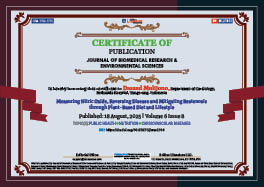
Certificate of Publication — Measuring Nitric Oxide, Reversing Disease and Mitigating Restenosis through Plant-Based Diet and Lifestyle

Certificate verifies that this article was peer-reviewed and published in the Journal of Biomedical Research & Environmental Sciences.

Publish with JBRES — Peer-reviewed, multidisciplinary Open Access with rigorous double-blind review, CrossRef DOI, and global visibility.
Double-Blind CrossRef DOI Discoverable
