Special Issue
Data-Driven Discovery: Biostatistics, Biometrics & Computational Science
Guest Editor: Yingjun Zhao — Department of Intelligent Manufacturing Engineering, Xinjiang University, China
Submission
Covid-19 Research
Safety Profile of COVID-19 Vaccines: Retrospective Analysis of Short, Medium, and Long-Term Side Effects: The Military Hospital Experience – Read more Evaluating the Efficacy of Different SARS-Cov-2 Drug Targets Using the Topo-Geometrical Superposition Algorithm, Molecular Docking and Chemical Reactivity Frameworks – Read more Preventing COVID-19 Infection by Complementary Medicine and Oral Health – Read more Analysis of Body Temperature in Patients with Trauma Visiting a Local Emergency Medical Center during the SARS-CoV-2 Outbreak – Read more N95 Respirator Fit Testing Experience during the Pandemic at a Singapore Tertiary Health Institution: Streamlining Workflow and Improving Respirator Fit Rate – Read more COVID-19 is an Amplifier of Social Inequalities Structural Violence against Students with Special Learning Needs and Low Socio-Economic Status – Read more Interaction between Chronic Influenza and COVID-19: Novel Aspects of Immune System Combat – Read more Daily Life, Fear of COVID-19 and Social Support in the Older Adults in Home Isolation: A Cross-Sectional Study – Read more The Impact of COVID-19 Pandemic on Cardiovascular Diseases in Brazil – Read more Diversity of Non-Influenza Respiratory Viruses Associated with Influenza-Like Illness during 2009 pre and pandemic periods in Sao Paulo, Brazil, a Historical Overview – Read more Cardiovascular Complications of SARS-CoV-2 (COVID-19) in Adults – Read more Impact of COVID-19 Pandemic on the Development of Childrens Executive Functions Implications for School-Based Interventions – Read more The Impact of the COVID-19 Pandemic on Youth Education – Read more Association between Dietary Habits, Lifestyle and Migraine Attacks During Social Isolation in the COVID-19 Pandemic: A Systematic Review of Observational Studies – Read more The Brazilian Increase in Cases of Lung Cancer and COVID-19, Can They be related? – Read more The Possible Therapeutic Application of CO on COVID-19 – Read more Planetary View of COVID Impact vs. IQ & PISA Rank as National Level of Intelligence – Read more Electrophysiological Study in a Patient with Visual Deficit after Severe Coronavirus 2 Pneumonia – Read more A Presentation of Analyses of COVID-19 Vaccine Samples, Blood Samples, Urine Samples, Foot Bath Samples, Sitz Bath Samples, and Skin-Extract Samples – Read more Is Anosmia-Ageusia in COVID-19 Patients Associated with Neuro-Philic Virus Mutant and Mild Respiratory Involvement? – Read more
Home/ All Articles/ Molecular Diversity and Characteristics of KRAS Mutations in Colorectal Cancers

Abstract & Article Details

Original Article • Vol.4, Issue 1 • ISSN: 2766-2276 • Open Access • CC BY 4.0

Open Access Original Article Vol.4, Issue 1 January 24, 2023

Molecular Diversity and Characteristics of KRAS Mutations in Colorectal Cancers

DOI: 10.37871/jbres1650
Authors
Amrit Kaur Kaler*, Omkar Dharut, Smitha Umarji, Shweta Limaye, Bijal Kulkarni, Meenal Hastak, Nivetha Athikari, Yash Tiwarekar, Samrudhi Rane, Ankita Nikam, Imraan Sheikh and Sandeep Goyle

Abstract

Background: KRAS oncogene is involved in colorectal carcinogenesis in 22 to 45% of cases. KRAS mutations can render Epidermal Growth Factor Receptor (EGFR) inhibitors ineffective. The present study is aimed to determine the molecular diversity, frequency, and characteristics of KRAS mutations in metastatic Colorectal Cancer (mCRC). The gene KRAS contains 4 coding exons and 1 non-coding exon, of which exon 2 has the highest mutation rate, which is directly associated with the occurrence of poor prognosis and drug resistance. Codon 12, 13, 61 are common KRAS mutations. The most prevalent KRAS mutation observed was codon 12-G12D mutation where Glycine is changed to Aspartic acid.

Materials and Methods: A retrospective study was conducted on both in-situ and metastatic colorectal cancers that were registered for KRAS gene mutation testing in Department of Molecular Pathology and Genomics, Kokilaben Dhirubhai Ambani Hospital & Medical Research Institute, from January 2016 to January 2022. KRAS mutations studies were carried out in primary and metastatic 87 patients of colorectal cancers. The samples contained 37 women aged 25-80 years and 50 men aged 29-77 years. Formalin fixed and paraffin embedded tissue samples were evaluated using Sanger sequencing and statistical analysis was carried out.

Results: KRAS mutations were demonstrated in 26 cases of 87 patients (29.88%). Of the 26 cases, the substitution nucleotide variations as point mutations were as follows: Codon 12-18 cases (69%), codon 13-4 cases (15%), codon 61-2 cases (8%), codon 146-1 case (4%), and codon 10-1 case (4%). The Codon 12 mutations were detected as follows: G12D-9 cases (50%), G12V-3 cases (17%), G12A-3 cases (17%), G12S-2 cases (11%), G12C-1 case (5%); Codon 13 showed all 4 mutations (4%) in G13D. KRAS mutations were found to be more frequent in elderly age group. Most m-KRAS tumors were located in sigmoid colon and rectum (left sided/distal colon), although, the mutations were spread across including ascending colon (right sided/proximal colon) and rarely in jejunum too. The TNM stage showed majority (50%) of KRAS mutations in stage IV, and 20% of cases in stage II and III each.

Conclusion: In this series, 29% of colorectal cancer tissue samples had KRAS mutations. Their frequency and distribution showed majority mutations on left sided/distal colon, elderly population, more common in females and presented at an advanced stage. There was no clinicopathological significance to histomorphology. Understanding KRAS mutations in different aspects can give a better comprehensive understanding of KRAS associated CRCs.

Research Topics

Get email alerts when new articles are published in these topics Subscribe for Alerts

How to Cite

Amrit Kaur Kaler*, Omkar Dharut, Smitha Umarji, Shweta Limaye, Bijal Kulkarni, Meenal Hastak, Nivetha Athikari, Yash Tiwarekar, Samrudhi Rane, Ankita Nikam, Imraan Sheikh and Sandeep Goyle (2023). Molecular Diversity and Characteristics of KRAS Mutations in Colorectal Cancers. Journal of Biomedical Research & Environmental Sciences, 4(1). https://doi.org/10.37871/jbres1650

Article Information

JournalJournal of Biomedical Research & Environmental Sciences (JBRES)
ISSN2766-2276
DOI DOI 10.37871/jbres1650
Volume / IssueVol. 4, Issue 1
ReceivedJanuary 18, 2023
AcceptedJanuary 21, 2023
PublishedJanuary 24, 2023
Article TypeOriginal Article
Pages077-083
LicenseCC BY 4.0 — Open Access
PublisherSciRes Literature LLC, Sheridan, WY, USA
LanguageEnglish
Creative Commons BY 4.0

Published under CC BY 4.0 — free to share, copy, adapt, and redistribute with attribution.

Certificate of Publication
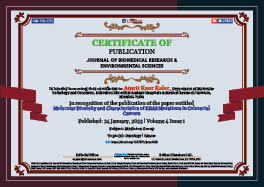
Certificate of Publication — Molecular Diversity and Characteristics of KRAS Mutations in Colorectal Cancers

Certificate verifies that this article was peer-reviewed and published in the Journal of Biomedical Research & Environmental Sciences.

Publish with JBRES — Peer-reviewed, multidisciplinary Open Access with rigorous double-blind review, CrossRef DOI, and global visibility.
Double-Blind CrossRef DOI Discoverable
