Abstract & Article Details
Review Article • Vol.7, Issue 4 • ISSN: 2766-2276 • Open Access • CC BY 4.0
Daivavyapashraya Chikitsa in Cancer Care: Bridging Ancient Wisdom with Modern Oncology
Abstract
Background: Cancer affects patients far beyond the physical burden of disease. Emotional distress, uncertainty, existential suffering, and unmet spiritual needs frequently accompany diagnosis, treatment, survivorship, and end-of-life care. In Ayurveda, Daivavyapashraya Chikitsa refers to spiritually oriented measures such as mantra, observances, ritual, fasting, and faith-based reassurance. Although this framework is well described in classical Ayurvedic thought, its role in modern oncology remains insufficiently defined.
Objective: To examine the potential supportive role of Daivavyapashraya Chikitsa in cancer care through an evidence-informed review of Ayurvedic scholarship, spiritual care literature, and integrative oncology research.
Methods: A focused narrative review was conducted using PubMed/PubMed Central and authoritative oncology sources. Priority was given to English-language reviews, clinical guidelines, randomized controlled trials, meta-analyses, and major scholarly articles relevant to Ayurveda, spiritual care, meaning-centered interventions, mind-body practices, and mantra/mantram-based approaches in cancer care.
Results: Direct oncology-specific evidence on Daivavyapashraya Chikitsa is limited. However, adjacent evidence suggests that spiritually oriented and mind-body interventions may improve anxiety, depression, distress, fatigue, spiritual well-being, and quality of life in patients with cancer. Meta-analyses support modest benefits of psychosocial and spiritual interventions on spiritual well-being, while recent guidelines from the Society for Integrative Oncology and ASCO support selected non-pharmacological interventions for anxiety and depression in cancer settings. Mantra/mantram-based practices appear feasible and potentially beneficial in survivorship settings, although oncology-specific data remain preliminary.
Conclusion: Daivavyapashraya Chikitsa should not be presented as a proven anticancer treatment. Rather, it may be understood as a traditional Ayurvedic framework for addressing spiritual and existential suffering within supportive oncology. Its most appropriate contemporary role is as a complementary, patient-centered, culturally sensitive supportive approach, used alongside standard cancer treatment. More rigorous oncology-specific research is needed.

Research Topics
How to Cite
Article Information
| Journal | Journal of Biomedical Research & Environmental Sciences (JBRES) |
|---|---|
| ISSN | 2766-2276 |
| DOI | DOI 10.37871/jbres2295 |
| Volume / Issue | Vol. 7, Issue 4 |
| Received | March 31, 2025 |
| Accepted | April 21, 2026 |
| Published | April 22, 2026 |
| Article Type | Review Article |
| Pages | 1-7 |
| License | CC BY 4.0 — Open Access |
| Publisher | SciRes Literature LLC, Sheridan, WY, USA |
| Language | English |

Published under CC BY 4.0 — free to share, copy, adapt, and redistribute with attribution.
Certificate of Publication
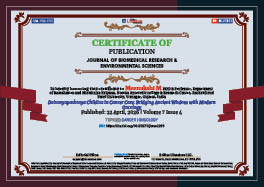
Certificate verifies that this article was peer-reviewed and published in the Journal of Biomedical Research & Environmental Sciences.