Special Issue
Data-Driven Discovery: Biostatistics, Biometrics & Computational Science
Guest Editor: Yingjun Zhao — Department of Intelligent Manufacturing Engineering, Xinjiang University, China
Submission
Covid-19 Research
Safety Profile of COVID-19 Vaccines: Retrospective Analysis of Short, Medium, and Long-Term Side Effects: The Military Hospital Experience – Read more Evaluating the Efficacy of Different SARS-Cov-2 Drug Targets Using the Topo-Geometrical Superposition Algorithm, Molecular Docking and Chemical Reactivity Frameworks – Read more Preventing COVID-19 Infection by Complementary Medicine and Oral Health – Read more Analysis of Body Temperature in Patients with Trauma Visiting a Local Emergency Medical Center during the SARS-CoV-2 Outbreak – Read more N95 Respirator Fit Testing Experience during the Pandemic at a Singapore Tertiary Health Institution: Streamlining Workflow and Improving Respirator Fit Rate – Read more COVID-19 is an Amplifier of Social Inequalities Structural Violence against Students with Special Learning Needs and Low Socio-Economic Status – Read more Interaction between Chronic Influenza and COVID-19: Novel Aspects of Immune System Combat – Read more Daily Life, Fear of COVID-19 and Social Support in the Older Adults in Home Isolation: A Cross-Sectional Study – Read more The Impact of COVID-19 Pandemic on Cardiovascular Diseases in Brazil – Read more Diversity of Non-Influenza Respiratory Viruses Associated with Influenza-Like Illness during 2009 pre and pandemic periods in Sao Paulo, Brazil, a Historical Overview – Read more Cardiovascular Complications of SARS-CoV-2 (COVID-19) in Adults – Read more Impact of COVID-19 Pandemic on the Development of Childrens Executive Functions Implications for School-Based Interventions – Read more The Impact of the COVID-19 Pandemic on Youth Education – Read more Association between Dietary Habits, Lifestyle and Migraine Attacks During Social Isolation in the COVID-19 Pandemic: A Systematic Review of Observational Studies – Read more The Brazilian Increase in Cases of Lung Cancer and COVID-19, Can They be related? – Read more The Possible Therapeutic Application of CO on COVID-19 – Read more Planetary View of COVID Impact vs. IQ & PISA Rank as National Level of Intelligence – Read more Electrophysiological Study in a Patient with Visual Deficit after Severe Coronavirus 2 Pneumonia – Read more A Presentation of Analyses of COVID-19 Vaccine Samples, Blood Samples, Urine Samples, Foot Bath Samples, Sitz Bath Samples, and Skin-Extract Samples – Read more Is Anosmia-Ageusia in COVID-19 Patients Associated with Neuro-Philic Virus Mutant and Mild Respiratory Involvement? – Read more
Home/ All Articles/ COVID-19 Vaccine Acceptability and Hesitancy in Africa: Implications for Addressing Vaccin…

Abstract & Article Details

Review Article • Vol.2, Issue 10 • ISSN: 2766-2276 • Open Access • CC BY 4.0

Open Access Review Article Vol.2, Issue 10 October 29, 2021

COVID-19 Vaccine Acceptability and Hesitancy in Africa: Implications for Addressing Vaccine Hesitancy

DOI: 10.37871/jbres1342
Authors
Steward Mudenda*
U

Abstract

Background: Increased acceptance and uptake of Coronavirus Disease 2019 (COVID-19) vaccines is very essential in containing the ongoing COVID-19 pandemic. Vaccine hesitancy is a threat to public health containment of infectious diseases.

Aim: The main aim of this study was to review published articles regarding COVID-19 vaccine acceptability and hesitancy across all populations in Africa.
Materials and methods: This was a narrative review. A comprehensive literature search was done using PubMed, Google Scholar, Scopus, and EMBASE using the keywords vaccine acceptability, vaccine hesitancy, COVID-19 vaccine, COVID-19 pandemic, H1N1 vaccine, swine flu, swine flu vaccine, Africa, and the Boolean word AND. The cited literature was published between March 2001 and June 2021.

Results: The few studies were done in Africa so far are among healthcare workers and medical students. Acceptance of vaccination against COVID-19 in Africa ranged from 15.4% to 55.9%. This shows increased hesitancy to receive the COVID-19 vaccines in African countries. Many people were concerned about the potential adverse effects and ineffectiveness of COVID-19 vaccines. Misinformation about the COVID-19 vaccines has contributed to the hesitancy reported from different studies. Moreover, sociodemographic characteristics were also predictors of the acceptability of COVID-19 vaccines.

Conclusion: Low acceptability rates reported in Africa indicates increased hesitancy to vaccination against COVID-19. The low acceptance of vaccines in Africa can hinder the required 60-70% vaccinations to achieve herd immunity. Therefore, there is a need to develop strategies that will address hesitancy against the COVID-19 vaccines across countries and populations in Africa and the entire globe.

Research Topics

Get email alerts when new articles are published in these topics Subscribe for Alerts

How to Cite

Steward Mudenda* (2021). COVID-19 Vaccine Acceptability and Hesitancy in Africa: Implications for Addressing Vaccine Hesitancy. Journal of Biomedical Research & Environmental Sciences, 2(10). https://doi.org/10.37871/jbres1342

Article Information

JournalJournal of Biomedical Research & Environmental Sciences (JBRES)
ISSN2766-2276
DOI DOI 10.37871/jbres1342
Volume / IssueVol. 2, Issue 10
ReceivedOctober 21, 2021
AcceptedOctober 28, 2021
PublishedOctober 29, 2021
Article TypeReview Article
Pages999-1004
LicenseCC BY 4.0 — Open Access
PublisherSciRes Literature LLC, Sheridan, WY, USA
LanguageEnglish
Creative Commons BY 4.0

Published under CC BY 4.0 — free to share, copy, adapt, and redistribute with attribution.

Certificate of Publication
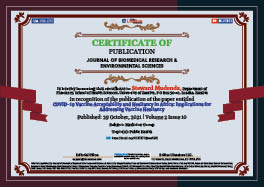
Certificate of Publication — COVID-19 Vaccine Acceptability and Hesitancy in Africa: Implications for Addressing Vaccine Hesitancy

Certificate verifies that this article was peer-reviewed and published in the Journal of Biomedical Research & Environmental Sciences.

Publish with JBRES — Peer-reviewed, multidisciplinary Open Access with rigorous double-blind review, CrossRef DOI, and global visibility.
Double-Blind CrossRef DOI Discoverable
