Special Issue
Innovations in Biomedical Research and Clinical Medicine
Guest Editor: Editorial Board — Journal of Biomedical Research & Environmental Sciences
Submission
Covid-19 Research
Safety Profile of COVID-19 Vaccines: Retrospective Analysis of Short, Medium, and Long-Term Side Effects: The Military Hospital Experience – Read more Evaluating the Efficacy of Different SARS-Cov-2 Drug Targets Using the Topo-Geometrical Superposition Algorithm, Molecular Docking and Chemical Reactivity Frameworks – Read more Preventing COVID-19 Infection by Complementary Medicine and Oral Health – Read more Analysis of Body Temperature in Patients with Trauma Visiting a Local Emergency Medical Center during the SARS-CoV-2 Outbreak – Read more N95 Respirator Fit Testing Experience during the Pandemic at a Singapore Tertiary Health Institution: Streamlining Workflow and Improving Respirator Fit Rate – Read more COVID-19 is an Amplifier of Social Inequalities Structural Violence against Students with Special Learning Needs and Low Socio-Economic Status – Read more Interaction between Chronic Influenza and COVID-19: Novel Aspects of Immune System Combat – Read more Daily Life, Fear of COVID-19 and Social Support in the Older Adults in Home Isolation: A Cross-Sectional Study – Read more The Impact of COVID-19 Pandemic on Cardiovascular Diseases in Brazil – Read more Diversity of Non-Influenza Respiratory Viruses Associated with Influenza-Like Illness during 2009 pre and pandemic periods in Sao Paulo, Brazil, a Historical Overview – Read more Cardiovascular Complications of SARS-CoV-2 (COVID-19) in Adults – Read more Impact of COVID-19 Pandemic on the Development of Childrens Executive Functions Implications for School-Based Interventions – Read more The Impact of the COVID-19 Pandemic on Youth Education – Read more Association between Dietary Habits, Lifestyle and Migraine Attacks During Social Isolation in the COVID-19 Pandemic: A Systematic Review of Observational Studies – Read more The Brazilian Increase in Cases of Lung Cancer and COVID-19, Can They be related? – Read more The Possible Therapeutic Application of CO on COVID-19 – Read more Planetary View of COVID Impact vs. IQ & PISA Rank as National Level of Intelligence – Read more Electrophysiological Study in a Patient with Visual Deficit after Severe Coronavirus 2 Pneumonia – Read more A Presentation of Analyses of COVID-19 Vaccine Samples, Blood Samples, Urine Samples, Foot Bath Samples, Sitz Bath Samples, and Skin-Extract Samples – Read more Is Anosmia-Ageusia in COVID-19 Patients Associated with Neuro-Philic Virus Mutant and Mild Respiratory Involvement? – Read more
Home/ Article Figures/ Image View

Article Figures

View article figures, metadata, abstract and related content from this JBRES publication.
Vol. 7, Issue 4 2026-04-06
Enhanced Genome Editing Needs an AI-Powered Meta-Platform for Smarter TALEN and CRISPR Tool Selection
Yufeng Liu, Muhammad Zawwad Raza and Muhammad Riaz
Bioengineering Bioinformatics Biotechnology
Enhanced Genome Editing Needs an AI-Powered Meta-Platform for Smarter TALEN and CRISPR Tool Selection
jbres2289-g001.webp

Article Figures (1)

Abstract

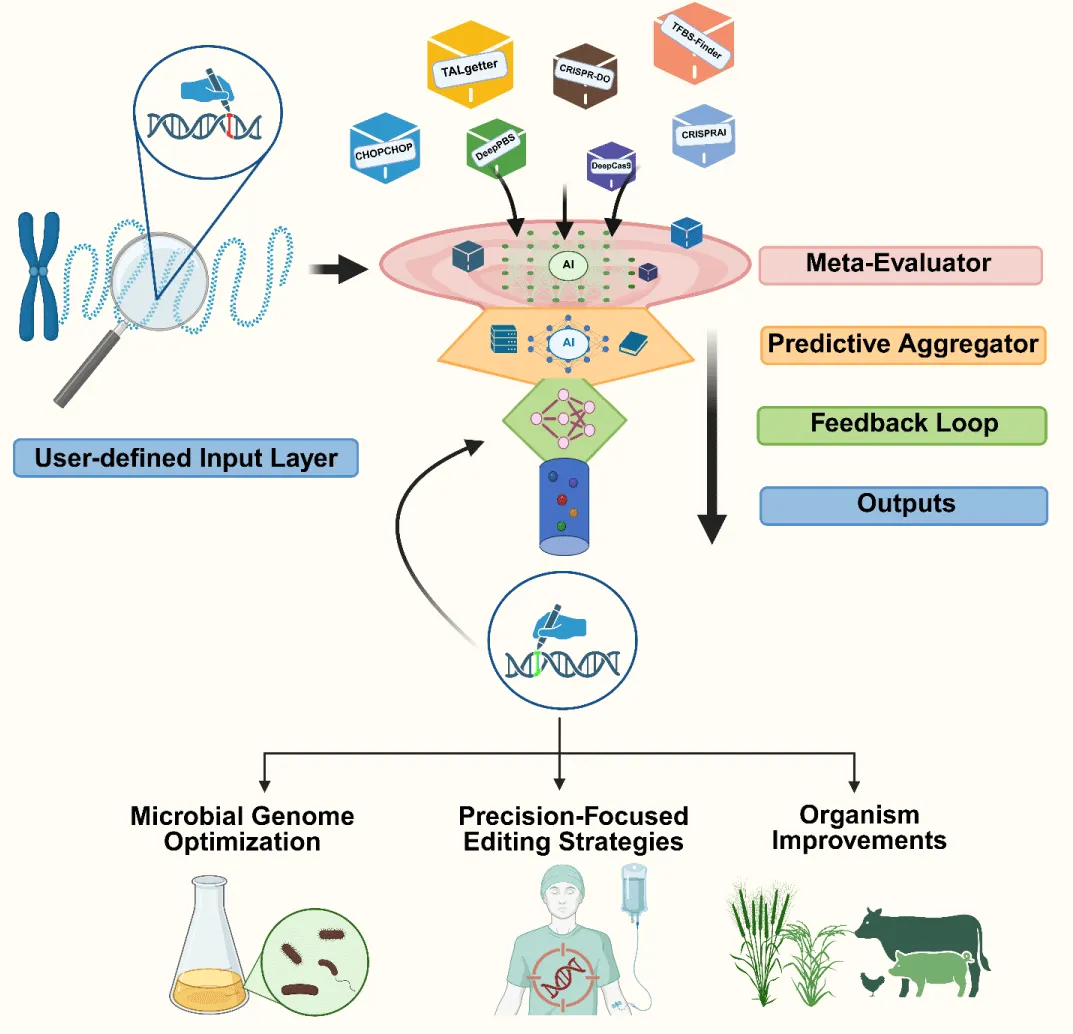
Artificial intelligence (AI) is increasingly shaping genome-editing design, supporting predictive modeling of TALEN- and CRISPR-based systems by integrating genomic sequence features, chromatin structural context, and experimental metadata. However, the rapid proliferation of machine learning (ML)-driven tools has created a fragmented landscape in which different models operate on distinct, incompatible scoring scales and rely on heterogeneous training datasets, thereby substantially limiting the systematic, reproducible benchmarking of these tools. It produces a clear unmet need for harmonization in this space. To address this gap, we propose an AI-driven meta-platform that integrates predictions from existing genome-editing design tools using a stacked ensemble learning strategy and meta-modeling. The framework harmonizes diverse datasets and incorporates continuously filtered feedback from experimentally validated editing outcomes, with appropriate safeguards to manage the challenges inherent to multi-source, community-contributed experimental data. Through this process, the system learns the context-dependent strengths and limitations of individual predictors across different cell types, delivery modalities, and nuclease variants. By doing so, it enables tool-agnostic benchmarking, mitigates model-specific biases, and provides confidence-aware prioritization of candidate guides. We argue that such a unifying platform can shift the field from isolated, model-specific predictions towards an integrated, knowledge-driven ecosystem. This is expected to enhance robustness, interpretability, and reproducibility while supporting responsible data governance through explainable AI and privacy-preserving learning.

Article Information

JournalJournal of Biomedical Research & Environmental Sciences (JBRES)
Published2026-04-06
Volume / IssueVol. 7, Issue 4
DOI10.37871/jbres2289
Pages1-6
LicenseCC BY 4.0 — Free to reuse with attribution
Back to Image Search
Publish with JBRES — Peer-reviewed, multidisciplinary Open Access with rigorous double-blind review, CrossRef DOI, and global visibility.
Double-Blind CrossRef DOI Discoverable