Abstract & Article Details
Review Article • Vol.7, Issue 6 • ISSN: 2766-2276 • Open Access • CC BY 4.0
Understanding Geopolitical Dynamics, Economics, Health and Environmental Implications in Nonferrous Metal Mining Operations
Abstract
This review explicates geopolitical issues and their impacts on nonferrous metal mining operations and the implications on the environment, health, economics, and global supply chains. The study explores the critical intersections of resource nationalism, environmental degradation, and economic impacts within the context of increasing global demand for critical minerals. This article is timely and pertinent, taking into cognizance extant global transitions toward green energy. The global issues associated with mining and metals are indicative globally of a vast majority of carbon-intensive sectors, and increasing demand for electronics and conventional produce culminating in the growth of metal and mineral production, as well as nonferrous metal mining activities in collaborative measures with numerous other perturbative and disruptive environmental and social activities via soil, water, air pollution, disease dissemination, climate change, environmental and economic distortions. Since prehistoric times, nonferrous metal mining operations have been facing complex and intricate metamorphoses driven by intense global geopolitical tensions, environmental demands and supplies, and the cravings for materials to undergird the green energy transition. The discourse pertaining to this article takes into account economic shifts within the sector, with highlights and hallmarks which impact geopolitical tensions on investment flows and operational costs. Invariably is the nuance that global trends have required reconfigurations of both industrial modalities and policy frameworks to embrace and improve environmental, health, social, and governance standards. Globally, nonferrous metal mining operations provide economic potential, stimulus, growth and jobs, community investments in development projects as well as enhanced anthropogenic economic impact. Conversely, nonferrous metal mining processes can negatively impact and degrade the environment through the destruction of biodiversity, contribute to the presence of hazardous chemicals or substances with resultant terrestrial, aquatic and atmospheric contamination and pollution enhanced by anthropogenic and natural activities. The inimical effects of mining include health perturbations, erosion, sinkholes, biodiversity loss, contamination and pollution of soil, groundwater and surface water caused by nonferrous metal and chemical emissions during and following mining operations. Furthermore, these processes adversely affect the atmosphere through emitted carbon contributing to climate change. The pivotal and primordial geopolitical issues, challenges, opportunities and priorities surrounding minerals and nonferrous metal mining processes are that geopolitical risks in the operational spheres are classifiable in disparate sections, such as resource nationalism, production concentration, processing concentration, landscape regulation, macroeconomic attributes and price volatility as well as expectations of stakeholder.

Research Topics
How to Cite
Article Information
| Journal | Journal of Biomedical Research & Environmental Sciences (JBRES) |
|---|---|
| ISSN | 2766-2276 |
| DOI | DOI 10.37871/jbres2307 |
| Volume / Issue | Vol. 7, Issue 6 |
| Received | May 13, 2026 |
| Accepted | June 9, 2026 |
| Published | June 10, 2026 |
| Article Type | Review Article |
| Pages | 1-15 |
| License | CC BY 4.0 — Open Access |
| Publisher | SciRes Literature LLC, Sheridan, WY, USA |
| Language | English |

Published under CC BY 4.0 — free to share, copy, adapt, and redistribute with attribution.
Certificate of Publication
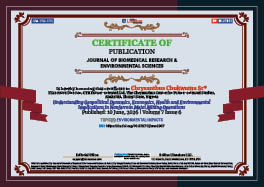
Certificate verifies that this article was peer-reviewed and published in the Journal of Biomedical Research & Environmental Sciences.