Abstract & Article Details
Research Article • Vol.6, Issue 4 • ISSN: 2766-2276 • Open Access • CC BY 4.0
QoS-Aware Task Scheduling using Reinforcement Learning in Long Rage Wide Area Network IoT Application
Abstract
Objective: The primary objective of this study is to develop a QoS-aware task scheduling algorithm for LoRaWAN IoT applications using a Reinforcement Learning (RL) approach.
Introduction: LoRaWAN is a widely adopted Low Power Wide Area Network (LPWAN) protocol designed for Internet of Things (IoT) applications due to its long-range communication and low power consumption. However, ensuring QoS in LoRaWAN networks remains challenging due to limited bandwidth, high device density, and dynamic traffic patterns. Existing scheduling algorithms often fail to balance competing QoS requirements effectively. Reinforcement Learning (RL) offers a promising solution by enabling intelligent decision-making through interaction with the network environment.
Case representation: The proposed model employs a Deep Q-Network (DQN) to optimize task scheduling in LoRaWAN networks. The RL agent interacts with a simulated LoRaWAN environment built using NS-3, where it learns to make scheduling decisions based on real-time network states. Key parameters, such as delay, PDR, PER, and throughput, are used as inputs to the reward function to guide the learning process. Performance is evaluated against existing models like RT-LoRa, and LoRa+ under varying node densities and traffic scenarios.
Result: The simulation results demonstrate that the proposed RL-based task scheduling algorithm outperforms existing models across multiple Quality of Service (QoS) metrics. It achieves the lowest delay at approximately 40 ms, significantly outperforming RT-LoRa, which has a delay of around 120 ms, and LoRa+, which experiences a delay of about 80ms. In terms of Packet Delivery Ratio (PDR), the model maintains a competitive value of approximately 85%, comparable to LoRa+ at 87%. Additionally, it records the lowest Packet Error Rate (PER) at around 5%, outperforming RT-LoRa and LoRa+, which exhibit PER values of approximately 15% and 10%, respectively. Furthermore, the model achieves the highest throughput of approximately 250 kbps, surpassing RT-LoRa at 150 kbps and LoRa+ at 200 kbps, demonstrating its superior performance in optimizing network efficiency.
Discussion: The proposed model demonstrates significant strengths in reducing delay and PER while maximizing throughput, making it suitable for time-sensitive IoT applications. However, its marginal improvement in PDR compared to existing models highlights an area for further optimization. Additionally, energy efficiency was not explicitly addressed in this study, which is critical for LPWAN applications like LoRaWAN. These limitations suggest potential directions for future research.
Conclusion: This research successfully develops a QoS-aware task scheduling algorithm using reinforcement learning for LoRaWAN IoT applications. By dynamically adapting to network conditions, the proposed model achieves superior performance across multiple QoS metrics compared to state-of-the-art algorithms. Future work will focus on incorporating energy efficiency into the model and extending its applicability to multi-gateway scenarios.

Research Topics
How to Cite
Article Information
| Journal | Journal of Biomedical Research & Environmental Sciences (JBRES) |
|---|---|
| ISSN | 2766-2276 |
| DOI | DOI 10.37871/jbres2089 |
| Volume / Issue | Vol. 6, Issue 4 |
| Received | March 13, 2025 |
| Accepted | April 15, 2025 |
| Published | April 18, 2025 |
| Article Type | Research Article |
| Pages | 340-360 |
| License | CC BY 4.0 — Open Access |
| Publisher | SciRes Literature LLC, Sheridan, WY, USA |
| Language | English |

Published under CC BY 4.0 — free to share, copy, adapt, and redistribute with attribution.
Certificate of Publication
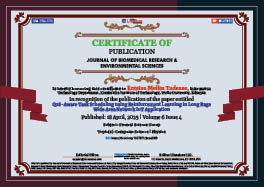
Certificate verifies that this article was peer-reviewed and published in the Journal of Biomedical Research & Environmental Sciences.