Special Issue
Advances in Environmental Health and Toxicology
Guest Editor: Editorial Team — Journal of Biomedical Research & Environmental Sciences
Submission
Covid-19 Research
Safety Profile of COVID-19 Vaccines: Retrospective Analysis of Short, Medium, and Long-Term Side Effects: The Military Hospital Experience – Read more Evaluating the Efficacy of Different SARS-Cov-2 Drug Targets Using the Topo-Geometrical Superposition Algorithm, Molecular Docking and Chemical Reactivity Frameworks – Read more Preventing COVID-19 Infection by Complementary Medicine and Oral Health – Read more Analysis of Body Temperature in Patients with Trauma Visiting a Local Emergency Medical Center during the SARS-CoV-2 Outbreak – Read more N95 Respirator Fit Testing Experience during the Pandemic at a Singapore Tertiary Health Institution: Streamlining Workflow and Improving Respirator Fit Rate – Read more COVID-19 is an Amplifier of Social Inequalities Structural Violence against Students with Special Learning Needs and Low Socio-Economic Status – Read more Interaction between Chronic Influenza and COVID-19: Novel Aspects of Immune System Combat – Read more Daily Life, Fear of COVID-19 and Social Support in the Older Adults in Home Isolation: A Cross-Sectional Study – Read more The Impact of COVID-19 Pandemic on Cardiovascular Diseases in Brazil – Read more Diversity of Non-Influenza Respiratory Viruses Associated with Influenza-Like Illness during 2009 pre and pandemic periods in Sao Paulo, Brazil, a Historical Overview – Read more Cardiovascular Complications of SARS-CoV-2 (COVID-19) in Adults – Read more Impact of COVID-19 Pandemic on the Development of Childrens Executive Functions Implications for School-Based Interventions – Read more The Impact of the COVID-19 Pandemic on Youth Education – Read more Association between Dietary Habits, Lifestyle and Migraine Attacks During Social Isolation in the COVID-19 Pandemic: A Systematic Review of Observational Studies – Read more The Brazilian Increase in Cases of Lung Cancer and COVID-19, Can They be related? – Read more The Possible Therapeutic Application of CO on COVID-19 – Read more Planetary View of COVID Impact vs. IQ & PISA Rank as National Level of Intelligence – Read more Electrophysiological Study in a Patient with Visual Deficit after Severe Coronavirus 2 Pneumonia – Read more A Presentation of Analyses of COVID-19 Vaccine Samples, Blood Samples, Urine Samples, Foot Bath Samples, Sitz Bath Samples, and Skin-Extract Samples – Read more Is Anosmia-Ageusia in COVID-19 Patients Associated with Neuro-Philic Virus Mutant and Mild Respiratory Involvement? – Read more
Home/ Article Figures/ Image View

Article Figures

View article figures, metadata, abstract and related content from this JBRES publication.
Research Article Vol. 7, Issue 2 2026-02-27
The Development of Acute Kidney Injury and Electrolyte Disorders in Relation to Different Cardioplegic Solutions used during Cardiac Surgery
Giulia Franceschini, Valentina Ajello, Laura De Felice, Paolo Prati, Andrea Farinaccio, Roberto Scaini, Mattia Gatta, Manuela Moresco, Marzia Flaminio, Dario Buioni, Augusto D Onofrio and Paolo Nardi
Cardiovascular Diseases
The Development of Acute Kidney Injury and Electrolyte Disorders in Relation to Different Cardioplegic Solutions used during Cardiac Surgery
jbres2273-g001.webp

Article Figures (1)

Abstract

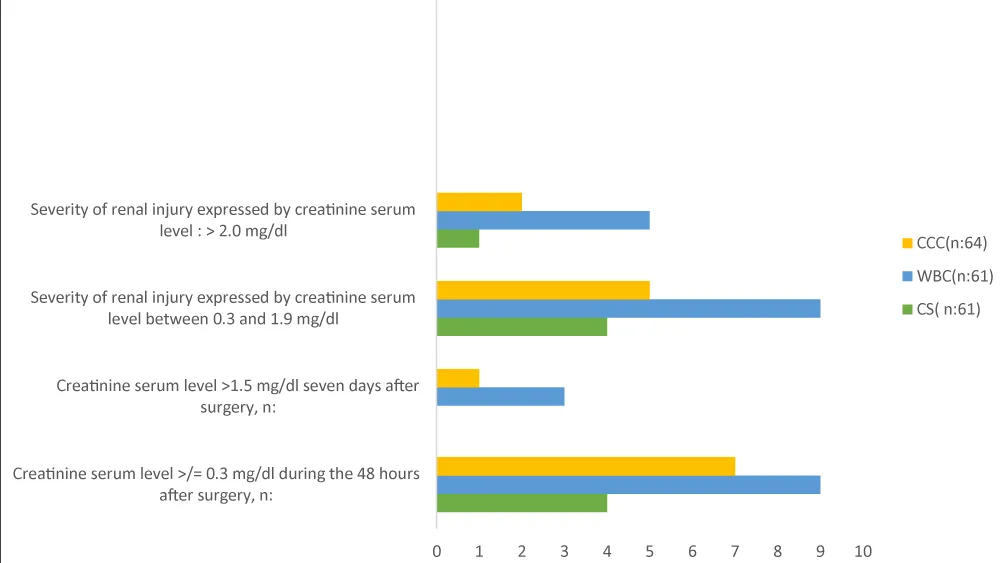
Background: Acute Kidney Injury (AKI) is a serious complication after cardiac surgery. We sought to determine the possible onset of AKI in patients undergoing cardiac surgery with different cardioplegic solution during Cardiopulmonary Bypass (CPB) including Custodiol Solution (CS), cold crystalloid St. Thomas cardioplegia (CCC), warm Blood Cardioplegia (WBC).Methods: We retrospectively collected data from 186 patients undergoing cardiac surgery between June 2023 and December 2024. Three groups of patients, based on the above mentioned three different types of cardioplegic solutions administered, were established. We analyzed pH, sodium, potassium, calcium, chlorine, lactates before cardiac surgery (T0), after the first dose of cardioplegic solution infusion (T1) and at the end of CPB (T2), at 48 hours (T3) and 7 days after cardiac surgery (T4). The severity of renal injury was defined as a creatinine serum increase between 0.3 and 1.9 mg/dl and an increase >/= 2 mg/dl.Results: Preoperative serum creatinine level (Odds Ratio [OR]: 9.5; p < 0.001), lactate level at weaning from cardiopulmonary bypass > 3 mMol/L (OR: 10; p =0.03), sodium level imbalance during CPB (OR: 1.1; p = 0.02), and, with a little statistical significance, male gender (OR: 4.2; p =0.05) were statistically significant independent predictors of AKI. Different type of cardioplegia was not detected as an independent risk factor at the multivariate analysis, although WBC was associated with a higher risk of AKI at the univariate analysis (p < 0.001, for all measurements).Conclusion: There is no evidence concluding which could be the safest cardioplegic solution to prevent AKI occurrence. However, WBC is associated with a slightly higher risk of developing postoperative AKI, as highlighted in the univariate analysis of the variables alone. In light of what we have observed in our study, the results are hypothesis-generating rather than definitive.

Article Information

JournalJournal of Biomedical Research & Environmental Sciences (JBRES)
Article TypeResearch Article
Published2026-02-27
Volume / IssueVol. 7, Issue 2
DOI10.37871/jbres2273
Pages1-11
LicenseCC BY 4.0 — Free to reuse with attribution
Back to Image Search
Publish with JBRES — Peer-reviewed, multidisciplinary Open Access with rigorous double-blind review, CrossRef DOI, and global visibility.
Double-Blind CrossRef DOI Discoverable