 CrossRef
 CrossMark
 Mendeley
 Scholar
Introduction
PBDs have been extensively investigated for their potential role in preventing and even reversing CHD [1-5]. Numerous studies highlight their positive impact on cardiovascular health, metabolic disorders, and longevity [6-8]. Nevertheless, the widespread adoption of PBDs in clinical practice is hindered by concerns over the lack of high-quality RCTs, particularly those employing a double-blind design. This article examines the methodological barriers to conducting such trials, the prevailing scepticism among medical professionals, and the challenges researchers face in publishing findings related to plant-based dietary interventions.
The impossibility of double-blind RCTs for PBDs
Although RCTs, particularly double-blinded ones, are considered the most rigorous form of clinical evidence [9], their application to dietary interventions, especially PBDs, presents insurmountable challenges:

Blinding is practically impossible
- In pharmacological studies, double blinding is feasible because interventions can be encapsulated and indistinguishable from placebos.
- In dietary interventions, participants inherently know whether they are consuming a plant-based or omnivorous diet, making blinding impractical. Even single-blind designs are challenging due to the necessity of personal food choices and lifestyle adjustments.
Dietary compliance and long-term feasibility
- Unlike pharmaceutical interventions involving standardised drug dosages, dietary interventions require significant behavioural modifications.
- Adherence is influenced by individual food preferences, cultural factors, and personal habits, making strict compliance challenging over extended periods.
Ethical constraints
- Forcing individuals to adopt specific dietary patterns without regard for personal preference raises ethical concerns.
- Restricting omnivorous participants from consuming certain animal products could lead to dissatisfaction and potential nutritional deficiencies, further complicating ethical feasibility.
Longitudinal nature of dietary impact
- Chronic diseases such as CHD develop over decades, necessitating long-term dietary adherence, which is difficult to enforce under controlled conditions.
- Most pharmaceutical RCTs are designed for short durations, whereas dietary interventions often require years to yield clinically significant outcomes.
Existing evidence and medical scepticism
Despite the challenges associated with double-blind RCTs, substantial evidence supports the health benefits of PBDs:
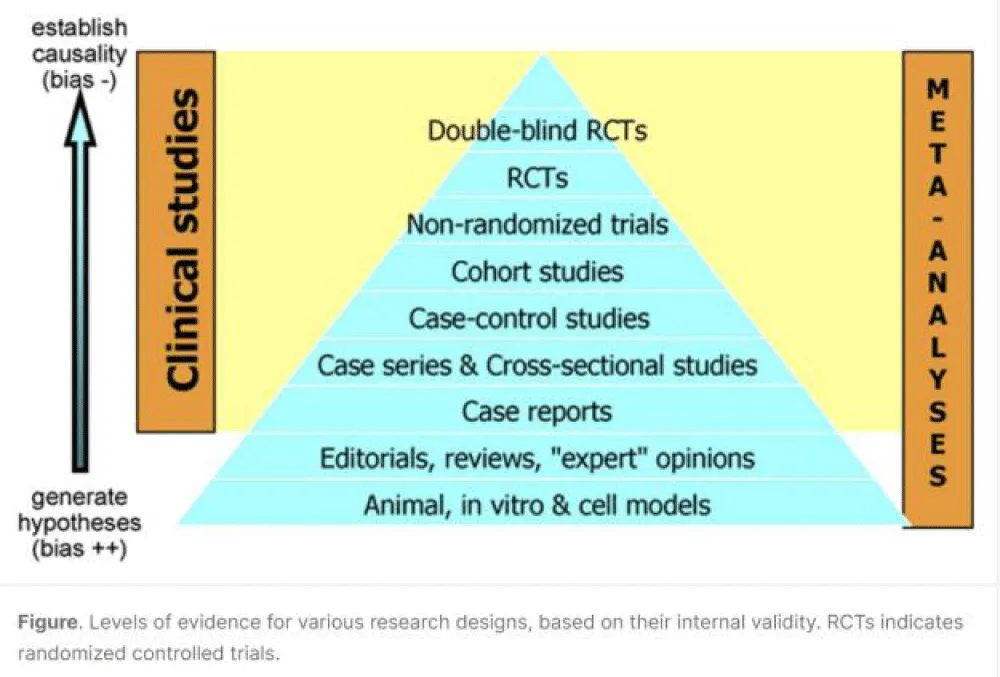
- Observational studies consistently demonstrate an association between PBDs and lower incidences of CHD, hypertension, and T2D [1-8].
- Case-control studies have demonstrated beneficial outcomes in patients who adopt a plant-based dietary pattern [10,11].
- Non-blinded RCTs, such as those conducted by Dr. Dean Ornish and Dr. Caldwell Esselstyn [1,2], have demonstrated CHD regression through plant-based dietary modifications.
Please refer to the figure to define the types of studies and their relative strength in establishing causality.
Nevertheless, scepticism persists, with criticisms including:
- "The study had a small sample size." While some studies are limited in scale, findings remain consistent across diverse populations.
- "The study was observational" – Observational studies, despite lacking randomisation, provide valuable insights into the long-term effects of dietary habits.
- "The study was case-controlled but small." Smaller trials contribute to the cumulative body of evidence.
- "The study was a case report." Although case reports lack rigorous controls, they provide compelling clinical narratives supporting dietary interventions.
Challenges in publishing PBD studies
Researchers investigating PBDs frequently encounter obstacles in securing funding and publication [12,13]:
Funding limitations
- Funding for PBD research is scarce, particularly in developing nations.
- Unlike pharmaceutical research, which attracts industry sponsorship, PBD studies offer minimal financial incentives to corporate stakeholders.
- Government and institutional grants for dietary research remain limited, prioritising pharmaceutical or technology-driven interventions.
Acceptance in reputable journals
- Studies from less-renowned institutions or researchers outside elite medical circles face difficulties gaining acceptance in high-impact journals.
- Prestige bias often favours established researchers with extensive funding and institutional backing.
High Article Processing Charges (APC)
- Publication fees in high-impact journals often reach thousands of dollars, restricting accessibility for researchers from low- and middle-income countries.
Bias in peer review
- Reviewers may harbour scepticism toward PBD [14-16], which can influence editorial decisions.
- Since many medical professionals remain unconvinced about plant-based approaches [17], implicit bias may lead to more severe critiques and rejections.
Prolonged review processes
- The peer review process can span months or even years, delaying the dissemination of critical findings.
- Lengthy and discouraging review procedures dissuade busy clinicians and researchers from pursuing publication.
Preference for highly technical articles over practical research
- Medical journals often favour highly sophisticated, niche research that benefits a small subset of researchers over practical dietary intervention studies that could aid a broader medical audience.
- Research papers demonstrating real-world applications, such as plant-based dietary interventions, may struggle to compete with more technically intricate studies, even if they offer valuable insights for medical practice in general.
Economic incentives and potential systemic bias
- There may be an unspoken incentive structure within healthcare and academia that favours procedural and pharmaceutical interventions over dietary approaches. Industries centred on stents, drug-coated balloons, and chronic medication regimens generate substantial revenue and are deeply integrated into modern healthcare systems.
- In contrast, a widespread shift toward PBDs—a cost-effective, preventative, and often restorative approach—offers limited commercial profitability.
- This economic imbalance may inadvertently discourage investment in PBD research, and in some cases, active resistance may emerge when dietary solutions are perceived as threatening to entrenched business interests.
- While not always overt, such systemic dynamics raise essential questions about whether scientific inquiry is being subtly steered toward treatments that sustain, rather than reduce, long-term medical dependency.
Solutions to enhance research and acceptance of PBDs
Redefining research standards
- Recognising well-designed observational studies, case-control trials, and non-blinded RCTs as valid evidence.
- Encouraging meta-analyses and systematic reviews to synthesise existing research on PBDs.
Promoting Open-Access and affordable publishing
- Advocating for reduced APCs for researchers from developing regions.
- Supporting open-access journals dedicated to the field of nutritional science.
Strengthening Institutional support
- Encouraging universities, hospitals, and research centres to fund and promote research on PBDs.
- Establishing dedicated grants for dietary intervention studies.
Educating medical professionals
- Integrating PBD into medical curricula.
- Offering Continuing Medical Education (CME) programs on evidence-based dietary interventions.
Enhancing public awareness and policy support
- Engaging policymakers to support nutrition-based preventive healthcare initiatives.
- Securing governmental funding for large-scale dietary research.
Encouraging collaborative research networks
- Forming international research alliances to conduct large-scale dietary studies.
- Supporting multi-centre trials to enhance the credibility of research on PBDs.
Clinical outcomes at the Bethsaida Cardiac Centre
The Cardiology Centre at Bethsaida Hospital in Tangerang, Indonesia, has implemented a PBD as part of its standard cardiac care protocol for nearly six years. This initiative, started seven years ago under the leadership of Prof. DM, now recognised as a national authority on plant-based nutrition, marks the first formal integration of evidence-based nutritional therapy into cardiovascular practice in Indonesia.
While the clinical outcomes have been compelling, broader dissemination and implementation remain constrained by several factors. Internationally, Indonesian research contributions are often marginalised, partly due to systemic limitations in funding, infrastructure, and perceived research quality. Locally, rigid adherence to conventional guidelines and considerable scepticism from medical peers have further limited the uptake of this approach—issues to be discussed in a separate forthcoming analysis.
Despite these barriers, the clinical impact of PBD has been unequivocal. The following summarises key outcomes observed in our patient population:
Hypertension reversal without Pharmacological Intervention: A substantial proportion of hypertensive patients achieved normotensive blood pressure levels without the use of antihypertensive medications. Dietary adoption of potassium-, magnesium-, and Nitric Oxide (NO)-rich leafy greens, combined with avoidance of sodium-laden animal products, resulted in measurable blood pressure normalization within several weeks to months.
T2D Management without Insulin: Numerous patients with T2D successfully discontinued insulin therapy while maintaining glycaemic control with minimal or no oral antidiabetic agents. Significant reductions in HbA1c were recorded, accompanied by reports of enhanced energy levels and improved quality of life.
Reduction of LDL Cholesterol without PCSK9 Inhibitors: Patients receiving high-intensity statins and ezetimibe, in conjunction with PBD, demonstrated profound reductions in Low-Density Lipoprotein Cholesterol (LDL-C), effectively eliminating the need for Proprotein Convertase Subtilisin/Kexin Type 9 (PCSK9) inhibitors. These effects are attributable to the diet’s high fibre content and the absence of saturated fats and dietary cholesterol.
Sustainable weight Loss: Individuals classified as overweight or obese achieved sustainable weight loss, reaching Body Mass Index (BMI) targets of 20–22 without needing caloric restriction. Plant foods' high satiety index and nutrient density facilitated natural caloric regulation and portion control.
Renal function restoration: Patients with stage 2-3 Chronic Kidney Disease (CKD) exhibited improvements in serum creatinine levels and Glomerular Filtration Rate (GFR). In some cases, stabilisation or partial reversal of renal dysfunction was observed, reducing the need for dialysis or further pharmacological intervention.
Improved outcomes in heart failure: In patients diagnosed with Heart Failure with Reduced Ejection Fraction (HFrEF), significant symptomatic improvement and increased Left Ventricular Ejection Fraction (LVEF) were observed following the incorporation of PBD into standard heart failure management protocols.
Coronary artery disease regression and superior restenosis rates: Among patients with CHD, angiographic and Computed Tomography Coronary Angiography (CTCA) regression of atherosclerotic plaques was frequently noted, facilitated by comprehensive lifestyle modification and pharmacotherapy. Notably, our DCB restenosis rate remains at 2%, markedly lower than the 10–20% rates reported at comparable centres.
Amelioration of chronic inflammatory conditions: Patients with autoimmune disorders (e.g., rheumatoid arthritis, psoriasis) and other chronic inflammatory conditions demonstrated clinical improvement and modulation of disease activity under a plant-based dietary regimen. Additionally, select patients with early-stage malignancies reported disease stabilisation or partial regression.
Conclusion
Despit growing evidence supporting the efficacy of PBDs in cardiovascular health and the prevention of chronic diseases, their integration into mainstream medical practice remains limited. Methodological constraints—particularly the impracticality of conducting DBRCTs—combined with entrenched scepticism and systemic publication biases, have contributed to the under-recognition of nutritional therapy in evidence-based medicine.
Implementing a PBD at Bethsaida Hospital’s Cardiology Centre offers a compelling counterpoint. As the first centre in Indonesia to adopt PBDs as part of standard cardiac care, our nearly seven-year experience has demonstrated significant and reproducible clinical outcomes, including atherosclerosis reversal, hypertension reversal, diabetes remission, improved lipid profiles, renal recovery, enhanced heart failure metrics, and markedly reduced restenosis rates following DCB angioplasty. These results challenge conventional treatment paradigms and highlight the untapped potential of lifestyle-based interventions, particularly in low- and middle-income settings where scalable, cost-effective solutions are urgently needed.
To advance the role of PBD in modern medicine, a more inclusive and holistic research paradigm is essential—one that values diverse forms of clinical evidence, supports systematic reviews and real-world data, addresses structural barriers in scientific publishing, and prioritises nutrition education in medical training. Integrating PBD into healthcare delivery will ultimately require scientific validation, visionary leadership, institutional support, and a shift in medical culture toward truly preventive, patient-centred care.
Author Contributions
D.M.; Conceptualization, writing, review and editing.
Funding
This research received no external funding.
Institutional Review Board Statement
Not applicable.
Informed Consent Statement
Not applicable.
Data Availability Statement
Data are contained within the article.
Conflict of Interest
The authors declare no conflict of interest.