 CrossRef
 CrossMark
 Mendeley
 Scholar
Introduction
Artificial Intelligence (AI) has rapidly advanced the design, optimization, and evaluation of genome editing systems. Both TALEN and CRISPR-Cas platforms have benefited from computational tools that have evolved from rule-based scoring methods to Machine Learning (ML) and, more recently, to deep and multimodal AI frameworks capable of integrating genomic sequences, structural, and contextual biological information [1]. Early TALEN design tools like TALgetter and TALE-NT used modular, position-weighted models of repeat-nucleotide binding. More recent systems, including DeepPBS and GCBLANE, use geometric and graph-based neural networks to learn complex relationships among Repeat Variable Di-residue (RVD) makeup, DNA structure, and binding energetics [2,3]. A similar progression has been seen in CRISPR guide design, where early rule-based platforms like CHOPCHOP and E-CRISP have been replaced by deep learning models such as DeepCRISPR, DeepCas9, and CRISPRon, which incorporate chromatin accessibility, epigenomic signatures, and 3D genome topology into predictions of guide efficiency and specificity [4-6]. Collectively, these AI-enabled approaches have substantially improved gene-editing accuracy and experimental success rates, while expanding the capacity to engineer increasingly complex biological traits across a broad range of organisms, from microbial and model systems to multicellular eukaryotes and mammalian cells [7,8].
While these advances are remarkable, they have also created a new challenge. The proliferation of AI-assisted design tools has led to increasing fragmentation across platforms, datasets, and prediction strategies in genome editing. Individual algorithms are often optimized for a particular data domain, such as TALEN binding motifs, sgRNA energetics, Cas variant selection, or multi-omics trait prediction. Consequently, researchers face a complex landscape of partially overlapping utilities, with no systemic way to determine which tool is best suited to a specific genome, target locus, or editing objective. Critically, the field currently lacks a unified framework for evaluating and comparing these tools using standardized experimental performance metrics. Here, we argue for the development of an integrated AI meta-platform that can objectively evaluate and coordinate diverse genome-editing tools to support rational, task-specific decision-making for improved genome-editing applications.
Unified meta-platform for AI-driven decision-making in genome editing
We envision developing an integrated AI-driven web platform that serves as a meta-evaluator for existing TALEN and CRISPR design tools. Rather than replacing existing systems, this platform would serve as a learning hub, aggregating, benchmarking, and refining predictions from multiple AI models using real-world gene-editing performance data. The proposed platform would be structured around five layers:
- User-defined input layer: At the front end, the platform would allow users to define the design context in a standardized yet flexible manner. Specifically, users would input key parameters including the reference genome of the organism under study, the target gene or genomic region, and the intended editing outcome, ranging from gene disruption and precise sequence modification to transcriptional or epigenetic regulation. Additional constraints, such as sequence composition, motif requirements, and nuclease compatibility, could also be specified. This abstraction ensures that the subsequent selection of one or more design tool systems remains applicable across editing technologies and biological systems, without privileging any particular genome-engineering approach (Figure 1).
- AI-Driven meta-evaluator layer: The core of the platform would consist of a tool-agnostic meta-evaluation layer that interfaces with existing TALEN and CRISPR design and prediction tools. Outputs from these tools would be normalized and assessed using shared criteria, including predicted efficiency, binding or cleavage feasibility, specificity, and genomic-context-dependent risk factors. Using a meta-learning framework, the system would learn the comparative strengths and limitations of different predictive models and design tools across diverse genomic and biological settings, thereby identifying where each model or tool performs optimally for a given task (Figure 1).
- AI-Powered predictive aggregator layer: Building on the comparative assessment in layer 2, this layer integrates multiple prediction tools with historical editing outcome data from the curated literature and public databases, and estimates real-world editing performance by prioritizing models that have shown higher accuracy in similar genomic and biological settings. In this way, the platform would not only generate candidate designs but also infer which underlying predictive frameworks should be trusted for a particular organism, locus, or editing strategy (Figure 1).
- Feedback loop layer: A defining feature of the proposed platform is its continuous feedback mechanism. Experimental outcomes contributed by users, whether successful edits, partial efficiencies, or failures, would be incorporated into ongoing model retraining. This closed-loop learning design allows the platform to improve over time, adapt to emerging genome-editing modalities, and correct biases inherent in individual tools or datasets (Figure 1). As usage grows, the system would evolve into a self-optimizing ecosystem that reflects the collective experimental experience across the genome-editing community.
- Output layer: The final layer of the meta-platform should display a ranked set of recommendations tailored to the user’s design needs, including suggested tools or workflows, predicted efficiency and precision scores, and confidence estimates based on model consensus and data availability. By abstracting across genome editing technologies and integrating outputs from multiple predictive frameworks, this approach aims to support more informed, context-aware design decisions while improving the reliability, accessibility, and reproducibility of genome engineering across diverse biological systems.
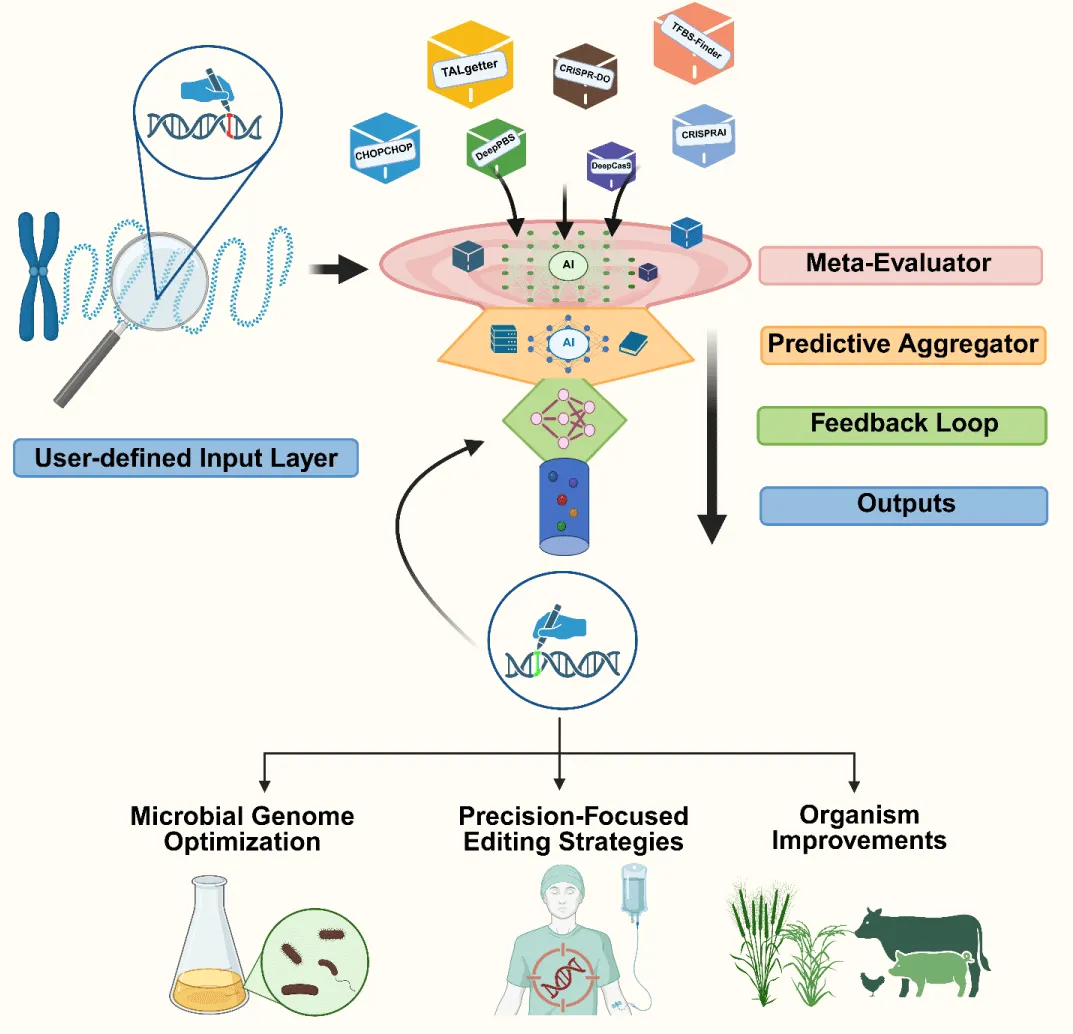
Genomic sequence information and user-defined design requirements are provided through a unified user-defined input (left). Multiple established design tools for genome-editing (top), spanning TALEN- and CRISPR-based approaches, independently generate candidate editing designs using distinct predictive models. These heterogeneous outputs are funneled into a centralized AI framework (center), where a meta-evaluator standardizes and assesses predictions against shared criteria, and a predictive aggregator then integrates cross-tool outputs and prior experimental evidence. A built-in feedback loop incorporates validated editing outcomes to iteratively refine model performance. The platform produces ranked, context-aware recommendations for genome editing. Downstream applications include precise microbial genome optimization, precision genome editing in patients, and organism-level trait improvement across diverse biological systems (bottom).
Implementation and future outlook
To enable the AI-driven meta-platform to function successfully in the applied genome-editing space, a substantial foundation already exists in publicly available gene-editing repositories, including Benchling [9], Addgene [10], dbGuide [11], and GenomeCRISPR [12], which collectively contain tens of thousands of experimentally validated editing events. However, these datasets are currently distributed across platforms and curated using heterogeneous annotation standards. This greatly limits their value for comparative evaluation, systematic benchmarking, and finally, meta-learning applications. To address this, the meta-platform would require a standardized, multi-dimensional data schema capable of harmonizing information on local genomic features such as DNA sequence and chromatin state, editing parameters, including nuclease type, targeting rules, and guide or repeat design, experimentally measured outcomes like on-target efficiency, off-target activity, and editing profiles. Moreover, it should include key experimental details, including the organism, cell or tissue type, delivery method, and measurement approach, across different genome-editing technologies and biological systems. By systematically curating and normalizing these dimensions, the meta-platform could generate the first benchmark-grade dataset explicitly designed for multi-system AI evaluation in genome editing.
A key strength of the proposed meta-platform is its capacity for self-learning from real-world experimental results, thereby transforming genome editing into a continuously evolving, context-aware discipline. User-tested TALEN or CRISPR designs, regardless of success level, are anonymized, standardized, and integrated into a comprehensive database. This enables dynamic weighting and cross-model calibration, progressively enhancing predictive accuracy. By incorporating locus-specific genomic features, chromatin accessibility, epigenetic modifications, developmental timing, and cell- or species-specific regulatory contexts, the system effectively captures the mechanistic factors underlying context-dependent editing outcomes. The feedback-driven architecture of this platform ensures precise editing across various applications, including microbial genome optimization, high-fidelity mammalian genome editing, and organismal engineering to improve or introduce novel traits, such as crop enhancement (Figure 1). As experimental data accumulate, the platform transitions from a static comparative tool to a self-optimizing, experimentally informed system. Future developments may incorporate multimodal AI to model gene regulatory networks, cellular states, and phenotypic outcomes, integrated with protein structure-function frameworks, facilitating rational nuclease and enzyme design within a unified, data-driven decision-making framework.
It is important to recognize that ethical, regulatory, and data governance issues are central to the responsible implementation of such a meta-platform. Federated learning methods can protect sensitive data by allowing local training of models and only sharing aggregated parameters. Additionally, explainable AI components can offer transparent explanations for platform recommendations, building user trust and facilitating regulatory approval. Continuous collaboration with bioethics experts and regulators will be vital to ensure responsible use, fair access, and compliance with evolving standards in genome engineering.
Conceptual innovation and summary
In summary, this AI-driven meta-platform is innovative in concept and potentially groundbreaking as it merges various TALEN and CRISPR predictions with curated experimental data. It systematically models locus-specific genomic features, chromatin accessibility, epigenetic landscapes, and sequence-context dependencies to iteratively enhance design strategies, correct tool-specific biases, and produce mechanistically informed, high-confidence recommendations that improve precision, efficiency, and reproducibility across different genome-editing scenarios. Importantly, this AI-based meta-platform has significant potential to transform genome editing from a fragmented, tool-focused practice into a continuously advancing engineering discipline.
Author Contributions
M.R. and Y.L. conceived the study and wrote the manuscript.
Acknowledgment
This work was supported by the American Heart Association (AHA) 24CDA1051180 (to M.R.). We would like to acknowledge the professional service of Biorender.com.