 CrossRef
 CrossMark
 Mendeley
 Scholar
Introduction
Degenerative knee Osteoarthritis (KOA) is one of the most common degenerative joint diseases in an aging society, causing significant pain and functional disability [1]. As the disease progresses, patients experience chronic pain, joint stiffness, and a decreased range of motion, leading to a substantial decline in their quality of life. The primary therapeutic goal for patients with moderate KOA (Kellgren-Lawrence [KL] grade 2-3) is to alleviate pain and improve joint function, thereby delaying the need for total knee arthroplasty for as long as possible [2]. For this purpose, various conservative treatments are employed, including exercise, weight reduction, Non-Steroidal Anti-Inflammatory Drugs (NSAIDs), and intra-articular corticosteroid injections [3]. However, these therapies primarily focus on symptomatic relief and often fail to address the underlying pathophysiology, such as cartilage damage. Consequently, their effects are frequently temporary or limited [4,5].
To overcome these limitations, regenerative medicine has recently emerged as a promising alternative in the field of orthopedics, offering therapies that can promote the regeneration of damaged tissue and modulate disease progression. Among these, autologous Bone Marrow Aspirate Concentrate (BMAC) is particularly noteworthy [6]. It is rich in Mesenchymal Stem Cells (MSCs), hematopoietic stem cells, growth factors, and anti-inflammatory cytokines, giving it the multifaceted therapeutic potential to induce cartilage regeneration and modulate the intra-articular inflammatory environment [7]. This biological mechanism is a key differentiator from other intra-articular injection therapies, such as hyaluronic acid or Platelet-Rich Plasma (PRP) [7,8].
In the South Korean healthcare system, new medical technologies must undergo a rigorous review process known as the New Health Technology Assessment (NHTA), administered by the National Evidence-based Healthcare Collaborating Agency (NECA), to verify their safety and efficacy before they can be introduced into clinical practice [9,10]. This assessment evaluates the level of scientific evidence for a given technology through systematic literature reviews, and only those that pass can be legally used in clinical fields. Recently, intra-articular BMAC injection therapy for KOA successfully passed this NHTA and was approved for clinical use in Korea. This represents a significant milestone, officially recognizing the scientific validity of the treatment and signifying that existing international research on its safety and efficacy has met the stringent criteria of the domestic regulatory agency.
Therefore, the purpose of this study, as part of an ongoing retrospective observational study, is to report the initial clinical outcomes in patients with moderate KOA who were treated with a BMAC procedure using the NovaStem BMAC kit in a domestic clinical setting following the NHTA approval. This case report aims to provide crucial preliminary evidence on the treatment's clinical effectiveness and to support the validity of the NHTA's decision.
Materials and Methods
Study design
This study was an interim analysis of an ongoing retrospective observational case series (target n = 62) conducted at Suwon JS Hospital, Republic of Korea. This study was conducted using retrospectively collected, fully anonymized clinical data obtained during routine clinical practice. No patient-identifiable information was used. The study was conducted in accordance with the principles of the Declaration of Helsinki.
Patients
The subjects of this study were patients who met the following inclusion criteria: (1) adults aged 18 years or older, (2) patients with symptomatic primary knee osteoarthritis corresponding to radiographic KL grade 2 or 3, and (3) patients who complained of persistent pain despite conservative treatment such as physical therapy and medication for at least 6 weeks. Exclusion criteria included end-stage osteoarthritis of KL grade 4, inflammatory arthritis such as rheumatoid arthritis, history of intra-articular injection treatment within the past 3 months, active infection, or history of malignancy.
BMAC preparation and injection
All procedures were performed in aseptic technique in an operative room setting. Bone marrow was harvested from the patient's iliac crest under local anesthesia. The collected bone marrow aspirate was concentrated by centrifugation using the NovaStem BMAC system (Rev-Med, Korea). BMAC was prepared in accordance with the manufacturer's protocol. Subsequently, 6 mL of the final BMAC product was injected once into the affected knee joint under aseptic conditions.
Outcome measures and follow-up
The primary endpoint was defined as the change in VAS score at 1 day post-procedure (discharge). Scheduled follow-up assessments were conducted at 1, 3, 6, and 12 months. The primary endpoint was change in pain intensity, measured using a 10 point Visual Analog Scale (VAS). The VAS defines 0 as no pain at all and 10 as the worst pain imaginable. Data were collected before the procedure (baseline) and at discharge after the procedure. To evaluate safety, patients were monitored for adverse events including infection, inflammatory reactions, swelling, and thrombotic complications. When clinically indicated, additional evaluations such as joint aspiration or imaging were performed.
Statistical analysis of data
Normality of the data distribution was assessed prior to analysis. A paired t-test was used for normally distributed data. Statistical analyses were performed using GraphPad prism v5. Changes in VAS scores in opposite directions were analyzed using a paired t-test. The statistical criterion was set at p < 0.05.
Results
A total of 11 patients were included in this analysis. The patient cohort consisted of 2 males (18.2%) and 9 females (81.8%), with a mean age of 58.55 ± 5.85 years (range: 50-71). All patients were diagnosed with moderate knee osteoarthritis, corresponding to a radiographic Kellgren-Lawrence (KL) grade of 2 or 3. A 6 mL volume of bone marrow aspirate concentrate (BMAC) was obtained via centrifugation using the NovaStem BMAC kit and administered as a single intra-articular injection into the affected knee. Pain assessment for all patients was performed at the time of discharge, one day post-procedure.
At the primary endpoint (1 day post-procedure), all 11 patients were evaluated. At 1-month follow-up, 9 patients were assessed, while longer-term follow-up data were available for a subset of patients. The primary endpoint, the Visual Analog Scale (VAS) score, demonstrated a statistically significant decrease following the procedure. The mean VAS score for the 11 patients decreased from a baseline of 5.00 ± 0.63 to 2.82 ± 0.60 post-treatment, yielding a mean difference of 2.18 points (Table 1, figure 1). This reduction was associated with a statistically significant decrease in VAS scores (t-statistic = 9.64, p < 0.0001).
| No. | Sex | Age | Diagnosis (Dx) | KL grade | Symptom |
| 1 | F | 55 | OA & OCD | ii | Mechanical catching sensation within the knee |
| 2 | F | 56 | OA & OCD | ii-iii | Limited tolerance for prolonged ambulation |
| 3 | F | 71 | OA & OCD | iii | Limited tolerance for prolonged ambulation |
| 4 | F | 51 | OA & OCD | ii | Intermittent knee pain severe enough to require cessation of activity |
| 5 | M | 61 | OA & OCD | ii | Knee pain exacerbated by flexion |
| 6 | F | 62 | OA & OCD | ii | Difficulty with directional changes |
| 7 | M | 50 | OA & OCD | ii | Reduced weight-bearing tolerance |
| 8 | F | 60 | OA & OCD | ii | Activity-induced intermittent pain requiring periods of rest |
| 9 | F | 61 | OA & OCD | ii | Reduced weight-bearing tolerance |
| 10 | F | 56 | OA & OCD | iii | Pain during routine daily activities |
| 11 | F | 61 | OA & OCD | ii | Impaired ambulation |
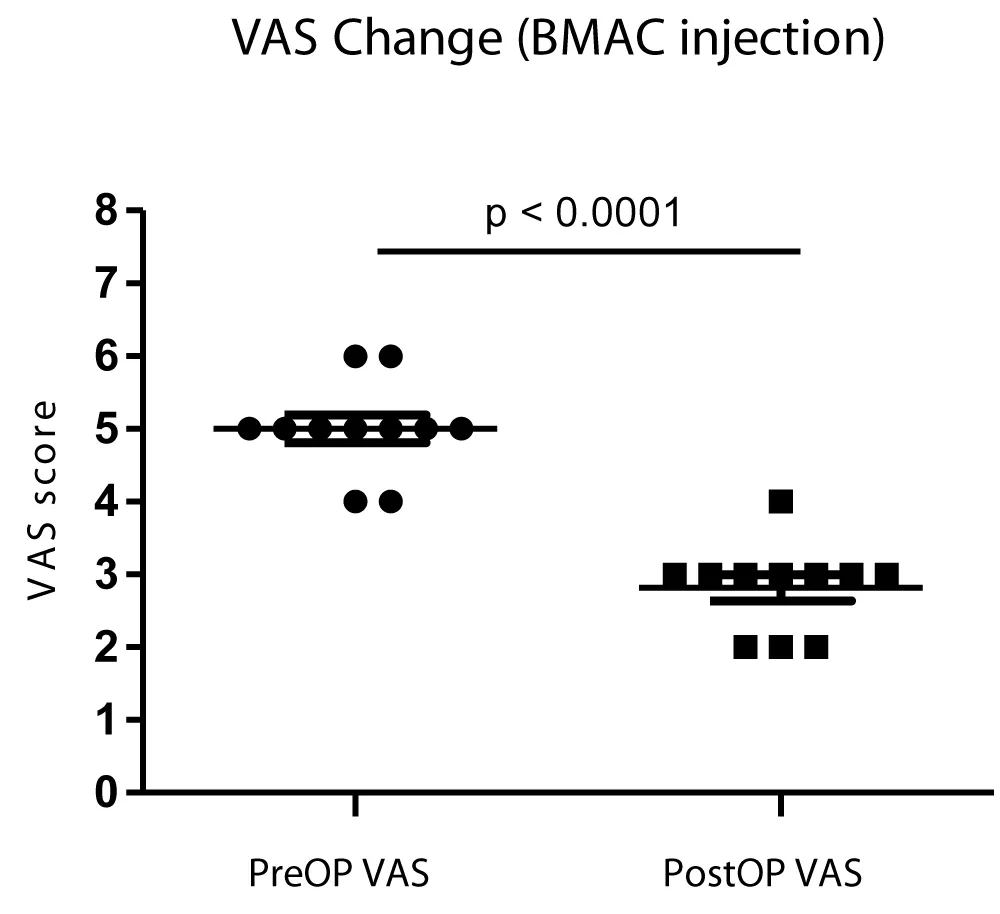
A clinically meaningful improvement (≥2-point reduction in VAS) was observed in 9 of 11 patients (81.8%), indicating a consistent analgesic response across the cohort. The observed mean VAS score reduction of 2.18 points holds clinical importance that extends beyond statistical significance. In studies of knee osteoarthritis pain, the Minimal Clinically Important Difference (MCID) is generally established to be between 1.3 and 1.7 points [11]. The magnitude of pain reduction in our study substantially exceeds this MCID threshold, suggesting that patients experienced a clinically meaningful and perceptible improvement in their condition.
To determine the consistency of the therapeutic effect, an analysis of individual patient data was conducted (Table 2). This analysis revealed that all 11 participants experienced a reduction in their post-procedural VAS scores. The magnitude of pain reduction ranged from 1 to 3 points, and approximately 82% of the patients (9 out of 11) reported a pain reduction of 2 points or more, surpassing the established MCID. Two patients (18.2%) required subsequent surgical intervention during follow-up. This finding indicates that the BMAC injection therapy confers a consistent analgesic effect across the entire study cohort, rather than being effective in only a subset of patients.
| No. | Sex | Age | Diagnosis (Dx) | KL grade | PreOP VAS | PostOP VAS | VAS Change |
| 1 | F | 55 | OA & OCD | ii | 5 | 3 | -2 |
| 2 | F | 56 | OA & OCD | ii-iii | 6 | 3 | -3 |
| 3 | F | 71 | OA & OCD | iii | 6 | 3 | -3 |
| 4 | F | 51 | OA & OCD | ii | 4 | 3 | -1 |
| 5 | M | 61 | OA & OCD | ii | 5 | 3 | -2 |
| 6 | F | 62 | OA & OCD | ii | 5 | 2 | -3 |
| 7 | M | 50 | OA & OCD | ii | 5 | 2 | -3 |
| 8 | F | 60 | OA & OCD | ii | 5 | 3 | -2 |
| 9 | F | 61 | OA & OCD | ii | 4 | 2 | -2 |
| 10 | F | 56 | OA & OCD | iii | 5 | 3 | -2 |
| 11 | F | 61 | OA & OCD | ii | 5 | 4 | -1 |
| Average ± Standard deviation | M: 2(18.2%) F: 9(81.8%) | 58.55±5.85 | - | - | 5 ± 0.63 | 2.82 ± 0.6 | -2.18 ± 0.75 |
At 1-month follow-up, 6 patients reported pain improvement, 3 patients reported mild pain, and 2 patients were not evaluated. Of the 6 patients who improved, one reported continued pain relief and satisfaction at 10 months, which remained high at 12 months. Of the 3 patients who initially reported mild pain, 2 patients experienced persistent pain for more than 10 months and subsequently worsened, requiring additional surgery (Table 3).
| No. | Sex | Age | <1M | <3M | <6M | <12M |
| 1 | F | 55 | Pain improvement Lt knee slightly better brace off | Pain improvement satisfaction | po 10 month satisfaction | satisfaction |
| 2 | F | 56 | Pain improvement brace off | N/A | N/A | N/A |
| 3 | F | 71 | Mild pain | Lt knee Mild pain | N/A | PO 10 month TKR both |
| 4 | F | 51 | N/A | Lt knee Mild pain | discomfort | N/A |
| 5 | M | 61 | Mild pain | Rt knee Mild pain | N/A | Rt knee Increased pain Operation |
| 6 | F | 62 | Pain improvement | N/A | N/A | N/A |
| 7 | M | 50 | Pain improvement | po 2 month Pain improvement | N/A | N/A |
| 8 | F | 60 | Pain improvement | N/A | N/A | N/A |
| 9 | F | 61 | Mild pain | Pain improvement | N/A | N/A |
| 10 | F | 56 | Pain improvement | Mild pain | Mild pain | N/A |
| 11 | F | 61 | N/A | Moderate pain | Swelling-aspiration Moderate pain Swelling-aspiration | N/A |
| Abbreviations: PO: Postoperative; Lt: Left; Rt: Right; TKR: Total Knee Replacement. | ||||||
No serious BMAC-related adverse events were observed during the follow-up period. No patient experienced complications such as infection, deep vein thrombosis, or severe inflammatory reactions at the injection site (Table 3). This suggests that autologous BMAC injection therapy administered using the NovaStem kit possesses a high short-term safety profile and is well-tolerated by patients.
Discussion
This interim analysis demonstrates that a single intra-articular injection of autologous BMAC prepared using the NovaStem system is associated with significant short-term pain reduction in patients with moderate Knee Osteoarthritis (KOA).
The observed mean VAS reduction of 2.18 points exceeds the established Minimal Clinically Important Difference (MCID), and the high responder rate (81.8%) suggests that the treatment effect is not limited to a small subset of patients but is consistently observed across the cohort. The pain relief and functional improvement observed in this study are consistent with findings from existing international research on BMAC for the treatment of knee OA. Numerous prospective studies and systematic reviews have reported positive short- and mid-term clinical outcomes [7]. In particular, the patient population of this study, those with KL grade 2-3, are considered an ideal group for regenerative therapies such as BMAC, as their less severe cartilage damage suggests a remaining potential for biological response. These results reaffirm existing evidence and indicate that similar therapeutic effects can be expected in the domestic (or Korean) patient population.
However, the significance of our findings extends beyond simple clinical efficacy. This study is one of the first clinical reports published following its approval by the Korean New Health Technology Assessment (NHTA), serving as a crucial bridge between policymaking and real clinical practice. The NHTA approval is primarily based on a comprehensive review of international literature [12]. Therefore, a critical question remains for Korean clinicians and policymakers: "Can these results be reproduced in the Korean patient population using a domestically available system (NovaStem)?" This study provides preliminary observational insights to this question. It transcends a simple clinical study, taking on the characteristics of health services research by validating the evidence-based policy-making process with real-world clinical data and does not establish causal effectiveness to clinicians and patients.
This accumulation of post-approval data forms an essential feedback loop for the maturation and advancement of the NHTA system.
The strengths of this study include its retrospective data collection, which reduces the potential for recall bias, and the inclusion of a clearly defined patient population (KL grade 2-3). Nevertheless, the study has several limitations. First, the small sample size (n = 11) limits the generalizability of the results. Second, these are short-term follow-up results, and the long-term durability of the therapeutic effect cannot be assessed. Third, as a case series lacking a control group (e.g., placebo or hyaluronic acid), the observed effects may not be distinguishable from the natural course of the disease or a placebo effect. Finally, the study relied solely on a subjective patient-reported outcome (VAS) and did not include objective radiological evaluations, such as MRI.
A key limitation of this study is the reliance on a single subjective outcome measure (VAS), without inclusion of validated functional scores such as WOMAC or KOOS. Future studies should assess the long-term durability of the therapeutic effect through follow-ups at more than 1 year. Furthermore, randomized controlled trials (RCTs) comparing BMAC with other standard treatments are necessary to establish its relative efficacy and cost-effectiveness. Such high-level evidence will contribute to future revisions of knee OA treatment guidelines and solidify the clinical positioning of BMAC therapy. These findings should be interpreted as preliminary clinical observations derived from routine clinical practice rather than definitive evidence of treatment efficacy.
Conclusion
KOA is one of the most common degenerative joint diseases, causing pain and functional impairment. Existing conservative treatments only alleviate symptoms and have limited ability to address the underlying pathophysiological issues. Thus, regenerative medicine therapies that promote regeneration of damaged tissue and control disease progression have gained attention. In Korea, the clinical introduction of new medical technologies requires rigorous NHTA by the Korea National Evidence-based Healthcare Collaborating Agency (NECA). The technology, "Intra-articular Injection of Bone Marrow Aspirate Concentrate for Knee Osteoarthritis" passed this assessment and was registered as New Health Technology Notification No. 918, thus being approved for clinical use. The results of the notification clearly demonstrate that BMAC injections are safe, without serious complications, and demonstrate similar levels of pain relief and functional improvement compared to existing hyaluronic acid injections.
This interim analysis suggests that intra-articular BMAC injection using the NovaStem system may provide clinically meaningful short-term pain relief in patients with moderate knee osteoarthritis in a real-world setting.
These findings provide preliminary clinical evidence supporting its use following NHTA approval, although further studies with larger cohorts and long-term follow-up are required.