 CrossRef
 CrossMark
 Mendeley
 Scholar
Introduction
Soliton excitations in magnetic systems, such as domain walls and topological solitons (e.g., skyrmions), attract significant interest due to their unique properties and possible applications in spintronics and magnonics. The classical Landau LD, Lifshitz EM (LL) equation was proposed by Landau LD and Lifshitz EM in 1935 to describe the dynamics of magnetization in ferromagnets [1]. Gilbert TL, modified it by introducing a dissipative viscous damping term [2]. The modern Landau LD, Lifshitz EM, Gilbert TL (LLG) equation can be written in vector form as:
Where M is the magnetization vector, Ms is the saturation magnetization, γ is the gyromagnetic ratio, α is the dimensionless Gilbert damping coefficient, and - is the effective field determined by the variation of the magnetic energy density. The first term (precession) in Eq. (1) corresponds to the conservative Landau LD, Lifshitz EM, dynamics [1], while the second term represents Gilbert dissipation [2]. Equation (1) describes a rich spectrum of phenomena, ranging from small perturbations (spin waves) to nonlinear soliton regimes, and possesses invariants and features that relate it to integrable systems of soliton theory [3].
Let us consider a homogeneous single-domain ferromagnet with an easy axis directed along the Oz axis. Within the continuum approximation, its energy functional can be written in the form
Where – is the unit magnetization vector, A is the exchange stiffness constant, and –is the uniaxial anisotropy constant (easy axis along z). The energy minima correspond to homogeneous states (magnetization directed along or opposite to the easy anisotropy axis). The LLG equation (1) with the above energy functional describes the dynamics of the magnetic subsystem taking into account precession and damping. In the absence of damping (α = 0), it is equivalent to the equations of the O(3) sigma model and, in the one-dimensional case under certain conditions, is integrable by the inverse scattering method [3]. For example, in the absence of an external field, one can introduce the polar angle θ of deviation from the axis and the azimuthal angle φ around the axis. For planar solutions (configuration in the x–z plane), the equations reduce to a nonlinear equation for θ. In particular, for small angles θ, one can obtain a generalized Sine-Gordon equation for the dynamics of the domain wall:
To make the reduction more transparent, we introduce the traveling coordinate ξ = x - vt and assume that the azimuthal angle remains spatially uniform, φ = Φ = const. In this approximation, the wall profile is determined by the polar angle θ(ξ), and the reduced conservative equation can be written in the generic form d²θ/dξ² - κ² sinθ cosθ = 0, where κ is the effective inverse wall width determined by exchange and anisotropy. With the substitution u(ξ) = 2θ(ξ), one obtains d²u/dξ² - κ² sin u = 0, that is, a Sine-Gordon-type equation. Its kink solution θ(ξ) = 2 arctan[exp(κ(ξ - ξ0))] describes a 180° domain wall interpolating between θ(-∞) = 0 and θ(+∞) = π, with characteristic width Δ = κ⁻¹. This solution should be interpreted as a kink-type topological domain wall rather than as a breather-like excitation.
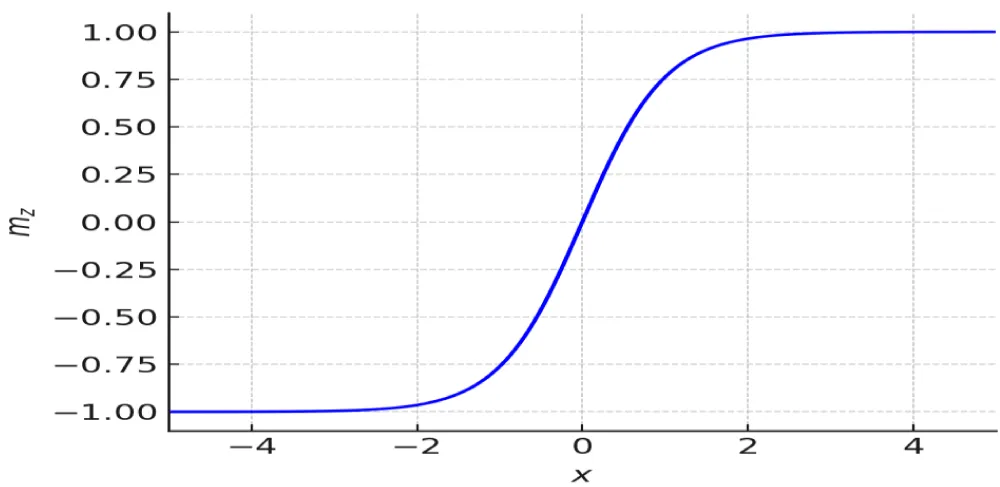
Figure 1 shows the profile of the component for a stationary soliton domain wall obtained from the analytical solution (hyperbolic tangent). It can be seen that at the boundaries x → ±∞ the magnetic moment reaches homogeneous values ±Mg, while at the center (x = 0) it passes through zero, which defines the plane of the wall.
At nonzero wall velocity the situation becomes more complicated. Under a constant magnetic field H applied along the anisotropy axis, the wall may enter a Walker-type steady propagation regime in which it moves with an approximately fixed profile and a nearly constant internal angle. Damping plays an essential role in establishing this regime, since it balances the energy input from the driving field and suppresses unrestricted internal precession. If an additional transverse restoring torque is present, for example due to hard-axis anisotropy, the Walker-type regime is valid only below the corresponding threshold field; above that threshold the motion becomes precessional and the rigid-wall approximation is no longer applicable.
Thus, the present work addresses the analytical description of soliton-like excitations in a uniaxial ferromagnet, with emphasis on the structure and dynamics of a domain wall within the Landau-Lifshitz-Gilbert framework. The novelty of the paper does not lie in the mere existence of a kink-type wall profile, which is classical, but in the explicit analytical derivation of the wall profile in the adopted normalization, in the transparent reduction of the reduced wall equation to a Sine-Gordon-type form, and in the clarification of the parameter range in which a Walker-type steady motion remains self-consistent.
We consider a one-dimensional easy-axis ferromagnet with normalized magnetization m = M/Ms, |m| = 1, parameterized by the angular variables m = (sinθ cosφ, sinθ sinφ, cosθ). In this representation, the Landau-Lifshitz-Gilbert equation and the energy functional with exchange stiffness A and uniaxial anisotropy K provide a self-consistent micromagnetic basis for the analytical treatment. The characteristic wall width is controlled by the competition between exchange and anisotropy, which directly links the microscopic energy parameters to the macroscopic spatial scale of the domain wall.
The analytical profile in the form of a hyperbolic tangent provides a transparent physical picture of the transition region: far from the wall center the magnetization approaches homogeneous values, whereas in the wall center the corresponding component passes through zero, thereby defining the wall plane. In this sense, the domain wall is naturally interpreted as a topological object connecting two energetically equivalent magnetic states aligned along and opposite to the easy axis.
Special attention should be paid to the dynamical regime of the wall. The use of the term Walker regime in the present paper is restricted to a Walker-type steady propagation approximation. In a strictly uniaxial model, this terminology must be used with caution, because the full classical Walker solution is usually associated with an additional transverse anisotropy. Nevertheless, the adopted approximation is useful for identifying the conditions under which the wall can move with an approximately fixed profile and for clarifying the onset of precessional behavior outside this regime.
In the limiting case of vanishing damping and external field, the reduced equations admit a closed-form solution describing a moving soliton. This idealized result is important primarily as an analytical reference case. It confirms the soliton character of the domain wall and provides a convenient starting point for more general treatments that include Gilbert damping, external fields, material inhomogeneities, and additional interactions such as the Dzyaloshinskii-Moriya interaction or spin-current effects.
Consequently, the present analysis shows that micromagnetic dynamics in a uniaxial ferromagnet can be studied effectively using the language of nonlinear soliton models, provided that the physical interpretation and the limits of applicability are stated explicitly. The obtained relations are useful for estimating domain-wall parameters and for understanding controlled wall motion in spintronic systems.