 CrossRef
 CrossMark
 Mendeley
 Scholar
Introduction
The Cath Lab is inherently a high-pressure environment that requires meticulous attention, precision, and resilience from medical teams due to the critical and often complex nature of interventional cardiac procedures. Stress, anxiety, and cognitive fatigue significantly impact both clinicians and patients, potentially leading to suboptimal outcomes if not effectively managed [1-5]. Recent attention has shifted to non-pharmacological methods to enhance performance, reduce stress, and improve patient comfort, with music being a highly effective approach. The use of music therapy in medical settings has garnered substantial empirical support, demonstrating diverse benefits that range from physiological relaxation to cognitive enhancement and pain relief. Despite its widespread cultural presence, the integration of music as a standardized adjunctive intervention in clinical cardiology remains relatively novel. This comprehensive review examines the multifaceted effects of music within the catheterization laboratory, delving into the physiological and neurochemical mechanisms underlying its beneficial outcomes, while highlighting its implementation through real-world examples, particularly at Bethsaida Hospital.
Physiological Effects of Music
Music has a considerable influence on the regulation of the autonomic nervous system, prominently modulating stress and relaxation responses. Listening to calming music has been demonstrated to decrease heart rate, blood pressure, and cortisol levels, thereby reducing sympathetic nervous system activity and enhancing parasympathetic dominance. These physiological changes promote relaxation and calm, which are crucial for both patients and clinical staff in the high-stress context of cardiac interventions [6-10].
In the catheterization laboratory, anxiety reduction through music facilitates better patient cooperation, fewer complications, and improved procedural precision. Additionally, the calming effects on healthcare providers enhance their focus, attention, and decision-making capabilities during critical moments.
Neurochemical Mechanisms
Music has a significant influence on brain chemistry by modulating neurotransmitter and hormone levels. Notably, it stimulates the release of dopamine, serotonin, and oxytocin, and endorphins— key neurochemicals associated with pleasure, well-being, and pain modulation. Dopamine, a neurotransmitter central to the brain's reward system, elevates mood and motivation, which are critical in stressful clinical settings [11-20].
The release of serotonin during music listening contributes to mood stabilization, emotional resilience, and improved cognitive performance, which are essential attributes during lengthy and demanding catheterization procedures. Oxytocin, often referred to as the "bonding hormone," enhances social interaction and teamwork, crucial components within the collaborative environment of the Cath Lab. Finally, endorphins, the body’s natural painkillers, provide analgesia that significantly reduces procedural pain perception, contributing to improved patient comfort and tolerance.
Cognitive and Procedural Enhancements
The cognitive benefits of music include improved concentration, enhanced memory retention, and reduced cognitive fatigue. Music fosters a state known as "flow," characterized by heightened focus, diminished perception of external distractions, and optimal mental performance. For clinicians performing delicate and precise catheterization procedures, such cognitive enhancement directly translates to better procedural accuracy, reduced error rates, and enhanced overall performance [21-25].
Music-induced reductions in stress hormones, such as cortisol, also mitigate cognitive impairment associated with chronic stress, leading to clearer thinking and improved clinical judgment. In combination, these cognitive improvements significantly elevate the procedural success rate and patient outcomes.
Pain and Anxiety Management in Patients
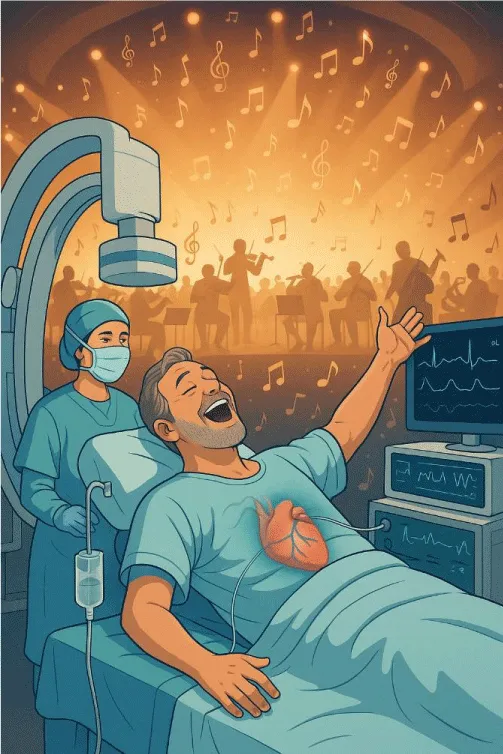
Music's analgesic and anxiolytic effects are particularly beneficial for patients undergoing catheterization. By activating brain regions responsible for emotion, reward, and pain modulation, music effectively diminishes patient anxiety, pain perception, and emotional distress. Consequently, this leads to reduced reliance on sedative and analgesic medications, fewer side effects, and shorter recovery times. These benefits support faster discharge rates, improved patient satisfaction, and enhanced long-term psychological outcomes [26-30].
Healing Melodies: How Bethsaida Hospital Harmonizes Compassion and Music in Cardiac Care
At Bethsaida Hospital, each patient is cherished as a beloved family member, embodying our deep commitment to compassionate care. Since the hospital's inception, we have uniquely integrated soothing, high-quality music into every consultation and coronary intervention procedure in our state-of-the-art catheterization laboratory. Equipped with advanced sound systems and premium music streaming services such as Spotify, Tidal, and Roon, our patients enjoy the freedom to select music that comforts and resonates personally with them during critical procedures. This thoughtful practice significantly enhances patient relaxation, reduces stress, and conveys a profound sense of appreciation and familial care, an essential element in interventional cardiology.
During coronary intervention, lesion preparation in drug-coated balloon (DCB) procedures may occasionally lead to vessel recoil. Therefore, we believe that stabilizing the patient's mood through music may play a crucial role in reducing the risk of acute recoil. Further studies are warranted to validate this hypothesis.
Furthermore, recognizing the spiritual dimensions of healing, we deeply respect and honour our patients' diverse religious beliefs. Prayer, reflective of each individual's faith, is warmly embraced before every cardiac procedure, fostering a supportive and spiritually enriching environment. Inspired by our Christian ethos, our guiding principle remains clear and heartfelt: we strive to care for every patient exactly as we would wish to be cared for ourselves.
Conclusion
The integration of music into catheterization laboratories represents a significant advancement in interventional cardiology, yielding numerous physiological, neurochemical, cognitive, and psychological benefits. Physiologically, music promotes autonomic balance by reducing heart rate, blood pressure, and cortisol levels, thereby fostering an environment conducive to calmness, precision, and optimal procedural outcomes. Neurochemically, music’s stimulation of dopamine, serotonin, oxytocin, and endorphins significantly enhances emotional stability, cognitive clarity, social collaboration, and pain modulation—essential elements that contribute to improved clinician performance and patient experience.
Moreover, music’s role in enhancing cognitive functions, including increased focus, reduced cognitive fatigue, and heightened procedural accuracy, is particularly relevant in the high-stress environment of cardiac interventions. For patients, the analgesic and anxiolytic properties of music have been consistently associated with reduced pain perception, lower anxiety levels, decreased reliance on sedative and analgesic medications, and shorter recovery times, collectively elevating patient satisfaction and procedural efficacy.
Importantly, existing literature indicates that the therapeutic effects of music are most pronounced when patient-preferred or familiar music is used, typically characterized by a slow to moderate tempo (approximately 60–80 beats per minute) and applied continuously or for durations of 15 to 60 minutes during medical procedures. These characteristics align with evidence demonstrating superior autonomic and emotional regulation when music selection is individualized rather than standardized.
The practical example set forth by Bethsaida Hospital, under the pioneering leadership of Prof. DM, exemplifies the transformative impact of thoughtfully integrating personalized musical experiences within clinical practice. By emphasizing compassion, spiritual mindfulness, and patient-centred care, Bethsaida Hospital demonstrates a replicable, real-world model in which music functions not merely as ambient comfort but as a structured, patient-tailored adjunct that complements established physiological and psychological mechanisms of stress and pain modulation.
Nevertheless, while the biological plausibility and supportive clinical evidence for music as a therapeutic adjunct are robust, its specific effects on procedural endpoints in interventional cardiology—such as medication requirements, vascular tone, or acute procedural responses—should be regarded as hypothesis-generating. Future research, including randomized controlled trials and larger-scale longitudinal studies specifically within catheterization laboratory settings, is encouraged to further quantify these effects, define optimal music protocols, and establish standardized implementation frameworks.
Given the growing empirical foundation and minimal risk associated with music interventions, catheterization laboratories worldwide should consider adopting music as a standard adjunctive strategy within patient-centred cardiac care. Such integration holds promise for advancing not only procedural efficiency and clinical outcomes but also the humanistic and holistic dimensions of modern interventional cardiology.
Author Contributions
D.M.; Conceptualization, writing, review, and editing.
Funding
This research received no external funding.
Institutional Review Board Statement
Not applicable.
Informed Consent Statement
Not applicable.
Data Availability Statement
Data are contained within the article.
Conflict of Interest
The authors declare no conflict of interest.