 CrossRef
 CrossMark
 Mendeley
 Scholar
Introduction
Cardioplegia has been introduced as a pharmacological approach essential for heart protection after ischemia–reperfusion injury [1]. Cardioplegic solutions have a role in arresting the heart by creating electrical quiescence and determining a reduction in oxygen demand aiming to protect the myocardium from ischemia. In addition to being protective for the myocardium, they also provide a relatively bloodless and motionless surgical field [2,3]. Over the years, numerous cardioplegic solutions have been developed, with each cardioplegic approach having its advantages and disadvantages.
Cardioplegic solutions can be both intracellular and extracellular. Extracellular solutions contain high levels of potassium, magnesium and sodium, while intracellular solutions contain low electrolyte levels. Intracellular solutions reduce potential concentration gradients across the plasma membrane creating an arrest of potassium efflux with a generation of action potentials. Extracellular cardioplegia works by preventing repolarization of myocytes, reducing membrane voltage difference. Repolarization is prevented by the high potassium concentration of the cardioplegic solution [4]. The usually used cardioplegic solutions are crystalloid- or blood-based.
Custodiol® solution / histidine-tryptophan-ketoglutarate (CS) is a particular kind of long-acting intracellular crystalloid cardioplegia with a low sodium and potassium content that induce a diastolic arrest of the heart through a hyperpolarization of the myocyte plasma membrane [5-7].
St. Thomas’ Hospital cold crystalloid extracellular cardioplegia (CCC) is based on solutions administered at 4°C temperature, containing high K+ concentrations, with elevated magnesium and normal Ca2+ concentrations, and it induces diastolic arrest through membrane depolarization [8-10].
Finally, Warm Blood Cardioplegia (WBC) has been proposed as a safe technique for myocardial protection based on the rationale that blood, as opposed to crystalloid solution, could potentially improve postoperative cardiac outcomes, because it more closely approximates the normal physiology, i.e., carrying oxygen to the myocardium or ensuring a less blood dilution [11-14].
A serious complication of cardioplegia administration can be represented by the onset of postoperative AKI. Up to 30% of patients undergoing cardiac surgery develop AKI, with the need for dialysis required in approximately in 1% of cases. The mechanisms involved in the development of AKI is complex and can be linked to the interaction and the overlap of multiple factors, such as hemodynamic, inflammatory, in association with direct nephrotoxic factors [13]. AKI denotes a sudden and often reversible reduction in kidney function, as measured by Glomerular Filtration Rate (GFR). However, immediately after a renal insult, Blood Urea Nitrogen (BUN) or creatinine (Cr) levels may be within the normal range, and the only sign of AKI may be a decline in urine output. AKI can lead to the accumulation of water, sodium, and other metabolic products. Fluid accumulation can be particularly hazardous in patients undergoing cardiac surgery as it may lead to tissue edema, including pulmonary edema, resulting in respiratory difficulties. Moreover, it can exacerbate any pre-existing cardiac dysfunction prior to the surgical intervention. AKI can also result in electrolyte imbalance [14,15].
Here we performed a retrospective analysis to assess the possible electrolyte disorders induced by three different cardioplegic solutions routinely used during extracorporeal circulation: Custodiol solution (CS), cold crystalloid St. Thomas extracellular cardioplegia (CCC) and warm blood extracellular cardioplegia (WBC), and their potential correlation with the occurrence of postoperative AKI.
Methods
We collected 186 patients (over the age of 18 years) who underwent cardiac surgery with the use of cardiopulmonary bypass (CPB) between June 2023 and December 2024 at the Tor Vergata University Hospital of Rome. Three groups of patients, based on the three different type of cardioplegic solutions administered, were established. We enrolled all consecutive patients undergoing elective surgery; were excluded patients with known preoperative renal impairment and those affected by emergency conditions, i.e., acute aortic dissection and acute endocarditis. The three groups of patients were divided as follows: CS group (n = 61), CCC group (n = 64) and WBC group (n = 61). Based on type of surgical operation we also considered three subgroups of patients: 1) coronary artery bypass grafting surgery (CABG) group (n = 54), 2) heart valve surgery group (n = 81), 3) combined cardiac operations group, i.e., aortic aneurysm repair with or without heart valve surgery and/or concomitant CABG, (n = 51).
In all cases, cardioplegia was administered via antegrade, directly into the aortic root or selectively, when the autotomy was required, into the coronary ostia. Custodiol cardioplegia was administered only once, St. Thomas and warm cardioplegia solutions intermittently. In the WBC group intermittent antegrade warm (34-35°C) blood cardioplegia was administered as first dose of 600 ml, followed by doses of 400 ml, each in 2 minutes. In the CCC group intermittent antegrade cold (4°C) crystalloid cardioplegia (10 mL/Kg as first dose, followed by doses of 5 mL/Kg) was administered every 25-35 minutes. The administration of the Custodiol solution, infused at a temperature of 5-8°C, was carried out over 6-8 minutes, at a dosage of 1 mL/gr of the heart weight. The delivery of cardioplegic solutions was done or directly into the aortic root, or selectively into the coronary ostia, in accordance to the type of surgical operation.
All patients underwent bladder catheterization, multi-parameter monitoring (electrocardiogram, Bispectral Index™ (BIS™) Monitoring System, invasive arterial pressure, pulse oximetry) a total-intravenous-anesthesia (TIVA) or balanced anesthesia, activated clotting time (ACT) for heparin monitoring, and a transfusional trigger defined as at 7 g/dL hemoglobin value or at a 75% of SVO2 value during CPB. Serum creatinine levels were collected before (T0), immediately after cardioplegia delivery (T1), at the weaning from cardiopulmonary bypass (T2), 48 hours (T3) after surgical operation, and at 7 days after cardiac surgery or at discharge (T4). In detail, moreover, blood gas analysis values included pH, sodium, potassium, calcium, chlorine, lactates (Lac) measurements before cardiac surgery (T0), after the first dose of cardioplegic solution infusion (T1) and at the end of extracorporeal circulation (T2); serum sodium (Na⁺)/potassium (K⁺) /calcium (Ca⁺⁺) and chlorine (Clˉ) before, at 48 hours (T3) and 7 days after cardiac surgery (T4). Three pH ranges were considered: normal value between 7.35 and 7.45, acidosis less than 7.35 and alkalosis greater than 7.45. The extracorporeal circulation times where considered and divided into three groups in relation with their duration: under 90 minutes, between 90 and 120 minutes and up to 120 minutes. Moreover, aortic cross-clamping times were categorized above or below 60 minutes. For Lac value we established as cut off up to 3 mMol/L. The normal blood lactate level is 0–2 mMol/L, and a value above 3–5 mMol/L defined the hyperlactatemia [15].
According to KDIGO classification, AKI was defined in presence of any of the following criteria: 1) increase in serum creatinine level by 0.3 mg/dL or more (26.5 μMol/L or more) within 48 hours; 2) increase in serum creatinine level up to 1.5 times or more in comparison with the baseline values within 7 days after cardiac surgery.
Informed consent was distributed to all participants and signed by them. The study protocol was approved by the Ethics Committee of Tor Vergata Polyclinic (Ethical Approval Statement: IRB - Fondazione Policlinico Tor Vergata, Registry No. R.S.44.22).
Statistical Analysis
Statistical analysis was performed with Stat View 4.5 (SAS Institute Inc., Abacus Concepts, Berkeley, CA). All continuous values were expressed as mean plus or minus one standard deviation of the mean. The Student’s t-test, and the χ2 or Fisher’s exact tests were applied to analyze continuous and categorical data, respectively.
The preoperative variables analyzed were demographic, i.e., sex, age, clinical, i.e., associated co-morbidity as cardiovascular risk factors and diabetes mellitus, atrial fibrillation, serum creatinine level; those intraoperative included the three type of cardioplegic solution administered, the number of the cardiolpegia’s doses per-patient, cardiopulmonary bypass (< 90 minutes, > 90 - < 120 minutes, and > 120 minutes) aortic cross-clamp times ( 60 minutes). As well as, the type of the three groups of surgical procedures above mentioned were also assessed to evaluate their association with the onset of AKI and of its severity. Univariate analysis of preoperative and intraoperative variables considered as potential risk factors of AKI and its severity was performed; all the variables that reached P-values
Logistic regression analysis was performed to identify independent risk factors of AKI. All the variables were established as frequencies and categories, while the quantitative variables were summarized as standard deviation or as median. The t-Paired test was applied for quantitative variables, the McNemar test for qualitative variables, i.e., correlation between electrolytes and creatinine serum levels, AKI. Data analysis were processed through the STATA software. All p values less than 0.05 were considered statistically significant.
Results
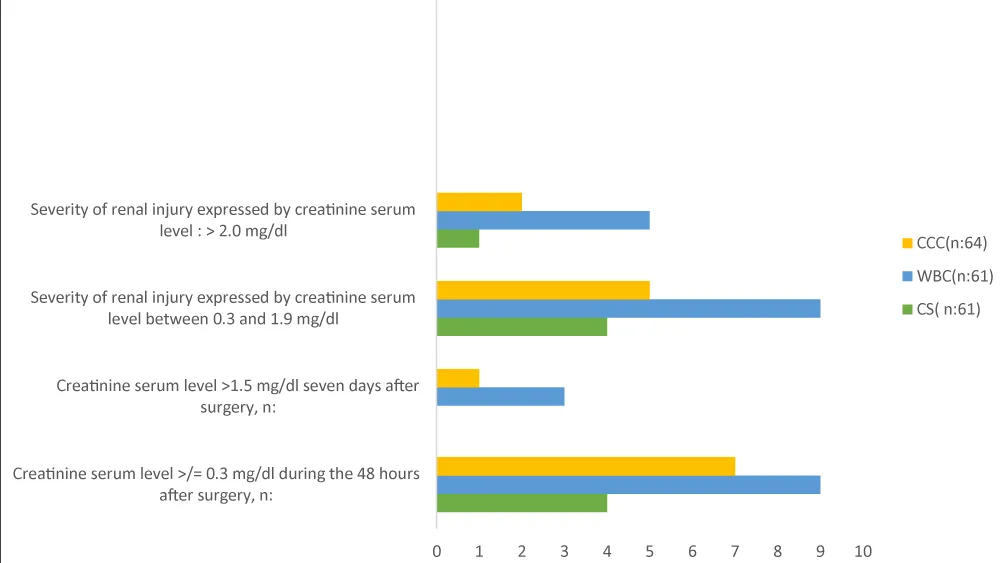
The clinical pre-operative and intra-operative characteristics of patients undergoing cardiac arrest with cold intracellular Custodiol solution (CS group, 61 patients), cold crystalloid St. Thomas extracellular cardioplegia (CCC group, 64 patients) and warm blood cardioplegia (WBC group, 61 patients) were reported in table 1 and in figure 1. Descriptive analysis showed no differences in age, height, and preoperative comorbidity among the three groups. In all three groups of patients, males were more prevalent than females. Coronary heart disease was more frequent in the WBC group, while valvular heart disease and complex cardiac disease were more common in the CS group. No statistically significant differences in preoperative serum creatinine levels were detected among the three groups of patients. Perioperative increases in serum creatinine levels and postoperative AKI severity in the three groups are shown in table 2. A serum creatinine level increase of ≥ 0.3 mg/dL within 48 hours post-surgery was observed in four patients (6.6%) in the CS group, in seven patients (10.9%) in CCC group, and in nine patients (14.8%) in WBC Group. We found a significant difference regarding creatinine increase in the WBC group vs CS group, but no differences were detected between CCC and CS groups. A serum creatinine level > 1.5 mg/dL seven days post-surgery was not significant in any of the three groups, i.e., 0 patients in CS group, 1 patient in CCC group and 3 patients in WBC group, respectively.
| Characteristics | CC (n = 61) | WBC (n = 61) | CCC (n = 64) | P-value |
| Age, years | 65.6 ± 14.8 | 69.2 ± 9.5 | 65.5 ± 13.0 | NS |
| Weight, Kg | 74.1 ± 13.1 | 79.9 ± 13.7 | 79.9 ± 11.8 | 0.01 (CC vs. CCC) 0.02 (CC vs. WBC) |
| Height, cm | 169.4 ± 10.5 | 170.6 ± 9.1 | 172.7 ± 9.4 | NS |
| Gender (M/F), n | 36/25 | 48/13 | 48/16 | 0.04 |
| Co-morbid diseases *, n: 0 1 2 3 | 14 32 15 0 | 12 34 15 0 | 14 34 15 1 | NS |
| Clinical diagnosis **, n: A B C | 1 35 25 | 37 19 5 | 16 27 19 | < 0.0001 |
| ECC groups, n: < 90 minutes > 90 < 120 minutes | 9 23 | 21 23 | 20 23 | 0.05 |
| > 120 minutes | 29 | 17 | 29 | |
| Aortic cross-clamp groups, n: < 60 minutes > 60 minutes | 4 57 | 29 32 | 12 52 | < 0.0001 |
| Preop. creatinine serum level, mg/dl | 0.99 ± 0.44 | 1.03 ± 0.29 | 0.99 ± 0.24 | NS |
| *presence of one or more of the following preoperative comorbid conditions: diabetes mellitus, atrial fibrillation, arterial hypertension. **A: Coronary artery disease requiring coronary artery bypass grafting; B: Valvular heart diseases requiring valve repair or replacement; C: Complex cardiac diseases (aortic pathology + valvular heart disease +/- coronary artery disease) requiring aortic repair and aortic valve replacement +/- coronary artery bypass grafting. CC: Custodiol Cardioplegia; CCC: Cold Crystalloid St. Thomas Cardioplegia; WBC: Warm Blood Cardioplegia; ECC: Extra-Corporeal Circulation; NS: Not Significant. | ||||
| Variable | CC (n = 61) | WBC (n = 61) | CCC (n = 64) | p - value |
| Creatinine serum level >/= 0.3 mg/dl during the 48 hours after surgery, n (%): | 4 (6.6) | 9 (14.8) | 7 (10.9) | 0.002 (WBC vs CS) 0.022 (WBC vs CCC) NS (CCC vs CS) |
| Creatinine serum level > 1.5 mg/dl seven days after surgery, n (%): | 0 | 3 (4.9) | 1 (1.6) | NS |
| Severity of renal injury expressed by creatinine serum level increase divided into 2 groups ┼, n (%): | ||||
| group 1 | 4 (6.6) | 9 (14.8) | 5 (7.8) | 0.002 (WBC vs CS) 0.003 (WBC vs CCC) |
| group 2 total patients, n (%) (groups 1 + 2) | 1 (1.6) 5 (8.2) | 5 (8.2) 14 (23) | 2 (3.1) 7 (10.9) | 0.007 (WBC vs CS) 0.012 (WBC vs CCC) < 0.0001 (WBC vs CS) 0.0001 (WBC vs CCC) NS (CS vs CCC, for all measurements) |
| ┼ group 1: between 0.3 and 1.9 mg/dl; group 2: equal or greater than 2.0 mg/dl. CC: Custodiol Cardioplegia; CCC: Cold Crystalloid Cardioplegia; WBC: Warm Blood Cardioplegia. NS: Not Significant. | ||||
As regarding the severity of renal injury, 4 patients (6.6%) in CS Group, 5 patient in CCC group (7.8%) and 9 patients in WBC (14.8%), showed an increase in creatinine serum level between 0.3 and 1.9 mg/dl respect to baseline with a statistically significant difference in WBC group vs CS and CCC. An increase in serum creatinine level > 2 mg/dL was observed in 1 patient in the CS Group (1.6%), 2 patients in the CCC Group (3.1%) and 5 patients in the WBC Group (8.2%), respectively. The P-value was statistically significant for WBC group vs CS group and for WBC group vs CCC group. Overall, 5 patients in the CS group (8.2%), 14 patients in the WBC group (23%) and seven (10.9%) in the CCC group developed postoperative renal injury (Figure 1). No differences were observed between the CS and CCC groups for any measurements of renal injury severity. The hemoglobin content was similar in three groups, significantly lower after reperfusion than at baseline in the WBC group vs CCC group and WBC group vs CS group.
Risk factors and independent predictors of AKI after cardiac surgery, including the severity and timing of onset, were analyzed in table 3 using both univariate and multivariate analyses. Preoperative serum creatinine level, lactate level at weaning from CPB > 3 mMol/L, sodium level imbalance during CPB, and male gender were statistically significant predictors of AKI in our population, although the latter variable had reached a very slight level of statistical significance. The type of cardioplegia, specifically WBC vs CS and CCC, was identified as a risk factor for AKI development at the univariate analysis only. We found that hyponatremia was an independent variable involved in AKI presentation, regardless of the type of cardioplegia used.
| Variables | p - value (Univariate) | Odds Ratio | 95% CI | p -value (Multivariable) |
| Preoperative creatinine serum level ↑ (1.2 vs 1.0 mg/dl) | 0.0007 | 9.5 | 2.5 – 36.0 | < 0.001 |
| Lactates level at the weaning from CPB (> 3 milli-Mole/L) | 0.02 | 10 | 1.21 – 86.0 | 0.03 |
| Sodium level imbalance during CPB (133 vs 131 milli-Mole/L) | 0.007 | 1.1 | 1.02 – 1.40 | 0.02 |
| Gender (male vs female) | 0.04 | 4.2 | 0.95 – 20.0 | 0.05 |
| Comorbid diseases | 0.03 | |||
| Type of cardioplegia (WBC vs CS and CCC, CCC vs CS) | < 0.0001 0.0001 | 0.36 0.56 | ||
| CPB: Cardiopulmonary by-pass; CC: Custodiol Cardioplegia; CCC: Cold Crystalloid Cardioplegia; WBC: Warm Blood Cardioplegia. | ||||
Discussion
AKI represents a significant medical challenge, particularly following cardiac surgery, where it is independently associated with increased short-term morbidity, healthcare costs, and long-term mortality. The pathophysiology of AKI in the context of cardiac surgery is complex and multifactorial, involving interrelated and synergistic mechanisms such as hemodynamic and inflammatory factors, ischemia-reperfusion injury, and oxidative stress [16].
Current literature identifies several independent risk factors for AKI following cardiac surgery, including advanced age, sex, preoperative cardiac dysfunction, i.e., intra-aortic balloon pump insertion, NYHA class IV, cardiogenic shock, reduced left ventricular ejection fraction, congestive heart failure, emergent surgery, peripheral arterial disease, redo operation. Other risk factors detected are insulin-dependent diabetes mellitus, preoperative renal dysfunction, i.e., e-GFR value < 60 mL/min., creatinine > 2.1 mg/dL, chronic obstructive pulmonary disease, and intraoperative use of the aprotinin. Among these variables, preoperative renal dysfunction is the most predictive of postoperative AKI. Additionally, the type of cardiac surgical procedure can negatively influence the risk of AKI, with patients undergoing valvular surgery — with or without Coronary Artery Bypass Grafting (CABG) — that are at a higher risk in comparison with those undergoing CABG alone. Cross-clamp time and the duration of cardiopulmonary bypass have been also identified as significant risk factors for AKI [17-24].
In our study, preoperative serum creatinine level, lactate level at weaning from cardiopulmonary bypass (CPB) > 3 mMol/L, sodium level imbalance during CPB, and male gender were significant predictors of post-operative AKI development.
The impact of preoperative renal impairment in the pathogenesis of AKI is well known in Literature [25]. Patients with chronic kidney disease have lower kidney reserve and during cardiac surgery the kidneys can be stressed by surgical factors, inflammation and oxidative stress, resulting in further decline in glomerular filtration rate. As shown by Husain-Syed, et al. even a transitory increase in postoperative creatinine level, can be related with a subsequently reduction in renal functional reserve, thus suggesting the idea that AKI leaves patient with a reduced functional margin in the setting of additional subsequent AKI events. The increase in serum lactate at CPB weaning is also an aspect well known and well investigated in literature. Postoperative tissue hypo-perfusion, showed by increased serum lactate levels, has been associated with cardiac surgery-associated AKI, even if papers regarding this issue in literature are not conclusive. In a study published in 2018 by Mitchell, et al. [26] the increase in intraoperative lactates levels was associated with worse renal outcome after cardiac revascularization procedures. Similarly, in our study, the increase in lactate levels at weaning from CPB was associated with an increase of serum creatinine levels after surgery. It can indicate that patients with a serum lactate > 3 had an intraoperative kidney injury likely due to an increase of oxygen demand, in a reduction in O2 availability (DO2) or in presence of a mismatch between Oxygen demand/ Oxygen consumption (DO2/VO2 ratio).
Hyponatremia is common during CPB and is associated with several adverse clinical outcomes in patients undergoing cardiac surgery including acute kidney injury. Cardioplegic solutions can directly contribute to the development of hyponatremia during CPB, primarily because of their low sodium content and the large volumes administered during the procedure. This effect can be particularly pronounced with Custodiol cardioplegia, which contains a sodium concentration markedly lower than plasma. The resulting hyponatremia may impair free water excretion or neuro-hormonal activation, all of which are linked to renal dysfunction. Reduced Sodium concentration at level of the distal tubules of the kidneys, stimulates macula densa to release renin that, throught the RAAS (Renin-Angiotensin-Aldosterone) system, contributes to Sodium readsorption at tubular site. In addition, Hypotonicity linked to hyponatremia, can have detrimental impact on neuron function. To preserve water hemostasis and electroneutrality at the level of cerebral extracellular fluid, there is an efflux of Potassium from the cell followed by other organic osmolytes, such as glutamine [27]. The ability to maintain water homeostasis decreases gradually with decreasing kidney function [28]. In literature, hyponatremia has been recognized as an independent risk factor for increased all-cause mortality and for progression to end-stage renal disease in patients with non–dialysis-dependent AKI. Our data confirmed hyponatremia as an independent predictor involved in AKI onset regardless of the type of cardioplegic solutions used.
Notably, in comparing postoperative AKI across the three different cardioplegic solutions evaluated in our study, no statistically significant differences were observed in preoperative serum creatinine levels among the groups. However, a significant increase in serum creatinine (≥ 0.3 mg/dL) within 48 hours’ post-surgery was observed in the WBC group in comparison with the CS group, although no such differences were found between the CCC and CS groups. By seven days’ post-surgery, creatinine levels were not significantly different among the three groups, with the severity of renal injury remaining statistically significant only in the WBC group in comparison with CS group. CS cardioplegic solution was associated with earlier and transient renal impairment, likely due to the induced blood dilution during its administration [23,29].
The ischemia-reperfusion injury induced by CPB may contribute to cellular stress and alterations in oxygen conditions, potentially damaging the kidneys, which, although not directly affected by ischemia and reperfusion, are vulnerable to changes in hemodynamics and the inflammatory response induced by CPB [30]. According to Feirer, et al. [23], AKI encompasses tubular cell injury characterized by the tubule swelling. In this study was observed that the preservation of proximal tubular structure in the HTK-N group in which it was administered Custodiol-N, i.e., including iron chelators to reduce oxidative injury, might be attributed to the supplementation of alanine, l-arginine, and glycine in the HTK-N solution, potentially mitigating the ischemia-reperfusion injury mechanism [23,31,32]. The severity of renal injury, stratified by serum creatinine increases (between 0.3 and 1.9 mg/dL and greater than 2.0 mg/dL) was more present with a statistically significance in the WBC vs CS, whereas no significant differences were detected between the CS and CCC groups, as observed in other studies [28-32]. The fact that WBC was still found to be a risk factor at least in the univariate analysis, could be linked, at least in part, to a reduced administration volume and, therefore, to a possible lower overall patient-volume during CPB time compared to a greater volume administration performed with the use of the custodiol and the non-haematic crystalloid solutions.
The lack of consistent data in the literature, and the absence of significant findings in our study in relation to the use of different cardioplegic solutions, complicates the interpretation of these results.
Moreover, hemoglobin levels were similar across the three groups but were significantly lower post-reperfusion than at baseline in the WBC group in comparison with CCC and CS groups.
This study has several limitations, including its retrospective nature and the relatively small sample size considering three groups of patients based on the three types of cardioplegia used, and the different surgical procedures within the same cohort. Most patients in the WBC group suffered from ischemic heart disease, which could also underlie diffuse atherosclerosis in other arterial districts, such as the renal arteries; however, the mean preoperative creatinine value was not different from that observed for the other two groups of patients. Besides, important indices often used to evaluate an adequate perfusion during CPB (SvO2, DO2, or DO2/VO2 ratio) and linked to postoperative AKI occurrence, were not collected for this research.
Moreover, the study population was not homogeneous, with a prevalence of male gender.
Conclusion
Current evidence regarding the safety of cardioplegic solutions and the possible electrolyte disorders induced by their infusion during extracorporeal circulation has shown that there is no evidence concluding which is the safest cardioplegic solution to prevent AKI occurrence. Warm blood cardioplegia is associated with a slightly higher risk of developing postoperative AKI, as highlighted in the univariate analysis of the variables alone. In light of what we have observed in our study, the results are hypothesis-generating rather than definitive. Thus, further clinical studies are needed to reach a consensus of best practices regarding type of cardioplegia to administer aiming to AKI prevention considering pre- intra- e postoperative variables, and potential prophylactic measures to reduce this complication.