
2025 December 05;6(12):1865-1876. doi: 10.37871/jbres2234.
-
Subject area(s):

 |
|
 |
|
 |
|

 Observational Study
Integrating Serum Biomarkers and Genetic Polymorphisms for Alzheimer’s disease Risk Screening
Zhizhen Li1*, Zhaohai Feng2, Song He1#, Huaping Tang3, Cai Zhao1, Jinfeng Liu1, Yao Su1, Jiayang Duan1, Xue Tian1, Yong Yan1, Xiaojing Shi1 and Xueling Bi1
2Department of Neurology, Maanshan People’s Hospital, Maanshan 243000, China
3Department of Gerontology, Maanshan People’s Hospital, Maanshan 243000, China
- Alzheimer’s disease
- Serum biomarkers
- APOE, SLCO1B1
- Nomogram model
- Diagnostic accuracy
Abstract
Objective: Analyze the differences in the detection results of Alzheimer’s Disease (AD) serum biomarkers and the expression of APOE and SLCO1B1 genotypes, then construct an AD diagnostic model integrating serum biomarkers with APOE and SLCO1B1 genotypes to enhance the sensitivity and specificity of AD screening.
Methods: Serum samples from 127 participants (41 AD, 39 cognitive impairments, 47 controls) were analyzed for Neurofilament light chain (NF), Aβ42/Aβ40 ratio, p-TAU231, and p-TAU217 via ELISA, combined with APOE/SLCO1B1 genotyping. A nomogram model was constructed using logistic regression and validated by ROC-AUC and Hosmer-Lemeshow tests.
Results: The AD group showed elevated NF (p < 0.01) and p-TAU231 (p < 0.05), reduced Aβ42/Aβ40 (p < 0.05). APOE ∑4 homozygotes exhibited the highest p-TAU181 (p < 0.001), while SLCO1B1*1b/*1b correlated with increased Aβ42 (p < 0.05). The biomarker model achieved AUC = 0.8365, improving to 0.8832 after genetic integration (calibration p > 0.05).
Conclusion: This study pioneers an AD diagnostic model combining serum p-TAU231, NF, and SLCO1B1 polymorphisms, surpassing single-marker limitations (AUC > 0.88). It provides a high-accuracy tool for non-invasive screening and genetic stratification, demonstrating substantial clinical potential.
Abbreviations
Aβ: β-Amyloid; AD: Alzheimer’s Disease; APOE: Apo lipoprotein E; ATN: Amyloid-Tau-Neurodegeneration; AUC: Area Under the Curve; CI: Cognitive Impairment; CSF: Cerebrospinal Fluid; ELISA: Enzyme-linked Immunosorbent Assay; NF: Neurofilament Light Chain; P-tau: Phosphorylated tau; PCR: Polymerase Chain Reaction; PET: Positron Emission Tomography; ROC: Receiver Operating Characteristic; SLCO1B1: Solute Carrier Organic Anion Transporter Family Member 1B1.
Introduction
Alzheimer’s Disease (AD) is a neurodegenerative disorder characterized by progressive cognitive decline and neuronal loss, affecting over 55 million individuals globally, with projections estimating a rise to 152 million by 2050 [1]. Its pathological hallmarks include senile plaques formed by b-Amyloid (Ab) deposition, neurofibrillary tangles resulting from hyper phosphorylated tau protein, accompanied by neuroinflammation and synaptic dysfunction [2,3]. Despite significant advances in understanding AD pathophysiology, early diagnosis remains challenging: Cerebrospinal Fluid (CSF) biomarker assays and Positron Emission Tomography (PET) are costly and invasive, while clinical symptoms typically manifest only after irreversible neuronal damage has occurred [4]. Consequently, the development of highly sensitive, non-invasive peripheral biomarkers and diagnostic models integrating genetic risk profiles has emerged as a critical research priority.
In recent years, blood-based biomarkers have garnered attention due to their accessibility and reproducibility. NeuroFilament light chain (NF), a marker of axonal injury, is significantly elevated in the serum of AD patients; however, its low specificity overlaps with other neurodegenerative disorders, such as frontotemporal dementia [5,6]. Reduced Ab42/Ab40 ratios and elevated phosphorylated tau (p-tau) protein levels, particularly p-tau 231 and p-tau 217, have been strongly associated with AD pathology, with their stability in plasma rendering them promising diagnostic tools [7,8]. Nevertheless, the diagnostic efficacy of individual biomarkers remains limited, while combining multiple biomarkers may lead to improved diagnostic performance, and interindividual genetic heterogeneity may influence biomarker expression [9]. For instance, the Apolipoprotein E (APOE) ∑4 allele, the strongest genetic risk factor for AD, correlates with impaired Ab clearance and accelerated tau pathology progression [10], while SLCO1B1 gene polymorphisms may indirectly modulate AD risk through lipid metabolism regulation and statin pharmacodynamics [11]. These findings underscore the potential of integrating multidimensional biomarkers and genetic data to overcome current diagnostic limitations.
Existing studies often examine single biomarkers or genetic factors in isolation, neglecting their potential interactions. Although the ATN (Amyloid-Tau-Neurodegeneration) framework proposes a diagnostic strategy combining Ab, tau, and neurodegeneration markers [12,13], the incorporation of genetic variants into this system remains undefined. Addressing these gaps, this study analyzes serum levels of NF, Ab42/Ab40, p-tau 231, and p-tau 217 in AD patients, individuals with Cognitive Impairment (CI), and healthy controls, combined with APOE and SLCO1B1 genotyping. Our aim is to evaluate the diagnostic utility of these biomarkers for AD and to construct a risk-prediction nomogram model based on their profiles.
Materials and Methods
Study participants and design
Serum samples were collected from 127 hospitalized patients in the Department of Neurology and Geriatrics at Maanshan People’s Hospital between 01/02/2024 and 31/01/2025. Participants were categorized into three groups based on diagnostic criteria: the AD group (n = 41), the CI group (n = 39), and the cognitively normal control group (n = 47). The diagnosis of AD was based on the McKhann criteria [14], while the diagnosis of CI followed the Peterson criteria [15]. Clinical data were recorded, and serum levels of NF, Ab40, Ab42 (to calculate the Ab42/Ab40 ratio), p-tau 181, p-tau 217, p-tau 231, as well as SLCO1B1 and APOE genotypes, were retrospectively analyzed. Intergroup differences in biomarker expression and their associations with APOE and SLCO1B1 polymorphisms were evaluated. Diagnostic performance of these biomarkers for AD was assessed, and a risk-prediction nomogram model was developed and validated. This research was a retrospective investigation. Patient identifiers were removed during data extraction, with only gender, age, clinical diagnoses, and laboratory test data collected. This study was approved by the Ethics Committee of Maanshan People’s Hospital (Approval No: ERMPH 2025 No 02-07 V1.0 2024.1.30), and the requirement for informed consent was waived due to the retrospective nature of the data analysis.
Assay reagents and equipment’s
Serum levels of NF, Ab40, Ab42, p-tau 181, p-tau 217, and p-tau 231 were quantified using Enzyme-Linked Immunosorbent Assay (ELISA). The NF ELISA kit was supplied by Jingmei Biotechnology Co., Ltd., while other reagents were provided by Shanghai Jianglai Biotechnology Co., Ltd. Assays were performed on a fully automated ELISA workstation (Model: ADC ELISA 1100; Yantai Aideng Biotechnology Co., Ltd.). Genotyping of APOE and SLCO1B1 was conducted via Polymerase Chain Reaction (PCR). Nucleic acid extraction kits were obtained from Jiangsu Kangwei Century Biotechnology Co., Ltd., and PCR reagents were sourced from Wuhan Youzhiyou Medical Technology Co., Ltd. PCR analysis was performed using an automated medical PCR system (Xi’an Tianlong Technology Co., Ltd.). All procedures strictly followed manufacturer protocols and equipment specifications.
Statistical analysis
Data were organized using Microsoft Excel 2019 and analyzed with SPSS 20, R (v4.4.3), and STATA 15. Categorical variables were compared using chi-square tests, while quantitative data were analyzed in R with appropriate statistical methods (stats and car packages). As most data deviated from normality, intergroup differences were assessed via the Kruskal-Wallis test, followed by Dunn’s post-hoc test for pairwise comparisons. Diagnostic performance was evaluated using Receiver Operating Characteristic (ROC) curves and Area Under the Curve (AUC) calculations. Data visualization was performed using ggplot2 in R. Statistical significance was defined as p < 0.05. The nomogram model was constructed using R (Rms package) and STATA, with validation metrics including ROC analysis for discriminative ability and the Hosmer-Lemeshow test for calibration (p > 0.05 indicating good agreement between predicted and observed values). The significance of differences in the AUC-ROC was assessed using DeLong’s test, with p < 0.05 indicating statistical significance.
Results
Baseline demographic characteristics
Among the study participants, the AD group included 13 males (31.71%), the CI group had 14 males (35.90%), and the cognitively normal control group comprised 19 males (40.43%). No statistically significant differences in gender distribution were observed across groups (β² = 0.723, p = 0.697). As shown in table 1, age distributions also did not differ significantly among the three groups (p > 0.05), confirming baseline comparability.
| Table 1: Descriptive statistics and intergroup comparative analysis of biomarkers. | |||||||||||
| Observation | Grouped data | Kruskal-Wallis test | Dunn’s test | ||||||||
| Group | Number | Mean | SD | Statistical magnitude | p-value | Group 1 | Group 2 | Statistical magnitude | Estimated value | Adjusted p-value | |
| AGE | AD | 41 | 73.976 | 8.3111 | 2.496 | 0.2871 | AD | CI | -0.0033467 | -0.027517 | 1 |
| CI | 39 | 74.282 | 8.8167 | AD | Control | -1.3604 | -10.687 | 0.5211 | |||
| Control | 47 | 72.021 | 7.5714 | CI | Control | -1.3387 | -10.659 | 0.542 | |||
| NF | AD | 41 | 1022 | 669.69 | 11.445 | 0.0033** | AD | CI | -1.1993 | -9.8727 | 0.6913 |
| CI | 39 | 828.26 | 211.33 | AD | Control | -3.3325 | -26.21 | 0.0026** | |||
| Control | 47 | 703.32 | 274.39 | CI | Control | -2.0494 | -16.338 | 0.1213 | |||
| Aβ40 | AD | 41 | 1.1076 | 1.0607 | 2.3187 | 0.3137 | AD | CI | -0.34513 | -2.8412 | 1 |
| CI | 39 | 1.2155 | 1.2507 | AD | Control | -1.4516 | -11.417 | 0.4398 | |||
| Control | 47 | 0.77357 | 0.37076 | CI | Control | -1.0757 | -8.5756 | 0.8462 | |||
| Aβ42 | AD | 41 | 0.77595 | 2.9226 | 1.9639 | 0.3746 | AD | CI | 0.39895 | 3.2839 | 1 |
| CI | 39 | 0.42067 | 0.36414 | AD | Control | 1.3589 | 10.687 | 0.5225 | |||
| Control | 47 | 1.0349 | 3.2024 | CI | Control | 0.9287 | 7.4029 | 1 | |||
| Aβ42/Aβ40 | AD | 41 | 1.2057 | 4.4075 | 6.4241 | 0.0403* | AD | CI | 0.561 | 4.6185 | 1 |
| CI | 39 | 0.62853 | 0.81507 | AD | Control | 2.412 | 18.971 | 0.0476* | |||
| Control | 47 | 2.876 | 12.362 | CI | Control | 1.8003 | 14.352 | 0.2154 | |||
| p-TAU181 | AD | 41 | 4.3642 | 13.999 | 0.38659 | 0.8242 | AD | CI | 0.57051 | 4.6964 | 1 |
| CI | 39 | 2.0084 | 1.7196 | AD | Control | 0.078522 | 0.61754 | 1 | |||
| Control | 47 | 1.6874 | 1.1227 | CI | Control | -0.51167 | -4.0788 | 1 | |||
| p-TAU217 | AD | 41 | 3.608 | 2.8587 | 3.0973 | 0.2125 | AD | CI | 1.3627 | 11.218 | 0.5189 |
| CI | 39 | 5.5843 | 5.354 | AD | Control | 1.6531 | 13.001 | 0.2949 | |||
| Control | 47 | 8.6221 | 16.303 | CI | Control | 0.22369 | 1.7831 | 1 | |||
| p-TAU231 | AD | 41 | 2.2772 | 1.4511 | 8.7167 | 0.0128* | AD | CI | -0.57281 | -4.7154 | 1 |
| CI | 39 | 2.346 | 2.4208 | AD | Control | -2.7832 | -21.889 | 0.0161* | |||
| Control | 47 | 1.5461 | 1.0921 | CI | Control | -2.1543 | -17.174 | 0.0937 | |||
Intergroup differences in biomarker levels
Biomarker data and intergroup comparisons are summarized in table 1. Significant differences (p < 0.05) were observed across groups in serum levels of NF, Ab42/Ab40, and p-tau 231. NF levels exhibited an increasing trend from the cognitively normal control group to the CI group and AD group, with pairwise comparisons confirming significantly higher NF in the AD group versus controls (p < 0.01). The Ab42/Ab40 ratio was significantly lower in the AD group compared to controls (p < 0.05), while p-tau231 levels were markedly elevated in the AD group (p < 0.05). Although p-tau 217 levels did not differ significantly across groups, a decreasing trend was noted from controls to the CI and AD groups.
Diagnostic performance of biomarkers for AD
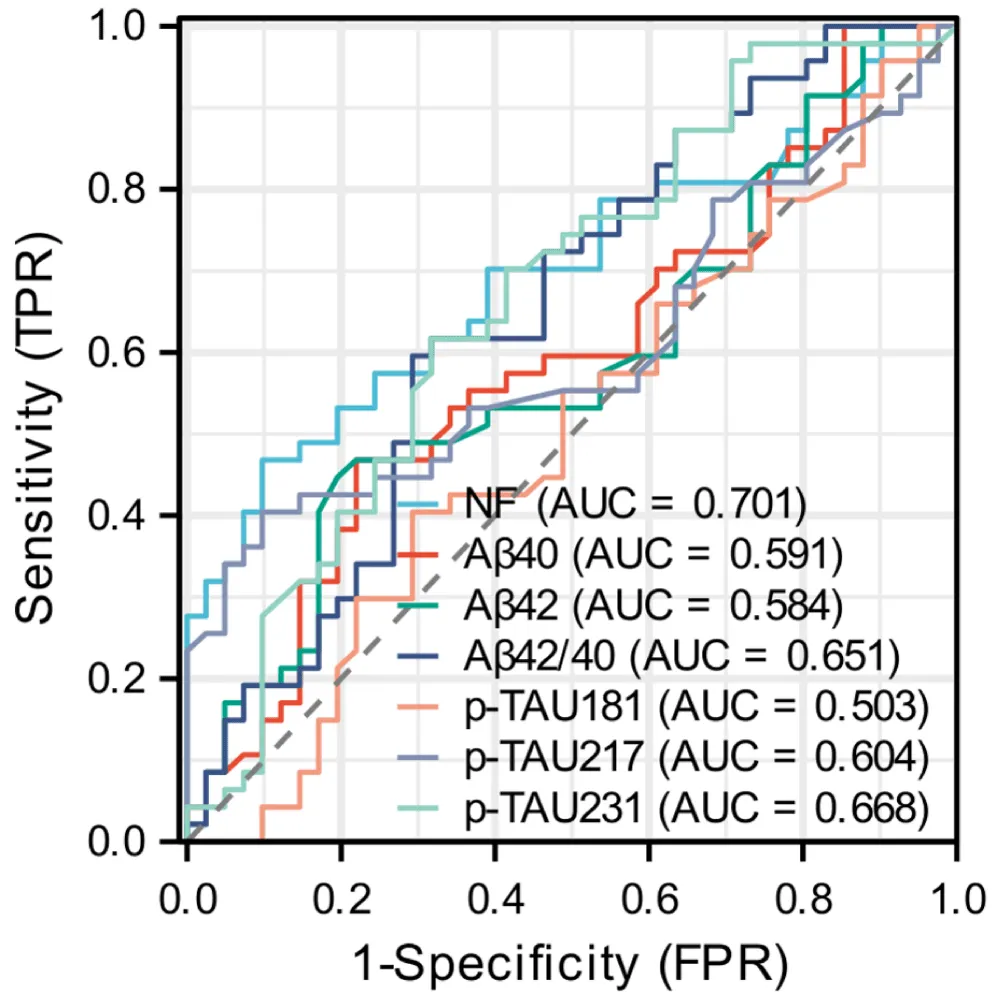
Receiver Operating Characteristic (ROC) curves were generated to evaluate the diagnostic utility of biomarkers for AD (Figure 1). NF demonstrated the highest discriminative power (AUC = 0.701), followed by p-tau 231 (AUC = 0.668), Ab42/Ab40 (AUC = 0.651), and p-tau 217 (AUC = 0.604).
Association of biomarkers with APOE and SLCO1B1 genotypes
Genetic analysis revealed significant associations between biomarker levels and APOE/SLCO1B1 polymorphisms. For APOE genotypes: NF levels were significantly higher in the ∑2/∑4 group compared to ∑3/∑3 carriers (p = 0.0049). Ab40 levels were elevated in the ∑2/∑4 group versus ∑3/∑4 carriers (p = 0.0447). p-tau 181 levels were markedly higher in ∑4/∑4 carriers than in ∑3/∑4 (p = 0.0001), ∑2/∑4 (p = 0.0447), and ∑2/∑3 (p = 0.0464) groups. ∑3/∑3 carriers also showed higher p-tau 181 levels than ∑3/∑4 carriers (p = 7.81 × 10). p-tau 217 levels were significantly elevated in ∑3/∑3 versus ∑3/∑4 carriers (p = 0.0399) (Figure 2a).
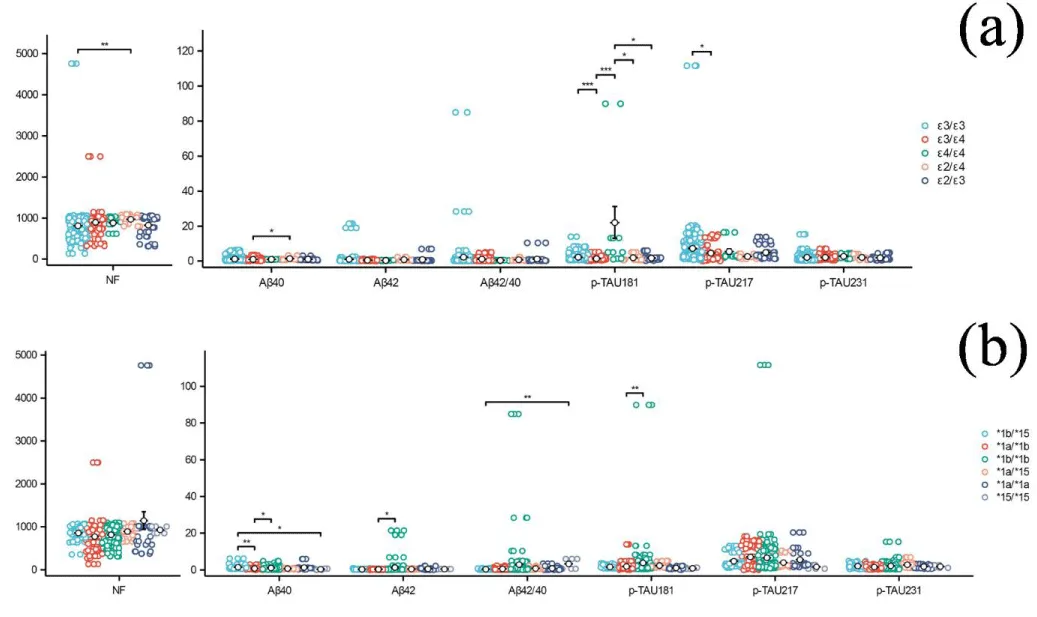
For SLCO1B1 genotypes: Ab40 levels were higher in *1b/*15 carriers compared to *1a/*1b (p = 0.0015) and *15/*15 (p = 0.0155) groups, with *1b/*1b carriers also showing elevated Ab40 versus *1a/*1b (p = 0.0102). Ab42 levels were increased in *1b/*1b versus *1a/*1b carriers (p = 0.0112). The Ab42/Ab40 ratio was higher in *15/*15 versus *1b/*15 carriers (p = 0.0043). p-tau 181 levels were significantly lower in *1a/*1b carriers compared to *1b/*1b (p = 0.005) and *1a/*15 (p = 0.0064) groups, with *1a/*1a and *15/*15 carriers also showing reduced levels versus *1b/*1b (p = 0.0002) and *1a/*15 (p = 0.0002) groups. p-tau 231 levels were lower in *1a/*1b carriers compared to *1a/*15 (p = 0.0205) and *1b/*15 (p = 0.0003) groups (Figure 2b).
Construction of the AD risk-prediction nomogram model
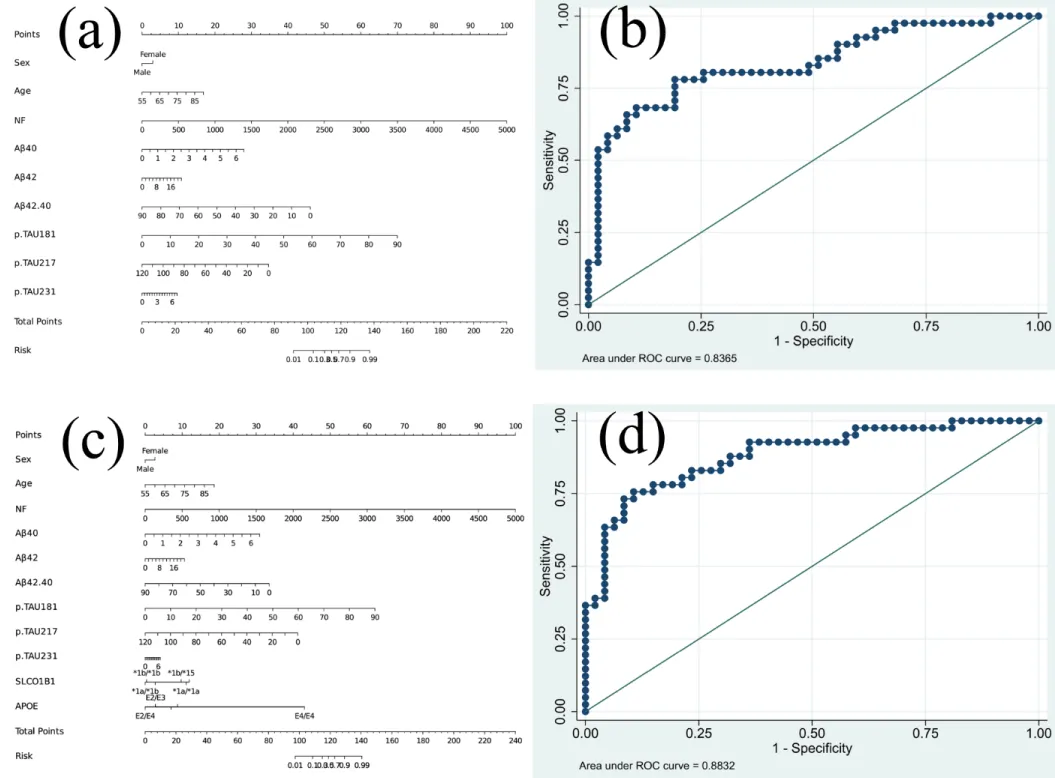
To enhance the diagnostic accuracy for AD risk, we performed logistic regression analysis on the biomarkers and constructed a nomogram model (Figure 3a). Discrimination validation via ROC curve analysis revealed an AUC of 0.8365, surpassing the diagnostic performance of individual biomarkers (Figure 3b). Calibration validation using the Hosmer-Lemeshow test yielded a Pearson c² = 88.73 (p = 0.2127), indicating good agreement between predicted and observed values. Given the observed associations between APOE/SLCO1B1 genotypes and AD biomarker levels, we further incorporated genetic variants into the nomogram (Figure 3c). This integrated model demonstrated increased diagnostic efficacy (p = 0.0939, Delong’s test), with an AUC-ROC of 0.8832 (Figure 3d) and a Hosmer-Lemeshow test result of b² = 81.47 (p = 0.313), confirming robust calibration.
Discussion
AD is a neurodegenerative disorder characterized by Amyloid-b (Ab) deposition, aberrant tau phosphorylation, and neuronal degeneration. Recent advancements in biomarker research have provided critical insights into early diagnosis and pathological mechanisms. This study developed an AD risk-prediction model by integrating serum biomarkers (NF, Ab42/Ab40 ratio, p-tau 231, p-tau 217) with APOE and SLCO1B1 polymorphisms.
Our findings revealed significantly elevated NF levels in the AD group compared to cognitively normal controls (p < 0.01), with a gradient trend (AD > CI > controls). NF, a marker of axonal injury, reflects progressive neuronal degeneration [5]. Previous studies have correlated NF with neurodegeneration severity in AD CSF [16], and our results further validate its diagnostic potential in serum. However, NF lacks disease specificity, as it is also elevated in other neurodegenerative conditions (e.g., Parkinson’s disease, multiple sclerosis) [17,18], necessitating integration with other bio-markers to enhance diagnostic specificity.
The reduced Ab42/Ab40 ratio in the AD group (p < 0.05) aligns with the pathological accumulation and impaired clearance of Ab42 in AD [2,3]. A low Ab42/Ab40 ratio is widely recognized as a core biomarker in both CSF and plasma [7,8]. Additionally, ele-vated p-tau 231 levels in the AD group (p < 0.05) underscore the role of tau hyperphos-phorylation in AD progression. Notably, while p-tau 217 did not show significant inter-group differences, its decreasing trend from controls to the AD group may suggest temporal specificity in phosphorylation dynamics, warranting longitudinal investigation.
NF demonstrated the highest diagnostic sensitivity (AUC = 0.701) compared to p-tau 231 (0.668) and Ab42/Ab40 (0.651). However, the limited discriminative power of single biomarkers highlights the need for multimodal approaches. For instance, the ATN framework advocates combining Ab, tau, and neurodegeneration markers a strategy corroborated by our findings.
Our data also revealed findings that are inconsistent with widely accepted evidence, such as: As shown in table 1, several key biomarkers exhibit counterintuitive patterns. The Cognitively Impaired (CI) group, rather than the AD group, shows the lowest levels of Ab42 and the Ab42/40 ratio, and the highest levels of Ab40 and p-tau 231. This suggests a more severe pathological profile in the CI group compared to the diagnosed AD group, which is biologically unexpected. The trend for p-tau 217 (Control > CI > AD) is in direct opposition to a large body of established literature, which consistently demonstrates that plasma p-tau 217 is significantly elevated in AD. These discrepancies are likely attributable to the suboptimal sensitivity of the assay methodology we employed. This observation nonetheless provides valuable clinical insight: more advanced and highly sensitive detection platforms, such as SIMOA [19,20], should be prioritized for measuring AD biomarkers.
The APOE ∑4 allele remains the strongest genetic risk factor for AD [21]. Our study revealed significantly elevated p-tau 181 levels in APOE ∑4/∑4 genotype carriers compared to other genotypes (p < 0.001), suggesting that ∑4 may accelerate AD progression by promoting tau phosphorylation. Additionally, the ∑2/∑4 genotype was associated with increased NF levels (p = 0.0049), implying a potential neuroprotective role of the ∑2 allele in counteracting e4-mediated toxicity [7]. These findings reinforce the utility of APOE genotyping in AD subtyping and prognostic evaluation.
SLCO1B1, encoding the hepatic organic anion-transporting polypeptide, influences statin metabolism and Ab clearance through its polymorphisms 9. In our cohort, *1b/*1b carriers exhibited higher Ab42 levels than *1a/*1b carriers (p = 0.0112), while the *15/*15 genotype was associated with an elevated Ab42/Ab40 ratio (p = 0.0043). These results suggest that SLCO1B1 variants may modulate Ab homeostasis via lipid metabolism regulation. Furthermore, genotype-dependent differences in p-tau 181 and p-tau 231 levels (e.g., lower p-tau in *1a/*1b carriers) could inform the development of genotype-guided therapies.
The nomogram model constructed via logistic regression achieved an AUC of 0.8365, significantly outperforming individual biomarkers (e.g., NF: AUC = 0.701). The model demonstrated excellent calibration (Hosmer-Lemeshow test p > 0.05), indicating high concordance between predicted and observed risks. Upon integrating APOE and SLCO1B1 genotypes, the AUC increased to 0.8832, underscoring the critical role of genetic data in AD stratification. Similar strategies, such as the Polygenic Risk Score (PRS) model by Kunkle BW, et al. [11], validate the superiority of combined genetic-biomarker approaches.
This model provides a novel tool for early AD screening and risk stratification, particularly in resource-limited settings where CSF or PET imaging is inaccessible. However, its clinical translation requires addressing several limitations. Firstly, sample size constraints: The relatively small AD cohort (n = 41) necessitates validation in larger populations. Secondly, unaccounted clinical variables: Cognitive scores and neuroimaging data were not included. Thirdly, population genetic heterogeneity: Generalizability across ethnic groups remains unverified.
As a cross-sectional study, our design precludes causal inferences between biomarkers and AD progression. Future longitudinal studies should delineate dynamic changes in NF, p-tau 231, and other biomarkers across disease stages. Additionally, the interplay between SLCO1B1 polymorphisms and statin pharmacodynamics warrants exploration, potentially guiding personalized treatment for AD patients with comorbid hyperlipidemia.
Acknowledgement
We would like to express our gratitude to all the members of our research team for their contributions in experimental testing and data management.
Conflict of Interests
All authors declare that there is no conflict of interest.
References
- Long S, Benoist C, Weidner W. World Alzheimer report 2023: Reducing dementia risk: never too early, never too late. Alzheimer’s Disease International, London, England. 2023.
- Jack CR Jr, Knopman DS, Jagust WJ, Petersen RC, Weiner MW, Aisen PS, Shaw LM, Vemuri P, Wiste HJ, Weigand SD, Lesnick TG, Pankratz VS, Donohue MC, Trojanowski JQ. Tracking pathophysiological processes in Alzheimer's disease: an updated hypothetical model of dynamic biomarkers. Lancet Neurol. 2013 Feb;12(2):207-16. doi: 10.1016/S1474-4422(12)70291-0. PMID: 23332364; PMCID: PMC3622225.
- Yang W, Wei Z, Wang T. Unraveling the role of LRP1 in Alzheimer’s disease: A focus on Aβ clearance and the liver-brain Axis. J Mol Neurosci. 2025;75(2):43. doi: 10.1007/s12031-025-02339-2.
- Horie K, Barthélemy NR, Spina S, VandeVrede L, He Y, Paterson RW, Wright BA, Day GS, Davis AA, Karch CM, Seeley WW, Perrin RJ, Koppisetti RK, Shaikh F, Lago AL, Heuer HW, Ghoshal N, Gabelle A, Miller BL, Boxer AL, Bateman RJ, Sato C. CSF tau microtubule-binding region identifies pathological changes in primary tauopathies. Nat Med. 2022 Dec;28(12):2547-2554. doi: 10.1038/s41591-022-02075-9. Epub 2022 Nov 24. PMID: 36424467; PMCID: PMC9800273.
- Khalil M, Teunissen CE, Otto M, Piehl F, Sormani MP, Gattringer T, Barro C, Kappos L, Comabella M, Fazekas F, Petzold A, Blennow K, Zetterberg H, Kuhle J. Neurofilaments as biomarkers in neurological disorders. Nat Rev Neurol. 2018 Oct;14(10):577-589. doi: 10.1038/s41582-018-0058-z. PMID: 30171200.
- Oh HS, Urey DY, Karlsson L, Zhu Z, Shen Y, Farinas A, Timsina J, Duggan MR, Chen J, Guldner IH, Morshed N, Yang C, Western D, Ali M, Le Guen Y, Trelle A, Herukka SK, Rauramaa T, Hiltunen M, Lipponen A, Luikku AJ, Poston KL, Mormino E, Wagner AD, Wilson EN, Channappa D, Leinonen V, Stevens B, Ehrenberg AJ, Gottesman RF, Coresh J, Walker KA, Zetterberg H, Bennett DA, Franzmeier N, Hansson O, Cruchaga C, Wyss-Coray T. A cerebrospinal fluid synaptic protein biomarker for prediction of cognitive resilience versus decline in Alzheimer's disease. Nat Med. 2025 May;31(5):1592-1603. doi: 10.1038/s41591-025-03565-2. Epub 2025 Mar 31. PMID: 40164724; PMCID: PMC12092275.
- Wojdała AL, Bellomo G, Gaetani L, Teunissen CE, Parnetti L, Chiasserini D. Immunoassay detection of multiphosphorylated tau proteoforms as cerebrospinal fluid and plasma Alzheimer's disease biomarkers. Nat Commun. 2025 Jan 2;16(1):214. doi: 10.1038/s41467-024-54878-8. PMID: 39747866; PMCID: PMC11696609.
- Jauregi-Zinkunegi A, Wilson RE, E Langhough R, Ashton NJ, Blennow K, Johnson SC, Zetterberg H, Bruno D, Mueller KD. Associations between the logical memory test story recall metrics and plasma biomarkers for Alzheimer's disease in individuals free of dementia. Clin Neuropsychol. 2025 Mar 20:1-20. doi: 10.1080/13854046.2025.2481119. Epub ahead of print. PMID: 40114424; PMCID: PMC12353963.
- Bellenguez C, Küçükali F, Jansen IE, Kleineidam L, Moreno-Grau S, Amin N, Naj AC, Campos-Martin R, Grenier-Boley B, Andrade V, Holmans PA, Boland A, Damotte V, van der Lee SJ, Costa MR, Kuulasmaa T, Yang Q, de Rojas I, Bis JC, Yaqub A, Prokic I, Chapuis J, Ahmad S, Giedraitis V, Aarsland D, Garcia-Gonzalez P, Abdelnour C, Alarcón-Martín E, Alcolea D, Alegret M, Alvarez I, Álvarez V, Armstrong NJ, Tsolaki A, Antúnez C, Appollonio I, Arcaro M, Archetti S, Pastor AA, Arosio B, Athanasiu L, Bailly H, Banaj N, Baquero M, Barral S, Beiser A, Pastor AB, Below JE, Benchek P, Benussi L, Berr C, Besse C, Bessi V, Binetti G, Bizarro A, Blesa R, Boada M, Boerwinkle E, Borroni B, Boschi S, Bossù P, Bråthen G, Bressler J, Bresner C, Brodaty H, Brookes KJ, Brusco LI, Buiza-Rueda D, Bûrger K, Burholt V, Bush WS, Calero M, Cantwell LB, Chene G, Chung J, Cuccaro ML, Carracedo Á, Cecchetti R, Cervera-Carles L, Charbonnier C, Chen HH, Chillotti C, Ciccone S, Claassen JAHR, Clark C, Conti E, Corma-Gómez A, Costantini E, Custodero C, Daian D, Dalmasso MC, Daniele A, Dardiotis E, Dartigues JF, de Deyn PP, de Paiva Lopes K, de Witte LD, Debette S, Deckert J, Del Ser T, Denning N, DeStefano A, Dichgans M, Diehl-Schmid J, Diez-Fairen M, Rossi PD, Djurovic S, Duron E, Düzel E, Dufouil C, Eiriksdottir G, Engelborghs S, Escott-Price V, Espinosa A, Ewers M, Faber KM, Fabrizio T, Nielsen SF, Fardo DW, Farotti L, Fenoglio C, Fernández-Fuertes M, Ferrari R, Ferreira CB, Ferri E, Fin B, Fischer P, Fladby T, Fließbach K, Fongang B, Fornage M, Fortea J, Foroud TM, Fostinelli S, Fox NC, Franco-Macías E, Bullido MJ, Frank-García A, Froelich L, Fulton-Howard B, Galimberti D, García-Alberca JM, García-González P, Garcia-Madrona S, Garcia-Ribas G, Ghidoni R, Giegling I, Giorgio G, Goate AM, Goldhardt O, Gomez-Fonseca D, González-Pérez A, Graff C, Grande G, Green E, Grimmer T, Grünblatt E, Grunin M, Gudnason V, Guetta-Baranes T, Haapasalo A, Hadjigeorgiou G, Haines JL, Hamilton-Nelson KL, Hampel H, Hanon O, Hardy J, Hartmann AM, Hausner L, Harwood J, Heilmann-Heimbach S, Helisalmi S, Heneka MT, Hernández I, Herrmann MJ, Hoffmann P, Holmes C, Holstege H, Vilas RH, Hulsman M, Humphrey J, Biessels GJ, Jian X, Johansson C, Jun GR, Kastumata Y, Kauwe J, Kehoe PG, Kilander L, Ståhlbom AK, Kivipelto M, Koivisto A, Kornhuber J, Kosmidis MH, Kukull WA, Kuksa PP, Kunkle BW, Kuzma AB, Lage C, Laukka EJ, Launer L, Lauria A, Lee CY, Lehtisalo J, Lerch O, Lleó A, Longstreth W Jr, Lopez O, de Munain AL, Love S, Löwemark M, Luckcuck L, Lunetta KL, Ma Y, Macías J, MacLeod CA, Maier W, Mangialasche F, Spallazzi M, Marquié M, Marshall R, Martin ER, Montes AM, Rodríguez CM, Masullo C, Mayeux R, Mead S, Mecocci P, Medina M, Meggy A, Mehrabian S, Mendoza S, Menéndez-González M, Mir P, Moebus S, Mol M, Molina-Porcel L, Montrreal L, Morelli L, Moreno F, Morgan K, Mosley T, Nöthen MM, Muchnik C, Mukherjee S, Nacmias B, Ngandu T, Nicolas G, Nordestgaard BG, Olaso R, Orellana A, Orsini M, Ortega G, Padovani A, Paolo C, Papenberg G, Parnetti L, Pasquier F, Pastor P, Peloso G, Pérez-Cordón A, Pérez-Tur J, Pericard P, Peters O, Pijnenburg YAL, Pineda JA, Piñol-Ripoll G, Pisanu C, Polak T, Popp J, Posthuma D, Priller J, Puerta R, Quenez O, Quintela I, Thomassen JQ, Rábano A, Rainero I, Rajabli F, Ramakers I, Real LM, Reinders MJT, Reitz C, Reyes-Dumeyer D, Ridge P, Riedel-Heller S, Riederer P, Roberto N, Rodriguez-Rodriguez E, Rongve A, Allende IR, Rosende-Roca M, Royo JL, Rubino E, Rujescu D, Sáez ME, Sakka P, Saltvedt I, Sanabria Á, Sánchez-Arjona MB, Sanchez-Garcia F, Juan PS, Sánchez-Valle R, Sando SB, Sarnowski C, Satizabal CL, Scamosci M, Scarmeas N, Scarpini E, Scheltens P, Scherbaum N, Scherer M, Schmid M, Schneider A, Schott JM, Selbæk G, Seripa D, Serrano M, Sha J, Shadrin AA, Skrobot O, Slifer S, Snijders GJL, Soininen H, Solfrizzi V, Solomon A, Song Y, Sorbi S, Sotolongo-Grau O, Spalletta G, Spottke A, Squassina A, Stordal E, Tartan JP, Tárraga L, Tesí N, Thalamuthu A, Thomas T, Tosto G, Traykov L, Tremolizzo L, Tybjærg-Hansen A, Uitterlinden A, Ullgren A, Ulstein I, Valero S, Valladares O, Broeckhoven CV, Vance J, Vardarajan BN, van der Lugt A, Dongen JV, van Rooij J, van Swieten J, Vandenberghe R, Verhey F, Vidal JS, Vogelgsang J, Vyhnalek M, Wagner M, Wallon D, Wang LS, Wang R, Weinhold L, Wiltfang J, Windle G, Woods B, Yannakoulia M, Zare H, Zhao Y, Zhang X, Zhu C, Zulaica M; EADB; GR@ACE; DEGESCO; EADI; GERAD; Demgene; FinnGen; ADGC; CHARGE; Farrer LA, Psaty BM, Ghanbari M, Raj T, Sachdev P, Mather K, Jessen F, Ikram MA, de Mendonça A, Hort J, Tsolaki M, Pericak-Vance MA, Amouyel P, Williams J, Frikke-Schmidt R, Clarimon J, Deleuze JF, Rossi G, Seshadri S, Andreassen OA, Ingelsson M, Hiltunen M, Sleegers K, Schellenberg GD, van Duijn CM, Sims R, van der Flier WM, Ruiz A, Ramirez A, Lambert JC. New insights into the genetic etiology of Alzheimer's disease and related dementias. Nat Genet. 2022 Apr;54(4):412-436. doi: 10.1038/s41588-022-01024-z. Epub 2022 Apr 4. PMID: 35379992; PMCID: PMC9005347.
- Um JW, Kaufman AC, Kostylev M, Heiss JK, Stagi M, Takahashi H, Kerrisk ME, Vortmeyer A, Wisniewski T, Koleske AJ, Gunther EC, Nygaard HB, Strittmatter SM. Metabotropic glutamate receptor 5 is a coreceptor for Alzheimer aβ oligomer bound to cellular prion protein. Neuron. 2013 Sep 4;79(5):887-902. doi: 10.1016/j.neuron.2013.06.036. Erratum in: Neuron. 2013 Oct 16;80(2):531. PMID: 24012003; PMCID: PMC3768018.
- Kunkle BW, Grenier-Boley B, Sims R, Bis JC, Damotte V, Naj AC, Boland A, Vronskaya M, van der Lee SJ, Amlie-Wolf A, Bellenguez C, Frizatti A, Chouraki V, Martin ER, Sleegers K, Badarinarayan N, Jakobsdottir J, Hamilton-Nelson KL, Moreno-Grau S, Olaso R, Raybould R, Chen Y, Kuzma AB, Hiltunen M, Morgan T, Ahmad S, Vardarajan BN, Epelbaum J, Hoffmann P, Boada M, Beecham GW, Garnier JG, Harold D, Fitzpatrick AL, Valladares O, Moutet ML, Gerrish A, Smith AV, Qu L, Bacq D, Denning N, Jian X, Zhao Y, Del Zompo M, Fox NC, Choi SH, Mateo I, Hughes JT, Adams HH, Malamon J, Sanchez-Garcia F, Patel Y, Brody JA, Dombroski BA, Naranjo MCD, Daniilidou M, Eiriksdottir G, Mukherjee S, Wallon D, Uphill J, Aspelund T, Cantwell LB, Garzia F, Galimberti D, Hofer E, Butkiewicz M, Fin B, Scarpini E, Sarnowski C, Bush WS, Meslage S, Kornhuber J, White CC, Song Y, Barber RC, Engelborghs S, Sordon S, Voijnovic D, Adams PM, Vandenberghe R, Mayhaus M, Cupples LA, Albert MS, De Deyn PP, Gu W, Himali JJ, Beekly D, Squassina A, Hartmann AM, Orellana A, Blacker D, Rodriguez-Rodriguez E, Lovestone S, Garcia ME, Doody RS, Munoz-Fernadez C, Sussams R, Lin H, Fairchild TJ, Benito YA, Holmes C, Karamujić-Čomić H, Frosch MP, Thonberg H, Maier W, Roshchupkin G, Ghetti B, Giedraitis V, Kawalia A, Li S, Huebinger RM, Kilander L, Moebus S, Hernández I, Kamboh MI, Brundin R, Turton J, Yang Q, Katz MJ, Concari L, Lord J, Beiser AS, Keene CD, Helisalmi S, Kloszewska I, Kukull WA, Koivisto AM, Lynch A, Tarraga L, Larson EB, Haapasalo A, Lawlor B, Mosley TH, Lipton RB, Solfrizzi V, Gill M, Longstreth WT Jr, Montine TJ, Frisardi V, Diez-Fairen M, Rivadeneira F, Petersen RC, Deramecourt V, Alvarez I, Salani F, Ciaramella A, Boerwinkle E, Reiman EM, Fievet N, Rotter JI, Reisch JS, Hanon O, Cupidi C, Andre Uitterlinden AG, Royall DR, Dufouil C, Maletta RG, de Rojas I, Sano M, Brice A, Cecchetti R, George-Hyslop PS, Ritchie K, Tsolaki M, Tsuang DW, Dubois B, Craig D, Wu CK, Soininen H, Avramidou D, Albin RL, Fratiglioni L, Germanou A, Apostolova LG, Keller L, Koutroumani M, Arnold SE, Panza F, Gkatzima O, Asthana S, Hannequin D, Whitehead P, Atwood CS, Caffarra P, Hampel H, Quintela I, Carracedo Á, Lannfelt L, Rubinsztein DC, Barnes LL, Pasquier F, Frölich L, Barral S, McGuinness B, Beach TG, Johnston JA, Becker JT, Passmore P, Bigio EH, Schott JM, Bird TD, Warren JD, Boeve BF, Lupton MK, Bowen JD, Proitsi P, Boxer A, Powell JF, Burke JR, Kauwe JSK, Burns JM, Mancuso M, Buxbaum JD, Bonuccelli U, Cairns NJ, McQuillin A, Cao C, Livingston G, Carlson CS, Bass NJ, Carlsson CM, Hardy J, Carney RM, Bras J, Carrasquillo MM, Guerreiro R, Allen M, Chui HC, Fisher E, Masullo C, Crocco EA, DeCarli C, Bisceglio G, Dick M, Ma L, Duara R, Graff-Radford NR, Evans DA, Hodges A, Faber KM, Scherer M, Fallon KB, Riemenschneider M, Fardo DW, Heun R, Farlow MR, Kölsch H, Ferris S, Leber M, Foroud TM, Heuser I, Galasko DR, Giegling I, Gearing M, Hüll M, Geschwind DH, Gilbert JR, Morris J, Green RC, Mayo K, Growdon JH, Feulner T, Hamilton RL, Harrell LE, Drichel D, Honig LS, Cushion TD, Huentelman MJ, Hollingworth P, Hulette CM, Hyman BT, Marshall R, Jarvik GP, Meggy A, Abner E, Menzies GE, Jin LW, Leonenko G, Real LM, Jun GR, Baldwin CT, Grozeva D, Karydas A, Russo G, Kaye JA, Kim R, Jessen F, Kowall NW, Vellas B, Kramer JH, Vardy E, LaFerla FM, Jöckel KH, Lah JJ, Dichgans M, Leverenz JB, Mann D, Levey AI, Pickering-Brown S, Lieberman AP, Klopp N, Lunetta KL, Wichmann HE, Lyketsos CG, Morgan K, Marson DC, Brown K, Martiniuk F, Medway C, Mash DC, Nöthen MM, Masliah E, Hooper NM, McCormick WC, Daniele A, McCurry SM, Bayer A, McDavid AN, Gallacher J, McKee AC, van den Bussche H, Mesulam M, Brayne C, Miller BL, Riedel-Heller S, Miller CA, Miller JW, Al-Chalabi A, Morris JC, Shaw CE, Myers AJ, Wiltfang J, O'Bryant S, Olichney JM, Alvarez V, Parisi JE, Singleton AB, Paulson HL, Collinge J, Perry WR, Mead S, Peskind E, Cribbs DH, Rossor M, Pierce A, Ryan NS, Poon WW, Nacmias B, Potter H, Sorbi S, Quinn JF, Sacchinelli E, Raj A, Spalletta G, Raskind M, Caltagirone C, Bossù P, Orfei MD, Reisberg B, Clarke R, Reitz C, Smith AD, Ringman JM, Warden D, Roberson ED, Wilcock G, Rogaeva E, Bruni AC, Rosen HJ, Gallo M, Rosenberg RN, Ben-Shlomo Y, Sager MA, Mecocci P, Saykin AJ, Pastor P, Cuccaro ML, Vance JM, Schneider JA, Schneider LS, Slifer S, Seeley WW, Smith AG, Sonnen JA, Spina S, Stern RA, Swerdlow RH, Tang M, Tanzi RE, Trojanowski JQ, Troncoso JC, Van Deerlin VM, Van Eldik LJ, Vinters HV, Vonsattel JP, Weintraub S, Welsh-Bohmer KA, Wilhelmsen KC, Williamson J, Wingo TS, Woltjer RL, Wright CB, Yu CE, Yu L, Saba Y, Pilotto A, Bullido MJ, Peters O, Crane PK, Bennett D, Bosco P, Coto E, Boccardi V, De Jager PL, Lleo A, Warner N, Lopez OL, Ingelsson M, Deloukas P, Cruchaga C, Graff C, Gwilliam R, Fornage M, Goate AM, Sanchez-Juan P, Kehoe PG, Amin N, Ertekin-Taner N, Berr C, Debette S, Love S, Launer LJ, Younkin SG, Dartigues JF, Corcoran C, Ikram MA, Dickson DW, Nicolas G, Campion D, Tschanz J, Schmidt H, Hakonarson H, Clarimon J, Munger R, Schmidt R, Farrer LA, Van Broeckhoven C, C O'Donovan M, DeStefano AL, Jones L, Haines JL, Deleuze JF, Owen MJ, Gudnason V, Mayeux R, Escott-Price V, Psaty BM, Ramirez A, Wang LS, Ruiz A, van Duijn CM, Holmans PA, Seshadri S, Williams J, Amouyel P, Schellenberg GD, Lambert JC, Pericak-Vance MA; Alzheimer Disease Genetics Consortium (ADGC),; European Alzheimer’s Disease Initiative (EADI),; Cohorts for Heart and Aging Research in Genomic Epidemiology Consortium (CHARGE),; Genetic and Environmental Risk in AD/Defining Genetic, Polygenic and Environmental Risk for Alzheimer’s Disease Consortium (GERAD/PERADES),. Genetic meta-analysis of diagnosed Alzheimer's disease identifies new risk loci and implicates Aβ, tau, immunity and lipid processing. Nat Genet. 2019 Mar;51(3):414-430. doi: 10.1038/s41588-019-0358-2. Epub 2019 Feb 28. Erratum in: Nat Genet. 2019 Sep;51(9):1423-1424. doi: 10.1038/s41588-019-0495-7. PMID: 30820047; PMCID: PMC6463297.
- Kim EW, Kim KY, Kim E; Alzheimer’s Disease Neuroimaging Initiative. Impact of diabetes on the progression of Alzheimer's disease via trajectories of amyloid-tau-neurodegeneration (ATN) biomarkers. J Nutr Health Aging. 2025 Feb;29(2):100444. doi: 10.1016/j.jnha.2024.100444. Epub 2024 Dec 10. PMID: 39662155; PMCID: PMC12180022.
- Wu J, Wang J, Xiao Z, Lu J, Ma X, Zhou X, Wu Y, Liang X, Zheng L, Ding D, Zhang H, Guan Y, Zuo C, Zhao Q; Shanghai Memory Study. Clinical characteristics and biomarker profile in early- and late-onset Alzheimer's disease: the Shanghai Memory Study. Brain Commun. 2025 Jan 15;7(1):fcaf015. doi: 10.1093/braincomms/fcaf015. PMID: 39850631; PMCID: PMC11756380.
- McKhann G, Drachman D, Folstein M, Katzman R, Price D, Stadlan EM. Clinical diagnosis of Alzheimer's disease: report of the NINCDS-ADRDA Work Group under the auspices of Department of Health and Human Services Task Force on Alzheimer's Disease. Neurology. 1984 Jul;34(7):939-44. doi: 10.1212/wnl.34.7.939. PMID: 6610841.
- Petersen RC, Smith GE, Waring SC, Ivnik RJ, Tangalos EG, Kokmen E. Mild cognitive impairment: clinical characterization and outcome. Arch Neurol. 1999 Mar;56(3):303-8. doi: 10.1001/archneur.56.3.303. Erratum in: Arch Neurol 1999 Jun;56(6):760. PMID: 10190820.
- Parnetti L, Castrioto A, Chiasserini D, Persichetti E, Tambasco N, El-Agnaf O, Calabresi P. Cerebrospinal fluid biomarkers in Parkinson disease. Nat Rev Neurol. 2013 Mar;9(3):131-40. doi: 10.1038/nrneurol.2013.10. Epub 2013 Feb 19. PMID: 23419373.
- Demiri S, Veltsista D, Siokas V, Spiliopoulos KC, Tsika A, Stamati P, Chroni E, Dardiotis E, Liampas I. Neurofilament Light Chain in Cerebrospinal Fluid and Blood in Multiple System Atrophy: A Systematic Review and Meta-Analysis. Brain Sci. 2025 Feb 25;15(3):241. doi: 10.3390/brainsci15030241. PMID: 40149766; PMCID: PMC11940017.
- Shin W, Lee EJ, Seo D, Choi BJ, Jang I, Kim JH, Choi L, Kim K, Kim JY, Jung HJ, Lee H, Kim H, Lim YM. Distinct prognostic implications of blood neuronal and astroglial biomarkers in neuromyelitis optica spectrum disorders versus multiple sclerosis. Sci Rep. 2025 Apr 2;15(1):11326. doi: 10.1038/s41598-025-95773-6. PMID: 40175444; PMCID: PMC11965290.
- Pilotto A, Quaresima V, Trasciatti C, Tolassi C, Bertoli D, Mordenti C, Galli A, Rizzardi A, Caratozzolo S, Zancanaro A, Contador J, Hansson O, Palmqvist S, De Santis G, Zetterberg H, Blennow K, Brugnoni D, Suárez-Calvet M, Ashton NJ, Padovani A. Plasma p-tau217 in Alzheimer's disease: Lumipulse and ALZpath SIMOA head-to-head comparison. Brain. 2025 Feb 3;148(2):408-415. doi: 10.1093/brain/awae368. Erratum in: Brain. 2025 Apr 3;148(4):e29. doi: 10.1093/brain/awaf034. PMID: 39679606; PMCID: PMC11788209.
- Li D, Mielke MM. An Update on Blood-Based Markers of Alzheimer's Disease Using the SiMoA Platform. Neurol Ther. 2019 Dec;8(Suppl 2):73-82. doi: 10.1007/s40120-019-00164-5. Epub 2019 Dec 12. PMID: 31833025; PMCID: PMC6908531.
- Corder EH, Saunders AM, Strittmatter WJ, Schmechel DE, Gaskell PC, Small GW, Roses AD, Haines JL, Pericak-Vance MA. Gene dose of apolipoprotein E type 4 allele and the risk of Alzheimer's disease in late onset families. Science. 1993 Aug 13;261(5123):921-3. doi: 10.1126/science.8346443. PMID: 8346443.




Content Alerts
SignUp to our
Content alerts.
 This work is licensed under a Creative Commons Attribution 4.0 International License.
