
2025 December 05;6(12):1877-1884. doi: 10.37871/jbres2235.
-
Subject area(s):

 |
|
 |
|
 |
|

 Review Article
Hydrogen Generation from the Reaction of Aluminum and Water Using Aluminum Hydroxide Synthesized from Different Salts
Pin-Yi Lu, Yung-Lun Fan, Kai-Yu Shih, Min-Han Lee and Hong-Wen Wang*
Abstract
This study investigates hydrogen generation from the reaction of aluminum and water using aluminum hydroxide synthesized under different conditions as a catalyst. The catalysts were prepared using sodium aluminate, aluminum nitrate, aluminum chloride, graphite-assisted precipitation, and re-precipitation from inactive aluminum hydroxide. The effects of precursor salt, synthesis environment, and reactivation treatment on catalyst phase composition and hydrogen production efficiency were examined. Results indicate that sodium-aluminate-derived aluminum hydroxide produced the highest hydrogen generation efficiency, attributable to its distinct phase structure and surface properties.
Introduction
Hydrogen is recognized as a clean and renewable energy carrier with high potential to replace fossil fuels. Among various hydrogen production strategies, the reaction between aluminum and water is attractive due to aluminum’s abundance, safety, and high hydrogen yield. However, the formation of a passive Al2O3 layer on aluminum surfaces significantly inhibits reaction kinetics. To address this limitation, catalysts such as aluminum hydroxide (Al(OH)) have been used to disrupt the oxide layer and facilitate continuous reaction. Al(OH)provides surface hydroxyl species that attack and weaken the AlO passivation layer through ligand-exchange and hydration processes. As a result, new reactive aluminum surfaces are exposed, allowing the Al–water reaction to proceed without being self-limited by oxide film formation. Many studies have addressed the effect of additives and catalysts on the hydrogen generation from Al/water reaction [1-23]. This study explores several synthesis routes to produce aluminum hydroxide catalysts and evaluates their effect on hydrogen generation efficiency.
Experimental Methods
Synthesis of aluminum hydroxide catalysts
Five catalyst synthesis routes were evaluated:
- Sodium aluminate route: 30 g of NaAlOwas dissolved in 300 mL ice-cold water, followed by addition of 600 mL ethanol under ice bath stirring for 3 hours. The precipitate was washed and freeze-dried to obtain 23-25 g of Al(OH)catalyst.
- Aluminum Nitrate Route: Solutions of KOH and Al(NO)·9HO were titrated simultaneously at controlled pH (approximately 12.3) under ice bath stirring. The product was washed and freeze-dried.
- Aluminum Chloride Route: AlCl·6HO and KOH were added dropwise into an ice-cooled KOH solution, maintaining pH = 12, followed by washing and freeze-drying to obtain 7.8 g of catalyst.
- Sodium Aluminate With Graphite: Same as (A), NaAlO and graphite were co-precipitated using cold ethanol to produce a graphite-composite Al(OH)catalyst.
- Re-dissolution/Re-precipitation: Inactive Al(OH)was mixed with NaOH, evaporated, re-dissolved in water, precipitated using ethanol, washed, and freeze-dried to form reactivated Al(OH).
Hydrogen production test
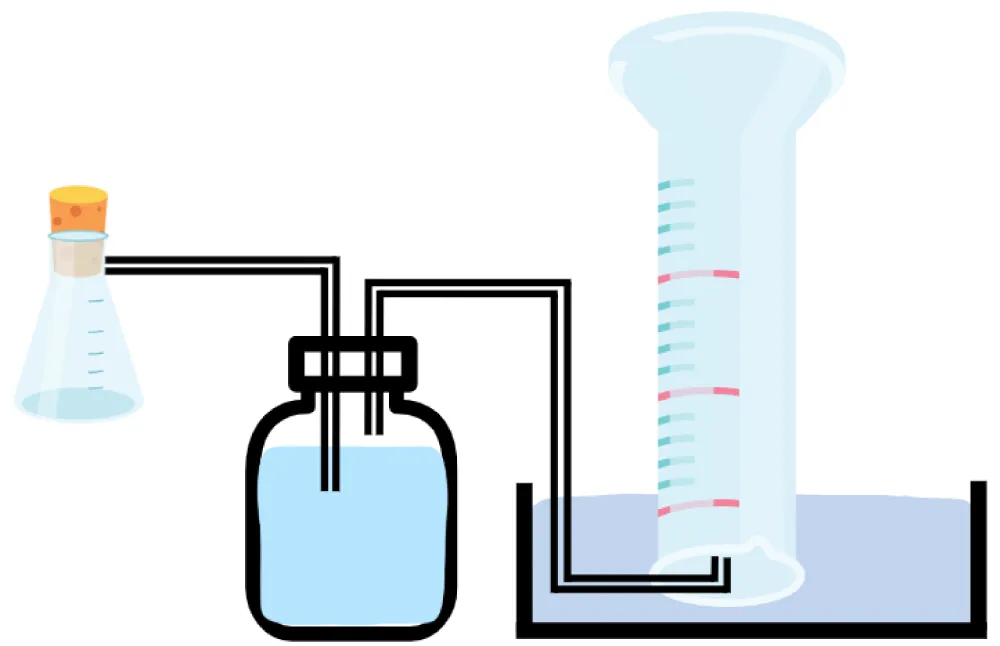
For each catalyst test, 3 g of aluminum hydroxide was mixed with 10 mL deionized water and stirred for 30 minutes. Then, 1 g of aluminum powder (0-40 µm) was added and the hydrogen evolution was recorded using water replacement method.
Results and Discussion
As shown in figures 1 & 2, X-ray Diffraction (XRD) was used to characterize the crystal structures of these catalysts. Distinct phase structure, bayerite, were observed depending on precursor and synthesis routes. Their performance on catalyzing hydrogen generation from Al/water reaction were shown in figure 3. Hydrogen evolution measurements revealed that aluminum hydroxide synthesized from sodium aluminate (Method A) exhibited high catalytic activity, followed by the reactivated aluminum hydroxide (Method E). The graphite-assisted sample (Method D) can further improve dispersion and slightly exceed the performance of Method A.
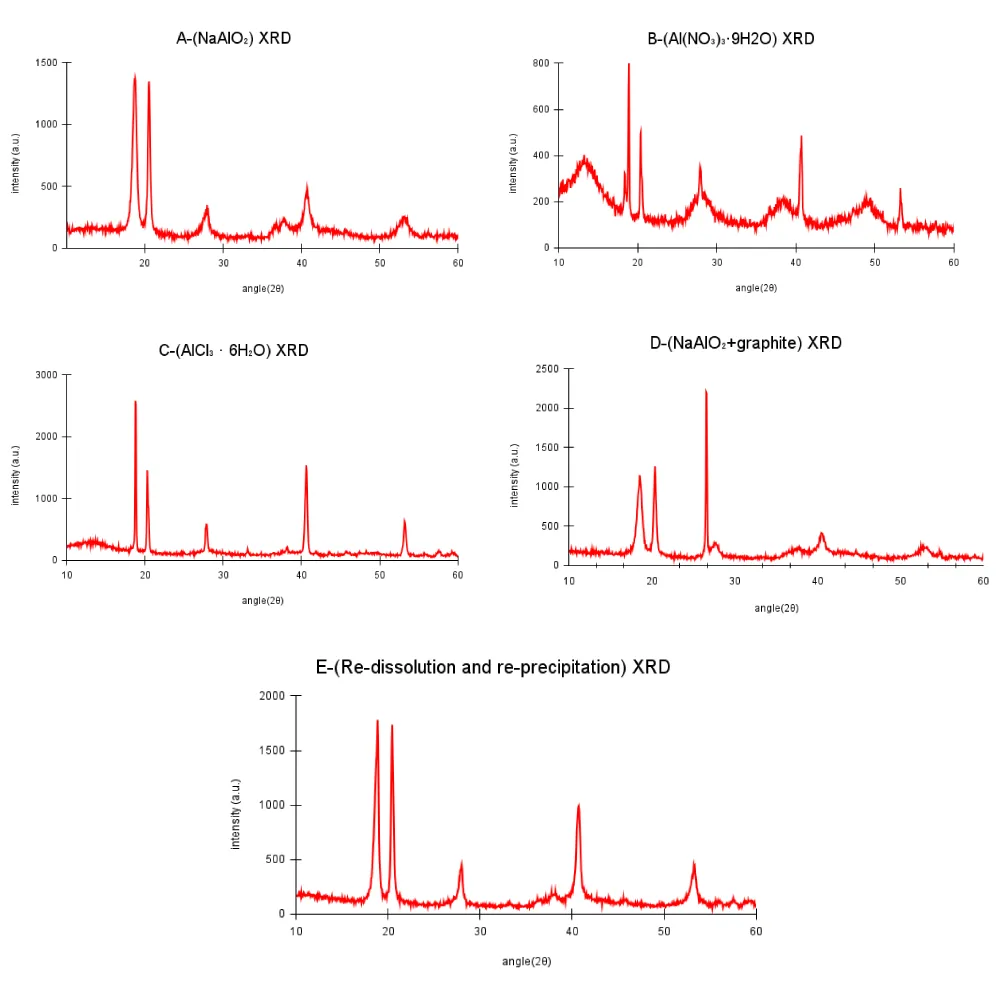
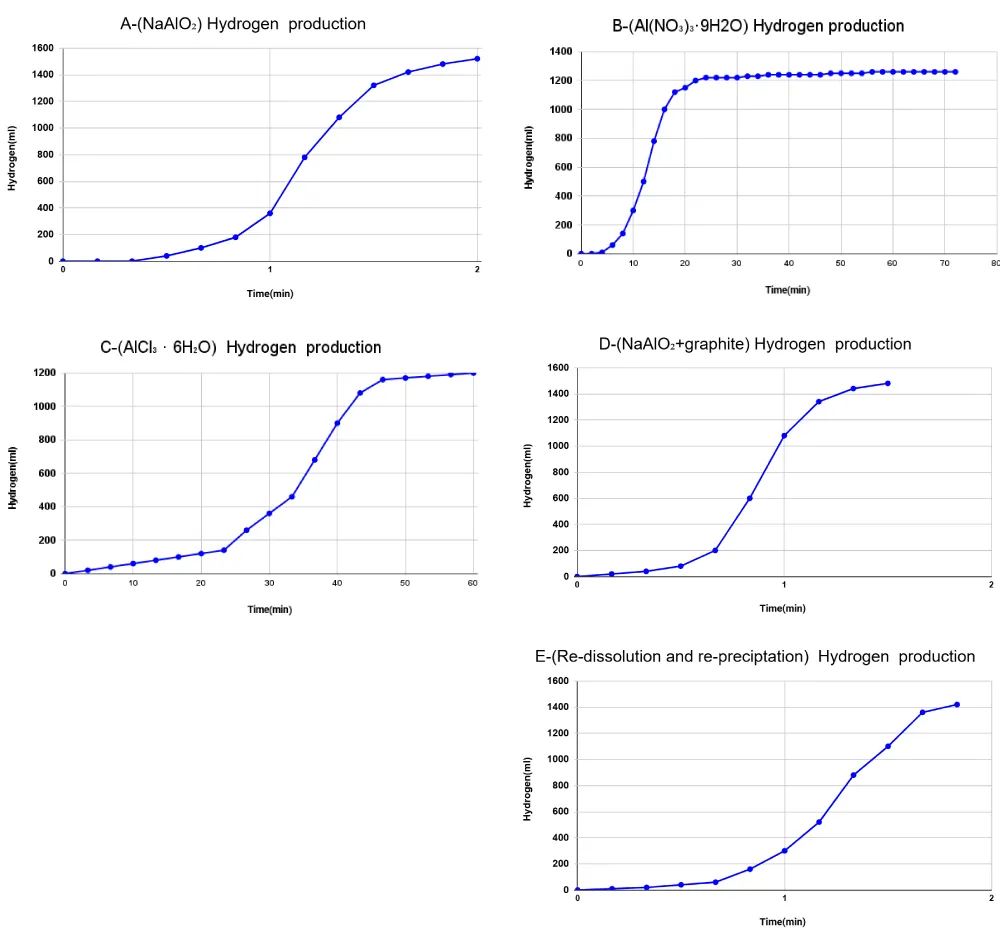
XRD results indicate that the aluminum hydroxide synthesized from the aluminum nitrate route (Method B) exhibits the lowest crystallinity, with broad and weak diffraction peaks characteristic of a highly amorphous structure. Such amorphous Al(OH)typically contains many structural defects and a high surface hydroxyl density, which can promote disruption of the passivating AlO layer on aluminum. However, despite its poor crystallinity, Method B did not produce the highest hydrogen generation efficiency. This suggests that crystallinity alone is not the determining factor, and the factors such as particle aggregation, morphology, and surface hydroxyl site distribution and accessibility also influence catalytic performance.
The lower performance of the highly amorphous Method B catalyst can be attributed to several interconnected structural factors beyond crystallinity. First, particle aggregation plays a critical role in determining effective catalyst-aluminum contact. While amorphous structures typically exhibit high surface hydroxyl density, excessive aggregation can significantly reduce the accessible surface area available for interaction with aluminum particles. Aggregated Al(OH)particles form densely packed clusters that limit water penetration and restrict the physical contact between hydroxyl sites and the aluminum oxide passivation layer. This aggregation phenomenon has been shown to substantially decrease catalytic efficiency even when the intrinsic surface chemistry remains favorable. In addition, hydroxyl site distribution and accessibility must be considered alongside total hydroxyl density. While amorphous structures contain abundant hydroxyl groups, these sites may not be optimally distributed or accessible if they are located within aggregated particle interiors rather than on exposed surfaces. The effectiveness of Al(OH)as a catalyst depends not merely on the presence of hydroxyl groups but on their spatial arrangement and availability to interact with the AlO passivation layer through ligand-exchange mechanisms.
In comparison, the sodium aluminate-derived sample (Method A) shows a moderate amorphous character with a more interconnected hydroxide structure, which appears to provide better contact with aluminum powder and therefore results in higher catalytic activity than Method B. The superior performance of Method A likely stems from an optimal combination of moderate crystallinity, favorable particle morphology, reduced aggregation, and improved surface accessibility that collectively enhance the catalyst-aluminum interfacial interaction.
Catalysts prepared from aluminum chloride (Methods C) showed sharper and more well-defined crystalline phases, suggesting more thermodynamically stable structures. These crystalline hydroxides tend to exhibit lower solubility in water and weaker interaction with aluminum surfaces, resulting in reduced catalytic efficiency. This behavior aligns with previous studies indicating that less crystalline or nano-structured aluminum hydroxides facilitate faster hydrogen generation due to increased reactivity of hydroxyl layers.
Meanwhile, the graphite-assisted sample (Method D) demonstrated enhanced hydrogen generation compared to Method A, suggesting that graphite improves catalyst dispersion and reduces particle agglomeration during reaction. Graphite may also serve as a conductive phase that accelerates micro-galvanic corrosion of aluminum, further enhancing hydrogen evolution. The addition of conductive graphite particles creates localized galvanic cells on the aluminum surface, where graphite acts as the cathode and aluminum as the anode in the electrochemical corrosion process. This galvanic coupling accelerates the dissolution of the aluminum oxide layer and promotes continuous exposure of fresh aluminum surfaces, thereby sustaining rapid hydrogen generation. Furthermore, graphite particles physically separate Al(OH) particles during synthesis, preventing excessive aggregation and maintaining high dispersion throughout the reaction, which contributes to the marginally superior performance of Method D over Method A. This is consistent with our previous publication [19].
The re-dissolution and re-precipitation method (Method E) produced a catalyst with improved performance relative to the untreated inactive Al(OH), confirming that structural activation through dissolution–recrystallization can regenerate reactive hydroxyl sites.
Figure 4 shows the SEM micrographs for Method A~E. The image of Method A shows aggregated nanosheets and irregularly stacked platelet structures, characteristic of partially crystalline bayerite. The loose and porous morphology suggests high interparticle voids, which enhance contact with aluminum powder and facilitate water diffusion during hydrogen evolution. The morphology is consistent with its strong catalytic activity. The aluminum nitrate sample (Method B) displays very fine, amorphous agglomerates with a dense and gel-like surface texture. The particles appear fused, forming compact aggregates, which may hinder water penetration and limit active surface exposure. This morphology aligns with the observed lower hydrogen generation efficiency. In Method C, the catalyst consists of relatively large, smooth crystallites indicative of a more ordered hydroxide phase. This compact morphology is less favorable for water permeation and catalytic activation of aluminum.
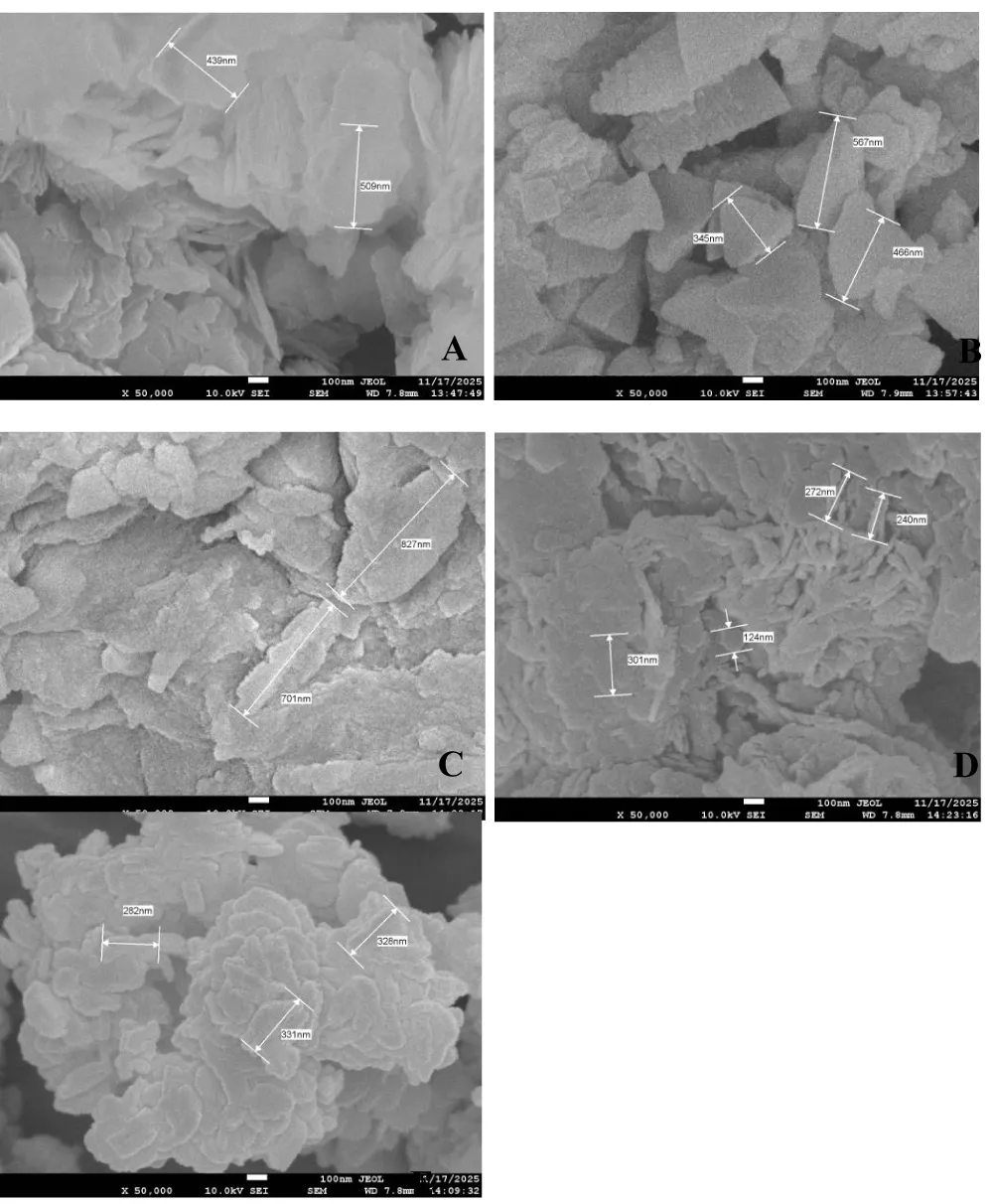
Method D exhibits a graphite-Al(OH)3 composite where dispersed hydroxide particles anchored on graphite flakes, exhibiting improved particle separation and reduced agglomeration compared with Method A. The graphite sheets provide a conductive scaffold that may enhance micro-galvanic effects and heat dissipation during reaction. This structural integration correlates with the slightly improved hydrogen evolution performance. Re-dissolution/re-precipitation (Method E) shows fine, loosely aggregated nanoparticles with a partially flocculent texture, reflecting re-nucleation after dissolution of inactive hydroxide. The regeneration process evidently restores active hydroxyl sites and surface heterogeneity beneficial for Al–HO reaction kinetics.
Overall, the observed trends highlight that both the chemical precursor and precipitation environment critically determine the final catalyst structure, which in turn governs its catalytic efficiency. The most active catalysts share common features: (1) partial crystallinity, (2) high surface area, and (3) strong interfacial interaction with aluminum particles.
Conclusion
This study demonstrates that the catalyst synthesis method significantly influences the hydrogen generation efficiency in the aluminum-water reaction. Among the tested synthesis procedures, the sodium aluminate precipitation method provided the most active aluminum hydroxide catalyst with high reproducibility. Further optimization of precipitation conditions, particle morphology, and catalyst activation could improve performance and broaden practical applications.
Acknowledgement
The authors are grateful for the support from the National Science and Technology Council, Taiwan, R.O.C. (NSTC 113-2622-M-033 -001).
References
- Woodall JM. Hydrogen fuel generation from solid aluminum. US Patent. 2008.
- Woodall JM. Power generation from solid aluminum. US Patent. 2008.
- Parmuzina AV, Kravchenko OV. Activation of aluminum metal to evolve hydrogen from water. Int J Hydrogen Energy. 2008;33:3073-6. doi: 10.1016/j.ijhydene.2008.02.025.
- Czech E, Troczynski T. Hydrogen generation through massive corrosion of deformed aluminum in water. Int J Hydrogen Energy. 2010;35:1029-37. doi:10.1016/j.ijhydene.2009.11.085.
- Alinejad B, Mahmoodi K. A novel method for generating hydrogen by hydrolysis of highly activated aluminum nanoparticles in pure water. Int J Hydrogen Energy 2009;34:7934-8. doi:10.1016/j.ijhydene.2009.07.028.
- Chaklader A. Hydrogen generation from water split reaction. US Patent. 2002.
- Deng ZY, Liu YF, Tanaka Y, Ye JH, Sakka Y. Modification of Al particle surfaces by γ-Al2O3 and Its effect on the corrosion behavior of Al. J Am Ceram Soc. 2005;88:977-9. doi: 10.1111/j.1551-2916.2005.00154.x.
- Deng ZY, Liu YF, Tanaka Y, Zhang HW, Ye JH, Kagwa Y. Temperature effect on hydrogen generation by the reaction of α-Al2O3-modified Al powder with distilled water. J Am Ceram Soc. 2005;88:2975-77. doi: 10.1111/j.1551-2916.2005.00534.x.
- Deng ZY, Ferreira JMF, Tanaka Y, Ye JH. Physicochemical mechanism for the continuous reaction of α-Al2O3 modified aluminum powder with water. J Am Ceram Soc. 2007;90:1521-26. doi: 10.1111/j.1551-2916.2007.01546.x.
- Yang Y, Gai WZ, Deng ZY, Zhou JG. Hydrogen generation by the reaction of Al with water promoted by an ultrasonically prepared Al(OH)3 suspension. Int J Hydrogen Energy. 2014;39:18734-42. doi: 10.1016/j.ijhydene.2014.09.085.
- Gai WZ, Zhang SH, Yang Y, Deng ZY. High activity AlOOH catalyzed Al hydrolysis for hydrogen generation. Sustain Energy Technol. 2020;38:100-676. doi: 10.1016/j.seta.2020.100676.
- Gai WZ, Deng ZY. Enhanced hydrogen production from Al-water reaction: Strategies, performances, mechanisms and applications. Renewable Energy. 2024;226:120-397. doi: 10.1016/j.renene.2024.120397.
- Wang HW, Chung HW, Teng HT, Cao G. Generation of hydrogen from aluminum and water - Effect of metal oxide nanocrystals and water quality. Inter J Hydrogen Energy. 2011;36:15136-44. doi: 10.1016/j.ijhydene.2011.08.077.
- Teng HT, Lee TY, Chen YK, Wang HW, Cao G. Effect of Al(OH)3 on the Generation of Hydrogen from the Aluminum-Water System. J Power Sources. 2012;219:16-21 doi: 10.1016/j.jpowsour.2012.06.077.
- Chen YK, Teng HT, Lee TY, Wang HW. Rapid hydrogen generation from aluminum-water system by adjusting water ratio to various aluminum/aluminum hydroxide. Inter J Energy Environ Eng. 2014. doi: 10.1007/s40095-014-0087-3.
- Wang HW, Chin MS. Rapid hydrogen generation from aluminum-water system using synthesized aluminum hydroxide catalyst. Inter J Chem Eng Appl. 2015;6:146-51. doi: 10.7763/IJCEA.2015.V6.470.
- Wen YC, Huang WM, Wang HW. Kinetics study on the generation of hydrogen from an aluminum/water system using synthesized Al(OH)3. Inter J Energy Research. 2018; 42:1615-24. doi: 10.1002/er.3955.
- Prabu S, Hsu SC, Lin JS, Wang HW. Rapid hydrogen generation from the reaction of aluminum powders and water using synthesized aluminum hydroxide catalysts. Topics in Catalysis. 2018;61:1633-40. doi: 10.1007/s11244-018-0970-x.
- Prabu S, Wang HW. Enhanced hydrogen generation from graphite-mixed aluminum hydroxides catalyzed Al/water reaction. Inter J Hydrogen Energy. 2020;45:33419-29. doi: 10.1016/j.ijhydene.2020.09.036.
- Prabu S, Wang HW. Hydrogen generation from the reaction of Al and H2O using a synthesized Al(OH)3 nanoparticle catalyst: The role of urea. Catalyst Sci Technol. 2021;11:4636-49 doi: 10.1039/D1CY00534K.
- Prabu S, Wang HW. Improved hydrogen generation from Al/water reaction using different synthesized Al(OH)3 catalyst crystalline phases. Inter J Ener Res. 2021;45:9518-29. doi: 10.1002/er.6478.
- Prabu S, Wang HW. Transition metal nanoparticles composite Al(OH)3 catalysts for hydrogen generation of Al/H2O system. J Taiwan Institute Chem Eng. 2023;145:104-771. doi: 10.1016/j.jtice.2023.104771.
- Chen YT, Huang, LY, Wang HW. Optimization of aluminum hydroxide catalyst for efficient hydrogen generation from aluminum-water reaction. International Journal of Hydrogen Energy. 2024;91:303-309. doi: 10.1016/j.ijhydene.2024.10.063.
- Gai WZ, Deng ZY, Enhanced hydrogen production from Al-water reaction: Strategies, performances, mechanisms and applications. Renewable Energy. 2024;226:120-397. doi: 10.1016/j.renene.2024.120397.
- Prabhsharan Kaur, Gaurav Verma, A critical assessment of aluminum-water reaction for on-site hydrogen-powered applications. Materials Today Energy. 2024;40:101-508. doi: 10.1016/j.mtener.2024.101508.
- Musicco N, Gelfi M, Iora P, Venturelli M, Artioli N, Montorsi L, Milani M. A review of hydrogen generation methods via aluminum and water reactions. International Journal of Thermofluids. 2025;27:101152. doi: 10.1016/j.ijft.2025.101152.




Content Alerts
SignUp to our
Content alerts.
 This work is licensed under a Creative Commons Attribution 4.0 International License.
