
2025 November 28;6(11):1756-1763. doi: 10.37871/jbres2227.
-
Subject area(s):

 |
|
 |
|
 |
|

 Research Article
Features of Vitamin D and Bone Metabolism in Patients with Cirrhosis of Non-Alcoholic and Non-Viral Etiology: Results of a Pilot Study
Gorbacheva AM1*, Spasskaya OY1, Lavreniuk AA1, Bibik EE1, Tikhonov IN2, Eremkina AK1, Khairieva AA1, Litvinova EE1 and Mokrysheva NG3
2N.V. Sklifosovsky Institute of Clinical Medicine of the I.M. Sechenov First Moscow State Medical University, Moscow, Russia
3Academician of the Russian Academy of Sciences, Russia
- liver cirrhosis
- Vitamin D
- Bone remodeling
- Parathyroid hormone
- Cancellous bone
Abstract
Background: Liver Cirrhosis (LC) is associated with significant bone metabolic disorders and an increased risk of fractures. While the problem is recognized, data on vitamin D metabolism and bone remodeling in patients with non-alcoholic and non-viral LC remain limited.
Aim: To conduct a comprehensive assessment of vitamin D metabolism and bone remodeling in patients with LC of non-viral and non-alcoholic etiology.
Patients and methods: A cross-sectional study included 25 patients with LC (cholestatic, autoimmune, or cryptogenic etiology) and 10 Healthy Volunteers (HV), comparable in age, sex, and BMI. All participants underwent blood sampling for analysis of vitamin D metabolites, PTH, calcium, phosphorus, bone turnover markers and IGF-1. Bone Mineral Density (BMD) was assessed by DXA, and bone microarchitecture was evaluated using the Trabecular Bone Score (TBS).
Results: Patients with LC had significantly lower levels of 25(OH)D (12.5 vs., 22.4 ng/mL, p = 0.036), PTH (26.0 vs., 37.6 pg/mL, p = 0.015), and IGF-1 (95 vs., 187 ng/mL, p = 0.010) compared to the HV group. While BMD values were comparable between groups, the TBS was significantly lower in the LC group (1.348 vs., 1.504, p = 0.004), indicating impaired bone microarchitecture. A positive correlation was found between TBS and 25(OH)D levels (R = 0.497).
Conclusion: Young patients with non-alcoholic, non-viral LC exhibit vitamin D deficiency and a lower TBS despite preserved BMD. The correlation between TBS and vitamin D underscores its potential role in bone quality. These findings highlight the need for extended diagnostics, including TBS assessment, for timely fracture risk detection in this patient population.
Introduction
Liver Cirrhosis (LC) is a socially significant disease associated with extremely severe complications, high rates of patient disability and mortality. In the structure of all causes of mortality, LC ranks 11th, and in the structure of morbidity – 15th. In 2016, LC was the cause of death in 2.2% of all deceased people; in 2017, Chronic Liver Diseases (CLD) led to 1.32 million deaths. A significant shift in the etiology of liver cirrhosis has been observed. The contribution of alcoholic liver disease and Metabolic Dysfunction-Associated Fatty Liver Disease (MAFLD) is increasing, steadily surpassing the historical dominance of viral hepatitis, a trend closely linked to the growing obesity epidemic [1]. According to the results of the Global Burden of Disease Study-2017, mortality from LC in Russia increased from 9.6 to 24.3/100 thousand population between 1990 and 2017 [2].
It is known that the liver is one of the key organs involved in mineral homeostasis. Moreover, an important stage of vitamin D metabolism occurs in the liver: hydroxylation and the formation of 25-hydroxyvitamin D (its main circulating form). Also, the synthesis of transport proteins, such as albumin and vitamin D-binding protein, occurs in the liver. All this, combined with impaired protein-synthetic function and reduced excretion of bile acids (and consequently, the absorption of fat-soluble vitamins and other nutrients), can cause various mineral and bone disorders in LC. Indeed, chronic liver failure is closely associated with bone pathology [3], the prevalence of osteoporosis among patients with LC reaches 12-55%, which significantly exceeds population rates [4]. Moreover, up to 40% of patients with CLD experience fractures of various locations [5,6]. Many studies have shown a high prevalence of vitamin D deficiency/insufficiency (in its native form) among patients with CLD; however, data on the frequency of secondary hyperparathyroidism are highly variable. Data on the vitamin D metabolites in patients with LC are lacking.
Thus, although the problem of mineral metabolism in patients with LC has long been known, information on the pathogenesis of these disorders (in particular, the metabolism of vitamin D, the state of bone tissue and the parathyroid glands) is currently extremely limited. The predictors of such disorders remain unknown, as well as optimal approaches to the treatment and prevention of mineral disorders in patients with LC have not been developed. In the guidelines of most professional endocrinological societies, CLD is considered as a secondary cause of mineral disorders (only osteoporosis) primarily from the perspective of malabsorption, which does not reflect the full clinical picture[7,8]. At the same time, pathogenetic factors in alcoholic and viral LC have an independent influence on mineral metabolism [9], which does not allow them to be extrapolated to LC of other etiologies.
In this regard, the aim of this pilot study was a comprehensive assessment of vitamin D metabolism and bone remodeling in patients with LC of non-viral and non-alcoholic etiology.
Patients and Methods
A cross-sectional study was conducted at the Endocrinology Research Centre, Moscow, Russian Federation in 2024-2025. Two groups were formed: a group of patients with liver cirrhosis (p) and a comparison group consisting of relatively Healthy Volunteers (HV).
The p group included men aged 18 to 50 years and women aged 18 years and older with preserved menstrual function; patients had a confirmed diagnosis of LC of cholestatic, autoimmune, or other etiology, excluding alcohol and viruses, with known liver function tests (ALT, AST, total bilirubin, total protein) within 1 month.
The diagnosis of LC was made on a clinical basis by a consulting gastroenterologist. It was grounded in a combination of clinical signs, laboratory abnormalities, and imaging features suggestive of portal hypertension and hepatic synthetic dysfunction, as per the current Russian clinical guidelines.
The HV group included men aged 18 to 50 years and women aged 18 years and older with preserved menstrual function; participants did not have CLD of any etiology (based on clinical, laboratory, instrumental, and morphological signs); there was fully information on liver function tests (ALT, AST, total bilirubin, total blood protein) within 1 month.
All participants signed voluntary informed consent to participate in the study.
The exclusion criteria included: individuals with alcohol-associated LC and/or consuming 3 or more units of alcohol per day (1 unit = 8-10 g of pure alcohol); those with viral hepatitis in the active stage of the disease or in their medical history; those with a glomerular filtration rate of less than 60 ml/min/1.73 m² according to the CKD-EPI formula; those taking drugs affecting bone-mineral metabolism, namely estrogen, testosterone, progesterone drugs, anti-osteoporotic drugs (bisphosphonates, denosumab, teriparatide), active vitamin D metabolites (alfacalcidol, calcitriol), tenofovir disoproxil fumarate, thiazide diuretics, glucocorticosteroids; those with diabetes mellitus of any type, body mass index ≥ 35 kg/m² ;a history of malignant tumors, PTH-independent hypercalcemia, sarcoidosis and other granulomatous diseases, congenital lactase deficiency, surgical interventions on the neck organs, immobilization, uncompensated adrenal insufficiency, uncompensated thyrotoxicosis, a history of known primary hyperparathyroidism, hypoparathyroidism, hypercortisolism of any etiology; pregnancy and lactation at the moment of this study.
Individuals who refused to continue participation in the study were also excluded.
This was a cross-sectional study with a single visit. All participants underwent anthropometry, blood sampling, radiography of the thoracic and lumbar spine (Optima RF420, GE Healthcare, Japan) and X-ray densitometry (Dual Energy X-Ray Absorptiometry, DEXA) of the lumbar spine, femur, and radius (Lunar iDXA, GE Healthcare, Japan). Additionally, Trabecular Bone Score (TBS) was assessed. It is a texture index derived from standard lumbar spine DEXA images that provides information about bone microarchitecture.
Blood samples were analyzed for serum concentrations of vitamin D metabolites (25(OH)D, 1,25(OH)2D, 24,25(OH)2D, 3-epi-25(OH)D) by high-performance liquid chromatography combined with tandem mass spectrometry (HPLC-MS/MS); PTH, osteocalcin, C-terminal telopeptide of type I collagen by electrochemiluminescent immunoassay (Cobas, Roche); ionized calcium, total calcium, albumin, phosphorus, magnesium, alkaline phosphatase (ARCHITECT c8000, Abbott); TSH by immunochemiluminescent assay (ARCHITECT, Abbott); IGF-1 was determined by immunochemiluminescent assay (Liaison, Diasorin).
The quantification of vitamin D metabolites was performed using a validated in-house HPLC-MS/MS method. The laboratory successfully participated in the Vitamin D External Quality Assessment Scheme (DEQAS). Serum sample 300 µL was spiked with deuterated internal standards (25(OH)D3-d6, 1,25(OH)2D3-d6, 3-epi-25(OH)D3-d3, 24,25(OH)2D3-d6). Proteins were precipitated using zinc sulfate and methanol. The supernatant was subjected to Solid-Phase Extraction (SPE) on Agilent Bond Elut C18 cartridges. The extracted analytes were derivatized with PTAD (4-phenyl-1,2,4-triazoline-3,5-dione) to enhance sensitivity. Chromatographic separation was achieved on a Waters Acquity UPLC HSS T3 column (2.1 × 100 mm, 1.8 µm) with a gradient of acetonitrile, methanol, and 0.1% aqueous formic acid. Detection was carried out on an AB Sciex Triple Quad 5500 mass spectrometer in Multiple Reaction Monitoring (MRM) mode.
Statistical analysis was performed in the Statistica 13 software package (TIBCO Software Inc., USA). Descriptive statistics for quantitative indicators are presented as medians, first and third quartiles in the form of Me [Q1;Q3]. Descriptive statistics for qualitative indicators are presented as absolute and relative frequencies. Comparison of independent groups for quantitative data was performed using the two-tailed Fisher's test. Correlation analysis was performed using Spearman's rank correlation coefficient.
Results
The p group included 25 patients (13 men and 12 women, age 36 [25;42] years), the HV group included 10 volunteers (5 men and 5 women, age 33 [25;39] years). The groups were comparable in sex (p = 1.000, two-sided Fisher's test), age (p = 0.812, U-test). The median BMI in the p group was 23.3 [20.9;25.6] kg/m², in the HV - 23.4 [22.4;26.3] kg/m² (p = 0.701, U-test).
In the p group, the causes of the underlying disease were as follows: primary sclerosing cholangitis in 9 (36%) patients, primary biliary cholangitis - in 4 (16%), Wilson's disease - in 4 (16%), autoimmune hepatitis - in 2 (8%), and cryptogenic LC - in 6 (24%). The median concentrations of ALT in the p group were 58 [25;93] U/L, AST 73 [42;107] U/L, total bilirubin 24 [20;46] µmol/L, direct bilirubin 8 [5;19] µmol/L, gamma-glutamyl transferase 107 [57;159] U/L, total protein 72 [67;77] g/L, platelets 116*109/l [86;208].
A comparative description of the two groups according to the main assessed parameters of mineral metabolism is presented in table 1.
| Table 1: Comparative characteristics of mineral metabolism parameters in the p and HV groups. | ||||
| Parameter, Units of Measurement | Reference Range | p Group, Me [Q1;Q3] | HV Group, Me [Q1;Q3] | p, U-test |
| Total Ca, mmol/L | 2.15-2.55 | 2.25 [2.18;2.33] | 2.43 [2.35;2.49] | 0.002 |
| Albumin, g/L | 35-50 | 40 [37;43] | 46 [45;48] | 0.000 |
| Corrected Ca, mmol/L | 2.15-2.55 | 2.25 [2.17;2.17] | 2.29 [2.26;2.30] | 0.352 |
| Ionized Ca, mmol/L | 1.03-1.29 | 1.07 [1.03;1.1] | 1.11 [1.09;1.15] | 0.053 |
| Phosphorus, mmol/L | 0.74-1.52 | 1.15 [1.03;1.26] | 1.21 [1.04;1.33] | 0.499 |
| Magnesium, mmol/L | 0.66-1.07 | 0.80 [0.75;0.83] | 0.80 [0.74;0.83] | 0.956 |
| Alkaline Phosphatase, U/L | 40-150 | 158 [94;250] | 52 [40;56] | 0.000 |
| Osteocalcin, ng/mL | 14.0-46.0 | 19.2 [16.8;21.1] | 22.3 [17.9;25.7] | 0.511 |
| CTX, ng/mL | 0.10-0.85 | 0.42 [0.35;0.59] | 0.48 [0.34;0.57] | 0.985 |
| TSH, mIU/L | 0.25-3.50 | 1.35 [1.04;2.67] | 1.54 [1.29;2.05] | 0.499 |
| PTH, pg/mL | 15.0-65.0 | 26.0 [20.9;43.5] | 37.6 [34.2;50.1] | 0.015 |
| IGF-1, ng/mL | 62-230 | 95 [61;151] | 187 [131;236] | 0.010 |
| 25(OH)D3, ng/mL | 20.0-60.0 | 12.2 [7.8;20.6] | 22.1 [16.7;34.1] | 0.036 |
| 25(OH)D2, ng/mL | 20.0-60.0 | 0.5 [0.5;0.5] | 0.3 [0.2;0.4] | 0.005 |
| 25(OH)D, ng/mL | 20.0-60.0 | 12.5 [8.3;21.1] | 22.4 [16.9;34.4] | 0.036 |
| 3-epi 25(OH)D3, ng/mL | 1.0-10.0 | 1.0 [0.8;1.6] | 0.9 [0.7;1.38] | 0.401 |
| 24,25(OH)2 D3, ng/mL | 0.5-5.6 | 0.5 [0.3;1.2] | 1.3 [0.7;2.4] | 0.108 |
| 25(OH)D3/24,25(OH)2 D3, ng/mL | 7.0-25.0 | 23.3 [15.6;30.3] | 17.9 [17.4;25.1] | 0.729 |
| 1,25(OH)2 D3, pg/mL | 18.0-64.0 | 18.7 [15.2;25.0] | 19.3 [18.1;23.3] | 0.333 |
| 25(OH)D3/1,25(OH)2D3 | - | 0.69 [0.51;0.88] | 0.95 [0.83;1.42] | 0.050 |
Hypocalcemia (based on corrected Ca) was observed in 1 patient in the p group, but in none of the patients in the HV group. This difference was not statistically significant (p = 1.000; two-sided Fisher's exact test). A similar pattern was observed for both total and ionized calcium.
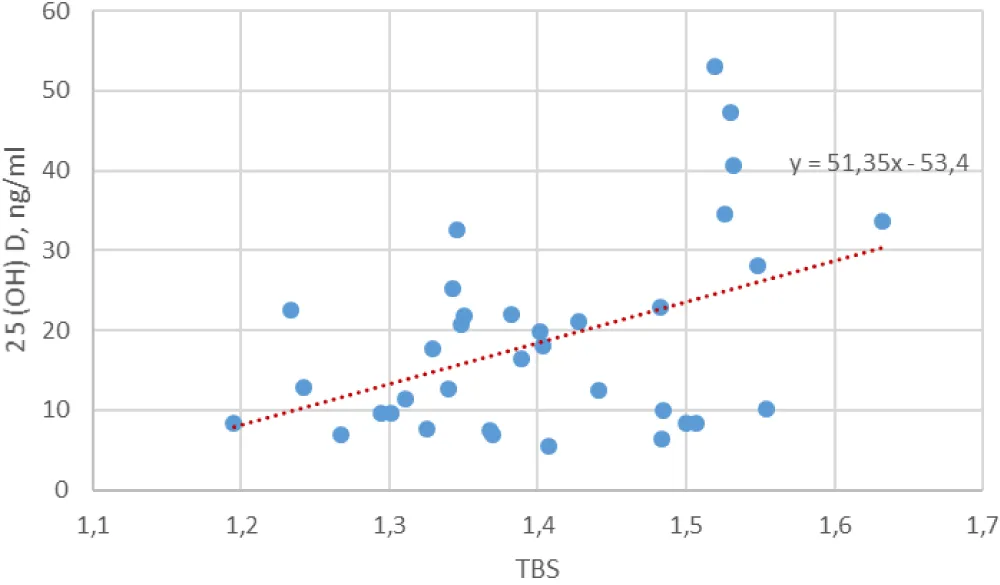
The state of bone mineral density was assessed separately; no significant differences were found between the study groups either by Z-score or by absolute BMD values. No significant differences were found in the frequency of BMD decrease ≤ 2.0 SD at each study site separately. The results are presented in table 2. At the same time, the TBS value in the P group was significantly lower than in the HV group. Furthermore, in 3 patients with LC (12%), a decrease in the height of the vertebrae of up to 20% was noted by radiography; no such changes were found in any participant in the comparison group. However, these differences were not statistically significant (p = 0.541; two-sided Fisher's test). A correlation analysis was performed, which revealed a statistically significant moderate positive correlation between TBS and the concentration of 25(OH)D (R = 0.002; Spearman's correlation coefficient R = 0.497, 95% CI 0.215-0.704). The results are presented graphically in figure 1.
| Table 2: Comparative characteristics of bone mineral density in the p and HV groups. | ||||||
| Parameter | p Group | HV Group | p, U-test (for absolute values) | p, Fisher's test (for absolute values) | ||
| Me [Q1;Q3] | n (%) of individuals with a BMD ≤ 2.0 SD | Me [Q1;Q3] | n (%) of individuals with a BMD ≤ 2.0 SD | |||
| Z-score, L1-L4 | -0.9 [-1.5;-0.2] | 3 (12%) | -0.3 [-0.93;0.3] | 0 (0%) | 0.090 | 0.545 |
| BMD L1-L4, g/cm² | 1.074 [1.000;1.190] | - | 1.165 [1.133;1.196] | - | 0.077 | - |
| Z-score, L1 | -1.1 [-2.0;-0.5] | 7 (28%) | -0.4 [-1.4;-0.1] | 0 (0%) | 0.154 | 0.084 |
| BMD L1, g/cm² | 1.000 [0.943;1.073] | - | 1.085 [0.997;1.114] | - | 0.080 | - |
| Z-score, L2 | -1.1 [-1.8;-0.2] | 3 (12%) | -0.4 [-1.0;0.0] | 0 (0%) | 0.083 | 0.545 |
| BMD L2, g/cm² | 1.077 [0.986;1.225] | - | 1.187 [1.127;1.217] | - | 0.171 | - |
| Z-score, L3 | -0.8 [-1.3;0.3] | 3 (12%) | 0.1 [-0.6;0.8] | 0 (0%) | 0.083 | 0.545 |
| BMD L3, g/cm² | 1.115 [1.035;1.270] | - | 1.229 [1.179;1.243] | - | 0.083 | - |
| Z-score, L4 | -1.3 [-1.9;0.0] | 6 (24%) | -0.2 [-1.0;0.1] | 2 (20%) | 0.290 | 1.000 |
| BMD L4, g/cm² | 1.071 [1.006;1.231] | - | 1.160 [1.086;1.241] | - | 0.189 | - |
| Z-score, femur neck | -0.4 [-1.1;0.4] | 2(8%) | -0.3 [-0.5;0.1] | 0 (0%) | 0.465 | 1.000 |
| BMD, femur neck, g/cm² | 0.985 [0.839;1.053] | - | 0.988 [0.975;1.080] | - | 0.391 | - |
| Z-score, femur total | -0.4 [-1.1;0.2] | 3 (12%) | -0.3 [-0.8;0.4] | 0 (0%) | 0.401 | 0.545 |
| BMD, femur total, g/cm² | 0.984 [0.798;1.092] | - | 1.024 [0.952;1.077] | - | 0.250 | - |
| Z-score, radius 33% | -0.2 [-0.7;0.5] | 1 (4%) | -0.6 [-0.8;-0.1] | 0 (0%) | 0.306 | 1.000 |
| BMD, radius 33%, g/cm² | 0.884 [0.844;0.950] | - | 0.897 [0.867;0.919] | - | 0.865 | - |
| Z-score, radius total | -0.4 [-0.9;0.3] | 1 (4%) | -0.1 [-0.8;0.1] | 0 (0%) | 0.948 | 1.000 |
| BMD, radius total, g/cm² | 0.687 [0.620;0.725] | - | 0.700 [0.679;0.739] | - | 0.473 | - |
| TBS L1-L4 | 1.348 [1.311;1.428] | - | 1.504 [1.423;1.524] | - | 0.004 | - |
Discussion
The P group had a number of differences in laboratory parameters of mineral metabolism. First of all, lower concentrations of total Ca and ionized Ca in the p group are noteworthy, while the concentrations of corrected Ca were comparable in both groups.
Measurement of ionized calcium (Ca²) is considered the most accurate method for assessing calcemia but is technically challenging due to strict preanalytical requirements [10,11]. While total calcium concentration is a common alternative, its levels are influenced by plasma proteins, limiting its diagnostic value in hypo- or hyperproteinemia [12,13]. Consequently, correction formulas like Payne's used here and recommended by guidelines[14,15], have been developed. Their utility in hypoproteinemic conditions (e.g., liver cirrhosis) remains debatable. Our data revealed a difference in total calcium between the p and LC groups, which was not observed with albumin-corrected calcium or ionized calcium. This discrepancy warrants further verification, as the choice of diagnostic method can impact patient management strategies.
The lower concentrations of PTH and IGF-1 in patients with LC are noteworthy. IGF-1 is produced in the liver [16], which explains the decrease in its production in LC. At the same time, it should be considered that this factor has an important anabolic effect on bone tissue [17]. PTH synthesis occurs exclusively in the parathyroid glands; however, there is a limited pool of data on its metabolism in the liver [18,19]. Nevertheless, a decrease in its degradation in the liver in LC should, on the contrary, lead to higher plasma concentrations.
As expected, an increase in ALP concentration was noted in the P group, due to the development of intrahepatic cholestasis [20]; however, ALP is also produced by bone tissue and is a marker of active bone remodeling [21]. To clarify the contribution of bone tissue to the ALP concentration, it is necessary to evaluate its bone-specific fractions. These further studies may allow determining the high- or low-turnover type of bone tissue changes in LC.
In both the P and HV groups, the concentrations of 25(OH)D did not reach normal values; however, deficiency was observed in the P group, and insufficiency in the HV group. Most likely, this is due to malnutrition and malabsorption, which are characteristic manifestations of LC [22]. Identical concentrations of vitamin D metabolites, in turn, indicate the preservation of functional regulatory mechanisms that ensure target concentrations of its active forms in LC.
An interesting result is the lower TBS values in the p group, despite comparable parameters of standard densitometry. TBS allows assessing the quality of trabecular bone tissue, it reflects not the degree of bone tissue mineralization, but the quality of its microarchitecture [23]. The TBS value is also associated with the risk of vertebral compression fractures, which may potentionally explain the decrease in the height of the vertebrae of up to 20% only in p group [24].
The data obtained in this study may indicate structural disorders of bone tissue even in young patients with LC without other risk factors, which emphasizes the importance of in-depth diagnostics for identifying risk groups. The results of the correlation analysis confirm the importance of replenishing vitamin D deficiency for bone formation [25]. The longitudinal controlled study by Benetti A, et al. [26], concluded that in the context of adequate calcium and vitamin D intake, cholestasis was not a significant independent risk factor for reduced bone mineral density in patients with well-compensated primary biliary cirrhosis.
This study has a number of limitations, largely related to its pilot nature. The main limitation is the small sample size with a large number of analyzed parameters, which reduces the level of statistical reliability of the results. Also, despite strict group selection criteria, the genesis of liver cirrhosis still differed, which could have left a certain imprint on the study results.
Conclusion
The conducted study revealed complex changes in mineral metabolism in patients with liver cirrhosis, including vitamin D deficiency, lower calcium levels, and decreased PTH concentration compared to the healthy control group. Young patients with liver cirrhosis of non-alcoholic and non-viral etiology are characterized by deterioration of bone microarchitecture (decreased TBS) with Preserved Mineral Density (PMD). The discovered positive correlation between TBS and vitamin D level emphasizes the importance of correcting the latter's concentrations. The obtained data demonstrate the need for extended diagnostics, including TBS, for the timely detection of fracture risk in this category of patients.
Conflict of interest
Authors declare no conflict of interest.
Funding
This work was supported by the Russian Science Foundation (RSF), grant number 24-25-00348, "Disorders of vitamin D metabolism and features of bone remodeling in patients with liver cirrhosis of various etiologies."
References
- Cheemerla S, Balakrishnan M. Global epidemiology of chronic liver disease. Clin Liver Dis (Hoboken). 2021 Jun 4;17(5):365-370. doi: 10.1002/cld.1061. PMID: 34136143; PMCID: PMC8177826.
- GBD 2017 Cirrhosis Collaborators. The global, regional, and national burden of cirrhosis by cause in 195 countries and territories, 1990-2017: a systematic analysis for the Global Burden of Disease Study 2017. Lancet Gastroenterol Hepatol. 2020 Mar;5(3):245-266. doi: 10.1016/S2468-1253(19)30349-8. Epub 2020 Jan 22. PMID: 31981519; PMCID: PMC7026710.
- Zheng JP, Miao HX, Zheng SW, Liu WL, Chen CQ, Zhong HB, Li SF, Fang YP, Sun CH. Risk factors for osteoporosis in liver cirrhosis patients measured by transient elastography. Medicine (Baltimore). 2018 May;97(20):e10645. doi: 10.1097/MD.0000000000010645. PMID: 29768330; PMCID: PMC5976349.
- Patel N, Muñoz SJ. Bone disease in cirrhosis. Clin Liver Dis (Hoboken). 2015 Oct 28;6(4):96-99. doi: 10.1002/cld.498. PMID: 31040999; PMCID: PMC6490654.
- Nakchbandi IA. Osteoporosis and fractures in liver disease: relevance, pathogenesis and therapeutic implications. World J Gastroenterol. 2014 Jul 28;20(28):9427-38. doi: 10.3748/wjg.v20.i28.9427. PMID: 25071337; PMCID: PMC4110574.
- Compston JE, McClung MR, Leslie WD. Osteoporosis. Lancet. 2019 Jan 26;393(10169):364-376. doi: 10.1016/S0140-6736(18)32112-3. PMID: 30696576.
- Arceo-Mendoza RM, Camacho PM. Postmenopausal Osteoporosis: Latest Guidelines. Endocrinol Metab Clin North Am. 2021 Jun;50(2):167-178. doi: 10.1016/j.ecl.2021.03.009. PMID: 34023036.
- Eastell R, Rosen CJ, Black DM, Cheung AM, Murad MH, Shoback D. Pharmacological Management of osteoporosis in postmenopausal women: An endocrine society* Clinical Practice Guideline. J Clin Endocrinol Metab. 2019 May 1;104(5):1595-1622. doi: 10.1210/jc.2019-00221. PMID: 30907953.
- Gorbacheva AM, Bibik EE, Lavreniuk AA, Eremkina AK, Tikhonov IN, Mokrysheva NG. Mineral disorders in patients with chronic liver disease. Part 1: Epidemiology and pathophysiology. Obes Metab. 2024;21(4):373-381. doi: 10.14341/omet13124.
- Boink ABTJ, Buckley BM, Christiansen TF, Andersen NF, Külpmann WR, Lewenstam A, Maas AHJ, Plathe OM, Sachs C, Andersen OS, VanKessel AL, Zijlstra WG. IFCC recommendation on sampling, transport and storage for the determinationof the concentration of ionized calcium in whole blood, plasma and serum. J Anal Methods Chem. 1991;13(5):235-239. doi: 10.1155/S1463924691000391.
- Grzych G, Roland E, Beauvais D, Maboudou P, Lippi G. Leukocytosis interference in clinical chemistry: shall we still interpret test results without hematological data? J Med Biochem. 2019;0(0). doi: 10.2478/jomb-2019-0005.
- Orrell DH. Albumin as an aid to the interpretation of serum calcium. Clin Chim Acta. 1971 Dec;35(2):483-9. doi: 10.1016/0009-8981(71)90224-5. PMID: 5125334.
- Mamedova EO, Golounina OO, Belaya ZE. [Albumin adjustment of total serum calcium - is it worth doing?]. Probl Endokrinol (Mosk). 2024 Nov 13;70(6):45-61. Russian. doi: 10.14341/probl13503. PMID: 39868447; PMCID: PMC11775680.
- Dedov II, Melnichenko GA, Mokrysheva NG, Andreeva EN, Antsiferov MB, Beltsevich DG, Bibik EE, Gorbacheva AM, Degtyarev MV, Yeghshatyan LV, Eremkina AK, Karonova TL, Kim IV, Krupinova JA, Kryukova IV, Kuznetsov NS, Lukyanov SV, Mamedova EO, Markina NV, Mirnaya SS, Pigarova EA, Rozhinskaya LYa, Slashchuk KYu, Sleptsov IV, Chagai NB. Draft of clinical guidelines for the diagnosis and treatment of primary hyperparathyroidism in adult patients. Endocr Surg. 2023;16(4):5-54. doi: 10.14341/serg12790.
- Bilezikian JP, Khan AA, Silverberg SJ, El-Hajj Fuleihan G, Marcocci C, Minisola S, Perrier N, Sitges-Serra A, Thakker RV, Guyatt G, Mannstadt M, Potts JT, Clarke BL, Brandi ML. Evaluation and management of primary hyperparathyroidism: Summary statement and guidelines from the fifth international workshop. J Bone Miner Res. 2020;37(11):2293-2314. doi: 10.1002/jbmr.4677.
- Adamek A, Kasprzak A. Insulin-like growth factor (igf) system in liver diseases. Int J Mol Sci. 2018 Apr 27;19(5):1308. doi: 10.3390/ijms19051308. PMID: 29702590; PMCID: PMC5983723.
- Fang J, Zhang X, Chen X, Wang Z, Zheng S, Cheng Y, Liu S, Hao L. The role of insulin-like growth factor-1 in bone remodeling: A review. Int J Biol Macromol. 2023 May 31;238:124125. doi: 10.1016/j.ijbiomac.2023.124125. Epub 2023 Mar 21. PMID: 36948334.
- Corvilain J, Manderlier T, Struyven J, Fuss M, Bergans A, Nijs N, Brauman H. Metabolism of human PTH by the kidney and the liver. Horm Metab Res. 1977 May;9(3):239-42. doi: 10.1055/s-0028-1093545. PMID: 885478.
- Martin K, Hruska K, Greenwalt A, Klahr S, Slatopolsky E. Selective uptake of intact parathyroid hormone by the liver: differences between hepatic and renal uptake. J Clin Invest. 1976 Oct;58(4):781-8. doi: 10.1172/JCI108529. PMID: 965485; PMCID: PMC333239.
- Lammers WJ, van Buuren HR, Hirschfield GM, Janssen HL, Invernizzi P, Mason AL, Ponsioen CY, Floreani A, Corpechot C, Mayo MJ, Battezzati PM, Parés A, Nevens F, Burroughs AK, Kowdley KV, Trivedi PJ, Kumagi T, Cheung A, Lleo A, Imam MH, Boonstra K, Cazzagon N, Franceschet I, Poupon R, Caballeria L, Pieri G, Kanwar PS, Lindor KD, Hansen BE; Global PBC Study Group. Levels of alkaline phosphatase and bilirubin are surrogate end points of outcomes of patients with primary biliary cirrhosis: an international follow-up study. Gastroenterology. 2014 Dec;147(6):1338-49.e5; quiz e15. doi: 10.1053/j.gastro.2014.08.029. Epub 2014 Aug 23. PMID: 25160979.
- Chen R, Gong K, Chen W, Chen Z, Hua X, Tan J, Tian Y, Liu D, Zhang L, Tang Y, Li Y, Zhou S. Association of serum alkaline phosphatase levels with bone mineral density, osteoporosis prevalence, and mortality in US adults with osteoporosis: evidence from NHANES 2005-2018. Osteoporos Int. 2025 Feb;36(2):283-297. doi: 10.1007/s00198-024-07324-w. Epub 2024 Nov 29. PMID: 39611944.
- Klein GL, Soriano H, Shulman RJ, Levy M, Jones G, Langman CB. Hepatic osteodystrophy in chronic cholestasis: evidence for a multifactorial etiology. Pediatr Transplant. 2002 Apr;6(2):136-40. doi: 10.1034/j.1399-3046.2002.01060.x. PMID: 12000470.
- Al-Hashimi L, Klotsche J, Ohrndorf S, Gaber T, Hoff P. Trabecular bone score significantly influences treatment decisions in secondary osteoporosis. J Clin Med. 2023 Jun 20;12(12):4147. doi: 10.3390/jcm12124147. PMID: 37373840; PMCID: PMC10299520.
- Schousboe JT, Vo TN, Langsetmo L, Taylor BC, Cawthon PM, Schwartz AV, Bauer DC, Orwoll ES, Lane NE, Barrett-Connor E, Ensrud KE; Osteoporotic Fractures in Men (MrOS) Study Research Group. Association of Trabecular Bone Score (TBS) With Incident Clinical and Radiographic Vertebral Fractures Adjusted for Lumbar Spine BMD in Older Men: A Prospective Cohort Study. J Bone Miner Res. 2017 Jul;32(7):1554-1558. doi: 10.1002/jbmr.3130. Epub 2017 Apr 7. PMID: 28300346; PMCID: PMC5489355.
- Yang SW, Lin YJ, Cheng YW, Chen YY, Chen WL. Unraveling the relationship between serum 25‑hydroxyvitamin d levels and trabecular bone score in american adults. Pol Arch Intern Med. 2022 Oct 21;132(10):16311. doi: 10.20452/pamw.16311. Epub 2022 Aug 4. PMID: 35929842.
- Benetti A, Crosignani A, Varenna M, Giussani CS, Allocca M, Zuin M, Podda M, Battezzati PM. Primary biliary cirrhosis is not an additional risk factor for bone loss in women receiving regular calcium and vitamin D supplementation: a controlled longitudinal study. J Clin Gastroenterol. 2008 Mar;42(3):306-11. doi: 10.1097/01.mcg.0000248017.31386.39. PMID: 18223492.




Content Alerts
SignUp to our
Content alerts.
 This work is licensed under a Creative Commons Attribution 4.0 International License.
