
2025 November 08;6(11):1655-1661. doi: 10.37871/jbres2218.
-
Subject area(s):

 |
|
 |
|
 |
|

 Research Article
Refluward® HA: Efficacy and Safety in Patients with Gastro-Esophageal Diseases
Mancheño Ferreras R1, Di Maio U2 and Cerciello A3*
2Shedir Pharma Group SPA, Via Bagnulo, Piano di Sorrento (NA), Italy
3Neilos SRL, Via Bagnulo, Piano di Sorrento (NA), Italy
- Gastro-esophageal reflux
- Hiatal hernia
- Tertiary oesophageal contractions
- Reflux esophagitis
Abstract
The physiological activity of stomach and esophagus is often impaired by the onset of various diseases such as Gastroesophageal Reflux Disease (GERD), esophagitis, hiatal hernia, tertiary esophageal waves, Barrett’s esophagus, achalasia, gastritis, peptic ulcers, esophageal and gastric cancer.
These pathologies present different symptomatology that could be classified as gastro-esophageal and extra gastro-esophageal and the current pharmacological treatments are poor in providing comprehensive therapeutic support with good efficacy and safety.
Refluward® HA is an innovative nutraceutical formulation with two patented technologies named WARDIMIX® and MUCEDIG®. A total of 40 patients suffering of four different conditions correlated with gastro-esophageal area such as gastro-esophageal reflux, reflux esophagitis, hiatal hernia and tertial esophageal waves with both typical and atypical GERD symptomatology were enrolled in the present retrospective clinical survey.
Refluward® HA oral administration after one month reduced the total symptomatology of gastro-esophageal diseases according to two different questionnaire used RSI and GIS score. Moreover, continuing the therapy up to 3 months, a further reduction in the symptomatology was obtained without any side effect or drop out. More consistent randomized and placebo-controlled studies considering also plasmatic or endoscopic data are necessary to confirm Refluward® HA as a novel therapeutic potential treatment for different gastro-esophageal diseases.
Introduction
The gastrointestinal tract plays a central role in digestion and absorption of nutrients, thanks to the presence of important organs which work together for processing food.
Among these, the esophagus transports food from the mouth to the stomach through wave-like muscle contractions called peristalsis. Once in the stomach, the food is mixed with gastric acids and enzymes, responsible of its chemical digestion in order to lead the nutrient absorption in the intestine [1].
Anyway, the functionality of these two organs is often impaired by the onset of various diseases such as Gastroesophageal Reflux Disease (GERD), esophagitis, hiatal hernia, tertiary esophageal waves, Barrett’s esophagus, achalasia, gastritis, peptic ulcers, esophageal and gastric cancer [2-4].
One of the most common diseases affecting the gastrointestinal tract is GERD, a condition where stomach acid frequently flows back into the esophagus, causing irritation and discomfort. Recently, it has been evaluated that between 18.1% and 27.8% of the population is affected by GERD and its main symptoms are heartburn, trouble swallowing and chest discomfort [5].
In addition to this, it is very relevant to also consider different extra-esophageal symptoms which involve areas beyond the esophagus and affect the respiratory tract. Typical extra-esophageal symptoms include dysphonia, chronic cough, hoarseness, pharyngitis, laryngitis, asthma exacerbations triggered by reflux and globus sensation [6].
As concerning the pharmacological treatment of GERD, Proton Pump Inhibitors (PPIs) are the most effective for decreasing the acid secretion and promote healing of the esophageal lining. H2 receptor antagonists and antiacids can be used in milder cases [7-9]. In the last decades, GERD has also been found to contribute in the development of other pathological conditions especially esophagitis, hiatal hernia and tertiary esophageal waves [10-12].
Esophagitis is an inflammation of the esophagus that manifests as regurgitation, heartburn, and chest pain. It is caused by gastroesophageal reflux, which is the frequent backflow of gastric juices from the stomach into the esophagus, causing inflammation of the esophageal mucosa [10]. Reflux esophagitis is often caused by a malfunction of the cardia, an orifice between the stomach and the esophagus that prevents the reflux of gastric contents. First-line medications aim to neutralize or reduce gastric acidity [13]. A hiatal hernia is a protrusion of a portion of the stomach from the abdomen into the chest cavity through the esophageal hiatus, a hole in the diaphragm that allows the esophagus to pass through [11].
This condition can cause various symptoms of gastroesophageal reflux disease, such as heartburn, regurgitation, bloating, and difficulty swallowing. Pharmacologic treatment includes the use of over-the-counter medications such as antacids and medications such as proton pump inhibitors and H2 receptor antagonists. In severe cases, surgical treatment is recommended [14]. Tertiary esophageal waves are brief muscle contractions that occur during swallowing, typical of a disorder known as diffuse esophageal spasm. They occur at high frequency and can cause retrosternal chest pain and dysphagia. Medications include calcium channel blockers, nitrates, and phosphodiesterase-5 inhibitors, which can relieve symptoms by promoting relaxation of the esophageal muscles [12].
Refluward® HA is an innovative nutraceutical formulation with two patented technologies named WARDIMIX® and MUCEDIG®. Differently from other commercial products based only on an antiacid composition, Refluward® HA is able also to stimulate the digestive process, the gastric emptying and, thanks to its polysaccharide component, stimulates the mucosa regeneration with an anti-inflammatory effect.
The aim of the present retrospective clinical survey was to evaluate the effect of Refluward® HA in patients with typical and atypical symptomatology related to GERD also associated with different conditions like gastro-esophageal reflux, reflux esophagitis, hiatal hernia and tertiary esophageal waves. The nutraceutical was orally administered following the prescribed posology and then patients were monitored after one month and three months from the start of the treatment.
Materials and Methods
Settings
The clinical survey has been conducted by a Spanish medical doctor with a specialization in otolaryngology and is based on its clinical experience in patients taking Refluward® HA. The aim of the present study was to evaluate the effect of Refluward® HA administration in patient with gastro-esophageal and extra-esophageal symptomatology after one month (T1) and three months (T3) of administration.
Ethical considerations
The retrospective observational survey was conducted in accordance with the Standards of Good Clinical Practice of the European Union and the ethical principles expressed in the Declaration of Helsinki. Data were retrospectively collected in the period April 2024 - July 2024 by the medical specialist. Ethical approval was not necessary according to National Code on Clinical Trials declaration because this data derives from a real- life retrospective study [15].
Study Population, inclusion criteria treatment and evaluated parameters
Participants were selected according to defined inclusion criteria:
- Patients with diagnosed: gastro-esophageal reflux, reflux esophagitis, hiatal hernia and tertiary esophageal waves.
- Patients as reported in the previous point that presented typical and atypical symptoms of gastro- esophageal reflux such as pirosis, esophagitis, cough, pharyngitis, dysphonia.
A total of 40 patients met these criteria and were enrolled in the study considering the division reported in table 1. At the first medical examination (T0), the doctor reported for each patient its age, gender and specific illness. Then, the patient’s clinical condition was assessed through two different questionnaires: Reflux Symptom Index (RSI) and GERD Impact Scale (GIS). The RSI questionnaire, mainly used for laryngopharyngeal reflux, consists of nine items covering some symptoms: hoarseness or a problem with your voice, clearing your throat, excess throat mucus or postnasal drip, difficulty swallowing, coughing after you eat or after lying down, breathing difficulties or choking episodes, troublesome or annoying cough, sensation of something sticking in your throat or a lump in your throat, heartburn, chest pain, or stomach acid coming up [16]. These ones were rated on a scale from 0 (No symptom) to 5 (Severe symptom).
| Table 1: Characteristics of the population under study in terms of type of disease, number of patients, gender and mean age. | ||||
| Gastro-Esophageal Disease | Number of patients | Number of male | Number of female | Mean Age (Years) |
| Gastro-esophageal reflux | 16 | 6 | 10 | 48.0 |
| Reflux esophagitis | 12 | 5 | 7 | 45.2 |
| Hiatal hernia | 5 | 2 | 3 | 44.8 |
| Tertiary esophageal waves | 7 | 3 | 4 | 48.3 |
| Total | 40 | 16 | 24 | 46.6 |
The GIS questionnaire, mainly used for gastro-oesophageal reflux, consists of different questions as reported in table 2 with a scale for the evaluation from 1 (Never) to 4 (Every day) [17]. Then, each participant administered Refluward® HA according to the medical indication according to the method of use and posology indicated on the package leaflet. Then, each patient made two follow-up visits after 1 month (T1) and three months (T3). At the T1 and T3 visit, the patients were again assessed by the doctor monitoring their symptomatology using RSI and GIS questionnaires.
| Table 2: Questions of the GERD Impact Scale (GIS). |
| 1. How often have you had the following symptoms : a. Pain in your chest or behind the breastbone? b. Burning sensation in your chest or behind the breastbone? c. Regurgitation or acid taste in your mouth? d. Pain or burning in your upper stomach? e. Sore throat or hoarseness that is related to your heartburn acid reflux? |
| 2. How often have you had difficulty getting a good night’s sleep because of your symptoms? |
| 3. How often have your symptoms prevented you from eating or drinking any of the foods you like? |
| 4. How frequently have your symptoms kept your from being fully productive in your job or daily activities? |
| 5. How often do you take additional medication other then what the physician told you to take? |
Results and Discussion
The management of GERD in both adults and children is still challenging, in fact, many combined pharmacological approaches have been adopted because no single drugs class is able to control all the clinical manifestations of reflux disease [18]. For these reasons, as for others therapeutic areas, there is a specific need to develop novel therapeutic tools with a combination of ingredients such as in medical device or food supplements with high safety profile and optimum therapeutic efficacy in an “all in one” formulation [19-21].
As reported in figure 1, patients with gastro-esophageal reflux associated with dysphonia presented very high symptomatology at T0 considering both RSI and GIS score highlighting the presence of both typical and atypical GERD symptomatology such as pirosis, chest pain, hoarseness, difficulty swallowing, sensation of something sticking in the throat.

After only 1 month of treatment with Refluward® HA the symptomatology was controlled with a mean reduction in the RSI score of about 43% and in the GIS score of about 38% demonstrating an optimum control of both gastro-esophageal and extra esophageal symptoms. After three months, continuing the treatment, the symptomatology was still reduced up to 79% - 66% according to both RSI and GIS questionnaires Patients with reflux esophagitis associated with dysphonia improved their quality of life and symptomatology too (figure 2).
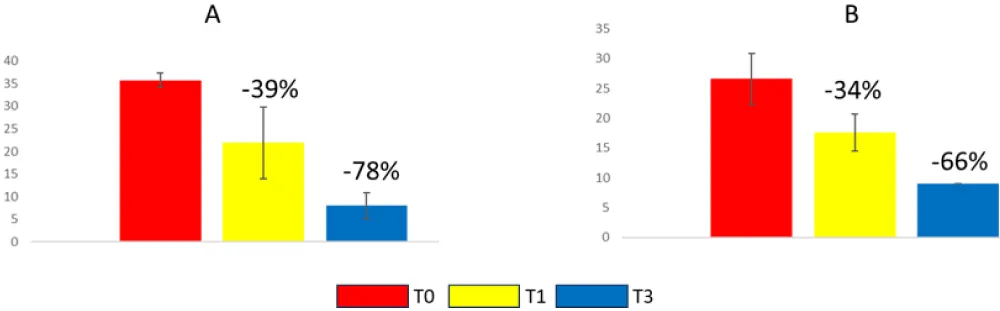
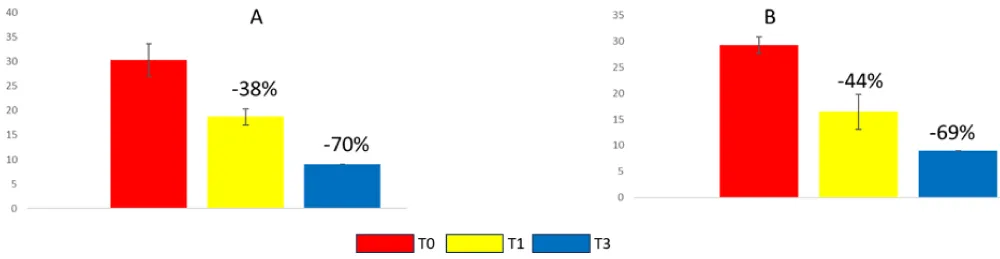
In fact, regarding the extra-esophageal symptomatology, Refluward® HA reduced of about 80% the symptoms like dysphonia after three months of treatment with a rapid action (39% of reduction of symptomatology) already after one month of administration. Typical gastro-oesophageal symptoms (such as chest pain, regurgitation, burning sensation) were also improved with a mean reduction of about 34% at T1 and 66% at T3.
Non propulsive esophageal contractions radiologically described as tertiary contractions or "corkscrew" oesophagus suggest the presence of an underlying motility disorder and may lead to impaired acid clearance [22]. Patients enrolled in the present study with tertiary esophageal contractions, showed at T0 very high levels in both RSI and GIS score (about 30), but, after the treatment with Refluward® HA, all the symptomatology was optimally reduced with high percentage for both RSI and GIS score (Figure 3). As reported in other papers, it could be hypothesized that detection and treatment of GERD symptomatology may improve the symptomatic management of patients with non-propulsive esophageal contractions [22]. Hiatal hernia is another gastro-esophageal disease considered at the enrolment time because its familiar manifestations include gastric reflux, nausea, bloating, chest and epigastric discomfort, pharyngeal and esophageal expulsion and dysphagia [23].
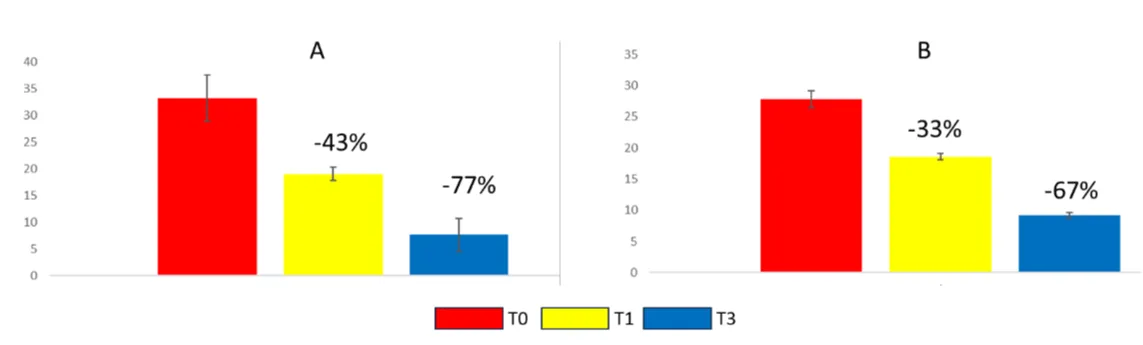
According to these data, the patients showed very high RSI and GIS score at T0 that were all improved after the treatment with Refluward® HA with a reduction of the symptomatology ranging between 33-43% at T1 and 67-77% at T3 (Figure 4). Considering all the patients enrolled (n = 40) for all the conditions related to gastro-esophageal diseases, it was recorded that both RSI and GIS score were reduced after one moth of treatment respectively of 41% and 37% with an optimization up to 67% and 77% continuing Refluward® HA oral administration for three months (Figure 5). No side effects or drop out were detected.
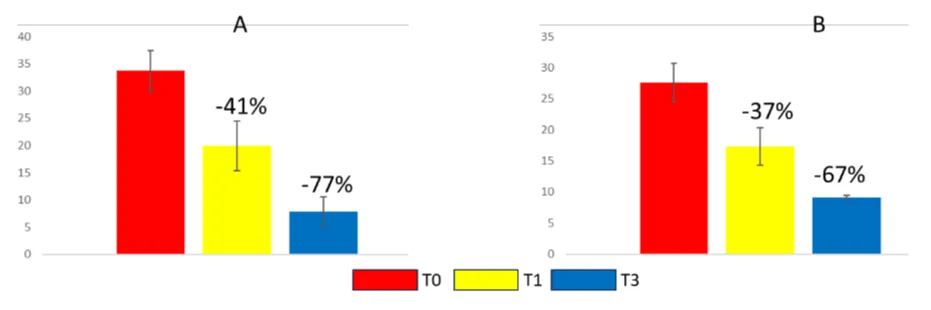
The obtained results indicated the high therapeutic potential of Refluward® HA in control gastro-esophageal and extra gastro-esophageal symptoms deriving from four different conditions examined such as gastro- esophageal reflux, reflux esophagitis, hiatal hernia and tertiary esophageal waves in adults’ population without any side effects demonstrating a good safety profile for chronic administration (up to 3 months).
The patented Refluward® HA formulation is able to determine five different therapeutic actions: prevents the rise of acids and food by forming a mechanical raft, neutralize the gastric acidity thanks to carbonates and bicarbonates, protect the mucosa stimulating its physiological reparation, counteract inflammation and stimulate the gastric emptying. Refluward® HA, after more important clinical investigations with randomized and placebo-controlled trials, could be recommended as alternative treatment for example in patients that are not responsive to PPIs; in fact, for different GERD conditions such as non-erosive gastroesophageal disease, it’s estimated that about 30-55% of patients receiving PPI therapy did not fully respond to treatment [24,25].
Conclusion
A total of 40 patients suffering of four different conditions correlated with gastro-esophageal area such as gastro-esophageal reflux, reflux esophagitis, hiatal hernia and tertial esophageal waves with both typical and atypical GERD symptomatology were enrolled in the present retrospective clinical survey.
Refluward® HA oral administration after one month reduced the total symptomatology of gastro-esophageal diseases according to two different questionnaire used RSI and GIS score. Moreover, continuing the therapy up to 3 months, a further reduction in the symptomatology was obtained without any side effect or drop out. The obtained data demonstrated the efficacy and safety of the innovative nutraceutical Refluward® HA in people with different diseases and with their different manifestations with gastro-esophageal and extra gastro-esophageal localization. More consistent randomized and placebo-controlled studies considering also plasmatic or endoscopic data are necessary to confirm Refluward® HA as a novel therapeutic potential treatment for different gastro-esophageal diseases.
Conflicts of Interest
We declare that Di Maio U is a Shedir Pharma Group S.p.A member and Cerciello A is a Neilos S.r.l. members.
Funding
This research was funded by a grant from Neilos S.r.l.
Author Contributions
All authors contributed equally to the manuscript and read and approved the final version of the manuscript.
References
- Greenwood VM, Anthony CJ, David G. Gastrointestinal physiology and function. Gastrointestinal pharmacology. 2017;1-16.
- Richter JE, Rubenstein JH. Presentation and Epidemiology of Gastroesophageal Reflux Disease. Gastroenterology. 2018 Jan;154(2):267-276. doi: 10.1053/j.gastro.2017.07.045. Epub 2017 Aug 3. PMID: 28780072; PMCID: PMC5797499.
- Katz PO, Dunbar KB, Schnoll-Sussman FH, Greer KB, Yadlapati R, Spechler SJ. ACG Clinical Guideline for the Diagnosis and Management of Gastroesophageal Reflux Disease. Am J Gastroenterol. 2022 Jan 1;117(1):27-56. doi: 10.14309/ajg.0000000000001538. PMID: 34807007; PMCID: PMC8754510.
- Hunt RH, Camilleri M, Crowe SE, El-Omar EM, Fox JG, Kuipers EJ, Malfertheiner P, McColl KE, Pritchard DM, Rugge M, Sonnenberg A, Sugano K, Tack J. The stomach in health and disease. Gut. 2015 Oct;64(10):1650-68. doi: 10.1136/gutjnl-2014-307595. Epub 2015 Sep 4. PMID: 26342014; PMCID: PMC4835810.
- Chen J, Brady P. Gastroesophageal Reflux Disease: Pathophysiology, Diagnosis, and Treatment. Gastroenterol Nurs. 2019 Jan/Feb; 42(1): 20-28. doi: 10.1097/SGA.0000000000000359. PMID: 30688703.
- Michael VF. Extraesophageal manifestations of gastroesophageal reflux disease. Clinical cornerstone. 2003;5:32-38.
- Kellerman R, Kintanar T. Gastroesophageal Reflux Disease. Prim Care. 2017 Dec;44(4):561-573. doi: 10.1016/j.pop.2017.07.001. Epub 2017 Oct 5. PMID: 29132520.
- Mousa H, Hassan M. Gastroesophageal Reflux Disease. Pediatr Clin North Am. 2017 Jun;64(3):487-505. doi: 10.1016/j.pcl.2017.01.003. PMID: 28502434; PMCID: PMC6509354.
- Rackoff A, Agrawal A, Hila A, Mainie I, Tutuian R, Castell DO. Histamine-2 receptor antagonists at night improve gastroesophageal reflux disease symptoms for patients on proton pump inhibitor therapy. Dis Esophagus. 2005;18(6):370-3. doi: 10.1111/j.1442-2050.2005.00518.x. PMID: 16336606.
- Kahrilas PJ, Kim HC, Pandolfino JE. Approaches to the diagnosis and grading of hiatal hernia. Best Pract Res Clin Gastroenterol. 2008;22(4):601-16. doi: 10.1016/j.bpg.2007.12.007. PMID: 18656819; PMCID: PMC2548324.
- Richter JE, Rubenstein JH. Presentation and Epidemiology of Gastroesophageal Reflux Disease. Gastroenterology. 2018 Jan;154(2):267-276. doi: 10.1053/j.gastro.2017.07.045. Epub 2017 Aug 3. PMID: 28780072; PMCID: PMC5797499.
- Patel DA. Esophageal motility disorders: Current approach to diagnostics and therapeutics. Gastroenterology. 2015;162:1617-1634.
- Katz PO, Dunbar KB, Schnoll-Sussman FH, Greer KB, Yadlapati R, Spechler SJ. ACG Clinical Guideline for the Diagnosis and Management of Gastroesophageal Reflux Disease. Am J Gastroenterol. 2022 Jan 1;117(1):27-56. doi: 10.14309/ajg.0000000000001538. PMID: 34807007; PMCID: PMC8754510.
- Seeras K, Bittar K, Siccardi MA. Nissen fundoplication. 2023.
- Kıraç FS. Is Ethics Approval Necessary for all Trials? A Clear But Not Certain Process. Mol Imaging Radionucl Ther. 2013 Dec;22(3):73-5. doi: 10.4274/Mirt.80664. Epub 2013 Dec 10. PMID: 24416621; PMCID: PMC3888015.
- Nacci A, Bastiani L, Barillari MR, Lechien JR, Martinelli M, Bortoli N, Berrettini S, Fattori B. Assessment and Diagnostic Accuracy Evaluation of the Reflux Symptom Index (RSI) Scale: Psychometric Properties using Optimal Scaling Techniques. Ann Otol Rhinol Laryngol. 2020 Oct;129(10):1020-1029. doi: 10.1177/0003489420930034. Epub 2020 May 29. PMID: 32468832.
- Louis E, Tack J, Vandenhoven G, Taeter C. Evaluation of the GERD Impact Scale, an international, validated patient questionnaire, in daily practice. Results of the ALEGRIA study. Acta Gastroenterol Belg. 2009 Jan-Mar;72(1):3-8. PMID: 19402364.
- Romano C, Scarpignato C. Pharmacologic treatment of GERD in adolescents: Is esophageal mucosal protection an option? Therap Adv Gastroenterol. 2022 Aug 17;15:17562848221115319. doi: 10.1177/17562848221115319. PMID: 36004307; PMCID: PMC9393348.
- Camerlingo A, Di MU, Cerciello A. Pain relief effect of Crackdol® fast foam in osteoarticular disorders. J Clin Stud Med Case Rep. 2023;10:2.
- Falvo OF, Di MU, Bagnulo A. Effectiveness and safety of zenasinil® nasal drops in patients with upper airways inflammation. Biomed J Sci Tech Res. 2025;63:2025.
- Sabha M, Di MU, Bagnulo A. Effect of zenasinil® spray in patient with upper respiratory tract disease. Biomed J Sci Tech Res. 2025;63:2025.
- Triadafilopoulos G, Castillo T. Nonpropulsive esophageal contractions and gastroesophageal reflux. Am J Gastroenterol. 1991 Feb;86(2):153-9. PMID: 1992626.
- Yu HX, Han CS, Xue JR, Han ZF, Xin H. Esophageal hiatal hernia: risk, diagnosis and management. Expert Rev Gastroenterol Hepatol. 2018 Apr;12(4):319-329. doi: 10.1080/17474124.2018.1441711. Epub 2018 Feb 22. PMID: 29451037.
- Koo TH, Fass R. A systematic review and meta-analysis of randomized controlled trials: the role of potassium-competitive acid blockers in endoscopy-negative reflux disease. Dig Liver Dis. 2025 Sep;57(9):1752-1760. doi: 10.1016/j.dld.2025.04.045. Epub 2025 May 16. PMID: 40382208.
- Dickman R, Maradey-Romero C, Gingold-Belfer R, Fass R. Unmet Needs in the Treatment of Gastroesophageal Reflux Disease. J Neurogastroenterol Motil. 2015 Jul 30;21(3):309-19. doi: 10.5056/jnm15105. Erratum in: J Neurogastroenterol Motil. 2019 Jan 31;25(1):173. doi: 10.5056/jnm25011. PMID: 26130628; PMCID: PMC4496897.





Content Alerts
SignUp to our
Content alerts.
 This work is licensed under a Creative Commons Attribution 4.0 International License.
