
2025 November 08;6(11):1662-1670. doi: 10.37871/jbres2219.
-
Subject area(s):

 |
|
 |
|
 |
|

 Review Article
Exploring the Tumor Microenvironment: Macrophages and PD-1 Checkpoint Inhibitors
Liu X*, Lu Y, Wei J, Liu H, Huang J and Ding Y
- Tumor microenvironment
- Macrophages
- PD-1 checkpoint inhibitors
Abstract
This review provides an in-depth examination of the tumor microenvironment, macrophages, and PD-1 checkpoint inhibitors. It delves into the fundamental aspects of the tumor microenvironment and macrophages, discussing the evolution of key concepts, the involvement of macrophages in tumor progression, and their interactions with tumor cells. The historical development of PD-1 checkpoint inhibitors is explored, detailing their discovery, early clinical trials, and initial challenges. Current insights into macrophages within the tumor microenvironment are presented, including their polarization, mechanisms of immunosuppression, and diagnostic techniques. The clinical application of PD-1 inhibitors is reviewed, encompassing therapeutic strategies, comparative efficacy across various cancers, and management of side effects. Additionally, the paper addresses technological advancements in tumor microenvironment research, future directions, and ongoing controversies, aiming to provide a comprehensive overview to inform further research and clinical applications.
Foundations of Tumor Microenvironment and Macrophages
Evolution of tumor microenvironment concepts
The understanding of the Tumor Microenvironment (TME) has undergone substantial evolution over time. Initially perceived merely as the surrounding milieu of tumor cells, the TME is now acknowledged as a complex and dynamic ecosystem [1]. For instance, gliomas arise in a distinct Tumor Microenvironment (TME) that includes a variety of cells such as those residing in the brain, cells of the immune system and blood vessels. These cells engage in reciprocal interactions that influence the development of the TME. Mouse models play a pivotal role in elucidating the processes and mechanisms underlying TME evolution [2].
Cellular communication within the Tumor Microenvironment (TME) has become recognized as a critical area of study. Innovative mechanisms such as vesicle transfer and cell fusion are increasingly recognized for their roles in cellular reprogramming within the TME [3]. Specifically, the information exchange between cells and the matrix, among tumor cells, and between tumor cells and the host immune system is mediated through exosomes and microvesicles. This interaction significantly impacts our comprehension of how tumors start and develop. Furthermore, the TME is characterized by spatial heterogeneity, with conditions that differ significantly from those in healthy tissues. Aneuploidy and polyploidy in cancer cells engage in a bidirectional interaction with the TME, wherein abnormal cells alter the TME, which in turn selects for the most adaptable cells under specific conditions [4].
Role of macrophages in tumor progression
Macrophages are pivotal in tumor progression, affecting various processes such as immune response modulation, angiogenesis, and tissue remodelling. Their interactions with tumor cells can facilitate tumor growth and metastasis, underscoring their importance in cancer development.
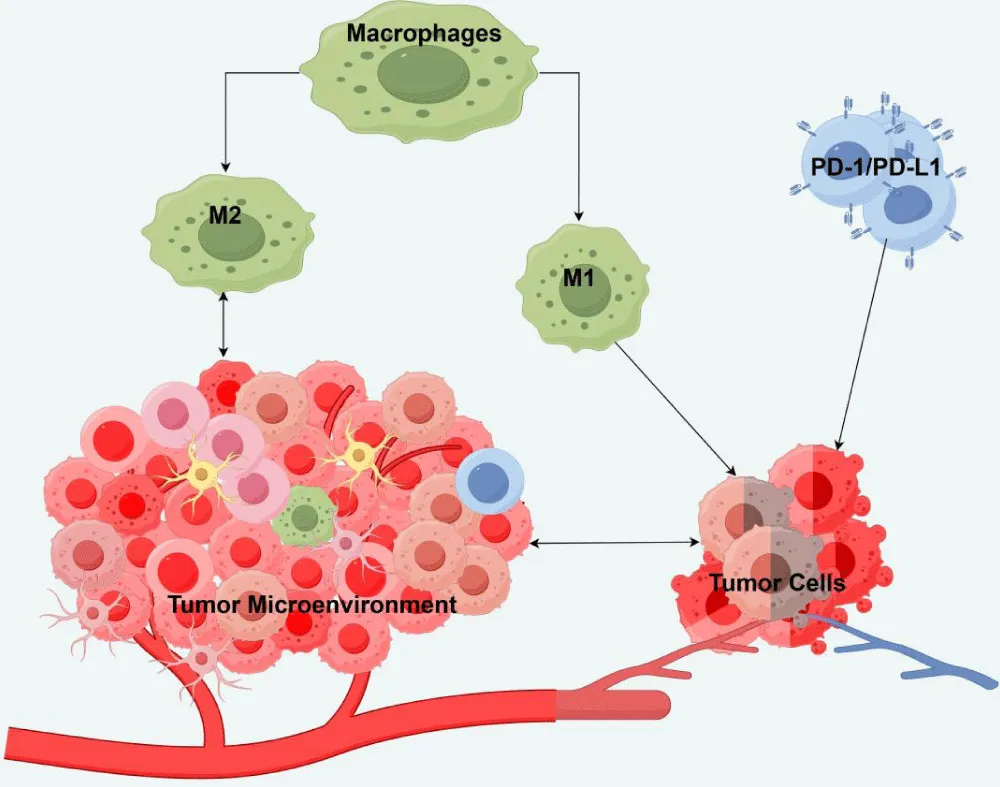
Macrophages are crucial and have multiple roles in the advancement of tumors. The primary stromal cells present in the Tumor Microenvironment (TME) are Tumor-Associated Macrophages (TAMs), can differentiate into either anti-tumorigenic (M1) or pro-tumorigenic (M2) phenotypes [5]. In advanced tumors, M2-like TAMs primarily modulate the TME. The release of multiple cytokines, chemokines, and growth factors by them encourages tumor growth. The tumor microenvironment, macrophages, immune cell surface PD-1/PD-L1, and the interaction between tumor cells (Figure1).
In the context of breast cancer, TAMs within the adipose microenvironment contribute to tumor progression. A portion of these macrophages expresses CD163, CCL2, and CCL5, which points to an immunosuppressive phenotype [6]. Macrophages associated with tumors are crucial in enhancing the development of new blood vessels, facilitating tumor cell metastasis, and contributing to multidrug resistance [7], thereby significantly advancing tumor progression in hepatocellular carcinoma. Macrophages can differentiate into M2-like TAMs, which possess immunoregulatory functions, contribute to the polarization of Th2 responses, and support tumor progression [8]. The emerging understanding of the phagocytic function of TAMs introduces a novel mechanism for cancer treatment. Boosting the phagocytic function of TAMs could strengthen natural cancer-fighting immunity and encourage T-cell-driven responses of the adaptive immune system [9].
Interaction between macrophages and tumor cells
The interplay between macrophages and tumor cells represents a complex and reciprocal process. Within the framework of Small Cell Lung Cancer (SCLC), Tumor-Associated Macrophages (TAMs) are implicated in tumor progression via the activation of STAT3 [10]. Immunohistochemically analyses indicate that the activation of STAT3 in tumor cells mainly occurs in the peripheral regions of tumor nests, adjacent to TAMs within the stromal compartment. Studies using In vitro co-culture have shown that when SCLC cells are indirectly co-cultured with macrophages, STAT3 is activated in both types of cells. The activation of STAT3 in SCLC cells is markedly enhanced by the culture supernatant derived from macrophages, thereby facilitating tumor cell proliferation, invasion, chemo resistance, and sphere formation.
Similarly, glioblastoma is characterized by intricate Interactions among cancerous cells and TAMs [11]. Cancer cells emit chemokines, cytokines, and growth factors to recruit TAMs, which in turn secrete factors that establish an immunosuppressive and tumor-promoting microenvironment. In papillary thyroid cancer, CD36+ pro-inflammatory macrophages interact with ZCCHC12+ tumor cells. These CD36+ macrophages secrete SPP1, which activates the PI3K-AKT signalling pathway in cancer cells, thereby augmenting their proliferation [12].
Current Understanding of Macrophages in Tumor Microenvironment
Macrophage polarization in tumor context
Within the tumor microenvironment, macrophages can differentiate into distinct phenotypes, predominantly the pro-inflammatory M1 and the anti-inflammatory M2 types. In this context, macrophages often polarize towards the M2 phenotype, which facilitates tumor progression [ 13]. Metabolic reprogramming plays a critical role in macrophage polarization, enabling both tumor cells and macrophages to meet their energy demands. A comprehensive understanding of the metabolic transitions between pro-tumor and anti-tumor states in Tumor-Associated Macrophages (TAMs) is essential for elucidating immune escape mechanisms [14].
Glutamine is recognized as an essential metabolite for both M1 and M2 macrophage types. Studies using monoculture and coculture cell models indicate that M1 polarization relies more heavily on the availability of glutamine in the culture environment compared to M2 polarization. A deficiency in glutamine impairs M1 polarization, whereas its impact on M2 polarization is comparatively milder [15]. Furthermore, apoptotic tumor cells can modulate macrophages to adopt a phenotype that facilitates tumor growth. Soluble mediators, such as Sphingosine-1-Phosphate (S1P) derived from apoptotic cells, can induce the expression of arginase 2 in macrophages, thereby reducing citrulline/nitric oxide synthesis while enhancing ornithine production [16].
Mechanisms of macrophage - mediated immunosuppression
Macrophages play a pivotal role in mediating immunosuppression through diverse mechanisms. In the context of sepsis, mitochondrial dysfunction within macrophages is closely linked to immunosuppressive outcomes. Specifically, the S1PR2 receptor on macrophages exacerbates sepsis-induced immunosuppression by promoting mitochondrial fragmentation [17]. This is evidenced by the elevated expression of S1PR2 in peripheral blood monocytes of septic patients, which is concomitant with mitochondrial fragmentation and dysfunction. The activation of S1PR2 triggers mitochondrial fragmentation in macrophages via the activation of ROCK I, which subsequently phosphorylates Drp1, thereby playing a crucial role in septic immunosuppression.
Furthermore, inside the microenvironment of the tumor, the interaction between tumor cells and macrophages mediated by CD147-K148me2 induces immunosuppression in Non-Small Cell Lung Cancer (NSCLC) through the CCL5/CCR5 pathway [18]. The interaction between CD147 and cyclophilin A is strengthened by the demethylation of CD147 at lysine 148, which in turn activates the p38–ZBTB32 signalling pathway to increase CCL5 gene transcription. This process increases CCL5 secretion from NSCLC cells, thereby promoting the infiltration of M2-like Tumor-Associated Macrophages (TAMs) in NSCLC tissues through CCL5/CCR5 axis-dependent communication between macrophages and cancer cells.
Diagnostic techniques for tumor - associated macrophages
Precisely identifying Tumor-Associated Macrophages (TAMs) is essential for comprehending tumor development and creating effective treatments. One promising method involves the application of nanoparticle-based Magnetic Resonance Imaging (MRI). Specifically, iron oxide nanoparticles with Superparamagnetic Properties (SPIONs) are used to non-invasively evaluate TAMs in animal studies and clinical research [19]. Tumors and metastases exhibiting macrophage infiltration tend to accumulate these iron oxide nanoparticles, resulting in a decreased T2-relaxation time and generating negative (dark) contrast in quantitative T2-weighted MRI (qT2wMRI).
One different method is to generate monocyte-derived Tumor-Associated Macrophages (TAMs) In vitro using media conditioned by tumors [15]. The co-expression of CD163/CD206 is more pronounced in these TAMs than in M2-like macrophages, with expression rates of 87% and 36%, respectively. They also exhibit elevated levels of transcripts for functional markers such as IL-6, IL-10, CCL2, c-Myc, iNOS, and arginase. Functionally, In vitro-generated TAMs suppress T cell proliferation by 47% relative to M1-like macrophages and reduce IFN-γ production by natural killer cells by 44%.
Historical Perspective on PD - 1 Checkpoint Inhibitors
The exploration and advancement of the PD-1 pathway
The development and identification of the PD-1 pathway constitute a key advancement in the field of cancer immunotherapy. In 1992, Honjo and his team at Kyoto University identified PD-1, marking the beginning of extensive research into its functions [20]. Over the past two decades, research on human PD-1 can be delineated into three distinct phases. Initially, the elucidation of the PD-1 gene's structure and genomic organization provided a foundational understanding. Subsequently, it became vital to grasp the mechanism by which PD-1, along with its ligands PD-L1 and PD-L2, manages immune checkpoints. PD-1 plays a critical role in modulating immune responses and enhancing self-tolerance by inhibiting T cell activity and facilitating the differentiation of regulatory T cells [21].
Preclinical animal studies indicate that PD-1 blockade effectively inhibits tumorigenesis and metastasis while exhibiting fewer side effects compared to CTLA-4 blockade. This finding has led to the creation of monoclonal antibodies tailored for human use, such as nivolumab, which targets human PD-1. Notably, PD-1 blockade exerts its therapeutic effects by targeting lymphocytes rather than tumor cells, allowing its efficacy to persist despite mutations that may occur during tumorigenesis. Additionally, its therapeutic applicability spans multiple tumor types, as it does not depend on specific tumor antigens. Nonetheless, challenges persist, particularly concerning the wide variability in response rates to PD-1 immune-checkpoint inhibition therapy across different cancer types, which range from 18% to 87% [22].
Initial clinical evaluations of agents that inhibit PD-1
Initial clinical trials of PD-1 inhibitors have played a pivotal role in evaluating their efficacy and safety. A meta-analysis encompassing 51 pairs of early-phase and phase III clinical trials for PD-1/PD-L1 inhibitors demonstrated that early-phase trials consistently overestimated the outcomes observed in phase III trials, with an Odds Ratio (OR) of 1.66 for the Overall Response Rate (ORR) (95% CI 1.43 to 1.92, p < 0.05) [23]. This overestimation was observed consistently in trials evaluating both PD-1/PD-L1 monotherapies and combination therapies.
Challenges in the application of PD-1 inhibitors
One of the primary challenges in the application of PD-1 inhibitors is the heterogeneous response rate observed across various cancer types. In lymphoid malignancies, although immunochemotherapy can achieve remission in some patients, a significant number experience relapse or disease progression despite undergoing intensive treatment. Further research is required to elucidate the role of PD-1 activation and its potential as a target for therapy in these malignancies [24]. The PD-1/PD-L1 pathway is crucial for tumors to evade the immune system, which is pivotal in the pathogenesis and progression of leukaemia [25].
Furthermore, a significant issue is the absence of dependable biomarkers to predict how individual patients will respond to PD-1 inhibitory immunotherapy. Patients may exhibit primary, adaptive, or acquired resistance to PD-1 immune checkpoint inhibitors, and some may develop hyper progressive disease after treatment. These issues highlight the urgent need for further investigation to understand the mechanisms underlying responses to PD-1 inhibitors and to develop strategies to overcome resistance.
PD - 1 Checkpoint Inhibitors in Medical Treatment
Current approaches to treatment with PD-1 inhibitors
Combination therapies incorporating PD-1 inhibitors are increasingly recognized as significant therapeutic strategies. A meta-analysis examining the combination of PD-1/PD-L1 inhibitors, radiotherapy, and anti-angiogenesis agents in solid tumors demonstrated a pooled overall response rate of 59% (95% CI: 48-70%), a disease control rate of 92% (95% CI: 81-103%), and a complete remission rate of 48% (95% CI: 35-61%) [26]. In contrast, neither monotherapy nor dual-combination treatments improved overall survival (HR = 0.499, 95% CI: 0.399-0.734) or progression-free survival (HR = 0.522, 95% CI: 0.352-0.774) when compared to the triple regimen.
Checkpoint inhibitors that target PD-L1 and PD-1 have revolutionized the therapeutic strategy for advanced urothelial bladder cancer. Currently, five approved agents are available for the management of platinum-refractory bladder cancer. In a randomized Phase III clinical trial, pembrolizumab exhibited superior efficacy compared to standard chemotherapy. Both pembrolizumab and atezolizumab have received FDA approval and are well-tolerated as first-line treatments for patients who are ineligible for cisplatin-based therapy [27].
Evaluating the relative effectiveness of PD-1 inhibitors across various cancer types
The effectiveness of PD-1 inhibitors exhibits variability across different cancer types. In a comparative study of PD-L1 and PD-1 inhibitors for Small Cell Lung Cancer (SCLC), the Overall Response Rate (ORR) was observed to be 50.0% in the PD-L1 cohort, compared to 36.8% in the PD-1 cohort, with no statistically significant difference (p = 0.308). The median survival durations were 21.0 months for the PD-L1 group and 17.0 months for the PD-1 group, also showing no statistically significant difference (p = 0.180) [28]. Additionally, the PD-L1 group experienced significantly milder bone marrow suppression and gastrointestinal adverse effects.
A network meta-analysis encompassing 37 randomized controlled trials and involving a total of 31,779 patients revealed that, in the context of Non-Small Cell Lung Cancer (NSCLC), the agents tislelizumab, pembrolizumab, and nivolumab significantly improved overall survival in comparison to chemotherapy. Among these, tislelizumab exhibited the maximum probability of being the most efficacious treatment in terms of enhancing overall survival and disease control rate. While cemiplimab and tislelizumab were associated with the greatest likelihood of improving progression-free survival, no statistically notable distinctions were observed among all PD-1/PD-L1 inhibitors [29].
Side effects and management of PD - 1 inhibitor therapy
Programmed Death-1 (PD-1) inhibitor therapy is associated with a range of adverse effects. In a study comprising 496 patients with metastatic melanoma who were administered nivolumab or pembrolizumab, 138 individuals experienced a total of 242 adverse events. These events predominantly affected the integumentary, gastrointestinal, hepatic, endocrine, and renal systems. Notably, the rare adverse reactions comprised the emergence of lichen planus, diabetes mellitus, and pancreatic insufficiency as a result of pancreatitis [30].
immune-related Adverse Events (irAEs) involving the ocular system may also occur. An analysis of 70 case reports indicated that the most prevalent malignancies were melanoma (n = 41; 58.6%) and lung cancer (n = 13; 18.6%). The primary PD-1 inhibitors administered were pembrolizumab (n = 38; 54.3%) and nivolumab (n = 28; 40%). The most frequently observed ocular complications were uveitis (n = 35; 50%) and myasthenia gravis (n = 13; 18.57%). The majority of these toxicities were responsive to treatment with topical and systemic steroids. However, severe cases may necessitate the temporary or permanent discontinuation of PD-1 inhibitor therapy [31].
Technological Advances in Tumor Microenvironment Research
Novel imaging techniques for tumor microenvironment
Advanced imaging techniques are offering novel insights into the tumor microenvironment. Uncommon side effects included the development of lichen planus, diabetes mellitus, and pancreatic deficiency due to pancreatitis [32]. These techniques allow for the study of cells within the complete tumor microenvironment in a mouse, facilitating prolonged observation of cellular interactions and the analysis of specific cell types,Interactions occur between T cells, neutrophils, monocytes, and the vasculature of tumors as well as cancer cells.
Molecular imaging modalities, including Magnetic Resonance Imaging (MRI), Positron Emission Tomography (PET), and fluorescence imaging, offer real-time, non-invasive, and longitudinal approaches for investigating the Tumor Microenvironment (TME) [33]. The Targeted Molecular Localization (TML) technique utilizes a singular imaging sequence and reconstruction process to co-localize super-resolved vasculature with molecular imaging signatures, thereby providing simultaneous anatomical and biological insights that may facilitate multiscale disease assessment [34] (The TML method employs a single imaging sequence and reconstruction technique to simultaneously map super-resolved blood vessels and molecular imaging markers. Thus offering concurrent anatomical and biological insights that could aid in multiscale disease evaluation). In a murine hind limb tumor model, the TML method achieved microvasculature resolution as fine as 28.8 μm [34].
Genomic and proteomic approaches to study macrophages
Genomic and proteomic methodologies are advancing our comprehension of macrophage biology. Genetic and genomic strategies have been employed to elucidate macrophage identity and functionality. Recent studies propose a model in which lineage-determining and signal-dependent transcription factors interact in a collaborative and hierarchical manner to delineate macrophage identity and function [36]. Additionally, natural genetic variation serves as a valuable tool for elucidating the context-dependent acquisition of specific macrophage phenotypes.
Proteomic analysis has been utilized to investigate the macrophage response to various stimuli. Employing a gel-free proteomic approach, a study identified 504 differentially expressed proteins with strong assurance (defined as ≥ 5 peptide spectral matches) in macrophages exposed to low-dose ethanol and lipopolysaccharide [37]. Among these items are, 319 proteins were consistently present under every treatment condition, whereas 69 proteins were uniquely identified in cells treated with ethanol or stimulated with lipopolysaccharide. Bioinformatics tools were employed to assess the combined impact of ethanol and lipopolysaccharide on the macrophage proteome, assisting in pinpointing proteins that respond differently, networks of protein interactions, and established pathways.
Novel biomarkers for predicting response to PD-1 inhibitors
The identification of biomarkers predictive of response to PD-1 inhibitors is crucial for the advancement of personalized therapy. In a study involving cancer patients treated with PD-1 inhibitors, early treatment levels of anti-thyroglobulin antibody (TgAb) (OR = 2.831, 95% CI 1.077-7.443, p = 0.035) and anti-Thyroperoxidase Antibody (TPOAb) (OR = 9.565, 95% CI 3.399-26.921, p < 0.001) were found to be independent predictors of immune-related Thyroid Dysfunction (irTD) [38]. These early-stage biomarkers exhibited a superior predictive capability for irTD, as evidenced by a larger Area Under the Curve (AUC) compared to pre-treatment biomarkers (0.655 vs. 0.571).
Through proteomic profiling, machine learning algorithms identified ten protein biomarkers associated with gastric cancer. The model demonstrated exceptional performance in predicting responses to PD-1 inhibitor immunotherapy in an independent validation cohort (n = 14; AUC = 0.959) [39]. These biomarkers were associated with pathways such as the complement system and blood clotting processes, and the presence of activated CD8 T cells was correlated with a positive response to immunotherapy.
Future Directions and Controversies
Exploring combination therapies with PD-1 inhibitors offers significant potential
PD-1 inhibitor combination therapies demonstrate considerable potential. A retrospective cohort analysis of metastatic melanoma indicated that combination Immune Checkpoint Inhibitor (ICI) therapy (anti-PD-1 ± anti-CTLA-4) significantly enhanced clinical Progression-Free Survival (cPFS) (HR 0.57, 95% CI 0.38 to 0.86, p = 0.007) and Overall Survival (OS) (HR 0.42, 95% CI 0.28 to 0.65, p < 0.001) in comparison to anti-PD-1 monotherapy [40]. Nonetheless, the incidence of grade 3 or 4 toxicities was higher with the combination therapy (31%) relative to PD-1 monotherapy (7%).
The use of PD-1/PD-L1 inhibitors alongside radiotherapy and anti-angiogenesis agents has demonstrated success in treating solid tumors. A meta-analysis reported a pooled overall response rate of 59% (95% CI: 48-70%) for solid tumors managed with this combination [26]. This therapeutic strategy may enhance survival outcomes more effectively than monotherapy or dual-combination therapies, highlighting the potential of multi-modal approaches in advancing cancer treatment outcomes.
Controversies in macrophage targeting strategies
One of the primary controversies in macrophage-targeting strategies pertains to the intricate nature of macrophage phenotypes and functions. Macrophages demonstrate considerable plasticity and heterogeneity, impacting the tumor microenvironment through both pro-tumor and tumor-suppressing activities, depending on various influencing factors [41]. The transformation of macrophages from the M2 phenotype, which promotes tumor growth, to the M1 phenotype, which suppresses tumors, emerges as a promising strategy. However, achieving precise control over this polarization process remains a significant challenge. Additionally, the design and development of Chimeric Antigen Receptor (CAR) macrophages encounter obstacles, including the need to ensure their specificity, efficacy, and safety.
The targeting of phagocytosis checkpoints on macrophages represents a contentious area of research. Although augmenting macrophage phagocytosis holds promise for enhancing anticancer immunity, the precise mechanisms and optimal targets for intervention remain incompletely elucidated. Furthermore, a thorough assessment of potential side effects and off-target effects associated with macrophage-targeting therapies is essential to ascertain their clinical feasibility and effectiveness.
Future prospects for personalized medicine in tumor microenvironment management
The management of the tumor microenvironment through personalized medicine offers significant potential. The application of radionuclide-based imaging and therapeutic techniques to target the tumor microenvironment represents a personalized medicine approach that is applicable across various cancer types [42]. Radio ligands designed to target modified procedures, the extracellular matrix, and cellular components within the Tumor Microenvironment (TME) have been designed and tested in both before clinical trials and during clinical trials research. These radio ligands have the potential to be employed for therapy and imaging with targeted radionuclides, facilitating more personalized interventions within the field of nuclear medicine.
The application of 3-Dimensional (3D) tumor models, including spheroids and organoids, is gaining recognition as a promising strategy in contemporary research [43]. These models, which are derived from patient tissues, employ high-throughput approaches in individualized medicine techniques to ascertain suitable therapies for individual patients. They significantly enhance the comprehension of tumor biology and its surrounding environment, support the advancement of innovative In vitro drug testing platforms, and facilitate the development of personalized therapeutic strategies.
Acknowledgments
This work was supported by Science and Technology Plan of the Health Commission of Jiangxi Province (202311840).
References
- Hu Y, Li Z, Zhang Y, Wu Y, Liu Z, Zeng J, Hao Z, Li J, Ren J, Yao M. The Evolution of Tumor Microenvironment in Gliomas and Its Implication for Target Therapy. Int J Biol Sci. 2023 Aug 21;19(13):4311-4326. doi: 10.7150/ijbs.83531. PMID: 37705736; PMCID: PMC10496508.
- Gong Z, Jia Q, Guo J, Li C, Xu S, Jin Z, Chu H, Wan YY, Zhu B, Zhou Y. Caspase-8 contributes to an immuno-hot microenvironment by promoting phagocytosis via an ecto-calreticulin-dependent mechanism. Exp Hematol Oncol. 2023 Jan 12;12(1):7. doi: 10.1186/s40164-022-00371-1. PMID: 36635765; PMCID: PMC9835222.
- Yang K, Wang X, Song C, He Z, Wang R, Xu Y, Jiang G, Wan Y, Mei J, Mao W. The role of lipid metabolic reprogramming in tumor microenvironment. Theranostics. 2023 Mar 13;13(6):1774-1808. doi: 10.7150/thno.82920. PMID: 37064872; PMCID: PMC10091885.
- Baudoin NC, Bloomfield M. Karyotype Aberrations in Action: The Evolution of Cancer Genomes and the Tumor Microenvironment. Genes (Basel). 2021 Apr 12;12(4):558. doi: 10.3390/genes12040558. PMID: 33921421; PMCID: PMC8068843.
- Li M, Jiang P, Wei S, Wang J, Li C. The role of macrophages-mediated communications among cell compositions of tumor microenvironment in cancer progression. Front Immunol. 2023 Feb 9;14:1113312. doi: 10.3389/fimmu.2023.1113312. PMID: 36845095; PMCID: PMC9947507.
- Li B, Liu S, Yang Q, Li Z, Li J, Wu J, Sun S, Xu Z, Sun S, Wu Q. Macrophages in Tumor-Associated Adipose Microenvironment Accelerate Tumor Progression. Adv Biol (Weinh). 2023 Jan;7(1):e2200161. doi: 10.1002/adbi.202200161. Epub 2022 Oct 20. PMID: 36266968.
- Dallavalasa S, Beeraka NM, Basavaraju CG, Tulimilli SV, Sadhu SP, Rajesh K, Aliev G, Madhunapantula SV. The Role of Tumor Associated Macrophages (TAMs) in Cancer Progression, Chemoresistance, Angiogenesis and Metastasis - Current Status. Curr Med Chem. 2021;28(39):8203-8236. doi: 10.2174/0929867328666210720143721. PMID: 34303328.
- He YC, Hao ZN, Li Z, Gao DW. Nanomedicine-based multimodal therapies: Recent progress and perspectives in colon cancer. World J Gastroenterol. 2023 Jan 28;29(4):670-681. doi: 10.3748/wjg.v29.i4.670. PMID: 36742173; PMCID: PMC9896619.
- Lecoultre M, Dutoit V, Walker PR. Phagocytic function of tumor-associated macrophages as a key determinant of tumor progression control: a review. J Immunother Cancer. 2020 Dec;8(2):e001408. doi: 10.1136/jitc-2020-001408. PMID: 33335026; PMCID: PMC7747550.
- Mito R, Iriki T, Fujiwara Y, Pan C, Ikeda T, Nohara T, Suzuki M, Sakagami T, Komohara Y. Onionin A inhibits small-cell lung cancer proliferation through suppressing STAT3 activation induced by macrophages-derived IL-6 and cell-cell interaction with tumor-associated macrophage. Hum Cell. 2023 May;36(3):1068-1080. doi: 10.1007/s13577-023-00895-6. Epub 2023 Mar 24. PMID: 36961655; PMCID: PMC10110690.
- Liu X, Liu Y, Qi Y, Huang Y, Hu F, Dong F, Shu K, Lei T. Signal Pathways Involved in the Interaction Between Tumor-Associated Macrophages/TAMs and Glioblastoma Cells. Front Oncol. 2022 May 4;12:822085. doi: 10.3389/fonc.2022.822085. PMID: 35600367; PMCID: PMC9114701.
- Zhang X, Guo L, Tian W, Yang Y, Yin Y, Qiu Y, Wang W, Li Y, Zhang G, Zhao X, Wang G, Lin Z, Yang M, Zhao W, Lu D. CD36+ Proinflammatory Macrophages Interact with ZCCHC12+ Tumor Cells in Papillary Thyroid Cancer Promoting Tumor Progression and Recurrence. Cancer Immunol Res. 2024 Nov 4;12(11):1621-1639. doi: 10.1158/2326-6066.CIR-23-1047. PMID: 39178310.
- Hu X, Liu X, Feng D, Xu T, Li H, Hu C, Wang Z, Liu X, Yin P, Shi X, Shang D, Xu G. Polarization of Macrophages in Tumor Microenvironment Using High-Throughput Single-Cell Metabolomics. Anal Chem. 2024 Sep 17;96(37):14935-14943. doi: 10.1021/acs.analchem.4c02989. Epub 2024 Sep 2. PMID: 39221578.
- Wang S, Liu G, Li Y, Pan Y. Metabolic Reprogramming Induces Macrophage Polarization in the Tumor Microenvironment. Front Immunol. 2022 Jul 7;13:840029. doi: 10.3389/fimmu.2022.840029. PMID: 35874739; PMCID: PMC9302576.
- Benner B, Scarberry L, Suarez-Kelly LP, Duggan MC, Campbell AR, Smith E, Lapurga G, Jiang K, Butchar JP, Tridandapani S, Howard JH, Baiocchi RA, Mace TA, Carson WE 3rd. Generation of monocyte-derived tumor-associated macrophages using tumor-conditioned media provides a novel method to study tumor-associated macrophages in vitro. J Immunother Cancer. 2019 May 28;7(1):140. doi: 10.1186/s40425-019-0622-0. PMID: 31138333; PMCID: PMC6540573.
- Zhang W, Wang M, Ji C, Liu X, Gu B, Dong T. Macrophage polarization in the tumor microenvironment: Emerging roles and therapeutic potentials. Biomed Pharmacother. 2024 Aug;177:116930. doi: 10.1016/j.biopha.2024.116930. Epub 2024 Jun 14. PMID: 38878638.
- Yu X, Hu X, Wang D, Cui P, Zeng M, Li M, Gong C, Huang D, Wang Y, Zhang K, Fang X. Macrophage S1PR2 Drives Sepsis-induced Immunosuppression by Exacerbating Mitochondrial Fragmentation. Am J Respir Cell Mol Biol. 2025 Jun;72(6):615-626. doi: 10.1165/rcmb.2024-0161OC. PMID: 39626018.
- Wang K, Chen X, Lin P, Wu J, Huang Q, Chen ZN, Tian J, Wang H, Tian Y, Shi M, Qian M, Hui B, Zhu Y, Li L, Yao R, Bian H, Zhu P, Chen R, Chen L. CD147-K148me2-Driven Tumor Cell-Macrophage Crosstalk Provokes NSCLC Immunosuppression via the CCL5/CCR5 Axis. Adv Sci (Weinh). 2024 Aug;11(29):e2400611. doi: 10.1002/advs.202400611. Epub 2024 Jun 14. PMID: 38873823; PMCID: PMC11304266.
- Dias AMM, Courteau A, Bellaye PS, Kohli E, Oudot A, Doulain PE, Petitot C, Walker PM, Decréau R, Collin B. Superparamagnetic Iron Oxide Nanoparticles for Immunotherapy of Cancers through Macrophages and Magnetic Hyperthermia. Pharmaceutics. 2022 Nov 5;14(11):2388. doi: 10.3390/pharmaceutics14112388. PMID: 36365207; PMCID: PMC9694944.
- Kamimura N, Wolf AM, Iwai Y. Development of Cancer Immunotherapy Targeting the PD-1 Pathway. J Nippon Med Sch. 2019;86(1):10-14. doi: 10.1272/jnms.JNMS.2019_86-2. PMID: 30918149.
- Salmaninejad A, Valilou SF, Shabgah AG, Aslani S, Alimardani M, Pasdar A, Sahebkar A. PD-1/PD-L1 pathway: Basic biology and role in cancer immunotherapy. J Cell Physiol. 2019 Aug;234(10):16824-16837. doi: 10.1002/jcp.28358. Epub 2019 Feb 19. PMID: 30784085.
- Berger KN, Pu JJ. PD-1 pathway and its clinical application: A 20year journey after discovery of the complete human PD-1 gene. Gene. 2018 Jan 5;638:20-25. doi: 10.1016/j.gene.2017.09.050. Epub 2017 Sep 23. PMID: 28951311.
- Li X, Zhou Y, Xu B, Qin Y, Zhao J, Li M, Xu J, Li G. Comparison of efficacy discrepancy between early-phase clinical trials and phase III trials of PD-1/PD-L1 inhibitors. J Immunother Cancer. 2024 Jan 17;12(1):e007959. doi: 10.1136/jitc-2023-007959. PMID: 38233100; PMCID: PMC10806571.
- Salik B, Smyth MJ, Nakamura K. Targeting immune checkpoints in hematological malignancies. J Hematol Oncol. 2020 Aug 12;13(1):111. doi: 10.1186/s13045-020-00947-6. PMID: 32787882; PMCID: PMC7425174.
- Xu M, Li S. The opportunities and challenges of using PD-1/PD-L1 inhibitors for leukemia treatment. Cancer Lett. 2024 Jul 1;593:216969. doi: 10.1016/j.canlet.2024.216969. Epub 2024 May 19. PMID: 38768681.
- Xian F, Wu J, Zhong L, Xu G. Efficacy and safety of PD1/PDL1 inhibitors combined with radiotherapy and anti-angiogenic therapy for solid tumors: A systematic review and meta-analysis. Medicine (Baltimore). 2023 Mar 10;102(10):e33204. doi: 10.1097/MD.0000000000033204. PMID: 36897735; PMCID: PMC9997836.
- Khalife N, Chahine C, Kordahi M, Felefly T, Kourie HR, Saleh K. Urothelial carcinoma in the era of immune checkpoint inhibitors. Immunotherapy. 2021 Aug;13(11):953-964. doi: 10.2217/imt-2021-0042. Epub 2021 Jun 29. PMID: 34184561.
- Zhang Q, Han X, Liu J, Qiao H. Comparison of the Efficacy and Safety of PD-1/PD-L1 Inhibitors in the Treatment of Small Cell Lung Cancer. Cancer Rep (Hoboken). 2025 Jan;8(1):e70081. doi: 10.1002/cnr2.70081. PMID: 39806774; PMCID: PMC11729371.
- Liu L, Yan Y, Wang Y, Li Z, Yang L, Yu K, Zhao Z. Comparative efficacy and safety of first‑line PD‑1/PD‑L1 inhibitors in immunotherapy for non‑small cell lung cancer: A network meta‑analysis. Oncol Lett. 2025 Jan 23;29(3):157. doi: 10.3892/ol.2025.14903. PMID: 39916949; PMCID: PMC11799748.
- Liu Y, Zhang H, Zhou L, Li W, Yang L, Li W, Li K, Liu X. Immunotherapy-Associated Pancreatic Adverse Events: Current Understanding of Their Mechanism, Diagnosis, and Management. Front Oncol. 2021 Feb 25;11:627612. doi: 10.3389/fonc.2021.627612. PMID: 33732647; PMCID: PMC7959713.
- Gong Y, Liu Y, Jiang F, Wang X. Ocular Immune-Related Adverse Events Associated with PD-1 Inhibitors: From Molecular Mechanisms to Clinical Management. Semin Ophthalmol. 2025 May;40(4):288-305. doi: 10.1080/08820538.2024.2433636. Epub 2024 Nov 28. PMID: 39606920.
- Turk M, Naumenko V, Mahoney DJ, Jenne CN. Tracking Cell Recruitment and Behavior within the Tumor Microenvironment Using Advanced Intravital Imaging Approaches. Cells. 2018 Jul 3;7(7):69. doi: 10.3390/cells7070069. PMID: 29970845; PMCID: PMC6071013.
- Chan HW, Kuo DY, Shueng PW, Chuang HY. Visualizing the Tumor Microenvironment: Molecular Imaging Probes Target Extracellular Matrix, Vascular Networks, and Immunosuppressive Cells. Pharmaceuticals (Basel). 2024 Dec 10;17(12):1663. doi: 10.3390/ph17121663. PMID: 39770505; PMCID: PMC11676442.
- Zhao F, Unnikrishnan S, Herbst EB, Klibanov AL, Mauldin FW Jr, Hossack JA. A Targeted Molecular Localization Imaging Method Applied to Tumor Microvasculature. Invest Radiol. 2021 Apr 1;56(4):197-206. doi: 10.1097/RLI.0000000000000728. PMID: 32976207; PMCID: PMC9462590.
- Zhao F, Unnikrishnan S, Herbst EB, Klibanov AL, Mauldin FW Jr, Hossack JA. A Targeted Molecular Localization Imaging Method Applied to Tumor Microvasculature. Invest Radiol. 2021 Apr 1;56(4):197-206. doi: 10.1097/RLI.0000000000000728. PMID: 32976207; PMCID: PMC9462590.
- Glass CK. Genetic and genomic approaches to understanding macrophage identity and function. Arterioscler Thromb Vasc Biol. 2015 Apr;35(4):755-62. doi: 10.1161/ATVBAHA.114.304051. Epub 2015 Mar 5. PMID: 25745059; PMCID: PMC4376616.
- Kamal AHM, Fessler MB, Chowdhury SM. Comparative and network-based proteomic analysis of low dose ethanol- and lipopolysaccharide-induced macrophages. PLoS One. 2018 Feb 26;13(2):e0193104. doi: 10.1371/journal.pone.0193104. PMID: 29481576; PMCID: PMC5826526.
- Liu J, Chen M, Li S, Cai L, Ma L, Yang Q, Zhang X, Bai N, Wu X, Tang Z, Wang T. Biomarkers in the early stage of PD-1 inhibitor treatment have shown superior predictive capabilities for immune-related thyroid dysfunction. Front Immunol. 2024 Oct 10;15:1458488. doi: 10.3389/fimmu.2024.1458488. PMID: 39450178; PMCID: PMC11499093.
- Sun J, Li X, Wang Q, Chen P, Zhao L, Gao Y. Proteomic profiling and biomarker discovery for predicting the response to PD-1 inhibitor immunotherapy in gastric cancer patients. Front Pharmacol. 2024 May 31;15:1349459. doi: 10.3389/fphar.2024.1349459. PMID: 38881867; PMCID: PMC11176556.
- Rose AAN, Armstrong SM, Hogg D, Butler MO, Saibil SD, Arteaga DP, Pimentel Muniz T, Kelly D, Ghazarian D, King I, Kamil ZS, Ross K, Spreafico A. Biologic subtypes of melanoma predict survival benefit of combination anti-PD1+anti-CTLA4 immune checkpoint inhibitors versus anti-PD1 monotherapy. J Immunother Cancer. 2021 Jan;9(1):e001642. doi: 10.1136/jitc-2020-001642. PMID: 33483342; PMCID: PMC7831745.
- Liu Y, Tan H, Dai J, Lin J, Zhao K, Hu H, Zhong C. Targeting macrophages in cancer immunotherapy: Frontiers and challenges. J Adv Res. 2025 Oct;76:695-713. doi: 10.1016/j.jare.2024.12.043. Epub 2025 Jan 6. PMID: 39778768.
- van der Heide CD, Dalm SU. Radionuclide imaging and therapy directed towards the tumor microenvironment: a multi-cancer approach for personalized medicine. Eur J Nucl Med Mol Imaging. 2022 Nov;49(13):4616-4641. doi: 10.1007/s00259-022-05870-1. Epub 2022 Jul 5. PMID: 35788730; PMCID: PMC9606105.
- Gilazieva Z, Ponomarev A, Rutland C, Rizvanov A, Solovyeva V. Promising Applications of Tumor Spheroids and Organoids for Personalized Medicine. Cancers (Basel). 2020 Sep 23;12(10):2727. doi: 10.3390/cancers12102727. PMID: 32977530; PMCID: PMC7598156.




Content Alerts
SignUp to our
Content alerts.
 This work is licensed under a Creative Commons Attribution 4.0 International License.
