
2026 February 03;7(2):1-07. doi: 10.37871/jbres2262.
-
Subject area(s):

 |
|
 |
|
 |
|

 Research Article
Coenzyme Q10 Nanoemulsions Enhance Bioavailability in Drosophila Melanogaster Larvae
Daniela Nappi1, Susanna Cotecchia1, Antonio Salerno2 and Joseph Cannillo2,3*
2Forza Vitale Italia S.r.l., Bari, Italy
3SILA Global Ltd, Nicosia, Cyprus
- Coenzyme Q10
- Bioavailability
- Nanoemulsion
- Drosophila melanogaster
- HPLC
Abstract
Coenzyme Q10 (CoQ10) is a vital lipophilic molecule involved in mitochondrial energy production and antioxidant defense mechanisms. Despite its therapeutic potential in aging, cardiovascular, and neurodegenerative diseases, CoQ10 exhibits poor oral bioavailability due to its hydrophobicity [1,2]. This study evaluates the bioavailability of CoQ10 in powder, nanoemulsion, and medium‑chain triglyceride (MCT) oil formulations using Drosophila melanogaster larvae as an experimental model
Larvae were reared on culture media supplemented with equivalent doses of CoQ10 (0.02% w/w). Homogenates were analyzed via high‑performance liquid chromatography (HPLC) to quantify absorbed CoQ10. Standards (0.15–12.8 µg/mL) yielded a linear calibration curve (R² = 0.9983), confirming analytical robustness. Results demonstrated significantly higher absorption in the nanoemulsion group (mean peak area: 444,073 ± 273,416) compared with powder (126,462 ± 65,265) and MCT oil (95,210 ± 36,401) (p < 0.01). No CoQ10 was detected in control larvae, confirming specificity. These findings indicate that nanoemulsions markedly enhance CoQ10 bioavailability in Drosophila, providing a foundation for improved nutraceutical delivery systems and a translational model for human CoQ10 pharmacokinetics [1,3,4].
Introduction
Coenzyme Q10 (CoQ10), or ubiquinone, is an essential organic molecule ubiquitous across living organisms, with a pivotal role in cellular bioenergetics and oxidative stress mitigation. Structurally, CoQ10 consists of a quinone ring attached to a polyisoprenoid tail with 10 isoprenoid units in humans, and exists in three redox states—ubiquinone, ubisemiquinone, and ubiquinol—facilitating electron transfer in the mitochondrial respiratory chain. CoQ10 is integral to oxidative phosphorylation, shuttling electrons from Complexes I and II to Complex III, thereby contributing to the proton gradient essential for ATP synthesis. In its reduced form, ubiquinol acts as a potent antioxidant, neutralizing reactive oxygen species and regenerating vitamins C and E. Endogenous synthesis provides most daily CoQ10 requirements (~500 mg), with an additional ~5 mg/day from diet (meats, fish, oils) . Biosynthesis declines with age, statin therapy, and in cardiovascular and neurodegenerative conditions [1,3]. Oral CoQ10 bioavailability is low (~4%) due to its lipophilicity, driving development of formulation strategies such as nanoemulsions, cyclodextrin complexes, and particle‑size reduction approaches to enhance absorption [2,4-6].
Nanoemulsions, typically with droplet sizes below 400 nm, increase apparent solubility and intestinal uptake via micellization and facilitated diffusion [5,7]. Nanoemulsions and other advanced formulations have produced 1.8–2.8‑fold increases in CoQ10 plasma levels in animal and human models [4,6-8]. Drosophila melanogaster is widely used in nutraceutical and pharmacokinetic research because it shares ~75% of human disease genes and offers a short life cycle and powerful genetic tools [1,3,9].
Recent work in Drosophila has characterized endogenous coenzyme Q isoforms, showing that CoQ9 predominates across life stages and body segments, with age‑ and sex‑dependent distribution patterns. Supplementation with exogenous CoQ9 and CoQ10 yields segment‑ and sex‑specific uptake without affecting lifespan, demonstrating the utility of Drosophila for dissecting CoQ pharmacokinetics and clearly distinguishing endogenous CoQ9 from exogenous CoQ10 [1,10]. Drosophila models of CoQ deficiency have revealed phenotypes such as reduced lifespan and mitochondrial dysfunction, which are amenable to rescue by CoQ supplementation [3,11,12].
However, direct comparison of different oral CoQ10 formulations in vivo in Drosophila has been limited. This work compares the bioavailability of CoQ10 nanoemulsion, powder, and MCT oil formulations in Drosophila larvae, with the dual aims of identifying a formulation that maximizes uptake and establishing Drosophila as a relevant screening platform for CoQ10 delivery systems
Materials and Methods
Drosophila strain and culture
Wild‑type Drosophila melanogaster (Oregon‑R) were obtained from the University of Bari genetics laboratory and maintained at 21 °C under a 12:12 h light:dark cycle
The standard culture medium contained distilled water (500 mL), maple syrup (50 g), Plate Count Agar (15 g), corn flour (40 g), brewer’s yeast (7 g), and propionic acid (1.5 mL) as preservative.
CoQ10 formulations and supplemented media
For supplemented media, 250 mL of standard medium were prepared and amended with 50 mg CoQ10 (Fagron, lot 231107) in one of three forms: (1) crystalline powder; (2) nanoemulsion (Redi Q10, Forza Vitale; 6.75 mL containing 50 mg CoQ10); or (3) MCT oil formulation (Labrafac, Gattefossé; 50 mg CoQ10 dissolved in 2 mL oil).
The final CoQ10 concentration was 0.02% w/w in all experimental diets
The commercial nanoemulsion contained water, vegetable glycerin, Tween 80, soy phospholipids, Labrafac Lipophile WL 1349, Tween 20, 2% CoQ10, orange essential oil, chitosan, and potassium sorbate.
Larval collection and sample preparation
Third‑instar larvae were collected from each treatment group. For each sample, 500 mg of larvae were harvested, frozen at −20 °C, and homogenized in 2.5 mL HPLC eluent (acetonitrile:tetrahydrofuran:water, 55:40:5 v/v/v). Homogenates were centrifuged at 3000 rpm for 10 min, and supernatants were filtered through 0.45 µm filters before HPLC analysis. For MCT oil media, 22 larval samples (500 mg each) were analyzed; for powder and nanoemulsion media, 27 samples (500 mg each) per group were processed . Control larvae were reared on unsupplemented medium.
HPLC conditions and calibration
CoQ10 analysis was performed using a Varian ProStar HPLC system with a C18 Phenomenex Luna column (150 × 4.6 mm, 5 µm). The mobile phase (acetonitrile:tetrahydrofuran:water, 55:40:5 v/v/v) was run isocratically at 1 mL/min, with UV detection at 275 nm and an injection volume of 20 µL. Calibration standards (0.15–12.8 µg/mL CoQ10) generated a linear calibration curve (R² = 0.9983), with mean peak areas ranging from 78,099 to 8,978,626 (Table 1). This calibration confirmed linearity over the concentration range used for quantification. Given identical sample mass and extraction conditions, CoQ10 peak area was used as a relative measure of tissue uptake to compare bioavailability across formulations rather than converting to absolute concentration.
Statistical analysis
Peak areas were analyzed by one‑way ANOVA followed by Tukey’s post hoc test, with p < 0.05 considered significant. Statistical analyses were performed using GraphPad Prism. For quality control, 10 samples of control larvae grown on unsupplemented medium were processed identically to verify the absence of exogenous CoQ10
Results
HPLC calibration and method validation
The HPLC method showed excellent linearity for CoQ10 over 0.15–12.8 µg/mL, with an R² value of 0.9983. Mean peak areas increased monotonically from 78,099 at 0.15 µg/mL to 8,978,626 at 12.8 µg/mL. No CoQ10 peak was detected in control larvae (n = 10), confirming specificity and negligible endogenous CoQ10 interference at the retention time of the exogenous standard under these conditions.
CoQ10 uptake from different formulations
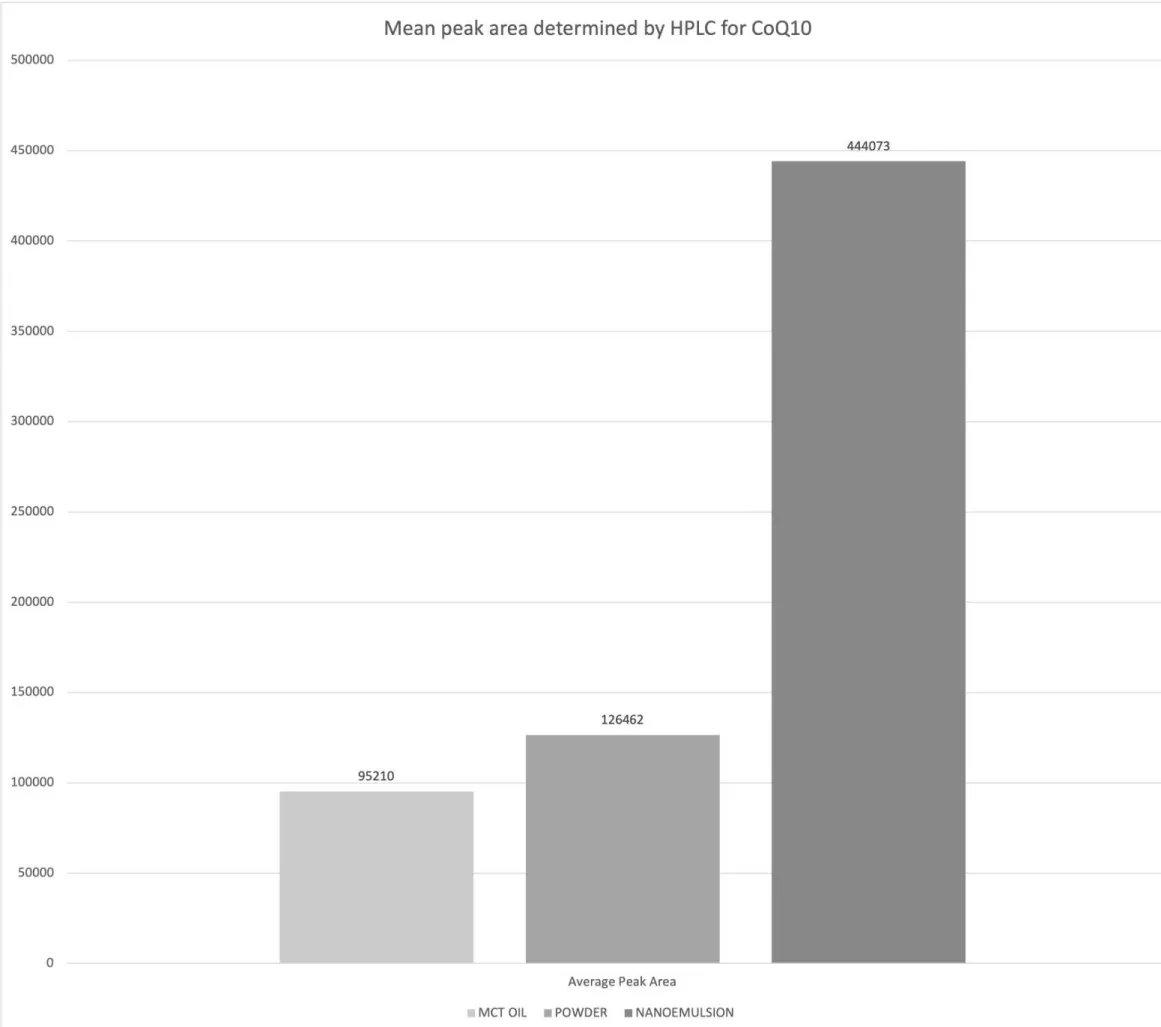
Nanoemulsion‑fed larvae displayed the highest CoQ10 uptake, with a mean peak area of 444,073 ± 273,416. Larvae fed crystalline powder showed intermediate uptake (126,462 ± 65,265), while those fed CoQ10 in MCT oil exhibited the lowest uptake (95,210 ± 36,401). One‑way ANOVA indicated significant differences among the three groups; Tukey’s post hoc analysis revealed p < 0.01 for nanoemulsion versus both powder and oil, and p < 0.05 for powder versus oil (Figure 1). Thus, the nanoemulsion yielded approximately 3–4‑fold higher CoQ10 uptake than the oil formulation and ~3.5‑fold higher than the powder.
Chromatographic profiles
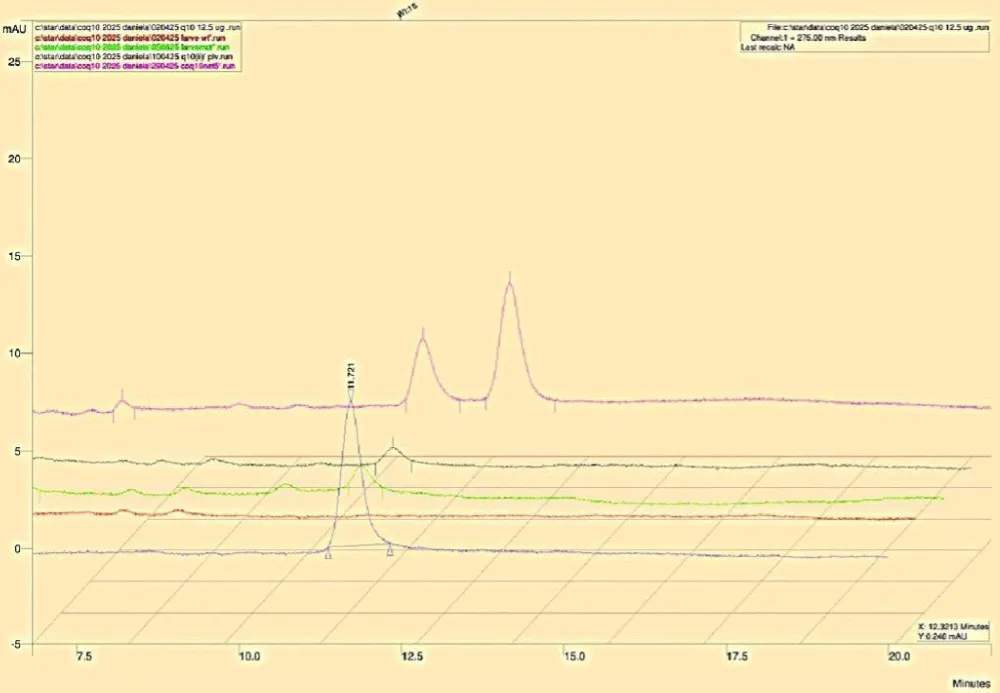
Representative chromatograms (Figure 2) showed that samples from nanoemulsion‑fed larvae had broader and higher peaks at the CoQ10 retention time than those from powder or oil groups, consistent with superior bioavailability. Control larvae chromatograms lacked a detectable CoQ10 peak, further supporting method specificity.
Discussion
This study demonstrates that a nanoemulsified CoQ10 formulation markedly enhances in vivo CoQ10 bioavailability in Drosophila larvae compared to both crystalline powder and MCT oil at the same nominal dietary concentration. The ~3–4‑fold increase in CoQ10 signal with nanoemulsion is consistent with previous reports in mammals where nanoemulsions, self‑nanoemulsifying systems, liposomes, and particle‑size reduction approaches improved CoQ10 bioavailability by roughly 2–4‑fold [4-8]. Mechanistically, nanoemulsions improve gastrointestinal absorption of lipophilic compounds by increasing apparent solubility, promoting formation of mixed micelles, and enhancing contact with and permeation across the intestinal epithelium [5,12]. Nanoemulsions can facilitate transporter‑mediated uptake (e.g., via NPC1L1) and may partially circumvent conventional lymphatic bottlenecks. Although the Drosophila midgut differs anatomically from the mammalian intestine, analogous processes—improved dispersion of CoQ10 in the diet, greater surface area, and surfactant‑mediated interaction with the gut epithelium—likely underlie the enhanced uptake observed here. Drosophila represents a powerful platform for nutraceutical and pharmacokinetic screening due to its conserved mitochondrial and metabolic pathways, high genetic homology to humans, and the availability of CoQ‑deficient and disease‑model strains [3,9,11,12]. Endogenous coenzyme Q content in Drosophila, dominated by CoQ9, shows age‑related decline and tissue‑specific distribution, paralleling human patterns [3,10]. Supplementation with exogenous CoQ9 or CoQ10 can modulate tissue CoQ status and rescue mitochondrial phenotypes without necessarily affecting lifespan, supporting the translational relevance of CoQ studies in this model [3,10,11]. By demonstrating a clear formulation‑dependent hierarchy in CoQ10 uptake (nanoemulsion > powder > oil), this work supports the use of Drosophila larvae as an efficient in vivo screen for optimizing CoQ10 delivery systems before more costly mammalian or human pharmacokinetic trials [4,9,13]. The data also reinforce a broader consensus that improving dispersion, solubilization, and interfacial behavior of CoQ10 in the gastrointestinal tract is central to overcoming its poor intrinsic bioavailability [2,4-7,14].
Limitations and Future Directions
The present study was intentionally designed as a focused evaluation of formulation-dependent CoQ10 uptake during the larval stage of Drosophila melanogaster, a developmentally and metabolically active phase that allows sensitive detection of differences in bioavailability. While this experimental framework enabled robust comparison among formulations under controlled conditions, extension of these findings to adult flies and longitudinal study designs will be important to determine how enhanced CoQ10 uptake relates to functional outcomes such as lifespan, locomotor performance, neurological function, cardiac function, and stress resistance, as previously explored in related models [3,9,11].
In this work, a single CoQ10 dose and sampling time point were selected to allow direct, standardized comparison of uptake efficiency across formulations. Future studies incorporating dose–response and time-course analyses would further refine the pharmacokinetic and dynamic profiles of these delivery systems.
CoQ10 levels were assessed using whole-larva homogenates, providing an integrated measure of systemic uptake. Although this approach captures overall bioavailability at the organismal level, subsequent investigations employing tissue-specific analyses (e.g., gut, fat body, muscle, or nervous system) would offer deeper insight into distribution patterns, particularly in light of prior reports of segment-specific and sex-dependent CoQ localization.
Bioavailability in the present study was expressed as relative signal intensity (peak area), which is appropriate for comparative evaluation of formulation performance. Absolute quantification normalized to protein content or tissue mass represents a valuable future step for defining precise tissue concentrations and enabling cross-study comparisons.
Building on these findings, future research should characterize dose–response relationships for different CoQ10 formulations, perform detailed time-course studies, and evaluate nanoemulsion supplementation in CoQ-deficient or disease-model Drosophila strains to assess effects on mitochondrial function and organismal phenotypes [2,3,12]. Integration of transcriptomic or proteomic profiling of the larval gut and metabolically active tissues following nanoemulsion versus powder or oil supplementation may further elucidate molecular pathways underlying enhanced uptake and utilization. Finally, comparative studies with other advanced delivery systems (e.g., liposomes, solid dispersions, co-amorphous systems) would help refine formulation strategies and inform translational development for clinical applications [4-8,15-17].
Conclusion
CoQ10 nanoemulsions substantially enhance CoQ10 uptake in Drosophila melanogaster larvae relative to powder and MCT oil formulations at identical dietary concentrations. These findings support nanoemulsification as a promising strategy to overcome the poor oral bioavailability of CoQ10 and validate Drosophila as a rapid, genetically tractable in vivo model for screening and optimizing CoQ10 delivery systems with potential relevance for human health.
References
- Nappi D, Cotecchia S, Cannillo J, Salerno A. Coenzyme Q10 and its bioavailability in an experimental model of Drosophila melanogaster. Heliyon. 2024;10(19):e38797.
- Mantle D, Dybring A. Bioavailability of Coenzyme Q10: An Overview of the Absorption Process and Subsequent Metabolism. Antioxidants (Basel). 2020 May 5;9(5):386. doi: 10.3390/antiox9050386. PMID: 32380795; PMCID: PMC7278738.
- González-García P, Barriocanal-Casado E, Díaz-Casado ME, López-Herrador S, Hidalgo-Gutiérrez A, López LC. Animal Models of Coenzyme Q Deficiency: Mechanistic and Translational Learnings. Antioxidants (Basel). 2021 Oct 26;10(11):1687. doi: 10.3390/antiox10111687. PMID: 34829558; PMCID: PMC8614664.
- Maciejewska-Stupska K, Czarnecka K, Szymański P. Bioavailability enhancement of coenzyme Q10: An update of novel approaches. Arch Pharm (Weinheim). 2024 Aug;357(8):e2300676. doi: 10.1002/ardp.202300676. Epub 2024 Apr 29. PMID: 38683827.
- Zhou H, Liu G, Zhang J, Sun N, Duan M, Yan Z, Xia Q. Novel lipid-free nanoformulation for improving oral bioavailability of coenzyme Q10. Biomed Res Int. 2014;2014:793879. doi: 10.1155/2014/793879. Epub 2014 Jun 5. PMID: 24995328; PMCID: PMC4068099.
- Bule MH, et al. Improvement of the oral bioavailability of coenzyme Q10 by reduction of the particle size or by complexation with cyclodextrins. LWT–Food Sci Technol. 2008;41(10):1853–1858.
- Niu Z, Acevedo-Fani A, McDowell A, Barnett A, Loveday SM, Singh H. Nanoemulsion structure and food matrix determine the gastrointestinal fate and in vivo bioavailability of coenzyme Q10. J Control Release. 2020 Nov 10;327:444-455. doi: 10.1016/j.jconrel.2020.08.025. Epub 2020 Aug 25. PMID: 32853729.
- Jäger R, Purpura M, Godavarthi A, Ceylan HI, Balcombe ST, Chandrappa A, Tinsley GM. Impact of liposomal delivery on coenzyme Q10 absorption: a double-blind, placebo-controlled, randomized trial. Front Nutr. 2025 Sep 17;12:1605033. doi: 10.3389/fnut.2025.1605033. PMID: 41041129; PMCID: PMC12486408.
- Piper MDW, et al. Enhancing drug administration in Drosophila melanogaster. Preprint. 2025. doi:10.21203/rs.3.rs-4274382/v1
- Cirilli I, Orlando P, Hrelia S, Marcheggiani F, Tiano L, Beghelli D, Angeloni C. Endogenous coenzyme Q content and exogenous bioavailability in D. melanogaster. Heliyon. 2024 Sep 12;10(18):e37854. doi: 10.1016/j.heliyon.2024.e37854. PMID: 39315151; PMCID: PMC11417581.
- Fernández-Ayala DJM, Jiménez-Gancedo S, Guerra I, Hernández-Camacho JD, Neto M, Scialo F, Astillero-López V, Cortés-Rodríguez AB, Santos-Ocaña C, Rodríguez-Aguilera JC, Casares F, Sanz A, López-Lluch G, Navas P. Modelling the human coenzyme Q deficiency in Drosophila melanogaster. Free Radic Biol Med. 2025 Mar 16;230:95-111. doi: 10.1016/j.freeradbiomed.2024.12.056. Epub 2025 Jan 27. PMID: 39864756.
- Liu J, et al. RNA interference of CoQ genes in Drosophila. Biofactors. 2008;32(1–4):113–118.
- ClinicalTrials.gov. Pharmacokinetic Study on Three Formulations of Coenzyme Q10. Identifier: NCT03978455. 2019.
- Wang Y, et al. Enhanced solubility and bioavailability of coenzyme Q10 via co-amorphization with stevioside. npj Mater Degrad. 2025;9:36.
- Cirilli I, Orlando P, Hrelia S, Marcheggiani F, Tiano L, Beghelli D, Angeloni C. Endogenous coenzyme Q content and exogenous bioavailability in D. melanogaster. Heliyon. 2024 Sep 12;10(18):e37854. doi: 10.1016/j.heliyon.2024.e37854. PMID: 39315151; PMCID: PMC11417581.
- Onoue S, et al. Self-nanoemulsifying particles of coenzyme Q10 with improved bioavailability. Procedia Food Sci. 2015;5:253–256.
- Rao S. Design of functional beverage emulsion systems for improved citral stability and coenzyme Q10 bioavailability. PhD thesis. Rutgers University; 2016.




Content Alerts
SignUp to our
Content alerts.
 This work is licensed under a Creative Commons Attribution 4.0 International License.
