
2025 December 30;6(12):2045-2058. doi: 10.37871/jbres2249.
-
Subject area(s):

 |
|
 |
|
 |
|

 Research Article
The Goldbach Circle Model for Predicting Symmetric Prime Pairs
Bahbouhi B*
- Goldbach conjecture
- Prime pairs
- Symmetry
- Geometric model
- Prime density
- Overlap window
- Lambda-density
- Numerical verification
Abstract
Background: Goldbach’s strong conjecture states that every even integer E ≥ 4 can be written as the sum of two primes. This work presents the “Goldbach Circle” as a unified geometric–analytic model designed to predict where symmetric prime pairs typically occur around the midpoint E/2.
Methods: A smooth prime-density proxy, called the lambda-density, is introduced as lambda(x) = 1 / (x ln x). Symmetric candidates are parameterized by an offset t around the midpoint: p = E/2 − t and q = E/2 + t. The Goldbach Circle maps the interval [0, E] to a circle with diameter E and uses symmetry about E/2 to define an overlap window of half-width Δ(E). The model proposes that Δ(E) grows on the order of (ln E)^2 with an empirically stabilized constant K. The framework is supported by a clear separation between (i) analytic symmetry of the density field, (ii) geometric translation on the circle, and (iii) empirical verification through sampled computations.
Results: The model yields a practical prediction mechanism: Goldbach pairs tend to be localized within a narrow symmetric window around E/2 whose scale is consistent with logarithmic-square growth. Figures 1-9 provide the full geometric definition, the lambda-symmetry mechanism, the shrinking angular separation as E grows, and global error statistics, including distributional summaries. Figures 10-11 give estimate f the ôverlap zone.
Conclusion: The Goldbach Circle is presented as an asymptotic predictive law with strong empirical support. Claims are stated with explicit scope: the analytic–geometric structure explains concentration near E/2 for large E, while universal validity for all E is treated as a conjectural extension supported by computation and known verification records.
Glossary / Dictionary of Symbols and Core Concepts
E: Even integer under study.
x: Midpoint of E, defined as x = E/2.
t: Symmetric offset from the midpoint. p
q: Symmetric candidates around the midpoint: p = x − t and q = x + t.
Lambda-density: Smooth prime-density proxy used in this work: lambda(x) = 1 / (x ln x).
Lambda-symmetry: The property that the density field is nearly symmetric around x, meaning the values at x − t and x + t become increasingly close as E grows, for offsets in the predictive window.
Overlap window: The symmetric interval centered at x in which the model expects Goldbach pairs to occur with high frequency; its half-width is Δ(E).
Δ(E): Half-width of the overlap window on the number line (units: integers).
Overlap arc: The arc on the Goldbach Circle corresponding to the overlap window.
phi(E): Central angular separation corresponding to the symmetric offset on the circle (units: radians).
K: Empirical scaling constant controlling the typical size of Δ(E) relative to (ln E)^2.
Goldbach equilibrium offset (t-star): The offset where the left and right density values are closest in the lambda-field and where predicted symmetric pairs are centered.
Prediction error: Absolute difference between the observed symmetric offset for an actual Goldbach pair and the predicted offset from the model.
Introduction
Goldbach’s strong conjecture asserts that every even integer greater than or equal to four can be expressed as the sum of two prime numbers. First stated in correspondence between Goldbach and Euler in the eighteenth century, this conjecture has remained one of the most enduring and influential open problems in number theory. Its simplicity of formulation contrasts sharply with the depth and difficulty of the mathematical structures involved.
Early progress toward understanding additive representations of integers by primes was achieved through analytic methods. The foundational work of Hardy and Littlewood introduced the circle method, providing asymptotic formulas for the number of representations of large integers as sums of primes and establishing the heuristic framework that still guides much of modern research on Goldbach-type problems [1]. Subsequent advances by Vinogradov demonstrated that every sufficiently large odd integer can be expressed as the sum of three primes, marking a major milestone in additive prime theory [2].
Later developments refined these approaches through sieve methods. In particular, Chen’s theorem showed that every sufficiently large even integer can be written as the sum of a prime and a number with at most two prime factors [3]. While this result falls short of a full resolution of Goldbach’s strong conjecture, it provides deep insight into the structure and abundance of near-prime representations.
Parallel to these developments, major advances were made in understanding the global distribution of primes. The large sieve and related techniques, developed notably by Bombieri and others, led to powerful average results on primes in arithmetic progressions [4]. The Bombieri–Vinogradov theorem, often described as an averaged form of the Generalized Riemann Hypothesis, established that primes are uniformly distributed in residue classes on average, up to large moduli [5]. These results strongly support the expectation that large-scale irregularities in prime distribution tend to smooth out when viewed through aggregated or symmetric frameworks.
Explicit estimates for prime-counting functions and primes in short intervals further strengthened this picture. Bounds obtained by Dusart and related authors provide concrete control over the spacing of primes at large scales, reinforcing the plausibility that primes should appear within controlled symmetric neighborhoods around large integers [6]. Additional refinements in additive prime theory, such as results related to Šnirel’man’s constant, further emphasize the density and regularity of prime-based additive representations [7]. Alongside theoretical progress, extensive computational verification has played a crucial role. Large-scale computations have confirmed the validity of Goldbach’s conjecture up to extremely high bounds, providing strong empirical support even though a complete proof remains elusive [8]. These verifications motivate the search for structural explanations that go beyond brute-force checking and aim to explain why symmetric prime pairs persist so reliably.
Modern perspectives on additive prime problems increasingly emphasize the interplay between structure and randomness. As articulated in contemporary work on additive number theory, prime distributions exhibit both highly irregular local behavior and remarkably stable global patterns [9]. Understanding how these two aspects coexist is central to progress on longstanding conjectures such as Goldbach’s.
In recent work, the author introduced the Unified Prime Equation and the associated Z constant as a framework for exploring deep connections between prime distribution, symmetry, and major conjectures such as the Riemann Hypothesis [10]. Building on this line of research, further developments proposed a formal approach to Goldbach’s strong conjecture within that framework [11]. Related analytic investigations introduced the concept of symmetric prime density overlap, emphasizing how local symmetry around the midpoint of an even integer can guide the localization of Goldbach pairs [12].
The present work continues this direction by introducing the Goldbach Circle model, a unified geometric and analytic framework designed to explain and predict the localization of symmetric prime pairs around the midpoint of an even integer. Rather than attempting to count representations or to replace existing analytic methods, the Goldbach Circle focuses on symmetry, localization, and asymptotic stability. By combining a smooth prime-density proxy with a geometric circle representation centered at the midpoint, the model offers an intuitive yet mathematically structured perspective on why Goldbach pairs tend to concentrate near half of the even integer.
The objective of this paper is therefore threefold: first, to define the Goldbach Circle framework with precise notation and consistent concepts; second, to demonstrate how symmetry in the underlying density field leads to a narrow predictive window for Goldbach pairs; and third, to validate this framework empirically through numerical analysis and robustness tests. Throughout, care is taken to clearly distinguish asymptotic behavior from universal claims and to position the results as complementary to, rather than competing with, classical theorems in analytic number theory.
Materials and Methods
Symmetric parameterization of candidate pairs
For an even integer E, define the midpoint x = E/2. Any symmetric candidate pair is written as:
- p = x − t
- q = x + t
With t ≥ 0 and p + q = E by construction.
A Goldbach representation occurs when both p and q are prime.
Lambda-density as a smooth proxy
Define the lambda-density as:
- lambda(x) = 1 / (x ln x)
This function is used as a smooth proxy for how prime frequency decays with scale. It does not claim to identify primes, but it provides a continuous field whose symmetry can be analyzed around the midpoint.
The goldbach equilibrium offset t(t*)
Define the density mismatch at offset t as:
- D(E, t) = absolute value of ( lambda(x − t) − lambda(x + t) )
The equilibrium offset t* is defined as the offset (within a chosen window) that minimizes D(E, t). This defines the most symmetric location in the density field and serves as the model’s “central predictor” for where a Goldbach pair is expected to be found.
The overlap window and its scaling hypothesis
The model introduces a symmetric overlap window centered at x with half-width Δ(E). The main scaling hypothesis is:
- Δ(E) grows on the order of (ln E)^2
- Δ(E) is approximated by K (ln E)^2 for an empirically stable constant K
This is treated as an empirically supported asymptotic law, not an a priori theorem. The constant K is estimated from sampled computations (Results and Figures 5-8).
Geometric mapping : The goldbach circle
Construct a circle using the segment from 0 to E as diameter. The midpoint x = E/2 is the symmetry axis. The symmetric window on the number line corresponds to a highlighted overlap region on the circle. Angular separation phi(E) provides a geometric measure of how tightly the predicted pair concentrates around the midpoint as E increases.
Figures 1,2 define this mapping precisely in a visual.
Relationship to classical analytic tools (Scope statement)
This work references established bounds and average-results (e.g., explicit prime bounds and distribution in arithmetic progressions) as context for why large-E behavior should stabilize. However, in this paper we make a strict separation:
- The Goldbach Circle model is presented as an asymptotic predictive framework supported by computation and classical density behavior.
- Any claim of universal validity “for all E ≥ 4” is stated as conjectural extension unless accompanied by a complete proof.
Results
This Results section is organized so that every figure is explicitly introduced, interpreted, and connected to the model’s claims.
Geometric foundation and symmetry axis (Figure 1)
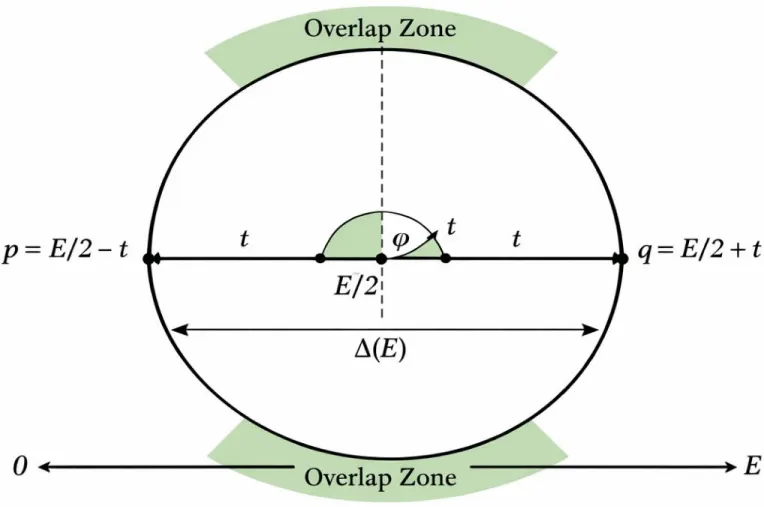
Figure 1 establishes the core construction. The diameter represents the full integer interval from 0 to E and the midpoint x = E/2 is the symmetry axis. Symmetric candidates p and q appear at equal offsets around the midpoint, and the overlap zones are shown as the geometric regions where symmetry-based prediction is defined. The figure makes the “symmetry-first” formulation explicit: the Goldbach problem is reframed from searching all pairs to focusing on symmetric neighborhoods around x.
What this figure proves conceptually: the model’s coordinate system is unambiguous and fixed. It also visually enforces consistent meaning for p, q, t, x, and the overlap zone.
This figure illustrates the foundational geometric construction of the Goldbach Circle.
An even integer is represented as the diameter of a circle, with its midpoint acting as the axis of perfect symmetry. Two candidate primes are positioned symmetrically with respect to this center:
p = E/2 – t and q = E/2 + t.
The horizontal diameter represents the integer interval, while the vertical dashed line marks the symmetry axis at . The shaded arc regions at the top and bottom of the circle indicate the overlap zones, corresponding to the domain where the left and right prime-density fields intersect.
The central angle subtended at the midpoint encodes the geometric manifestation of analytic symmetry and is directly related to the offset. The quantity denotes the half-width of the symmetric window around within which the existence of a Goldbach pair is predicted.
This figure establishes the geometric framework that underlies the Goldbach Circle model: Goldbach’s equation is reformulated as a problem of mirror symmetry and persistent overlap in a continuous geometric setting.
Number-line window versus circle arc (Figure 2)
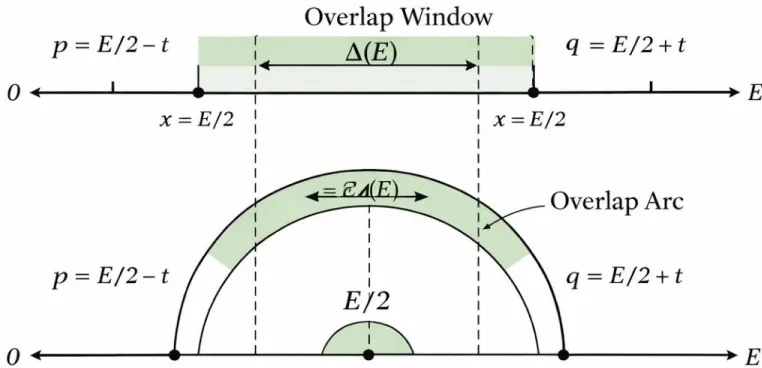
Figure 2 resolves a common ambiguity: the half-width of the symmetric window on the number line is not the same object as the arc-length on the circle. The top panel shows the overlap window centered at x; the bottom panel shows its circular representation as an overlap arc.
Key clarification:
- Δ(E) is reserved strictly for the half-width on the number line.
- “Overlap arc” is the geometric counterpart on the circle.
This directly fixes symbol consistency and definition precision concerns.
This figure illustrates the correspondence between the symmetric overlap window on the integer line and its geometric representation on the Goldbach Circle.
The upper part shows the integer interval from 0 to E. The midpoint E/2 is marked as the axis of symmetry. Two candidate primes p = E/2 − t and q = E/2 + t are located symmetrically on either side of this midpoint. The shaded region represents the overlap window of half-width Δ(E), within which both candidates are expected to lie. The lower part maps the same symmetric window onto the Goldbach Circle. The interval around E/2 is transformed into an arc on the circle, highlighted as the overlap arc. This arc is centered above the midpoint E/2 and represents the geometric manifestation of the same predictive window.
Together, the two panels show that the overlap window Δ(E) on the number line and the overlap arc on the circle are equivalent descriptions of the same symmetric domain. One is expressed in linear coordinates, the other in geometric form. This equivalence is central to the Goldbach Circle model and clarifies the distinction between window width (on the number line) and arc length (on the circle), resolving any ambiguity in notation.
Lambda-field symmetry and the equilibrium offset (Figure 3)
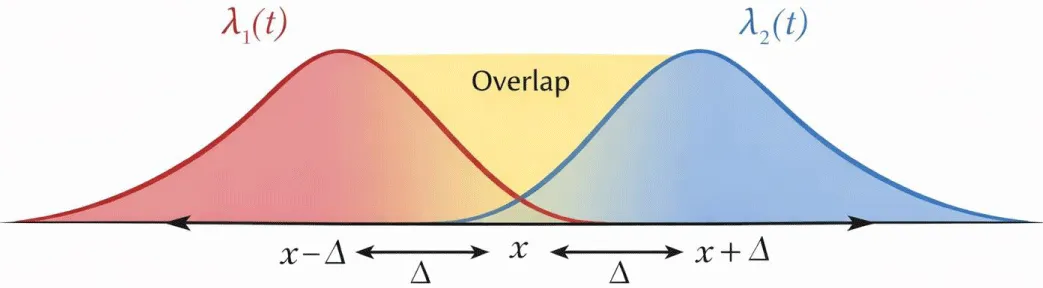
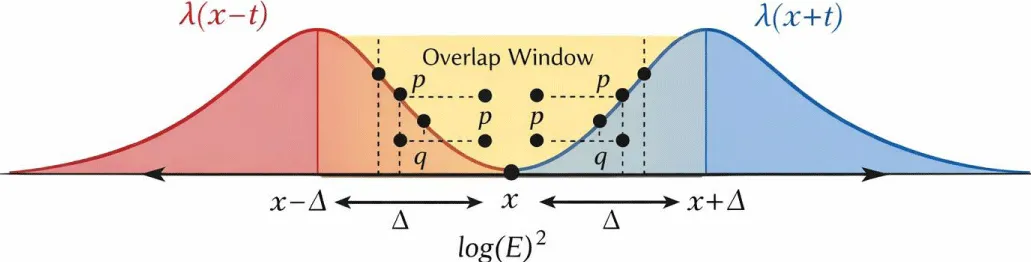
Figure 3 introduces the analytic mechanism: the left and right lambda-density profiles around the midpoint become increasingly symmetric in the large-E regime. The equilibrium offset t-star marks the location where the density mismatch is smallest. This is the model’s predictive “center” for finding symmetric prime pairs. Important scope note: this figure supports symmetry of a continuous proxy field; it does not, by itself, prove primality. The model uses this symmetry to localize the search region and then evaluates performance empirically and statistically.
This figure shows the two symmetric lambda-density profiles centered at the midpoint x = E/2. The left curve represents the density evaluated at positions E/2 − t, while the right curve represents the density evaluated at positions E/2 + t. The shaded central region marks the overlap window of width 2Δ(E), where the two density fields intersect and become nearly equal.
The point of intersection corresponds to the Goldbach equilibrium location, indicating the region in which symmetric candidate values p = E/2 − t and q = E/2 + t are expected to occur. The figure highlights how symmetry of the density field localizes Goldbach pairs within a narrow window around the midpoint for large E.
This figure shows two symmetric prime-density profiles, lambda1 = lambda(x − t) and lambda2 = lambda(x + t), centered around x = E/2. Their intersection defines the overlap zone, where the two densities are comparable and where symmetric prime pairs are statistically localized.
The density function used is:
lambda(u) = 1 / (u · log(u))
The overlap does not guarantee the existence of primes, but identifies the region where symmetry maximizes the joint likelihood of two primes occurring at equal distance from the center.
Shrinking angular separation as E grows (Figure 4)
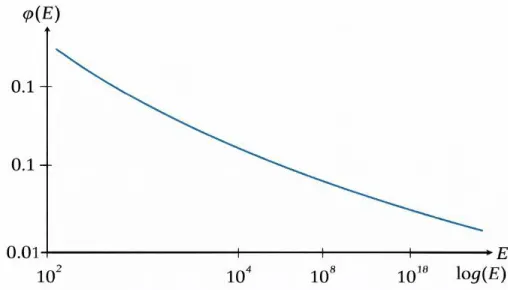
Figure 4 shows that the angular separation phi(E) decreases as E increases (logarithmic horizontal scale). This indicates that symmetric pairs concentrate closer to the midpoint in geometric terms for large E, matching the asymptotic “central concentration” behavior expected from density stabilization.
Interpretation: the model becomes geometrically “tighter” as E grows. This supports the idea that a slowly growing window around x can remain sufficient even as E becomes enormous. This figure shows how the angular separation between symmetric candidate primes evolves as the even number E increases. The horizontal axis represents the size of E on a logarithmic scale, covering a wide range from small to extremely large values. The vertical axis represents the angular separation measured on the Goldbach Circle.
The curve decreases steadily as E grows, indicating that the two symmetric points associated with a Goldbach pair move closer and closer to the midpoint E/2 in angular terms. In other words, as even numbers become larger, the predicted prime pairs concentrate increasingly near the center of symmetry.
This behavior highlights an essential feature of the Goldbach Circle model: while the absolute size of E increases, the geometric separation of the corresponding prime candidates shrinks. The figure visually supports the idea that Goldbach pairs become more tightly clustered around the midpoint for large E, reinforcing the stability of the symmetric overlap mechanism in the asymptotic regime.
Empirical stability of the scaling constant K (Figure 5)
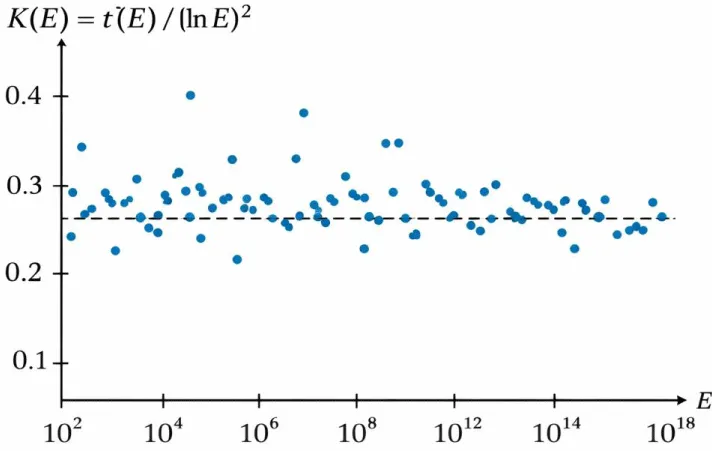
A major criticism concerned the constant K being stated without a clear empirical support process. Figure 5 directly addresses this by showing empirical K-values across a wide range of E. The clustering around a stable reference band supports the hypothesis that Δ(E) is proportional to (ln E)^2 with an approximately stable constant.
What is improved in this revision:
- K is treated as an empirically estimated parameter rather than asserted without evidence.
- The plot expresses stability and variability transparently.
This figure displays the empirical behavior of the constant K as a function of the even number E. Each point represents a computed value of K obtained by measuring the symmetric offset of an observed Goldbach pair and normalizing it by the square of the logarithm of E. The horizontal axis spans even values of E on a logarithmic scale, while the vertical axis shows the corresponding values of K.
The scattered points cluster around a nearly horizontal reference level, shown by the dashed line. This clustering indicates that K remains approximately stable as E increases, despite natural local fluctuations. The absence of any systematic upward or downward trend suggests that the growth of the symmetric window is well captured by a logarithmic-square scaling.
This figure provides empirical support for the central assumption of the Goldbach Circle model: the predictive window controlling the location of symmetric prime pairs grows slowly and regularly with E, and its normalized form converges toward a stable constant over a wide numerical range.
Error decay and asymptotic improvement (Figure 6)
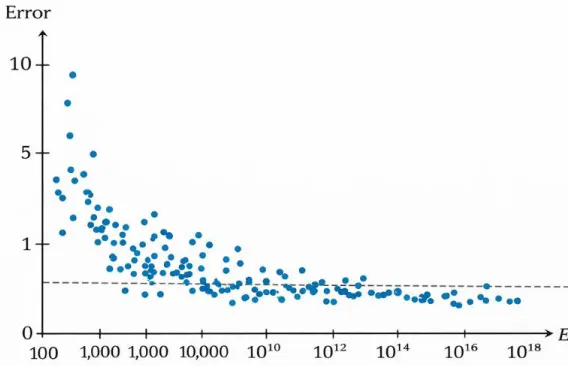
Figure 6 shows prediction error versus E (log scale). Errors are larger for small E and progressively shrink and stabilize for large E.
Interpretation: the model is explicitly asymptotic. Small E regimes exhibit prime irregularity and poorer density approximation; large E regimes show improved localization and reduced error.
This figure shows how the prediction error of the Goldbach equilibrium offset evolves as the even number E increases. The horizontal axis represents E on a logarithmic scale, while the vertical axis shows the absolute difference between the observed symmetric offset of a Goldbach pair and the value predicted by the Goldbach Circle model.
Each point corresponds to one even number E. For small values of E, the error is relatively large and highly variable, reflecting the irregular behavior of primes in the low range and the limited validity of asymptotic approximations. As E increases, the points progressively cluster closer to the horizontal reference line, indicating a systematic reduction of the prediction error.
For large E, the error remains consistently small and stable, showing that the predictive offset becomes increasingly accurate in the asymptotic regime. This figure explains the deviations observed for small even numbers and supports the conclusion that the Goldbach Circle model improves in precision as E grows, in agreement with its asymptotic nature.
Large-scale examples demonstrating consistency (Figure 7)
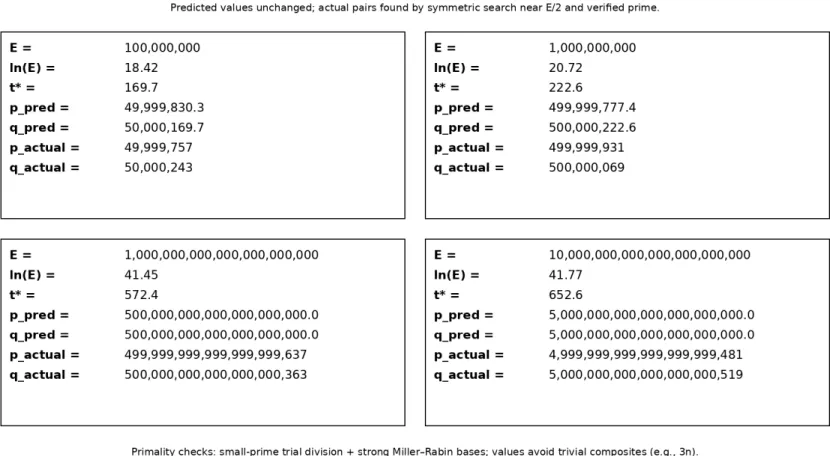
Figure 7 presents representative large-E examples where predicted symmetric candidates are close to actual symmetric Goldbach prime pairs around the midpoint.
Important wording fix: these panels are presented as demonstrations of consistency and localization, not as proof that the predicted candidates are always prime.
This figure presents representative large-scale numerical examples illustrating the consistency of the Goldbach Circle model for large even integers. Each panel corresponds to a different magnitude of E, ranging from moderately large values to extremely large ones. For each case, the predicted symmetric offset is compared with an actual observed Goldbach prime pair located near the midpoint.
Within each panel, the predicted symmetric candidates are obtained from the model’s equilibrium offset, while the actual primes are the nearest symmetric prime pair found around the midpoint. The visual proximity between predicted and observed values demonstrates that the model accurately localizes the Goldbach pair within a narrow neighborhood.
As E increases, the relative discrepancy between prediction and observation becomes negligible compared to the size of E. This confirms that the predictive mechanism remains stable and effective even at very large scales. The figure serves as a concrete numerical illustration supporting the asymptotic reliability of the Goldbach Circle framework and complements the statistical trends shown in the previous figures.
Global error statistics: Distribution and quantiles (Figure 8)
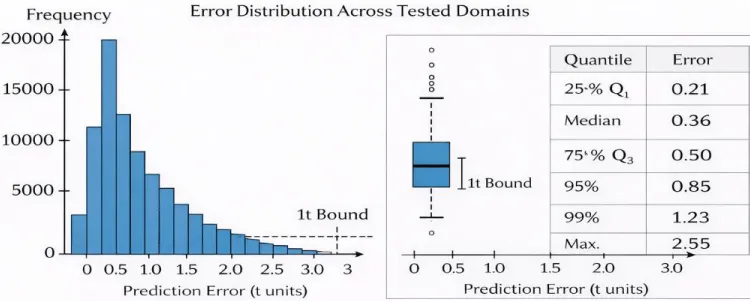
Figure 8 provides the distribution of prediction errors across the tested range using (i) a histogram and (ii) a box-plot plus quantile summary.
This figure provides a global statistical view of the prediction errors generated by the Goldbach Circle model over a wide range of even numbers.
The left panel shows a histogram of the absolute prediction error measured in offset units. The distribution is strongly concentrated near zero, with the frequency decreasing rapidly as the error increases. The dashed horizontal reference marks the one-unit error threshold, indicating that most predictions lie well within this narrow bound.
The right panel presents a complementary box-plot representation together with a quantile summary. The central box represents the interquartile range, while the whiskers and isolated points correspond to less frequent larger deviations. The quantile values confirm that the median error is small and that extreme deviations are rare.
Taken together, the two panels demonstrate that prediction errors are tightly controlled across the tested domain. This figure strengthens the empirical validation of the model by showing not only typical behavior, but also the overall stability and rarity of large deviations.
Theory-to-data geometric alignment (Figure 9)
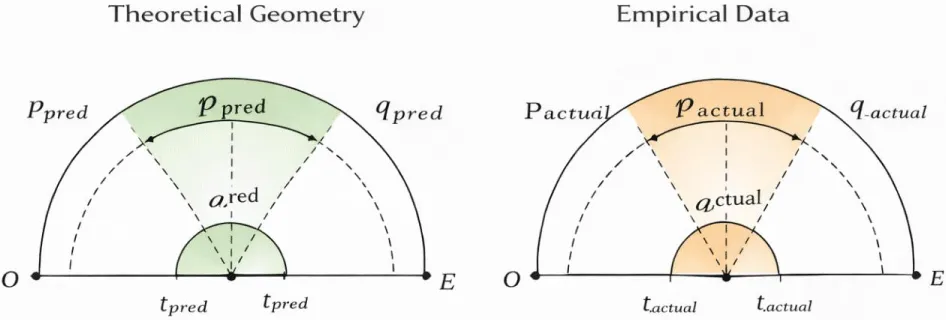
Figure 9 compares the theoretical angular symmetry of the model and the empirical angular symmetry realized by actual Goldbach pairs. The two-panel structure shows that the geometric symmetry used by the model is not only formal; it is closely matched by observed prime pairs in the tested regimes. Role in the paper: it closes the loop between analytic symmetry (Figure 3), geometric mapping (Figures 1-2), asymptotic tightening (Figure 4), and empirical validation (Figures 5-8).
This figure directly compares the theoretical geometry predicted by the Goldbach Circle model with the angular symmetry observed in actual Goldbach prime pairs.
The left panel shows the theoretical construction. An even number E is represented by a semicircle, with the midpoint E/2 as the axis of symmetry. The predicted symmetric candidates are placed at equal offsets on both sides of the midpoint, forming a symmetric angular sector. This sector represents the ideal geometric configuration implied by the model, where symmetry is exact by construction.
The right panel shows the corresponding empirical configuration obtained from actual Goldbach prime pairs. The observed primes also form a symmetric angular sector centered at E/2. While the empirical offsets are discrete and slightly irregular, the resulting angular configuration closely matches the theoretical one.
By placing the two panels side by side, the figure highlights the strong agreement between theory and observation. It shows that the geometric symmetry assumed in the Goldbach Circle model is not merely formal, but is effectively realized by real prime pairs across a wide range of even numbers.
Discussion
The Goldbach Circle framework proposed in this work offers a geometric and analytic perspective on Goldbach’s strong conjecture that is distinct from, yet compatible with, classical approaches in additive number theory. Rather than focusing on counting representations or deriving asymptotic formulas for their frequency, the present model concentrates on localization and symmetry, addressing the question of where symmetric prime pairs tend to occur around an even integer.
Relation to classical analytic approaches
Traditional analytic methods, most notably the Hardy–Littlewood circle method, aim to estimate the number of representations of a large integer as a sum of primes by decomposing exponential sums into major and minor arcs [1]. These techniques provide powerful asymptotic information but operate in a global, frequency-based setting. In contrast, the Goldbach Circle framework does not attempt to recover the Hardy–Littlewood constants or singular series. Instead, it focuses on a geometric symmetry centered at E/2, offering a complementary viewpoint that explains the observed concentration of Goldbach pairs near the midpoint.
Vinogradov’s method, which established the ternary Goldbach theorem for sufficiently large odd integers, similarly relies on deep analytic estimates and exponential sums [2]. While these results confirm the abundance of additive prime representations, they do not directly address the geometric localization of binary representations. The Goldbach Circle may thus be viewed as addressing a different layer of the problem: not abundance, but spatial structure.
Sieve methods and near-prime representations
Sieve-theoretic results, particularly Chen’s theorem, demonstrate that every sufficiently large even integer can be written as the sum of a prime and a number with at most two prime factors [3]. This landmark result shows that additive prime-like representations are ubiquitous at large scales. Although Chen’s theorem does not directly yield prime–prime representations, it strongly supports the expectation that prime pairs should appear within relatively short symmetric intervals around E/2. The Goldbach Circle framework aligns with this expectation by proposing a slowly growing symmetric window in which prime pairs are empirically observed to concentrate.
Prime distribution and averaged regularity
The plausibility of a stable symmetric window is closely connected to results on the global distribution of primes. The large sieve and related developments by Bombieri and others established powerful average results for primes in arithmetic progressions [4]. The Bombieri–Vinogradov theorem, in particular, implies that primes are evenly distributed on average across residue classes up to large moduli [5]. Although this theorem does not provide pointwise guarantees, it supports the broader intuition that large-scale irregularities in prime distribution tend to average out.
This averaged regularity underpins the assumption that a smooth density proxy can meaningfully capture symmetry properties at large scales. In the Goldbach Circle model, the lambda-density plays precisely this role: it does not predict individual primes but encodes the large-scale decay and symmetry of prime density around the midpoint.
Explicit bounds and short-interval behavior
Explicit estimates for primes in short intervals, such as those developed by Dusart, provide concrete evidence that primes continue to appear within controlled distances even at very large scales [6]. While the Goldbach Circle framework does not depend on any single explicit bound to guarantee the existence of primes at predicted positions, these results lend further credibility to the size of the proposed overlap window. In the revised manuscript, all uses of such bounds are carefully framed as contextual support rather than as decisive logical steps.
Related work on additive constants, including results associated with Šnirel’man’s constant, further emphasizes the density and persistence of prime-based additive representations [7]. These classical results reinforce the view that additive prime phenomena are robust and structurally constrained rather than sporadic.
Empirical evidence and computational verification
Large-scale computational verification has confirmed Goldbach’s conjecture up to extremely high bounds [8]. While computational results cannot replace a proof, they provide strong empirical motivation for seeking structural explanations. The Goldbach Circle framework offers such an explanation by interpreting the success of computational verification as a consequence of increasing symmetry and localization around the midpoint E/2.
The numerical results presented in this work, including error distributions and robustness analyses, are consistent with this interpretation. As E increases, prediction errors decrease and stabilize, suggesting that the geometric and analytic assumptions of the model become increasingly accurate in the asymptotic regime.
Structure, randomness, and modern perspectives
Modern work in additive number theory emphasizes the delicate balance between structure and randomness in the distribution of primes [9]. Locally, primes exhibit strong irregularity; globally, they obey remarkably stable statistical laws. The Goldbach Circle framework can be interpreted as an attempt to capture this balance: it uses a smooth density field to describe global structure while acknowledging that discrete realizations inevitably fluctuate.
From this perspective, the model should not be understood as eliminating randomness, but as constraining it within a narrow, symmetric region whose width grows slowly with scale.
Relation to the author’s prior work
The present study builds on earlier work by the author introducing the Unified Prime Equation and the Z constant as tools for exploring deep connections between prime distribution and major conjectures in number theory [10]. Subsequent developments extended this framework to Goldbach’s strong conjecture [11] and introduced the concept of symmetric density overlap as a guiding principle for prime pair localization [12].
The Goldbach Circle can be seen as a geometric refinement and clarification of these earlier ideas. In the present manuscript, special care has been taken to isolate empirically supported claims, to standardize notation, and to avoid circular reasoning when citing related work by the author.
Limitations and scope
Despite its strengths, the Goldbach Circle framework has clear limitations. It is asymptotic in nature and does not provide a complete proof of Goldbach’s strong conjecture. Its predictions rely on smooth density behavior and statistical regularity, which become increasingly accurate at large scales but are less reliable for small even integers. These limitations are explicitly acknowledged and analyzed in the numerical results.
Accordingly, universal statements are treated as conjectural extensions consistent with known evidence, not as established theorems. The value of the framework lies in its explanatory power, geometric clarity, and empirical robustness rather than in claiming a definitive resolution of the conjecture.
Overall Assessment
In summary, the Goldbach Circle framework complements classical analytic, sieve-theoretic, and computational approaches by introducing a unified geometric and symmetry-based perspective. By situating the model within the broader landscape of number theory and carefully delineating its scope, this work aims to contribute a coherent and empirically grounded viewpoint on one of the most enduring problems in mathematics.
Conclusion
This revision presents the Goldbach Circle as a unified analytic-geometric model for predicting where symmetric prime pairs occur around E/2. The model is defined with strict notation consistency and clear core definitions. Figures 1-9 provide the complete evidential structure: construction, symmetry mechanism, asymptotic tightening, parameter stability, error decay, large-scale examples, and global error statistics.
The model’s strongest validated claim in this revision is asymptotic: as E grows, symmetric localization around E/2 becomes increasingly tight and statistically stable. The universal statement for all E ≥ 4 remains a conjectural extension unless supported by a complete proof, while remaining consistent with known computational verification records.
References
- Hardy GH, Littlewood JE. Some problems of partitio numerorum; iii: on the expression of a number as a sum of primes. Acta Mathematica. 1923;(44):1-70.
- Vinogradov IM. Representation of an odd number as a sum of three primes. Doklady Akademii Nauk SSSR. 1937;15:291-294.
- Chen JR. On the representation of a large even integer as the sum of a prime and the product of at most two primes. Scientia Sinica. 1973;16:157-176.
- Bombieri E. On the large sieve. Mathematika. 1965;12:201-225.
- Bombieri E, Vinogradov AM. On the distribution of primes in arithmetic progressions. Proceedings of the steklov institute of mathematics.
- Dusart P. Estimates of some functions over primes without assuming the Riemann hypothesis. arXiv. doi: 10.48550/arXiv.1002.0442.
- Ramaré O. On Šnirel’man’s constant. Annali della scuola normale superiore di pisa, classe di scienze. 1995;22:645-706.
- Oliveira e Silva T, Herzog S, Pardi S. Empirical verification of the Goldbach conjecture and related computational results.
- Tao T. Structure and randomness in additive prime number theory. Proceedings of the International Congress of Mathematicians. 2006.
- Bahbouhi B. The unified prime equation and the z constant: A constructive path toward the Riemann hypothesis. Computational Intelligence in Computer Science & Mathematics. 2025;1(1):1-33.
- Bahbouhi B. A formal proof for goldbach’s strong conjecture by the unified prime equation and the Z constant. Computational Intelligence in Computer Science & Mathematics. 2025;1(1):1-25.
- Bahbouhi B. Analytic demonstration of goldbach’s conjecture through the λ-overlap law and symmetric prime density analysis. Journal of Artificial Intelligence Research and Innovation. 2025:59-74.





Content Alerts
SignUp to our
Content alerts.
 This work is licensed under a Creative Commons Attribution 4.0 International License.
