
2025 December 05;6(12):1889-1896. doi: 10.37871/jbres2237.
-
Subject area(s):

 |
|
 |
|
 |
|

 Review Article
Physical Properties of Structures Formed by Vertical Graphene Walls and Graphene Films
Khodos II*, Matveev VN, Nikolaichik VI and Kononenko OV
- Graphene
- Graphene walls
- Electron microscopy
- Conductivity
- Magnetic field
Abstract
The work is devoted to the study of heterostructures consisting from the graphene film covering the substrate, and a high density of graphene-like structures vertically oriented to the substrate plane and forming multilayer walls predominantly of circular shape. A technique has been developed that allows obtaining such structures from the carbon-containing atmosphere. The walls grew predominantly around the particles formed during the heat treatment of Fe/Al film pre-deposited on SiO2/Si substrate. The influence of electromagnetic radiation of visible and near-ultraviolet ranges on the conductivity of the obtained structures has been established. The dependence of their conductivity on the magnetic field has been shown, and the values of mobility µ and concentration ns of carriers have been measured.
Introduction
As is known, Graphene vertical Nano Walls (GNWs) (the term was introduced in the work of Wu Y, et al. [1] are formed by graphene multilayers [2] that grow perpendicular to their substrate. The wall thickness varies from several nanometers to several tens of nanometers. As shown by SEM and TEM microscopy, in most studies, GNWs are contained in carbon films in the form of micron-sized flakes with a layered graphite-like structure [1,3,4]. Raman spectra indicate that the obtained GNWs have a structure of significantly disordered nanocrystalline graphite and are immersed in an amorphous/quasi-amorphous carbon matrix [4,5].
GNWs are obtained by decomposition of carbon-containing gas into free radicals. Methane CH4 or acetylene C2H2 mixed with hydrogen or argon are mainly used, and in some studies, benzene is used, mainly utilizing the technology of chemical Vapor Deposition of Carbon (CVD) [6], similar to the methods used for producing graphene, carbon nanotubes, and thin diamond films. GNWs are obtained on SiO2 and other substrates. To intensify the dissociation of carbon-containing gas molecules, Plasma is used (PE CVD method), less common is the use of magnetron sputtering [7] or Atomic Layer Deposition (PEALD) [8]. The use of plasma is considered a key factor for the formation of GNWs. Plasma also increases the gradient of the chemical potential near the substrate surface, and increases the mobility of carbon atoms. Various methods of plasma generation are used, electromagnetic radiation of different wavelengths [1,9-11], electron beam [12], and other methods.
A number of works note that the electric field is the most important factor for understanding the mechanism of nanowall growth. According to [5], in addition to the electric field generated by plasma, the growth of nanowalls is influenced by inhomogeneous charging of the substrate due to the presence of metallic particles or other type of sharp features on the substrate surface. When the metal particles act as both a catalyst and a field modulator, nanofibers like nanotubes can be formed depending on the magnitude of the lateral electric field and other growth parameters such as gas flow and temperature. However, in the subsequent experiments, it was discovered that nanofibers can also grow on substrates even in the absence of catalytic particles [13].
Possible mechanisms of growth of GNW obtained using plasma have been considered in a number of works. According to works, e.g., [4,7,14], randomly oriented flat graphene nanoparticles are generated in the initial deposited buffer amorphous layer, among which vertically oriented particles exhibit a higher growth rate along their edges. The structure of the buffer layer was analyzed in [3,15] and a number of subsequent works. In [4], it is believed that vertical nanowalls are generated on the upwardly curving edges of the carbon film on the substrate at the sites of crack formation in it, and the electric field stimulates further attachment of carbon atoms to these edges.
According to studies on graphene nanowalls [4,6], the presence of a non-zero band gap in GNWs is due to the electronic states of the edges of graphene nanosheets and defects in the crystalline structure of the nanosheets. In [16-18] and related studies, the interaction of GNWs with a semiconductor substrate underlies the photodetection property of GNW-based structures. GNWs are also believed to be substrate-independent [6]. Studies of the electronic and magnetic properties of nanographite tapes using a tight-binding model allowed to conclude that the presence of an open boundary in sheets of two-dimensional graphite and of edge states at zigzag edges determine the unique electronic and magnetic properties [19]. The current state of GNW research, including methods and proposed mechanisms of GNW growth, electrical and optical properties, and advances in the application of GNWs for photodetection is discussed in the review [6].
In our works [20,21], the growth of multilayer graphene structures of type-circular graphene walls was reported. These walls were strongly vertically oriented to an oxidized silicon substrate on which Ni island film was previously created. It is noteworthy that the GNWs were not individual flakes in an amorphous/quasi-amorphous matrix, but a continuous forest of circular structures mainly around Ni catalyst particles and filled the entire surface of the sample with high density, leaving virtually no unfilled spaces. The structures have a uniquely large magnitude of the Hall Effect (a Hall sensor sensitivity of up to 3000 Ω/T was demonstrated), which opens up the possibility of their application, for example, in small-sized highly sensitive magnetic field sensors.
The use of plasma to obtain GNWs is accompanied by the formation of a large number of defects in the graphene layers. It leads, for example, to an increase in the resistance of GNWs and a decrease in the mobility of carriers in comparison with graphene films (by two orders of magnitude according to the review [6]). In this work, we applied the method of growing graphene nanowalls by catalytic decomposition of carbon-containing gas without the use of plasma, as a result of which the structure of the layers can be more ordered and less defective. The difference in the appearance of our nanowalls from flakes in known works is also obvious.
Therefore, one can expect some differences in the physical properties of our structures and the known results of measurements of the properties of samples containing GNW in the form of flakes.
In the present work we report on the formation of the carbon structure consisted of both a) a graphene film covering a SiO2 substrate with an island Fe catalyst deposited on it and b) high density of graphene layers vertically oriented to the SiO2 substrate in the form of vertical multilayer walls. The structure was obtained in the course of a single growth process. The influence of electromagnetic radiation of visible and near-ultraviolet ranges on the conductivity of the obtained samples, the large Hall Effect on the obtained structures and the results of TEM study are also reported.
Experimental
Graphene structures were synthesized using a Fe catalyst deposited in the form of Fe island films with the weighted average thickness of 1 nm. The Fe island films were deposited on the oxidized Si and Cu substrates previously coated with a 10 nm thick Al film by ablation with a pulsed laser with a wavelength of 1.06 μm in a vacuum of 10-5 Pa or by electron-beam evaporation. The samples were then annealed in air at 700°C to form the desired state of the catalyst in the form of an island film. During annealing, the aluminum film was oxidized, fixing the oxidized iron islands located on it. Synthesis of graphene structures occurred on reduced iron islands after a short-term injection of acetylene into the quartz chamber, rapid heating of the chamber to a temperature in the range of 850-950°C, and rapid cooling. The carbon film was separated from the substrates by etching in aqueous HF and FeCl3 solutions. The obtained structures were studied in the Transmission Electron Microscope (TEM) JEM-2100.
The effect of light on the electrical resistance of the samples was studied in the visible and near ultraviolet ranges. The source of white light was a 120 watt incandescent lamp located at a distance of 10 cm from the sample. Sources with emission wavelengths of 395 nm and 365 nm were also used. Light intensity was not measured quantitatively. The electrical resistance was measured in a complete darkness and under illumination. Hall measurements were performed by the van der Pauw method.
Results
The obtained films consist of two types of graphene-like structures. Examples of structures are shown in figure 1. It can be seen that, as a result of the above heat treatment, circular multilayer graphene-like walls consisting of (0001) monolayers oriented perpendicular to the substrate surface grow around the Fe islands formed by Fe catalyst deposited on Al underlayer. Such structures grow predominantly parallel to the edges of the Fe particles (Figure 1a). The absence of Fe particles inside the circular walls in some cases marked by “flower” in figure 1b can be explained by chemical etching of these particles during the separation of the grown graphene film from the substrate. It is often observed that some of the outer graphene monolayers in graphene walls can detach from the inner graphene layers adjacent to the Fe Island and propagate linearly (Figure 1c). This pattern is more often observed in heterostructures obtained on a copper substrate, in which the distances between Fe particles are larger
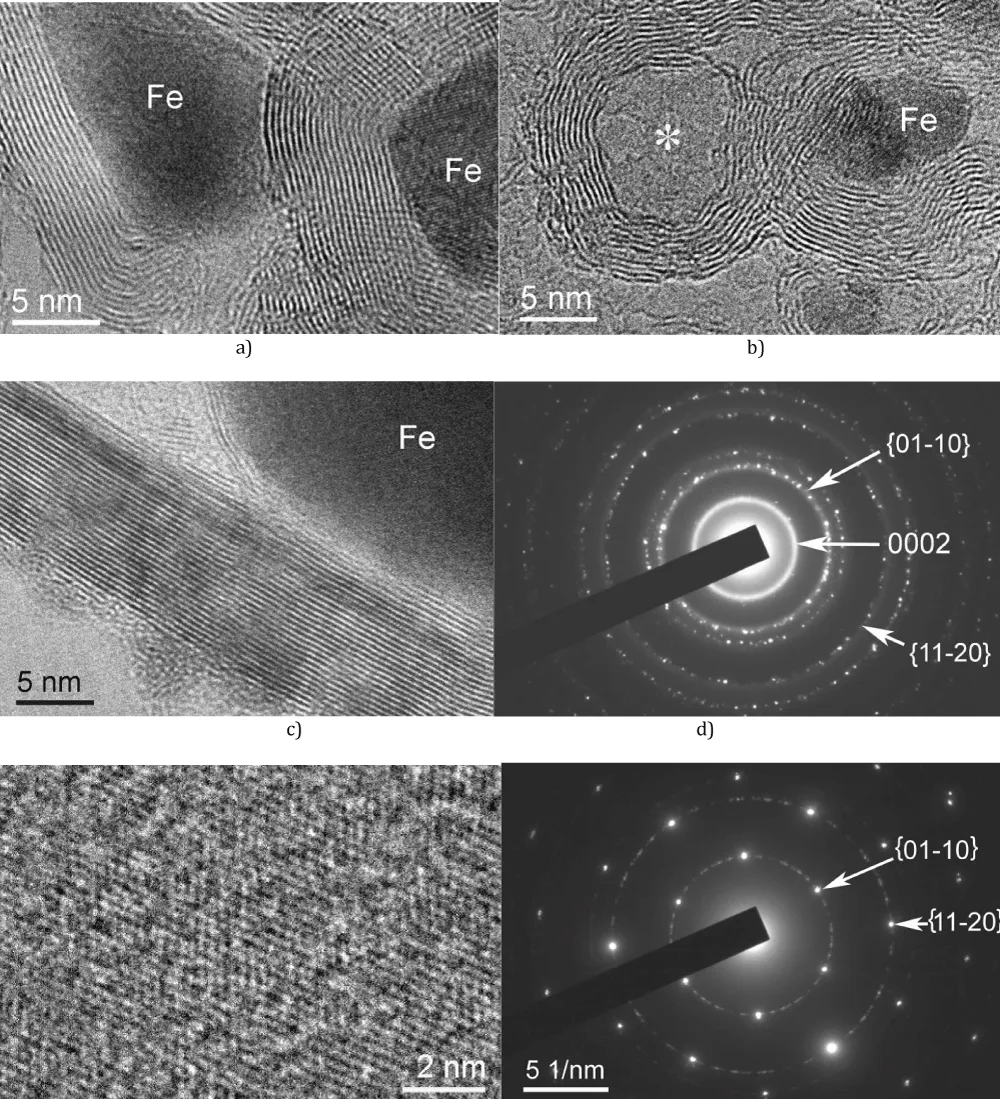
The measured values of the distance d between the lattice fringes are d = 0.34-0.36 nm, which correspond to the second-order reflection 0002 allowed by the structural factor for the diffraction on the basal planes in the hcp graphite lattice (d0002 = 0.34 nm, the lattice period along the c-axis is 0.68 nm), when the axis of the crystallographic zone [0001] is oriented perpendicular to the electron beam. The presence of numerous curved basal planes parallel to the electron beam is also evidenced by the intense diffraction ring 0002 in the electron diffraction pattern in figure 1d.
Besides the clearly visible vertical walls, the grown samples contain a polycrystalline graphene film covering the substrate. The presence of such a graphene film is evidenced by the image in figure 1e and Selected Area Diffraction (SAD) pattern in figures 1d,f. The diffraction pattern in figure 1f, corresponding to the image in figure 1e, contains the set of allowed reflections only from the planes of the crystallographic zone 0001, oriented parallel to the electron beam. This set includes reflections of types {01-10} and {-1210} (Among other reflections), market with arrows in figures 1d,1f but does not include the 0002 reflection. Thus, figure 1f contains a set of reflections inherent only to the horizontal graphene film, which does not contain vertical walls.
Unlike figure 1d,1f contains a 0002 ring in addition to the reflections of types {01-10} and {-1210}. This ring arises when the [0001] zone axis is oriented parallel to the substrate plane, i.e., in our case, during diffraction on vertical graphene walls. Thus, the above shows that we have obtained a heterostructure consisting of graphene-like structures of two types: a conventional graphene film with the (0001) basal planes laying on the substrate plane and vertical multilayer structures in which the (0001) basal planes are vertically oriented to the graphene film. Apparently, the graphene film is the basis on which the vertical walls grow.
The circular shape of the graphene walls, as well as their large number selected on the film by the microscope aperture in the SAD mode, leads to almost uniform filling of the diffraction ring 0002 with reflections. Furthermore, numerous diffraction spots filling the {01-10} and {-1210} diffraction rings, as well as additional weak diffuse contrast on the diffraction rings, indicate that some adjacent monolayers are rotated at different angles. This affects the clarity of the graphene film lattice in TEM images. This affects the clarity of the graphene film lattice in TEM images.
Examples of the conductivity of the obtained heterostructures are given in tables 1-3. It is found that under the influence of light, there is a sharp decrease in the resistance of the films, indicating the appearance of additional carriers (Table 2). Examples of several measurements of the effect of white light on the resistance of such graphene heterostructures obtained on SiO2/Si substrate are given in table 1. As can be seen from the tables, under the influence of light, resistance of the samples can change up to 20 times or more. As follows from table 2 for one of such samples, the resistance of these heterostructures is also affected by electromagnetic radiation of the near-ultraviolet range. Similar results of resistance measurement of heterostructures obtained on copper substrate are presented in table 3.
Besides the effect of light on conductivity, the dependence of the conductivity of the obtained structures on the magnetic field is observed, as in similar structures grown using Ni catalyst see our works [20,21]. As it follows from table 2, the measured Hall sensitivity S is comparable to the best values obtained on other materials [20]. Table 2 also shows the measured values of mobility µ and carrier concentration ns in the same sample obtained by the first method. Note that the parameters of other samples obtained in the course of this work were close to those given in tables 1-3 for the particular hybrid films.
| Тable 1: Examples of the influence of white light on the resistance of heterostructures obtained on SiO2/Si substrate. | ||
| Sample number | Resistance, R, kΩ | |
| In darkness | White light | |
| 1 | 46 | 1.0 |
| 2 | 32 | 0.3 |
| 3 | 193 | 40 |
| 4 | 1700 | 100 |
| 5 | 85 | 4.2 |
| 6 | 800 | 30 |
| Table 2: Measured parameters of one of the samples grown on SiO2/Si substrate: resistance under white light, in the dark and under near-ultraviolet light, sensitivity S, carrier mobility µ, and carrier concentration ns. | ||
| Resistance, R, kΩ | In darkness | 62 |
| White light | 3 | |
| Λ = 395 nm | 7 | |
| Λ = 365 nm | 25 | |
| Sensitivity, S, kΩ/T | 758 | |
| Carrier mobility, µ, cm2/V·s | 177 | |
| Carrier concentration, ns, сm-3 | 8.2 1011 | |
| Table 3: Resistivity of one of the graphene heterostructures grown on copper substrate in the dark and under illumination with white and near-UV light with wavelengths λ=395 nm and λ=365 nm. | |
| Resistance, R, kΩ | |
| In darkness | 89 |
| White light | 4 |
| λ=395 nm | 28 |
| λ=365 nm | 18 |
To summarize, it can be concluded that the obtained heterostructures demonstrate significant sensitivity to the light of the visible range and by light of the near-ultraviolet range and magnetic field.
The appearance of the above properties of the graphene-like structures obtained in this work, in contrast to the properties of regular graphene, is obviously associated with the peculiarities of their zone structure that is determined by their structural features. Such features may have the upper edges of vertical graphene structures, as well as the places of connection of these vertical multilayer walls with the graphene film on the substrate surface.
Discussion
According to studies on the formation of nanowalls using plasma, it is noted that the graphene sheets forming the walls contain numerous structural defects that reduce the mobility of charge carriers and the conductivity of structures with GNW and thereby worsen the properties of photodetectors. The high defect density is associated with the use of plasma. We admit that catalytic decomposition of carbon-containing gases without plasma, as employed here, yields more ordered structures. This is indicated, in our opinion, by the high ordering of the GNS structure in the electron microscopic images of GNW at any place in the obtained samples and the absence of a noticeable amorphous component in the electron diffraction patterns.
The appearance of the above properties of the graphene-like structures obtained in this work, in contrast to the properties of regular graphene, is obviously associated with the peculiarities of their zone structure that is determined by their structural features. A key question is which structural features cause the emergence of new physical properties of samples with GNW. Several studies e.g., [1-3] report that the interaction of GNW with a semiconductor substrate can lead to an increase in conductivity under the electromagnetic radiation. However, in the samples obtained using plasma deposition, the presence of a thin amorphous film between the substrate and the layer containing flakes oriented mainly vertically has been reported. This raises the question of how GNW-substrate interaction occurs in such cases. However, it is hardly possible to exclude the formation of a thin graphene film on the substrate in the aforementioned studies.
By varying the growth conditions of graphene structures, we could radically decrease the density of the GNW, while maintaining the formation of a graphene film covering the substrate surface. The conductivity of such samples under illumination remained virtually unchanged, consistent with prior reports that photoconductivity is weak when the Si substrate is covered only by a graphene film [3]. A distinguishing feature of our samples is the simultaneous presence of the GNW and a graphene film on the substrate surface, which appear to be in direct contact, without the presence of an amorphous carbon film interlayer. This suggests that the vertical walls begin their growth from favorable places within the graphene film, and therefore share structural bonds with it. The energies of these covalent bonds should differ from those in a regular graphite lattice; consequently, one can the formation of features in the band structure that do not occur in the regular graphite structure. Changes in the energy state of covalent bonds at film–nanowalls junctions-along with states at the free upper edges of the graphene sheets-may lead to the opening of a band gap. As a result, illumination at corresponding wavelengths alters the conductivity. Thus, covalent bonds in the GNS-graphene film transition region may also be responsible for the sensitivity of these hybrid structures to external electromagnetic radiation and magnetic field.
Highlights
- Vertical multilayer walls and graphene film were grown by CVD in a single process.
- Fe island film on Al film served as a basis for obtaining these structures.
- Conductivity of the grown structures depends on electromagnetic radiation (light).
- The values of carrier mobility and concentration in the obtained samples were measured.
Acknowledgement
Funding
The work was supported by the Ministry of Science and Education of the Russian Federation, Task No 075-00295-25-00. The TEM JEM-2100 of the Center of Collective Use at the Institute of Solid-State Physics of RAS was used.
Author contributions
Conceptualization and graphene growth, V.N.M.; TEM study, I.I.K and V.I.N.; catalyst deposition, O.V.K.
All authors have read and agreed to the published version of the manuscript.
Conflicts of interest
The authors declare no conflict of interest.
References
- Wu Y, Qiao P, Chong N, Shanet Z. Carbon nanowalls grown by microwave plasma enhanced CVD. Adv Mater. 2002;14:64-77. doi: 10.1002/1521-4095(20020104)14:1<64::AID-ADMA64>3.0.CO%3B2-G.
- Takeuchi W, Takeda K, Hiramatsu M, Tokuda Y, Kano S, Sakata O, Tajiri H, Hori M. Monolitic self-sustaining nanographene sheet grown using plasma-enhanced chemical vapor deposition. Phys Status Solidi. 2010;207:139-43. doi: 10.1002/pssa.200925230.
- Hiramatsu M. Hori M. Fabrication of carbon nanowalls using novel plasma processing. Japanese Journal of Applied Physics. 2006;45(6B):5522-7. doi: 10.1143/JJAP.45.5522.
- Qian F, Deng J, Xiong F, Dong Y, Hu Y, Pan G, Wang Q, Xie Y, Sun J, Xu C. Direct growth of high-quality graphene ganowalls on dielectric surfaces by plasma-enhanced CVD for photo detection. Opt. Mater. Express. 2020;10(11):2901-10. doi: 10.1364/OME.404881.
- Chang S H. Synthesis of Carbon Nanowalls (CNWs) on a SiO2 substrate by Microwave Plasma-Enhanced Chemical Vapor Deposition (MPECVD) without catalyst J. of Academic Reseach and Reflection. 2019.
- Yang J, Yang Oi, Zhang Y, Wei X, Shi H. Graphene nanowalls in photodetectors. RSC Advances. 2023;13:22838-62. doi: 10.1039/D3RA03104G.
- Mineo H, Masaru H. Carbon nanowalls: synthesis and emerging applications. Springer Wien New York, NewYork. 2010. doi: 10.1007/978-3-211-99718-5.
- Cong J, Khan A, Li J, Li J, Wang Y, Xu M, Yang D, Yu X. Direct growth of graphene nanowalls on silicon using plasma-enhanced atomic layer deposition for high-performance Si-based infrared photodetectors ACS Appl. Electron. Mater. 2021;3(11):5048-58. doi: 10.1021/acsaelm.1c00807.
- Song X, Liu J, Yu L, Yang J, Fang L, Shi H, Du C, Wei D. Direct versatile PECVD growth of graphene nanowalls on multiple substrates, Mater. Lett. 2014;137:25-8. doi: 10.1016/j.matlet.2014.08.125.
- Ma Y, Jang H, Kim SJ, Pang C, Chae H. Copper-assisted direct growth of vertical graphene nanosheets on glass substrates by low-temperature plasma-enhanced chemical vapour deposition process. Nanoscale Res. Lett. 2015;10(1):1019. doi: 10.1186/s11671-015-1019-8.
- Hojati-Talemi P,Simon GP. Field emission study of graphene nanowalls prepared by microwave-plasma method. Carbon. 2011;49(8):2875-7. doi: 10.1016/j.carbon.2011.03.004.
- Mori T, Hiramatsu M, Yamakawa K, Takeda K. Fabrication of carbon nanowalls using electron beam excited plasma-enhanced chemical vapor deposition, Diamond Relat. Mater. 2008;17(7):1513-7. doi:10.1016/j.diamond.2008.01.070.
- Wu Y, Vang B, Rong BY, Sun U. Carbon nanowalls and related materials, J. Mater. Chem. 2004;14:469-77. doi:10.1039/B311682D.
- Zhu M, Wang J, Holloway BC, Outlaw RA, Zhao X, Hou K, Shutthanandan V , Manos DM. A mechanism for carbon nanosheet formation. Carbon. 45; 2007:2229-34. doi: 10.1016/j.carbon.2007.06.017.
- Davami K, Jiang Y, Cortes J, Lin C, Shaygan M, Turner KT, Bargatin I. Tuning the mechanical properties of vertical graphene sheets through atomic layer deposition. Nanotechnology. 2016 Apr 15;27(15):155701. doi: 10.1088/0957-4484/27/15/155701. Epub 2016 Feb 29. PMID: 26926386.
- Zhou Q, Liu X, Zhang E, Luo S, Shen J, Wang Y, Wei D. The controlled growth of graphene nanowalls on Si for Schottky photodetector. AIP Adv. 2017;7:125317. doi: 10.1063/1.5001782.
- Li L, Dong Y, Guo W, Qian F, Xiong F, Fu Y, Du Z, Xu C, Sun J. High-responsivity photodetectors made of graphene nanowalls grown on Si. Appl. Phys. Lett. 2019; 115:081101. doi: 10.1063/1.5097313.
- Wang H, Fu Y. Graphene-nanowalls/silicon hybrid heterojunction photodetectors. Carbon. 2020;162:181-6. doi: 10.1016/j.carbon.2020.02.023.
- Wakabayashi K, Fuyita M, Ajiki H, Sigrist M. Electronic and magnetic properties of nanographite ribbons. Phys.Rev. B 1998;59:8271. doi: 10.1103/PhysRevB.59.8271.
- Matveev VN, Levashov VI, Kononenko OV, Matveev DV, Kasumov YuA, Khodos II, Volkov VT. Hall effect sensors on the basis of carbon. Materials Letters. 2015;158:384-7. doi: 10.1016/j.matlet.2015.06.055.
- Matveev VN, Volkov VT, Levashov VI, Kononenko OV, Khodos II. One-step synthesis of a h+ybrid of graphene films and ribbons. Inorganic Materials. 2018;54:229-32. doi: 10.1134/S002016851803010X.




Content Alerts
SignUp to our
Content alerts.
 This work is licensed under a Creative Commons Attribution 4.0 International License.
