
2025 October 23;6(10):1544-1564. doi: 10.37871/jbres2209.
-
Subject area(s):

 |
|
 |
|
 |
|

 Research Article
Linking Forest Ecological Status to Wild Food Availability: A Quantitative Assessment
Debal Deb*
- Food security
- Forest ecology
- Forest management
- Human ecology
- Wild edible plants
- Wild food harvest
Abstract
Forests have always been an integral part of the livelihood of indigenous “Forest People” living in settlements in and around forests. The economic value of non-timber forest products is primarily comprised by wild food items, which constitute a substantial portion of the annual diet spectrum of the forest villagers. During the lean period of agricultural production, as well as in times of climate-induced uncertainties of food, harvest of wild food biota from the forest is a traditional measure of food security in the indigenous societies in much of the global South. There is an ample body of literature documenting the flow of wild food biomass into indigenous households of forest fringe villages in South and Southeast Asia, and it is common ecological understanding that the diversity, abundance, and availability of wild food depend on the forest ecological status. However, there is a paucity of empirical research examining how forest floral species diversity, abundance and stand structure are associated with the diversity and biomass of wild food biota. This paper presents a benchmark quantitative assessment of wild food biomass flow into villages from different types of forests managed under two distinct regimes, a centralized 'command and control' approach by state Forest Department (FD), vis-à-vis decentralized informal community management (ICM), examined in two districts of Odisha, India.. This study reveals for the first time a set of significant linkages between forest stand ecological characters and wild food diversity and biomass in the forests. This study also reveals that aside from the forest ecological status, shaped largely by the management regime, ethnic food cultural preferences for diverse edible biota also determined the quantity of the food biomass flux into the forest villages.
Introduction
Among the world’s ecosystems, tropical forests are the richest in biodiversity and ecological complexity [1]. The three dimensionality of mature forest vegetation is conducive to providing multiple habitat strata and micro-habitats for numerous life forms [2]. The forest is also an important resource base for livelihood and material culture of indigenous forest-dependent societies of the global South. This aspect of economic importance of the forest has often been neglected in classical forestry literature, in which the forest was described merely as ‘Tree Farm’, for the sole purpose of producing commercial timber (e.g. for paper and polyfibre industry) and revenue generation.
The history of forestry in India is paradigmatic of the forest use and management in the global South. After an initial European view of forests as “Wastelands” until the mid-nineteenth century, the British colonial government enacted to claim legal ownership of all forests of the country, and established the Forest Department to maximize and sustain the production of a chosen quality of timber, first for railways and shipbuilding, and subsequently for timber trade and revenue generation at the expense of all other species [3-5]. This led to raising of monocultures of high-value timber species like sal (Shorea robusta) and teak (Tectona grandis) in central and eastern India, and pine (Pinus gerardiana) in the Himalayas [6]. After the 1960s, however, the Forest Directorate emphasized raising monoculture plantations of exotic Quick-Growing Species (QGS) like Eucalyptus tereticornis and Acacia auriculiformis at the expense of natural forest biodiversity and local economies - primarily in order to supply pulpwood to paper and polyfibre industry. This QGS plantation drive became as negligent of the subsistence needs of the rural population as the continuing deforestation in other parts of the country [5,7], and was justified by the technocratic concept of 'consumer needs', which are effectively the needs of the commercial-industrial sector, which has been “The prime beneficiary of state forest management” [6]. More recently, several tracts of forests have been de-notified and cleared in order to serve unbridled growth of industry, a policy that values rapid industrial growth over the ecological as well as economic value of forests. For instance, the Government of India allowed the diversion of 259.24 hectares of forest land for the Suliyari coal mining project in Singrauli, Madhya Pradesh for coal mining [8]. More recently, over 90,000 trees of Hasdeo forest in the State of Chhattisgarh were felled and several villagers were displaced in 2024 for the Adani Industry’s mining operation [9]. In August 2025, the State Forest Department of Chhattisgarh has recommended approval of diversion of 1742.60 hectare of the biodiversity-rich Hasdeo Arand forest, allotted to Rajasthan government’s power utility, for coal mining [10]. In view of this prioritisation of industrial growth over the environmental services of forest lands, the role of non-timber forest produce (NTFP) in rural economies [11,12] tend to fade out of cognizance.
Despite a policy environment disfavouring forest conservation [7], the option value and existence value of the forest as perceived by the local user communities [5] tend to transcend the industrial value perception of the state bureaucracy. Even ignoring the option value and the cultural value of the forest, the direct use value (goods) of the forest amounts to a staggering contribution to the local and national economies [12,13]. Wild foods are of further importance in local food and nutrition security context in the face of food production uncertainties under the current Climate Crisis [14,15]. Indeed, forests constitute an important source of food during the lean periods of agricultural production, and provides for a significant proportion of the annual food consumption in forest villages in forest-dependent villages in Asia and Africa. A plethora of ethnobotanical studies have documented the importance of wild foods in food security for the rural groups in different parts of India and other countries [16-22]. More formal economic studies, involving documentation and valuation of NTFP, invariably include a wide diversity of wild food biota [13,23-26].
The availability and flow of wild food diversity and biomass are understandably highly variable, and crucially depends on the forest ecological status, which in turn is shaped by the governance regime, directly impacting on the extent of forest available for the harvest of wild foods from the forest [5,23,27]. In particular, deforestation and forest degradation affect biodiversity and the variety of food available through habitat loss and forest transformation. Even in the absence of deforestation, stand structure, tree cover and the biodiversity spectrum of the existing forest influence food availability to rural populations depending on the forest [28-30]. However, the importance of the NTFP and wild food in rural economies notwithstanding, quantitative estimates of wild food flux into forest-dependent villages are scarce. There is also paucity of quantitative evidence of the links between the extent and type of forest to the diversity and biomass of wild edible biota. This study is an attempt to provide an empirical evidence of the relationship between forest ecological status and wild food availability, from a primary survey conducted over two years from 2016-2017 in the eastern State of Odisha, India.
Study Sites and Methods
Four forest areas in the districts of Rayagada and Balangir in southern Odisha were selected for a comparative study of forest status and management, conducted from March 2016 through December 2017, spanning a period of 22 months. The locations of the forests in the two districts are shown in figure 1.
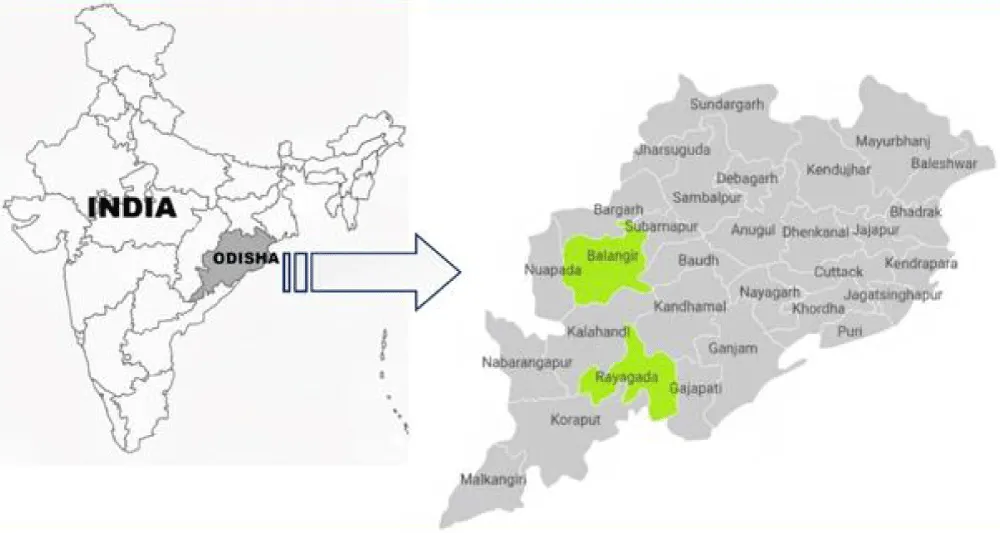
Study sites
District Rayagada: Forest area: (a) Sikabandha and (b) Sindhupanga (Protected Forest) in Muniguda Forest Range, Rayagada Division.
- Village demography: The villages adjacent to, and managing the forest locations under study are Sikabandha and Sindhipanga, in Bissamcuttack Block. Both the villages, Sikabandha and Sindhupanga are composed of Kondh households (Table 1).
- Forest type and physiognomy: The forests in both Sikabandha and Sindhipanga are moist deciduous type [31], with prominence of Terminalia tomentosa, Madhuca indica, Pterocarpus marsupium, Lannea coromandelica, Diospyros melanoxylon, Cleistanthus collinus, Holarrhena antidysenterica, Terminalia bellerica, Buchanania lanzan, Syzygium cumini and Haldinia cordifolia. Lianas like Ventilago madaras-patana are also present in considerable numbers. In Sindhipanga forest under JFM, a few patches are planted to teak (Tectona grandis) and Cassia siamea, interspersed with patches of copsewood, consisting of regenerating native trees. The mean crop height of the Sikabandha and Sindhipanga forests, is ca. 6.2 m and 4.3 m, respectively.
- Forest management regime: Sikabandha villagers began managing the forest at Sikabandha in 2009, disallowing the Forest Department from undertaking plantations and felling of trees. The status of this 'Community Management' of the forest is not officially registered as “Community Forest” in congruity with the Forest Rights Act of 2006. Rather, it is locally recognised by the Forest Beat offices as a form of Joint Forest Management (JFM). However, JFM in this forest does not involve any FD Range Officer or Beat Officer as heads of the Protection Committee. In contrast, all management decisions are taken by the villagers unilaterally, with rare instances of advice from the FD. Thus, we describe this management as Informal Community Management (ICM). The Sindhipanga villagers are members of a forest protection committee under Joint Forest Management with the District Forest Department. The forest of Sindhupanga is a Protected Forest with porous statutory management, allowing frequent degradation from wood theft. The FD conducts rotational harvest of timber, and permits free NTFP collection by villagers. Alongside the rotational harvest, illegal felling of trees is rampant in Sindhipanga.
| Table 1: Ethnic compositions of Sikabandha and Sindhipanga villages. | |||
| Village | Ethnicity | Primary Occupation | No. of Households |
| Sikabandha | Scheduled Tribe (ST) | Agriculture | 55 |
| Scheduled Caste (SC) | Wage Labour | 12 | |
| Total | 67 | ||
| Sindhupanga | Scheduled Tribe | Agriculture & Wage Labour | 10 |
| Other Backward Castes | Agriculture & Wage Labour | 25 | |
| Total | 35 | ||
District Balangir: Forest area: (a) Kutasinga and Singjuri (Reserved Forest) in Loisinga Forest Range, Bolangir Division.
- Village demography: The village adjacent to both the Kutasinga forest and Singjhuri Reserve Forest is Kantapali, in GP Kutasinga, Block Duduka-Agalpur. Kantapali is composed of caste Hindu households, including Brahmins, Scheduled Caste (SC) and Other Backward Castes (Table 2).
- Forest type and physiognomy: The forests of Kutasingha and Singjuri are contiguous, located on two sides of a highway, which marks a boundary between the two forests. Both are Dry Deciduous Type, showing prominence of Madhuca indica, Teminalia tomentosa, Diospyros melanoxylon, Lannea coromandelica, Pterocarpus marsupium, Cleistanthus collinus, Anogeissus latifolia, Buchanania lanzan, Lagerstroemia parviflora and Chloroxylon swietenia, interspersed with small patches of Eucalyptus and teak plantations. A few rare trees such as Ceriscoides turgida. The Singjuri forest is a Reserve Forest, and contains a few large patches of old teak plantation. In Kutasinga forest, there are a few eucalypt plantations, from which many have been felled. The average crop height of both the forest tracts was ca. 8.5 m.
- Forest management regime: Kutasinga villagers began managing the Kantapali forest in 1984. They continue to protect the forest from wood theft and NTFP collection by people from other villages. Although the Forest Department has in the past raised plantations of teak and Eucapyptus tereticornis, the villagers have over the past few years stopped the Forest Department from undertaking plantations of exotics as well as clear felling. Villagers regularly collect NTFP from both these forests, while giving strict protection of the trees from illegal felling. Sikabandha villagers have also planted domesticated trees like lemon and mango in their forest. The management of Kutasinga forest represents a community mamnagement de facto, although not recognized de jure. To distinguish from the officially recognized Community Forest, we describe this type of management as ICM. The Singjuri Reserve Forest is entirely protected by the Forest Department, but its porosity allows people from different villages including Kantapali to collect NTFP.
| Table 2: Ethnic composition of Kantapali village. | ||
| Ethnicity | Primary Occupation | No. of Households |
| General (incl. Brahmin) | Agriculture, Business | 12 |
| Scheduled Caste | Agriculture | 9 |
| Other Backward Castes | Wage Labour | 54 |
| Total | 75 | |
Study design
We compare the forest ecological properties and food species availability and use between two types of forest management and two ethnic communities in two districts. The study design is summarized in table 3.
| Table 3: Design of study on the different categories of forest and ethnic compositions of the user populations in two districts. | ||
| Criteria | District Rayagada | District Balangir |
| Forest Type | Moist Deciduous | Dry Deciduous |
| Statutory Management | Sindhipanga (PF) | Singjuri (RF) |
| Informal Community Management | Sikabandha | Kutasinga |
Methods
For assessment of the biodiversity and structural status, standard forest mensuration methods [32] were adopted.
Number of transects and species effort curve: For mensuration purpose, we used 100 m x 10 m belt transects, along north-south axis, in all forest patches. The number of tree species with trees above 15 cm girth at breast height (GBH) was plotted against the number of transects to obtain species effort curves [33] until saturation was indicated. The maximum number of transects was determined by the saturation level reached in the species effort curve in each forest patch (Figure 2).
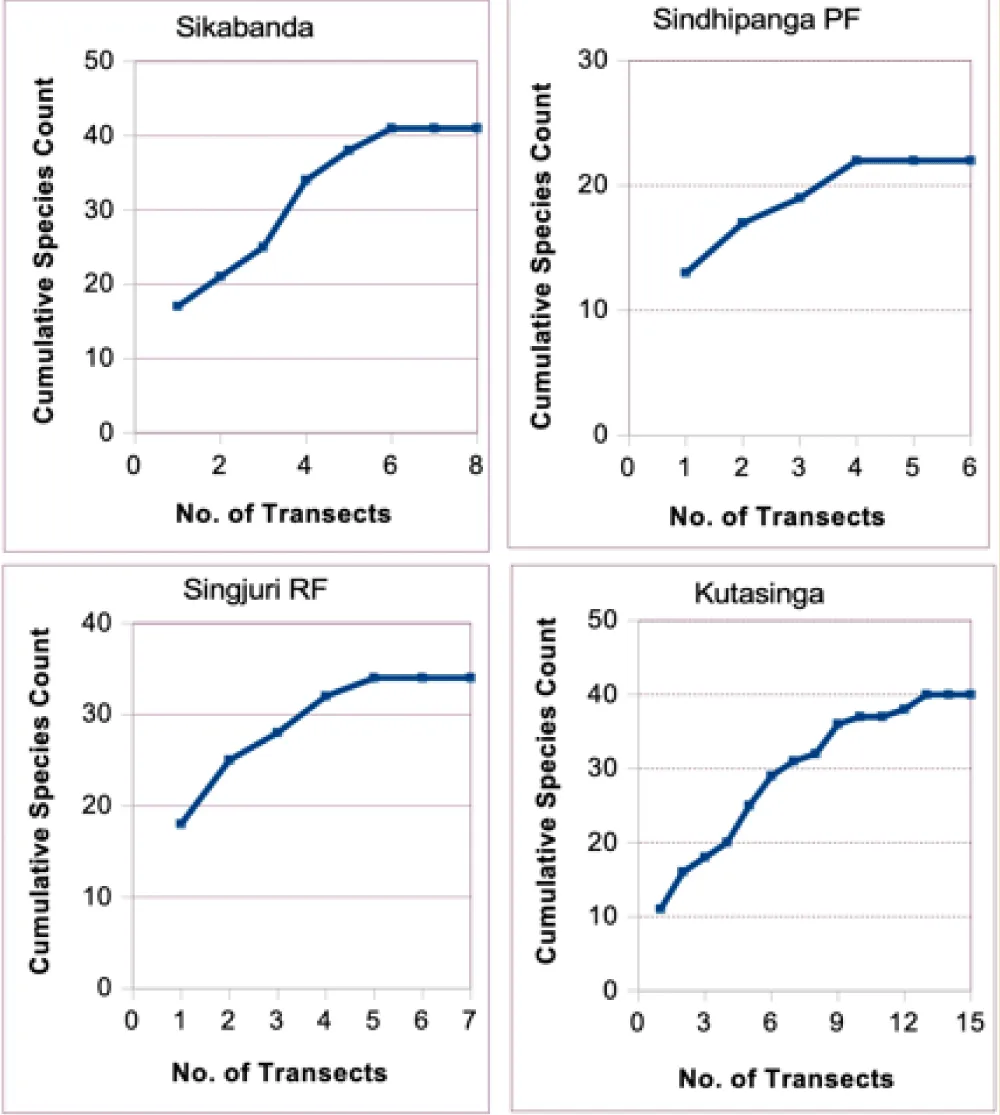
In Rayagada District, the Sikabandha forest under ICM is a small patch, in which 7 transects were laid. The locations of the northern end of the Transects laid in Sikbanda forest are as follows:
S1 19° 33’ 43.5” N 83° 35’ 13.66” E
S2 19° 33’ 44.01” N 83° 35’ 19.78” E
S3 19° 33’ 46.19” N 83° 35’ 23.47” E
S4 19° 33’ 45.62” N 83° 35’ 26.37” E
S5 19° 33’ 45.07” N 83° 35’ 29.7” E
S6 19° 33’ 47.27” N 83° 35’ 33.7” E
S7 19° 33’ 48.5” N 83° 35’ 37.5” E
S8 19° 33’ 39” N 83° 35’ 51.6” E
In the forest of Sindhipanga PF, five North-South Transects were laid:
PF1 19° 33’ 40.1538” N 83° 33’ 38.156” E
PF2 19° 33’ 8.37” N 83° 34’ 6.636” E
PF3 19° 33’ 35.88” N 83° 33’ 51.12” E
PF4 19° 35’ 31.08” N 83° 43’ 51.12” E
PF5 19° 56’ 11.16” N 83° 56’ 08.55” E
PF6 19° 56’ 03.18” N 83° 55’ 07.30” E
In Kutasinga forest under ICM, a total of 15 transects, with 5 transects in each patch, and were laid. The locations of the transects were as follows:
K1 20° 56’ 53.4402” N 83° 37’ 10.941” E
K2 20° 56’ 53.5956” N 83° 36’ 53.3376” E
K3 20° 56’ 54.3654” N 83° 36’ 49.0494” E
K4 20° 56’ 55.0896” N 83° 36’ 45.4098” E
K5 20° 56’ 55.5612” N 83° 36’ 41.5758” E
K6 20° 56’ 22.9056” N 83° 36’ 28.818” E
K7 20° 56’ 26.4042” N 83° 36’ 34.11” E
K8 20° 56’ 25.821” N 83° 36’ 37.8216” E
K9 20° 56’ 25.7958” N 83° 36’ 42.9366” E
K10 20° 56’ 26.271” N 83° 36’ 46.5732” E
K11 20° 57’ 8.409” N 83° 36’ 50.0034” E
K12 20° 59’ 31.3116” N 83° 36’ 45.4494” E
K13 20° 57’ 4.968” N 83° 36’ 59.0034” E
K14 20° 27’ 7.2324” N 83° 36’ 55.5048” E
K15 20° 57’ 7.884” N 83° 36’ 51.7428” E
The Singjuri RF was studied in 6 transects. To capture the native tree species diversity, we took care to exclude the large monoculture eucalypt plantations to lay transects in this RF. The locations of these transects are as follows.
RF1 20° 56’ 9.6” N 83° 36’57.35” E
RF2 20° 56’ 8.52” N 83° 36’48.74” E
RF3 20° 56’ 5.57” N 83° 36’40.86” E
RF4 20° 56’ 46.5” N 83° 37’ 15.78” E
RF5 20° 56’ 48.4” N 83° 37’ 25.1” E
RF6 20° 56’ 52.4” N 83° 37’ 39.32” E
RF7 20° 56’ 54.2” N 83° 37’ 39.28” E
Basal area estimation: All trees above 10 cm Girth at Breast Height (GBH) were counted and identified in a number of 100 m x 5 m Transects, laid in N-S axis in each forest site.
Basal Area (BA) in each transect (= 1000 m2) was estimated from the basal perimeter of all trees [32], as:
BA (m2/ha) = P2 / [4000 π]
where the basal parameter P = (GBH + x), with a mean factor x = 10 cm.
Stand density: Density of trees (> 10 cm GBH) and of the ground flora were recorded periodically throughout the duration of this study, from the same transects. Per hectare density of trees in each forest was calculated from the number of trees counted in the total of T transects (each 1000 m2 area), as
where i = 1,2,3… S is the species identity, Nij denotes the number of individual trees belonging to ith species counted in the jth transect.
Estimation of floral species diversity and abundance: We chose Hill’s index N1 [34] to measure both species diversity and species distribution, as the Effective Number of Species (ENS), which monotonically increases with evenness of distribution:
ENS = exp (H′)
where H′ is Shannon-Wiener Diversity index, calculated for all tree and herbaceous species in each transect, using the formula:
H′ = ∑ pi ln pi
where pi is the proportion of the ith species.
Quantification of harvest of wild foods: Field assistants lived in the villages under study, and visited every household as participant observer in the respective villages, sorted out the day’s harvest made by the household members, and took measurements of the food biomass.
All edible fruits, mushrooms, tubers, flowers, leafy vegetables, and animals and animal products (Like honey) were weighed using a spring balance (0-40 kg, 50 g resolution) on every occasion of collection from the forest.
In addition to the total influx of forest food items into the villages, the amount of food items gathered from each fixed transect area was also measured in situ during the period from June 2016 to October 2017, in order to get an estimation of the proportion of contribution of the transects to the total food harvest. Each wild food item gathered was identified and weighed upon full consent of the household members.
Assessment of the association of wild food availability with forest ecological status: While it is well understood that a forest tract rich in biodiversity is likely to provide more edible biota than a tract poor in biodiversity, it would be practically impossible to quantitatively assess the species composition and density of all forest plots for each of the edible flora and fauna harvested round the year. The pooled species diversity, stem density and stand density estimated from the sample transects may not reliably indicate a reliable association with the abundance of edible flora and fauna, because villagers may not necessarily gather any edible species from the laid transect plots. Furthermore, the numbers of wild animals hunted for food cannot be determined by the stem density or floral species diversity of any particular forest patch. Therefore we assessed the diversity of stationary edible biota, comprised by edible plants, fungi (mushrooms) and leaf stitching ant nests in each laid transect, and determined the approximate harvestable quantity from the expert assessment of the villagers, who regularly gather the same items. Thus, we quantified available edible biota in addition to the forest stand density and floral diversity in each transect.
Statistical Analyses
Relationships between different forest demographic parameters were examined using linear regression. Tests of normality of distribution [35] were performed using R software, followed by the methodology of Shapiro-Wilk test at 5% level of significance. When the data failed in normality tests, we performed Kruskall-Wallis test [36], to measure the significance of the difference between means of species richness and diversity index. The level of significance as well as the confidence interval for all statistical tests was chosen at p < 0.05.
Limitations of the Study
Constrained by resource limitations, this study remained confined to only two forest villages for each forest management regime; and only two (Dry deciduous and moist deciduous) forest types. Furthermore, the number of transects for sampling in each forest tract was small, although the number was based on a species-effort curve. This sample size was optimal, under the financial and labour-time constraints. Therefore, the insights and inferences drawn on this study may not be robust for all forest types. Admittedly limited sample size notwithstanding, the salient findings of this study, pertaining to the relationships between forest ecosystem status and the availability of forest food biota, are statistically valid. The limitations of this study will hopefully inspire replications of such studies in Odisha as well as in different states, and elicit interest among more resourceful teams of competent researchers.
Results
The floral diversity of the forests surveyed in the districts of Rayagada and Balangir are given in supplementary table 1. The forest ecological characteristics based on the tree and herbal species compositions are depicted for the forests of two districts under separate subsections, namely, 3.1 for Rayagada district forests and 3.2 for Balangir district forests.
Forest ecological status in Rayagada district forests
The list of tree species (GBH > 10 cm) enumerated in both Kutasinga and Singipanga forests of Rayagada district are given in supplementary table 1. The ecological status of the forests, based on belt transect assessments, are described as follows.
Species diversity and distribution: The number of tree species in Sikabandha forest is 41, with the mean of 26.67 from all transects examined. The species diversity index is the highest (ENS = 15.98) in Transect S3, while the overall species diversity for Sikabandha is ENS = 18.3.
In Sindhipanga forest, the pooled tree species number (above 10 cm GBH) is 30, with the mean of? The pooled evenness of distribution (ENS) is 14.4, with the highest (18.5) in Transect PF5, the number of tree species in Sikabandha forest is 41, across all the 8 Transects with the mean of 18.6 in all the transects examined. The species diversity index is the highest in Transect S3 of Sikabandha forest (ENS = 15.98), while the pooled ENS for Sikabandha is 11.57. In contrast, 22 tree species were recorded in Sindhipanga PF, with a mean of 12.6 enumerated from 6 optimal transects. The species diversity for Sindhipanga forest is the highest (ENS = 18.49) in transect No. T5. The overall species diversity for this forest, across all 6 Transects, is ENS = 7.15. However, the difference in tree species numbers is not statistically significant between the two forests with 8 and 6 respective transects (Kruskall-Wallis H = 3.231, p > 0.05). The values of ENS of the two forests across the total of 14 transects are also statistically no different (Kruskall-Wallis H = 3.75, p > 0.05).
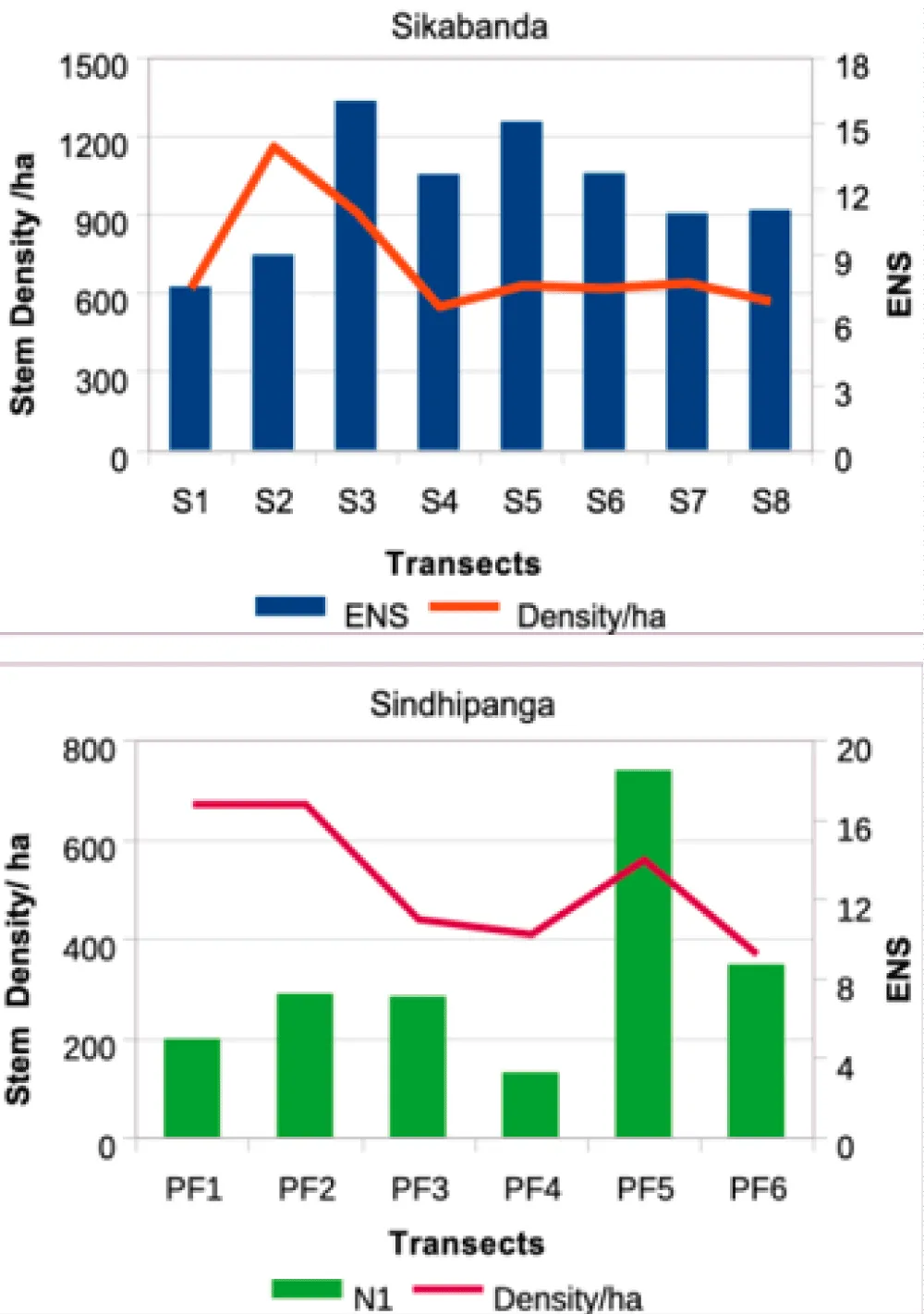
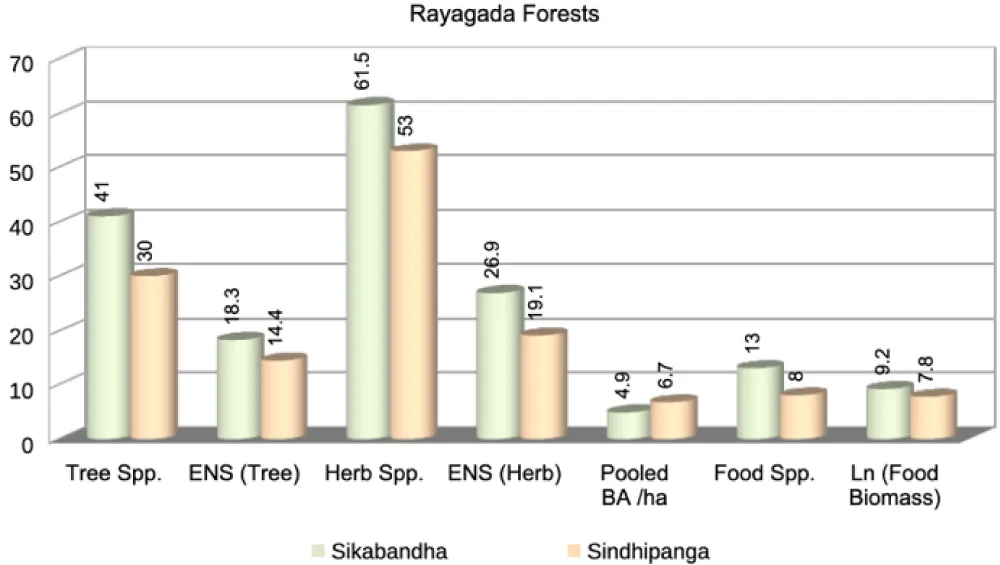
Stem density and basal area: The overall density of trees in Sikabandha forest is 736 per ha, compared to 548/ha in Sindhipanga forest. The tree diversity, density and basal area in the Sikabandha forest under CFM appear to be greater than that of the Protected Forest of Sindhipanga (Figure 3).
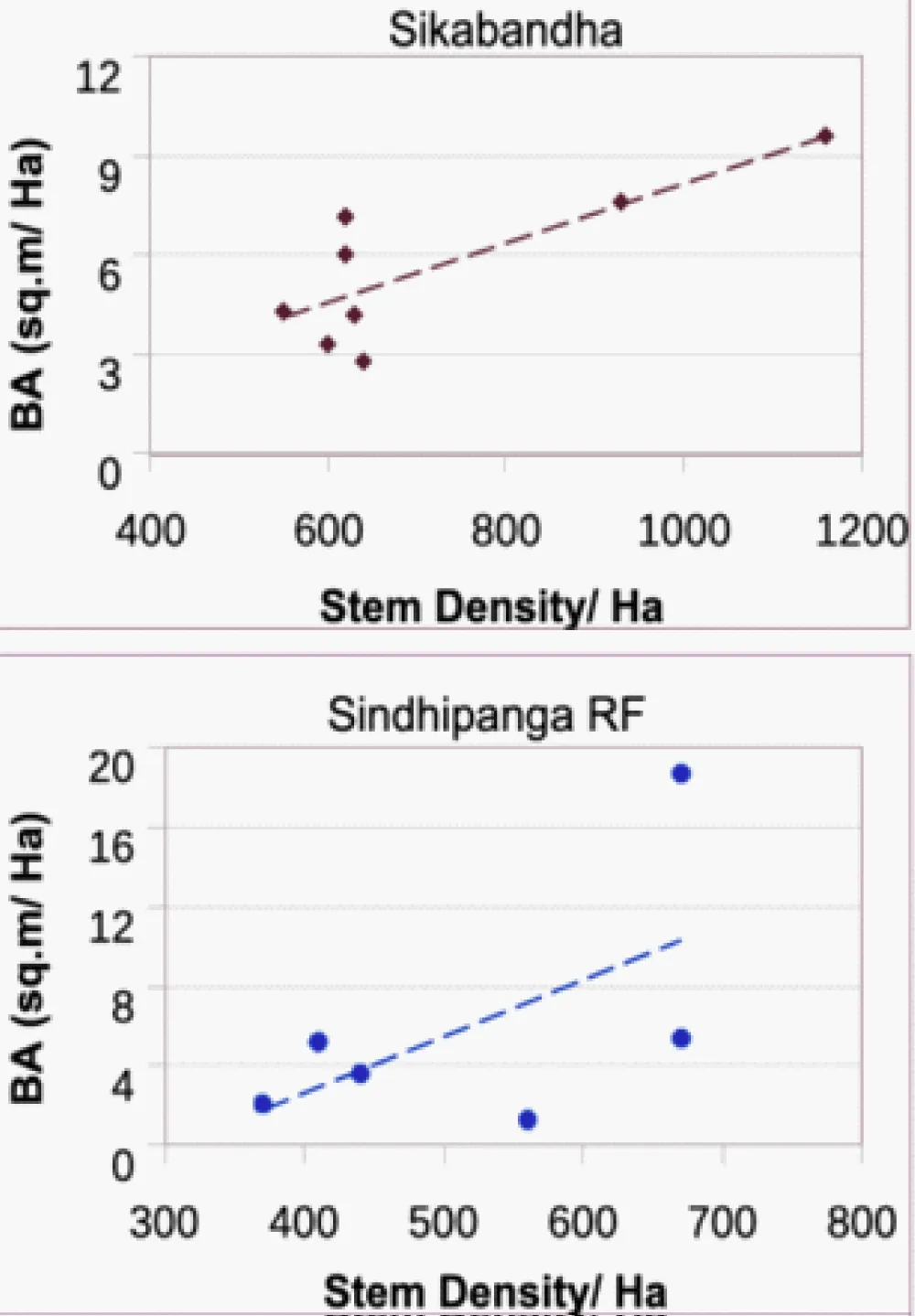
As shown in figure 4, the relationship between tree density and basal area (BA) is direct, and highly significant (R2 = 0.64, t = 3.49, p < 0.005) for Sikabandha forest. However, the slope of regression for Sindhipanga forest is marginally significant (R2 = 0.345, t = 1.62, p = 0.08). This indicates that the total basal area seems to occupy less area where relatively older trees are numerically dominant.
A comparison of the tree diversity and density between Sikabandha and Sindhipanga forests (Table 4, figure 3) indicate that over all, the pooled tree species number and and species diversity (ENS) are slightly higher in Sikabandha ICM forest than in Sindhipanga PF. The difference is statistically significant (Kruskall-Wallis test H = 4.004, p < 0.05). Despite greater uniformity of tree distribution in the teak and eucalypt plantations in Sindhipanga PF (max. ENS = 18.49), the pooled ENS is smaller than that in Sikabandha forest, where the number of tree species as well as pooled ENS is greater. This greater pooled ENS in the mixed forest of Sikabandha is likely due to frequent harvest of selected species of trees above 10 cm GBH for fuelwood and structural uses.
| Table 4: Overall tree species diversity and density in Sikabandha and Sindhipanga forests. | ||||
| Forest | No. of Tree Species | Pooled Basal Area (m2/ha) | Pooled ENS | Mean Stem Density/ ha |
| Sikabandha | 41 | 4.88 | 18.3 | 735.7 |
| Sindhipanga PF | 30 | 6.72 | 14.4 | 4520 |
The greater tree basal area in Sikabandha forest than that in Sindhipanga forest (Figure 4) implies that the proportion of older and mature trees (With greater girth of stem) is considerably larger in the former than in the latter. The proportion of older trees in Sikabandha is due to community protection of the forest from wood removal.
Herbaceous floral diversity and density: The herbaceous layers of Sikabandha and Sindhipanga forests show slight differences in species counts (S and ENS), but remarkably similar density of the ground flora (Table 5). The floral diversity ENS of the two forests across the total of 14 transects is statistically no significant, either during pre-monsoon (H = 0.796, p > 0.05) or post-monsoon season (H = 0.811, p > 0.05).
| Table 5: Seasonal changes in mean herbaceous species diversity and density in Sikabandha and Sindhipanga Forests. | ||||
| Forest Stand | Pre-Monsoon (2016 & 2017) | Post-Monsoon (2016 & 2017) | ||
| Descriptors | Sikabandha | Sindhipanga | Sikabandha | Sindhipanga |
| Species Count | 72 | 70 | 51 | 36 |
| ENS | 21.53 | 13.66 | 32.48 | 24.49 |
| Density/Ha | 16888 | 35474 | 226000 | 161600 |
| Loge Density | 9.73 | 10.48 | 12.32 | 11.99 |
| No. Edible spp. | 14 | 14 | 11 | 12 |
Forest food availability and influx into villages: Supplementary table 2 gives a list of all wild food biota gathered by the forest villagers. The diversity of forest food biota seems to be greater in Sikabandha forest than in Sindhipanga. The range of forest food flora includes edible flowers, tubers, fruits, leaves, and mushrooms. In addition, leaf stitching ants (Oecophyla smaragdina) snails and crabs constitute the repertoire of edible fauna periodically harvested from the forest.
The repertoire of forest food items from the Sikabandha forest under CFM far exceeds those from Sindhipanga forest under statutory management (Figure 5). In the case of Sikabandha, the maximum number of wild food species collected from the forest is 28 (in the month of June), while the maximum number of food items from Sindhipanga forest is 6 (In the month of July). The mean number of food items gathered from Sikabandha forest is more than 4 times that from Sindhipanga forest (Table 6).
| Table 6: The diversity and quantity of edible species harvested from Sikabandha and Sindhipanga forests. | ||||
| Month/Year | Sikabandha | Singjpanga RF | ||
| No. of Food Species | Biomass (kg) | No. of Food Species | Biomass (kg) | |
| Mar-16 | 5 | 247 | 4 | 15.9 |
| Apr-16 | 11 | 864.1 | 6 | 71.7 |
| May-16 | 17 | 570.6 | 5 | 48.3 |
| Jun-16 | 28 | 909.6 | 6 | 37 |
| Jul-16 | 24 | 514.4 | 5 | 65.5 |
| Aug-16 | 17 | 602.5 | 5 | 100.5 |
| Sep-16 | 21 | 447.1 | 2 | 180 |
| Oct-16 | 17 | 286.1 | 3 | 154.7 |
| Nov-16 | 18 | 215 | 4 | 111 |
| Dec-16 | 11 | 245.1 | 5 | 178.7 |
| Jan-17 | 14 | 73.1 | 4 | 66 |
| Feb-17 | 14 | 48.1 | 5 | 100 |
| Mar-17 | 10 | 610.3 | 4 | 83.9 |
| Apr-17 | 10 | 880 | 4 | 118.3 |
| May-17 | 14 | 465 | 2 | 44.5 |
| Jun-17 | 27 | 674.9 | 3 | 92.7 |
| Jul-17 | 21 | 343.5 | 2 | 128.8 |
| Aug-17 | 18 | 253.5 | 6 | 137.4 |
| Sep-17 | 21 | 584.6 | 4 | 81.76 |
| Oct-17 | 20 | 322.5 | 5 | 170.4 |
| Nov-17 | 12 | 195.3 | 6 | 172.7 |
| Dec-17 | 14 | 271.9 | 8 | 178.6 |
The highest amount of wild food biomass harvested from Sikabandha forest is 909 kg, whereas that from Sindhipanga forest is 87 kg. The annual mean quantity of wild food items gathered from Sikabandha forest is significantly greater than that from Sindhipanga forest (Table 6, figure 5).
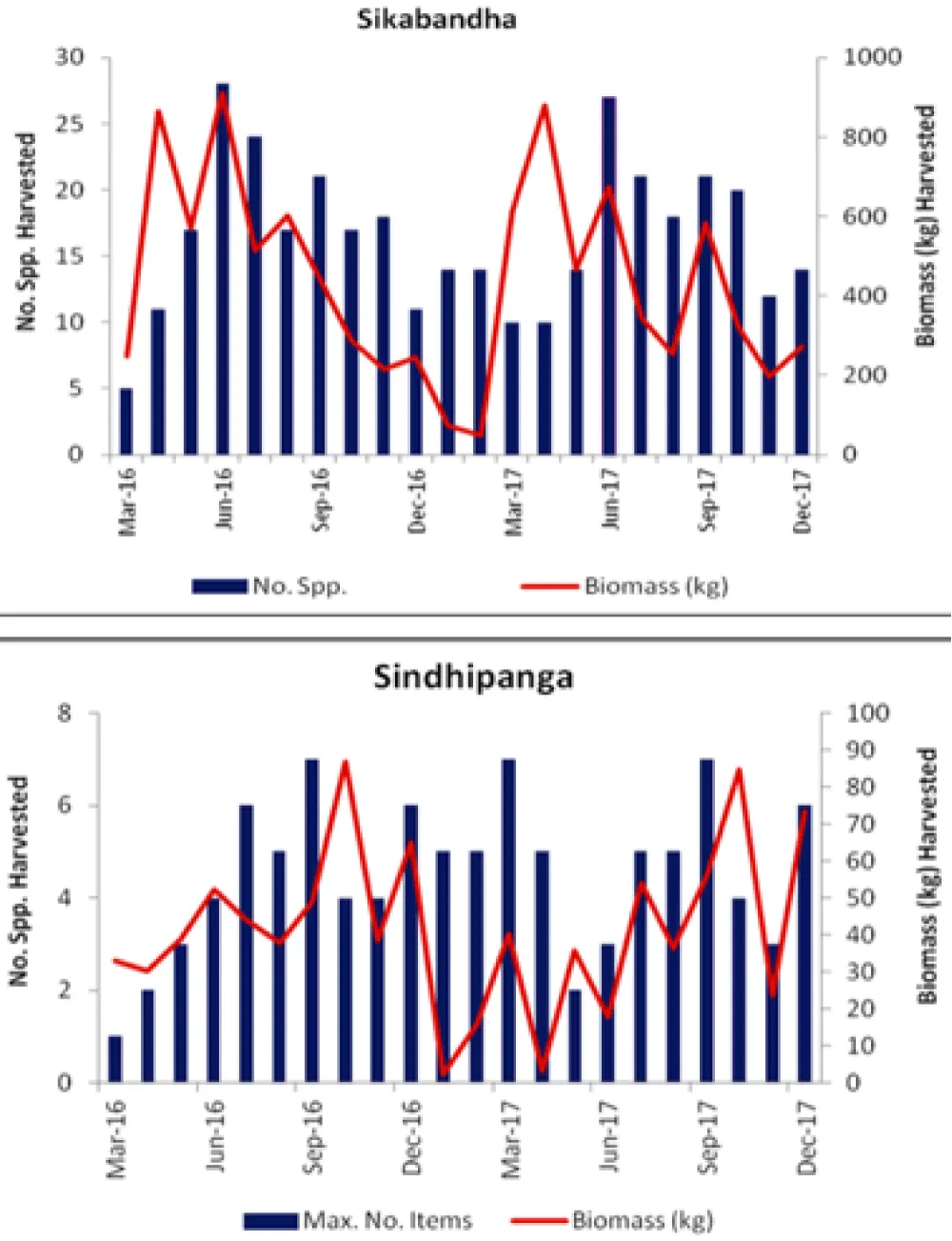
A total of edible biota (plants, mushrooms and hunted animals) harvested from the two forests were calculated from our household survey. This data, when examined along the ecological features of the forests, indicate a plausible direct correspondence of the quantity of edible biota with tree and herbaceous diversity (Figure 6). However, basal area appears to be inversely correlated (t = 2.1, p <0.05) with the overall number of food biota gathered from the forest.
Relationship of wild food abundance with forest ecological status: While it is well understood that a forest tract rich in biodiversity is likely to provide more edible biota than a tract poor in biodiversity, it would be practically impossible to quantitatively assess the species composition and density of all forest plots for each of the edible flora and fauna harvested round the year. Furthermore, the numbers of wild animals hunted for food cannot be determined by the stem density or floral species diversity of any particular forest patch. Therefore instead, we estimated the edible plant and mushroom diversity and quantity obtainable from each of the laid forest transects (Figure 7).
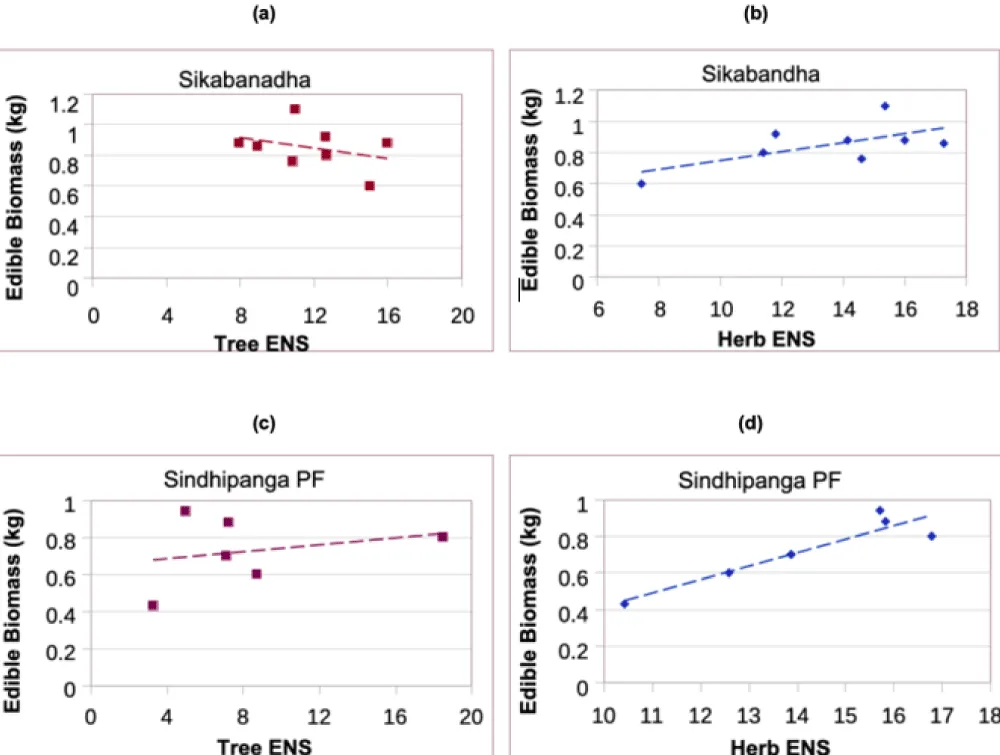
In both the PF and the ICM forests, the relationship of ENS of the trees with the quantity of edible biomass is not statistically significant. It appears that in Rayagada forests, the availability of wild edible plants and mushrooms are strongly associated with the diversity and abundance of the herbaceous flora, which include many edible plants.
Forest ecological status in Balangir district forests
A list of tree species (GBH > 10 cm) of Kutasinga and Singjuri forests are given in supplementary table 1. The forest ecological status of the forests are as follows.
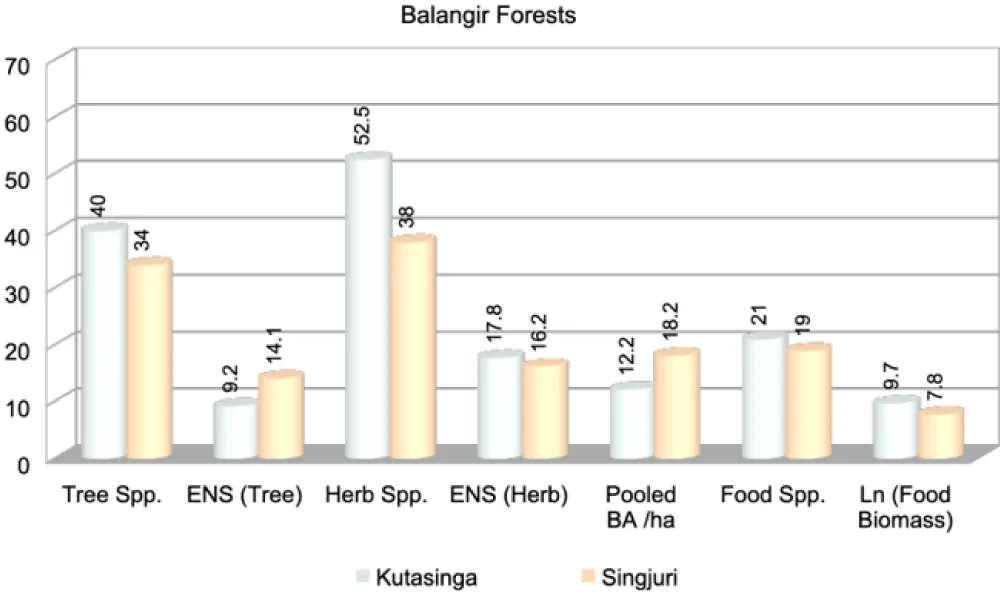
Species diversity and distribution: The number of tree species in Kutasinga forest is 40, across all the 15 Transects with the mean of 12.7 in all transects examined. The pooled ENS for Kutasinga forest is 9.21, with the highest in Transect K13 (ENS = 7.27). In contrast, 34 tree species were recorded in Singjuri RF, with a mean of 15.8 enumerated from 7 optimal transects. The evenness of tree species distribution (ENS) for Sindhipanga forest is the highest (ENS = 12.6) in Transect No. RF3. Pooled ENS of all 7 Transects together, was 14.07.
Table 7, figure 8 indicate that the tree species number pooled from all transects is higher in Kutasinga ICM forest than in Singjuri RF. However, the difference between the tree species numbers estimated from the 15 and 7 transects of Kutasinga and Singjuri forests respectively, is statistically no different (Kruskall-Wallis H = 3.52, p > 0.05).
| Table 7: Overall tree species diversity and density in Kutasinga and Singjuri forests. | ||||
| Forest | No. of Tree Species | Pooled Basal Area (m2/ha) | Pooled ENS | Mean Stem Density /ha |
| Kutasinga | 40 | 12.15 | 9.21 | 1288.7 |
| Singjuri RF | 34 | 18.19 | 14.07 | 1360 |
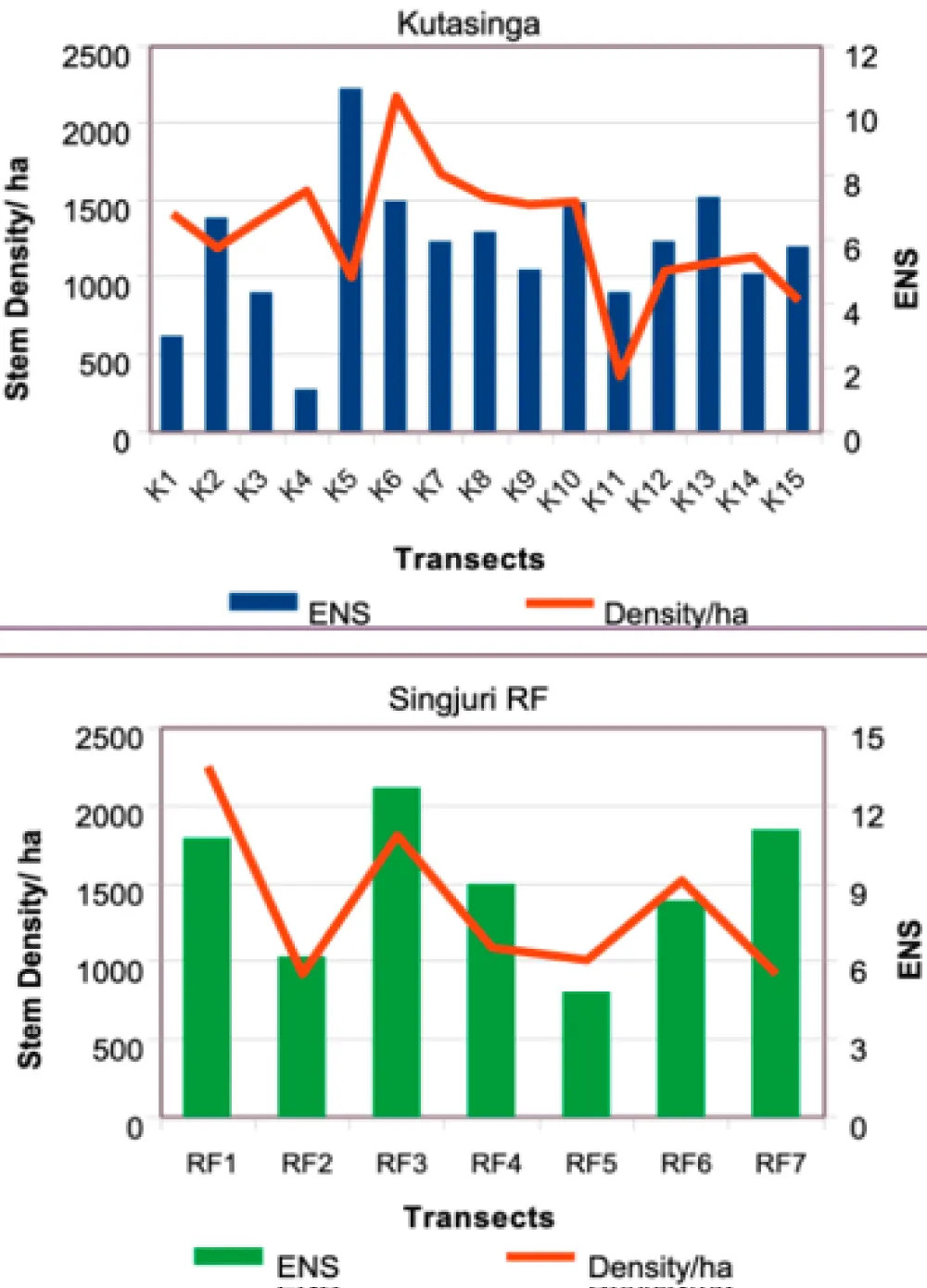
The ENS of the pooled tree species distribution is significantly (Kruskall-Wallis H = 5.248, p < 0.05) greater in Singjuri Reserve Forest than in Kutasinga forest, implying a greater evenness of species distribution, caused primarily by large patches of teak and eucalypt monoculture plantations. The greater ENS in the RF indicates that despite lesser count of species, the relative abundances of species are more uniform than in the Kantapalli forest under CFM. This relatively greater evenness in the RF is conferred by frequent monoculture plantations of teak (Tectona grandis) and Eucalyptus tereticornis.
Stem density and basal area: Regression of basal area (sq.m/ha) estimated from all transacts against stem density/ ha (Figure 9) shows that the relationship is direct. However, the relationship is not statistically significant for both Kutasinga forest (Slope of regression = 0.005, R2 = 0.088, t = 1.16, p > 0.1) and Singjhuri RF (Slope = 0.003, R2 = 0.113, t = 0.87, p > 0.2).

Herbaceous floral diversity and density: The floral density and diversity of the herbaceous stratum of the Singjuri and Kutasinga forests are summarized in table 8. Despite the apparent differences between the two forests in floral composition abundances of the herbaceous stratum, the overall density is remarkably similar. Kruskall-Wallis test reveal that the distribution of the herb-layer ENS values is no different between the two forests across the total of 22 transects during pre-monsoon ((H = 2.515, p > 0.05) and post-monsoon seasons (H = 2.115, p > 0.05).
| Table 8: Seasonal change in mean herbaceous diversity and density in Kutasinga and Singjuri forests. | ||||
| Forest Stand Characteristics | Pre-Monsoon (2016 & 2017) | Post-Monsoon (2016 & 2017) | ||
| Kutasinga | Singjuri | Kutasinga | Singjuri | |
| Species Count | 56 | 36 | 49 | 40 |
| Density/Ha | 18974 | 18847 | 362800 | 347667 |
| loge Density | 9.85 | 9.84 | 12.8 | 12.76 |
| ENS | 13.6 | 14.39 | 22.09 | 18.21 |
| Edible spp. | 20 | 11 | 13 | 9 |
Forest food availability and influx into village: The list of wild food biota gathered by the forest vilagers is given in supplementary table 2. The repertoire of forest food biota from the Kantapali forest under CFM far exceeds those from Singjuri Reserve Forest under statutory management (Figure 6). In the case of Kantapali forest under community management, the maximum number of wild food species collected from the forest is 7, which is almost the same as the number of wild food species from Singjuri RF (Table 9, figure 10).
| Table 9: The diversity and quantity of edible species harvested from Kutasinga and Singjuri forests. | ||||
| Month/Year | Kutasinga | Singjuri RF | ||
| No. of Food Species | Biomass (kg) | No. of Food Species | Biomass (kg) | |
| Mar-16 | 12 | 994.1 | 4 | 15.9 |
| Apr-16 | 9 | 566.3 | 6 | 71.7 |
| May-16 | 12 | 174.15 | 5 | 48.3 |
| Jun-16 | 7 | 1018.7 | 6 | 37 |
| Jul-16 | 6 | 381.5 | 5 | 65.5 |
| Aug-16 | 8 | 759.3 | 5 | 100.5 |
| Sep-16 | 6 | 314.9 | 2 | 180 |
| Oct-16 | 6 | 477.7 | 3 | 154.7 |
| Nov-16 | 9 | 837 | 4 | 111 |
| Dec-16 | 11 | 1197.2 | 5 | 178.7 |
| Jan-17 | 9 | 92.8 | 4 | 66 |
| Feb-17 | 12 | 385.8 | 5 | 100 |
| Mar-17 | 13 | 2473.7 | 4 | 83.9 |
| Apr-17 | 10 | 494.3 | 4 | 118.3 |
| May-17 | 8 | 240.7 | 2 | 44.5 |
| Jun-17 | 8 | 853.2 | 3 | 92.7 |
| Jul-17 | 8 | 506.3 | 2 | 128.8 |
| Aug-17 | 7 | 495.3 | 6 | 137.4 |
| Sep-17 | 6 | 463.5 | 4 | 81.76 |
| Oct-17 | 7 | 1228 | 5 | 170.4 |
| Nov-17 | 10 | 1352.4 | 6 | 172.7 |
| Dec-17 | 11 | 1537.5 | 8 | 178.6 |
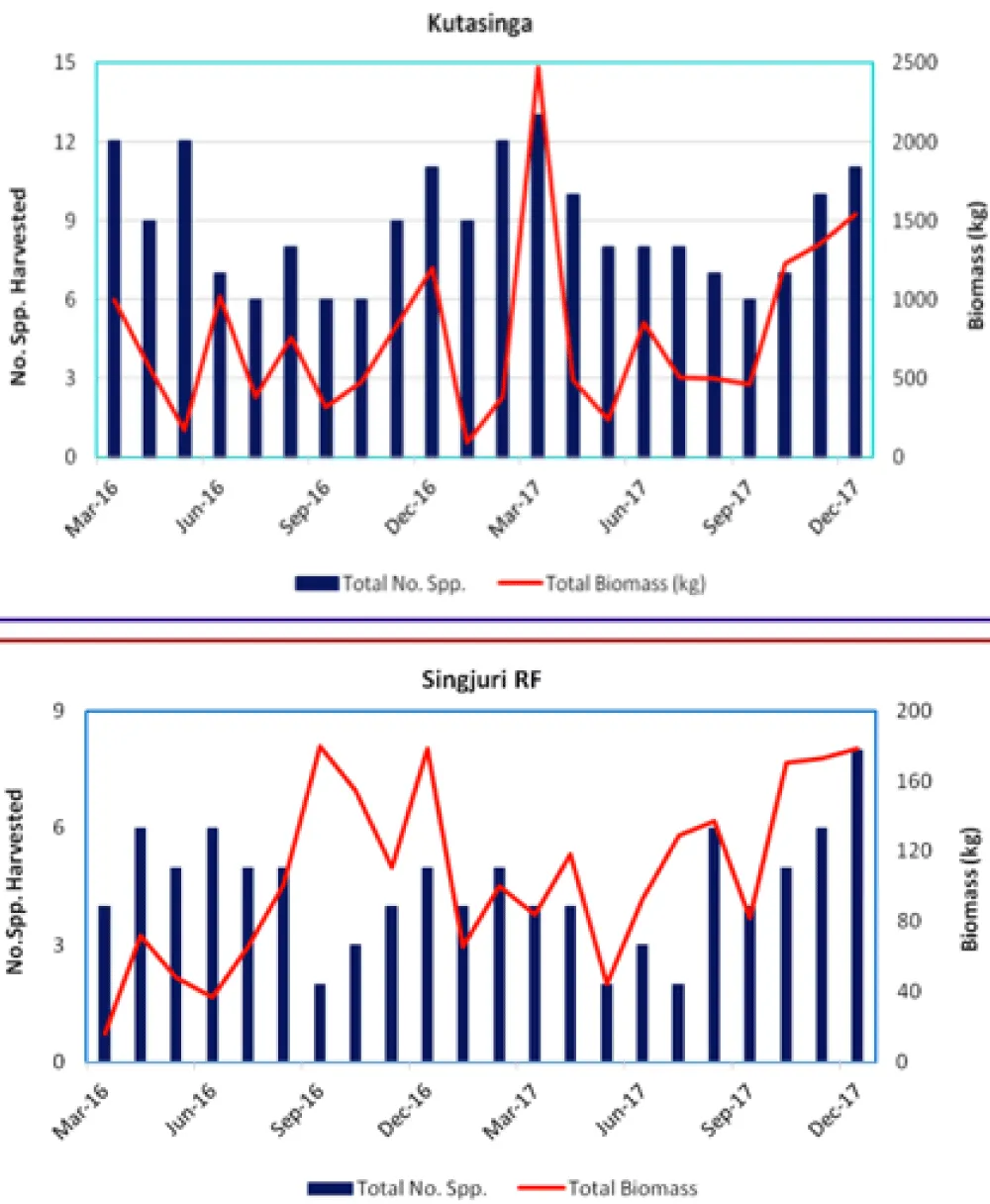
The quantities of food biomass (flora and fauna combined) harvested from the Kutasinga and Singjuri forests are widely different. The highest amount of these food species harvested from Kutasinga forest is 2473.7 kg, whereas that harvested from the RF does not exceed 180 kg (Table 9). The total annual harvest of wild foods from Kutasinga forest for the year 2017 is 10123 kg, whereas the annual harvest of food biomass from Singhuri forest for the same year is 1375 kg.
The diversity of forest food biota seems to be greater in Katapali forest than in Singhuri Reserve Forest of Balangir. The range of forest food flora includes edible flowers, tubers, fruits, leaves, and mushrooms. In contrast with the forests of Rayagada, leaf stitching ants (Oecophyla smaragdina) and snails are not harvested from the forests of Balangir. Clearly, local food culture of the villagers depending on the forest is an important determinant of the diversity and quantity of wild food influx into the villagers.
When the diversity and biomass of edible biota harvested from Balangir district forests are examined along the ecological features of the source forests, a plausible direct correspondence of the quantity of edible biota with tree and herbaceous diversity is discerned (Figure 11). However, basal area appears to be inversely related (t = 2.3, p < 0.05) with the overall number of food biota gathered from the forest.
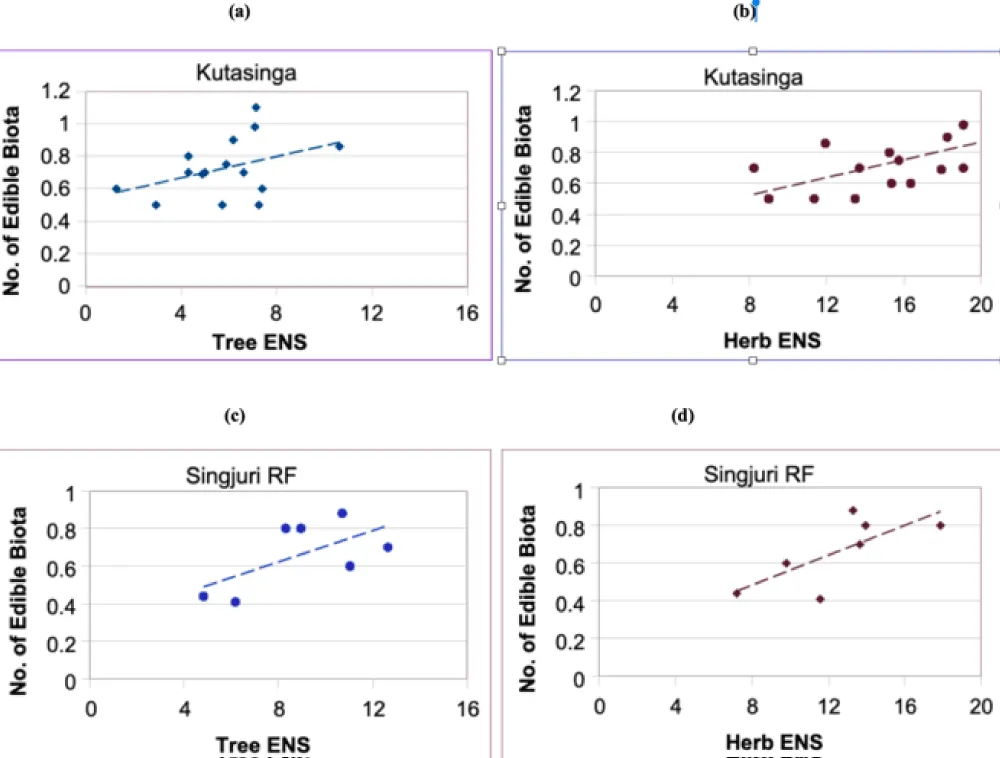
Relationship of wild food abundance with forest ecological status: We quantified the stationary food biota plants, mushrooms in each transect in the two forest tracts of Balangir district. It appears that the biomass of wild edible plants and mushrooms are more strongly associated with the diversity and abundance of the herbaceous flora, than with species diversity and abundance of the tree stratum. The correlation between the edible biomass and the tree species ENS was statistically not detected in Kutasinga forest (Figure 12).
The anthropology of wild food consumption
Human food culture also determines the specific parts of the edible species. In the villages surveyed in this study, most of food biota was consumed for a single edible part (e.g. fruit), a few species were harvested for consumption of more than one part. Thus, both the fruits and tubers of the wild date palm (Phoenix acaulis) are harvested both Rayagada and Balangir. Kutasinga villagers in Balangir consume both the leaves and fruits of kuler (Bauhinia purpurea). Villagers in both districts consume mahula (Madhuca longifolia) fruits and flowers. Table 10 shows the frequency distribution of edible species harvested and their parts consumed.
| Table 10: Edible flora and their parts consumed. | |||
| No. of Parts Consumed | No. of Species | Rayagada Forests | Balangir Forests |
| 1 part | 54 | 52 | 32 |
| 2 parts | 3 | 2 | 2 |
| 3 or more parts | 2 | 2 | 1 |
| Whole | 6 | 5 | 4 |
Members of the Kondh community consume at least three insect species from the forest, namely, the wild tassar (Antheraria paphea and A. mylitta) pupae, the weaver ant (Oecophylla smaragdina) and the red palm weevil (Rhynchophorus ferrugineus) larvae. In contrast, the caste community - excepting a few individuals who tasted them for adventure – does not consume these insects, although they hunt and consume several species of reptiles, birds and mammals that are consumed by the tribal group as well. Conversely, the Katapalli villagers hunt the wild cat (Felis chaus) for its flesh, while the Kondh households do not hunt this animal for food. The predominantly caste households of Katapalli village also customarily avoid several dioscorid tubers (such as Dioscorea bulbifera and D. oppositifolia), that are consumed in large quantities in Rayagada by the Kondh people. This ethnicity-related difference in food cultures explains why, despite a large spectrum of biodiversity in Balangir forests, the harvest of wild food diversity and biomass are considerably less in Balangir villages than in the Rayagada forest villages (Tables 10,11).
| Table 11: Number of items of edible biota harvested from forests in Rayagada and Balangir districts. | ||||
| Taxon | Food Items | Rayagada Villages | Balangir Villages | Total No. of Items |
| Plantae | Leaf & Stem | 12 | 6 | 14 |
| Roots and Tubers | 16 | 6 | 16 | |
| Flowers | 3 | 2 | 3 | |
| Fruits | 21 | 18 | 22 | |
| Fungi | Mushrooms | 5 | 4 | 6 |
| Animalia | Insects | 2 | 0 | 2 |
| Fish | 2 | 0 | 2 | |
| Reptiles | 2 | 0 | 2 | |
| Birds | 5 | 6 | 6 | |
| Mammals | 7 | 6 | 7 | |
| Total items consumed | 75 | 46 | 79 | |
Discussion
The findings from our study of forests under two categories of management may be summarised as follows.
- It is well understood that the number of food biota harvested from a forest primarily depends on the stock of the edible biota in the forest. Thus, several edible plants abundantly available in Rayagada forests rarely occur in Balangir forests, and vice versa. Phanji sag (Argyreia speciosa), for instance, is scarcely available in Balangir, but abundant in Rayagada forests. Conversely, phande (Oroxylum indicum) in Balangir forests is extremely rare, and hence the villagers of Kantapalli do not consume this plant, while the same item is frequently consumed in Rayagada forest villages. Likewise, because Kutasinga and Sindhipanga forests contain no permanent water body as stable fish habitat, the Katapali villagers do not consume any fish from these forest areas. The number of wild edible species harvested from a patch of forest is a subset of the forest biodiversity; therefore, a forest with greater species richness is expected to provide more edible flora and fauna than an equivalent patch with poor species richness and abundance. Reports of forest user communities [23] and forest ecological literature [37] endorse that almost no edible plants are available from monoculture plantations of eucalyptus; in particular, its allelopathic inhibition of the germination of fungal spores and plant seedlings is prominent [38]. Studies have shown that there is a direct relationship between tree cover, tree species diversity and food security especially of vulnerable groups [28,29]. Changes in the extent and type of forest have implications for the provisioning of food, and for food security and nutrition of local and distant human populations.
- Tree species diversity in the forest patches under Informal Community Management (ICM) is no different from the forest under statutory management in both districts. However, diversity, estimated as ENS, is significantly (Kruskall-Wallis H = 4.0, p < 0.05) greater in Sikabandha forest than the Sindhipanga RF. The highest value of ENS = 18.5 was recorded in the uniform plantation in the PF-5 transect of Sindhipanga. In both Sindhipanga and Singjuri forests under statutory management, large tracts of exotic plantation appear to reduce the available niches for several native food biota, such as mushrooms and tubers. Eucalyptus spp. are known to have strong allelopathic effects on native flora. Besides, plantations of exotics (Both Eucalyptus tereticornis and Acacia siamea in the forests under study) were raised after removal of native mixed vegetation. As a consequence, a large number of edible species – both plants and animals - were eliminated from these patches, thereby reducing the number of food items from these plantation areas. Although the overall diversity of edible biota is available in the entire forest area, the absolute biomass of several food biota is reduced by their elimination from the monoculture plantation patches. Thus, a larger number of older trees characterized by larger BA in plantation patches would entail a greater reduction in the biomass of numerous food biota. Conversely, a larger number of older trees or greater BA% in a native forest vegetation implies greater biodiversity, including food diversity and biomass. A higher value of ENS in the forest patches of Balangir district indicates greater evenness of distribution of the component tree species. A plausible reason is that the natural dominance of indigenous species (Llike Shorea robusta, Diospyros melanoxylon and Buchanania latifolia) of direct economic value to the villagers was replaced with the exotic Cassia siamea, planted at a large scale in Singjuri forest, leading to the curtailment of the potential availability of wild food species and their biomass.
- The overall diversity and biomass of wild food species gathered by the villagers over 22 months was immensely greater (Kruskall-Wallis H = 27.892, p < 0.0001 for edible species count; H = 28.39, p < 0.00001 for biomass) in Kutasinga than Singjuri RF. Likewise, the edible species enumerated from Sikabandha was remarkably greater than gathered from Sindhipanga Protected Forest, and the significance of this difference was extremely high (H = 30.1686, p < 0.0001). The difference between these two forests in terms of wild food biomass flow was also highly significant (H = 23.837, p < 0.00001). These findings indicate that more provisional services are obtained from forests under ICM than under statutory “command and control” management by the State Forest Department.
- In the forests in this study, the diversity and abundance of herbaceous flora include a number of edible plants. Mushrooms are more abundantly available from forest floors and tree stems (e.g. Mangifera indica and Syzygium cumini) in patches with high stem density. Conversely, higher stem density of older trees is likely to disfavour ground floral diversity, potentially reducing the edible floral component. However, the girth of trees and basal area was not significantly influenced by stem density in Sindhipanga, Kutasinga and Singjuri forests (Figures 4,9), chiefly due to frequent removal of logs. Therefore, unaffected by the density of growing trees, the high abundance of the herbaceous flora provided an unabated supply of edible items - especially dioscorid tubers.
- It is well documented that food consumption patterns are broadly influenced by local food cultures, ethnicity, religion, education and economic status. Several studies in various parts of the world report the significant influence of social and demographic factors on food consumption pattern [39,40]. While gender differences in food intake also prevail, the differences are not much in case of India [41]. Alongside caste and religion, household size is an important determinant of food consumption [42,43]. The present study highlights that ethnicity-related food preferences influence the quantity of food biomass harvested from the forest. Several edible species (such as the fruit of Olax scandens, flowers of Indigofera cassoides and the leaf-stitching ant, Oecophylla smaragdina) are commonly harvested by the indigenous Kondh households in Rayagada district but not considered ‘edible’ by general caste populations residing in the forest villages of Balangir district, although the same species are available in forest habitats in both locales. Conversely, the Kondh do not consume a few wild plants and animals (such as the wild cat Felis chaus), due to totemic inhibitions (Table 11). This food cultural difference modulates the wild food biomass flow into the villages, regardless of the availability and abundance of the resources in the forest habitat.
Conclusion
A plethora of publications have shown that the forest provides a large number of NTFP that are of vital importance to the forest village economies [13,23,44]. These NTFP items include wild food, fodder, fuel, and raw materials for construction and implements, as well as materials of medicinal and ornamental value. Clearly, the availability of NTFP depends on the repertoire of the forest, which is likely to be enriched with efficient management of the forest. Since the implementation of Joint Forest Management throughout the country, it has been documented that the forest biodiversity and architecture are improved when the forest is managed in the hands of the local user population, rather than by statutory ‘Command and Control’ mechanisms [7,45]. Community Forest Management (CFM), devoid of statutory intervention from the State Forest Department, is acknowledged to considerably improve the forest ecological status and forest villagers’ economic conditions in Odisha [27,46-48]. Our pioneering study quantitatively links the forest ecological status, shaped by prevalent management regime, with the provisional services to the user communities, and indicates that the forest ecological condition tends to be better – at least in terms of tree species abundances, herbaceous diversity, and basal area cover under informal community management than under statutory ‘Command and Control’ governance of the forest.
In the face of a large body of evidence, the institutional inertia of retaining official power persists in the forest bureaucracy [5,27,49,50]. Alongside, the rationale of extracting forest resources – or even clearing the forest – for the benefit of industry, is strong in the current policy institution, which is ensconced in the belief that economic prosperity for all can be ensured by the opulence of a few at the expense of well-being and happiness of the majority [51,52]. The present study, corroborating many others cited above, amply demonstrates that the forests of South Asia deserve to be protected and valued more than the estimated commercial value of timber, not only for environmental service of C emission mitigation and C sequestration, but also for its wide range of provisioning services, most prominently for diverse food for humans. The value of forest as an important source of food, in addition to agriculture, needs to be acknowledged in national food policy. On a larger scale, land use planning should consider local traditional knowledge and governance in decision and policy making [5,27,53]. Recognizing that natural resource users are often involved in landscape and resource stewardship [52,54] will help policies and institutions to achieve a more informed and synergized governance system. Furthermore, it is imperative to protect the forest ecosystems as a component of local food security during the Climate Crisis, which is certain to jeopardize our already destabilized agricultural food production, distribution and entitlement.
Acknowledgements
I shall always remain grateful to the Late. Debjeet S of Living Farms, who provided all the financial and logistic support for this study from its conception to completion. I am indebted to Dr. Hemanta S for taxonomic identification of forest flora; and to Radheshyam S, Sumanta S, Bibhuti S, Bhagawan K, Champa K and Pradeep P for their diligent assistance in forest surveys and household level data collection throughout the study period of two years.
Data Availability
All data in XLSX format is available on reasonable request.
Funding
This study received all financial support from Living Farms (https://living-farms.in), Bhubaneswar.
Statement of ethics and community consent
Full consent of all members of the ethnic communities was obtained for interviews after sharing with them prior information about the study's purpose, procedures, possible outcomes, and their right to withdraw at any time without penalty. The identity of each individual participant remains undisclosed.
Conflict of Interest
The author declares that there is no conflict of interest.
References
- Global biodiversity assessment. United Nations Environmental Program (UNEP). Cambridge: Cambridge University Press; 1995.
- Palik, B, Bengstrom T. Species composition. In: Hunter ML, editor. Maintaining biodiversity in forest ecosystems. Cambridge: Cambridge University Press; 1999. p. 65-94.
- Flint EP. Deforestation and land use in northern India with a focus on sal (Shorea robusta) forests 1880-1980. In: Grove R, Damodaran V, Sangwan S, editors. Nature and the orient. New Delhi: Oxford University Press; 1998. p. 421-458.
- Sivaramakrishnan K. Modern forests: Statemaking and environmental change in colonial eastern India. New Delhi: Oxford University Press; 1999.
- Deb D. The value of forest: An ecological economic examination of forest people’s perspective, In: Trevor Fenning, editor. Challenges and opportunities for the world’s forests in the 21st Century. Heidelberg: Springer; 2014. p. 123-159.
- Gadgil M, Guha R. Ecology and Equity: The use and abuse of nature in contemporary India. London: Routledge; 1995.
- Kothari A, Camill P, Brown J. Conservation as if people also mattered: Policy and practice of community-based conservation. Conservation and Society. 2013;11:1-15.
- Letter to Principal Secretary (Forests). Ministry of Environment, Forest and Climate Change, Government of India. 2021.
- The Wire. 94,460 trees felled in Chhattisgarh's Hasdeo forest, 2,73,757 more to go, Government tells Parliament. The Wire. 2025.
- PTI. Chhattisgarh forest department recommends approval of forest land for coal mining project. Press Trust of India. 2025.
- Deb D. Joint forest management. In: Ghosh AK, editor. Status of Environment in West Bengal: a Citizens’ Report. Kolkata: ENDEV Society for Environment and Development; 2008. p. 96-104.
- Shackleton C M, Pandey AK. Positioning non-timber forest products on the development agenda. Forest Policy and Economics. 2014;38:1-7.
- Sardeshpande M, Shackleton C. Wild edible fruits: A systematic review of an under-researched multifunctional NTFP (Non-Timber Forest Product). Forests. 2019;10:467.
- Kapoor R, Sabharwal M, Ghosh-Jerath S. Indigenous Foods of India: A Comprehensive Narrative Review of Nutritive Values, Antinutrient Content and Mineral Bioavailability of Traditional Foods Consumed by Indigenous Communities of India. Front Sustain Food Syst. 2022 Apr 28;6:696228. doi: 10.3389/fsufs.2022.696228. PMID: 35607508; PMCID: PMC7612755.
- Cheek JZ, Lambrecht NJ, den Braber B, Akanchha N, Govindarajulu D, Jones AD, Chhatre A, Rasmussen LV. Wild foods contribute to women's higher dietary diversity in India. Nat Food. 2023 Jun;4(6):476-482. doi: 10.1038/s43016-023-00766-1. Epub 2023 Jun 22. PMID: 37349564.
- Ong HG, Kim YD. The role of wild edible plants in household food security among transitioning hunter-gatherers: Evidence from the Philippines. Food Secur. 2017;9:11-24.
- Chauhan SH, Yadav S, Takahashi T, Łuczaj Ł, D'Cruz L, Okada K. Consumption patterns of wild edibles by the Vasavas: a case study from Gujarat, India. J Ethnobiol Ethnomed. 2018 Aug 29;14(1):57. doi: 10.1186/s13002-018-0254-3. PMID: 30157859; PMCID: PMC6116503.
- Singh RK, Bhardwaj R, Singh A, Payum T, Rai AK, Singh A, Wangchu L, Upadhyay S. Mainstreaming Local Food Species for Nutritional and Livelihood Security: Insights From Traditional Food Systems of Adi Community of Arunachal Pradesh, India. Front Nutr. 2021 Aug 16;8:590978. doi: 10.3389/fnut.2021.590978. PMID: 34485354; PMCID: PMC8415219.
- Pieroni A, Hovsepyan R, Manduzai AK, Soukand R. Wild food plants traditionally gathered in central Armenia: archaic ingredients or future sustainable foods? Environ Dev Sustain. 2020;3:2358-2381.
- Nagashree G, Kotresha K. Checklist on wild edible fruits from forest areas of Tumkur district, Karnataka, India. J Plant Sci Res. 2024;11:258
- Ghanimi R, Ouhammou A, Ahouach A, Cherkaoui M. Ethnobotanical study on wild edible plants traditionally used by Messiwa people, Morocco. J Ethnobiol Ethnomed. 2022 Mar 15;18(1):16. doi: 10.1186/s13002-022-00500-4. PMID: 35292058; PMCID: PMC8922891.
- Yangdon P, Araki T, Rahayu YYS, Norbu K. Ethnobotanical study of wild edible fruits in eastern Bhutan. J Ethnobiol Ethnomed. 2022 Mar 30;18(1):27. doi: 10.1186/s13002-022-00526-8. PMID: 35354474; PMCID: PMC8966357.
- Challe JF, Niehof A, Struik PC. The significance of gathering wild orchid tubers for orphan household livelihoods in a context of HIV/AIDS in Tanzania. Afr J AIDS Res. 2011 Sep;10(3):207-18. doi: 10.2989/16085906.2011.626287. PMID: 25859789.
- Ahmed MA. Contribution of non-timber forest products to household food security: The case of Yabelo Woreda, Borana Zone, Ethiopia. Food Science and Quality Management. 2013;20.
- Bwalya SM. Household dependence on forest income in rural Zambia. Zambia Soc Sci J. 2013;2:6.
- Vira B, Wildburger C, Mansourian S. Forests and food. Cambridge: Open Book Publishers; 2015.
- Blaikie P, Springate BO. Understanding the policy process. In: Baginski OS, Blaikie P, editors. Forest, People and Power: The political ecology of reform in South Asia. London: Earthscan; 2007. p. 61-91.
- Ickowitz A, Powell B, Salim MA, Sunderland TCH. Dietary quality and tree cover in Africa. Global Environmental Change. 2014;24:287-294.
- Van NM, Bizard V, Wangpakapattanawong P. Tree cover transitions and food security in Southeast Asia. Global Food Security. 2014;3:200-208.
- Kleinschmit D, Basnett BS, Martin A. Drivers of forests and tree-based systems for food Security and nutrition. In: Vira B, Christoph W, Stephanie M, editors. Forests and Food. Cambridge: Open Book Publishers; 2015. p. 137-182.
- Champion HG, Seth SK. A revised survey of forest types of India. New Delhi: Govt. of India: Press; 1968. p. 404.
- West PW. Tree and forest measurement. 2nd ed. London: Springer; 2009.
- Soberón JM, Llorente JB. The use of species accumulation functions for the prediction of species richness. Conservation Biology. 1993;7:480-488.
- Magurran AE. Measuring biological diversity. 2nd ed. London: Blackwell; 2004.
- Georgiev GZ. Normality calculator; 2023.
- Gibbons JD, Chakraborti S. Nonparametric statistical inference. 6th ed. London: CRC Press; 2021.
- Puig CG, Reigosa MJ, Valentão P, Andrade PB, Pedrol N. Unravelling the bioherbicide potential of Eucalyptus globulus Labill: Biochemistry and effects of its aqueous extract. PLoS One. 2018 Feb 13;13(2):e0192872. doi: 10.1371/journal.pone.0192872. PMID: 29438430; PMCID: PMC5811039.
- Liu B, Qu Z, Ma Y, Xu J, Chen P, Sun H. Eucalyptus Plantation Age and Species Govern Soil Fungal Community Structure and Function Under a Tropical Monsoon Climate in China. Front Fungal Biol. 2021 Sep 10;2:703467. doi: 10.3389/ffunb.2021.703467. PMID: 37744134; PMCID: PMC10512287.
- Harriss WB. The intra-family distribution of hunger in South Asia. In: Dreze J, Sen A, editors. The Political Economy of Hunger. Oxford: Clarendon Press; 1991.
- Mahadevan R, Suardi S. Is there a role for caste and religion in food security policy? A look at rural India. Economic Modelling. 2013;31:58-69.
- Subramanian S, Deaton A. Gender effects in Indian food consumption patterns, Research Programme in Development studies, Discussion Paper 147, Princeton, NJ: Princeton University; 1990.
- Gupta A, Mishra DK. Food consumption pattern in rural India: a regional perspective. J Econ Soc Dev. 2014;9:1-16.
- Meenakshi JV, Ray R. Regional differences in India’s food expenditure pattern: a complete demand systems approach. J Intern Dev. 1999;11:47-74.
- Baddianaah I, Baaweh L. The prospects of community-based natural resource management in Ghana: A case study of Zukpiri community resource management area. Heliyon. 2021 Oct 15;7(10):e08187. doi: 10.1016/j.heliyon.2021.e08187. PMID: 34712859; PMCID: PMC8529512.
- Deb D, Malhotra KC. People’s participation: The evolution of joint forest management in West Bengal. In: Roy SB, Ghosh A, editors. People of India: The biocultural dimensions. New Delhi: Inter-India Publication; 1993. p. 329-342.
- Conroy C, Mishra A, Rani A. Learning from self-initiated community forest management in Orissa, India. For Policy Econ. 2002;4:227-237.
- Patnaik S. Sulia paribesh parishad: Guardians of the forest. In: Durst PB, Brown C, Tacio HD, Ishikawa M, editors. In search of excellence: Exemplary forest management in Asia and the Pacific. Bangkok: FAO Regional Office for Asia and the Pacific; 2015. p. 61-71.
- Durst PB, Brown C, Taco HD. In search of excellence: Exemplary forest management in Asia and the Pacific. Asia-pacific forestry commission. Bangkok: Food and Agriculture Organisation of the United Nations; 2015.
- Nayak PK, Berkes F. Politics of co-optation: community forest management versus Joint Forest Management in Orissa, India. Environ Manage. 2008 May;41(5):707-18. doi: 10.1007/s00267-008-9088-4. PMID: 18288518.
- Banerjee AK, Ghosh AS, Springate BO. Obstructed access to forest justice in West Bengal: State violations in the mis-implementation of the Forest Rights Act 2006. IPPG discussion paper #49. Improving Institutions for Pro-Poor Growth Research Programme, Manchester, UK; 2010.
- Douthwaite R. The growth illusion. 2nd ed. Dublin: Lilliput Press; 1999.
- Deb D. Beyond developmentality: Constructing inclusive freedom and sustainability. London: Earthscan/ Routledge; 2009.
- Mukhopadhayay R. Biodiversity conservation through participatory monitoring: A case study from People’s protected area Dhamtari, Chhattisgarh. J Biodivers. 2012;3:45-53.
- Ball AA, Brancalion PH. Governance challenges for commercial exploitation of a non-timber forest product by marginalized rural communities. Environ Conserv. 2016;43:208-220.




Content Alerts
SignUp to our
Content alerts.
 This work is licensed under a Creative Commons Attribution 4.0 International License.
