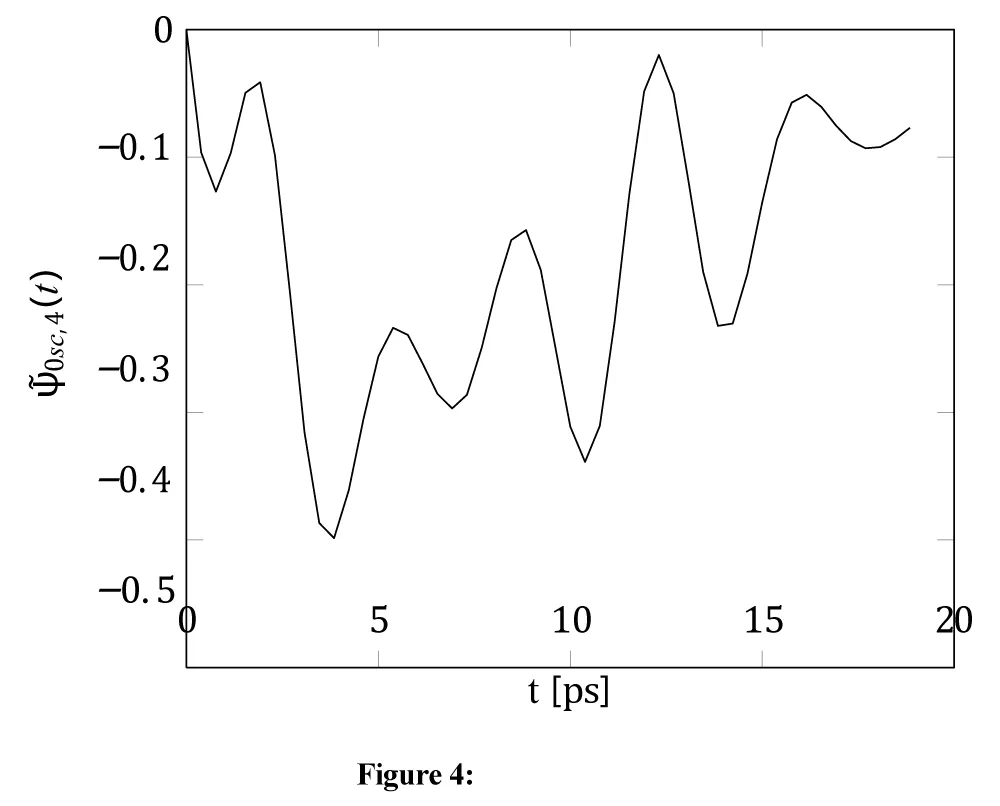
Recently experiments with Cu2O crystals were performed, when two waves with energies close to Eg/2 and finite pulse duration, excited a population of excitons in various states En[4], n stands for the set of quantum numbers n,l m. The population decays then with a lifetime τn. The emission line shapes show deviations from the decay line, which are due to interference effects between neighboring exciton states and are termed quantum beats [4,5]. The lifetimes can be read off from the shape of time-dependent susceptibility, which consists of linear susceptibility χ(1) , and nonlinear ones χ (3) [2,6].
χ(1) (χ,t) = (2/ ε0) ) ∑nψosc,n (t)(Gn(t,t’)F(t’ )) × (|cn|2 (En+Eg) )((Eg+En) 2 –ħ2 [(ω1+ω2) +i/ωn]2)-1 , (1)
In the above equation M0 is the interband-transition integrated dipole strengths, ε0 the vacuum electric susceptibility constant, w1,w2 the frequencies of the impinging waves, ϕn are the excitonic eigenfunctions, Elm the related eigenvalues, tn their lifetimes, and |cn|2 the corresponding oscillator strengths. The quantity T1 denotes the inter-band recombination time, and An, Bn represent the intra-band dissipation [7]. The function F(t) determines the impulse shape, and G(t,t′) is the Green function appropriate for the exciton decay equation. The functions ψosc,n describe the quantum beats. The exciton emission reported in [4] is described by the imaginary part of χ(3) . Having χ(1) and χ(3) , we are also able to determine the nonlinear index of refraction n2, defined as [2].
(2)
where c the vacuum light velocity, and εb the bulk crystal dielectric constant. The total index of refraction is
n2 = εb + χ(1) + χ(3)|Eprop|2 ,
n(I) = n0 +n2I, n0 2 = εb + χ(1) ,
I = (c/2) n0ε0|Eprop|2 . (3)
Eprop being the amplitude of the electromagnetic wave. This amplitude is related to the intensity I of the incoming wave by the relation
|Eprop|2 = 2ζ I (4)
where z ≈ 377Ω is the impedance of free space. Note that we have to distinguish the refraction index n from the state number n. The phase shift is calculated from
∆f =( wL/c) [n(I)−n(0)], (5)
where n(I) is the total refraction index obtained for average intensity I inside the crystal, and L is the crystal length. As we will show in the following, the nonlinear optical effects depend, in the case of short-pulse excitation, on time t, and applied laser power P. The time t = 0 corresponds to the maximum of the incoming pulse. We find it opportune to use in the formulas the nominal laser power p. The dependence τn(p) of the exciton life time was observed experimentally [4], and can be described by the formulas [6]
τn = τ0 exp( nb1 −n2 b2 −Pb3 ). (6)
The coefficients τ0,b1,b2,b3 (τ0 in ps, b3 in 1/mW)
b1 = 0.98, b2 = 0.04, b3 = 6.6×10⁻³ , τ0 = 0.197, (7)
were obtained from fitting experimental results from [4].
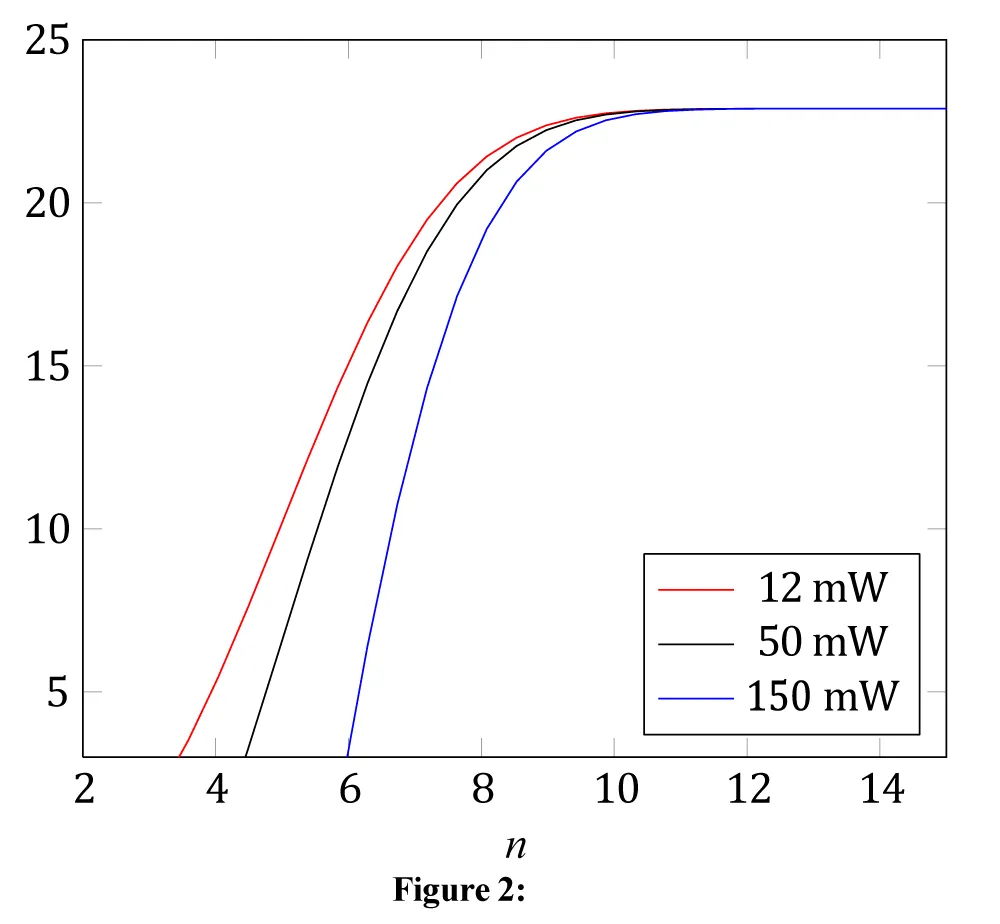
Below we discuss the dependence n(P). Both susceptibilities, linear and nonlinear, depend on W through the dependencies τn(P) and An(P), Bn(P). As observed in experiments, the values of lifetimes for n > 7 arrive at a plateau. For higher states we observe a slow increase, tending to a value τ∞. The scaling in this interval can be described by the formula
τn00 = τnS = τ∞S[1−exp (b3p −n3 λS ] , S excitons,
τ∞S = 22.89 ps, λS = 5.36×10⁻³ . (8)
With the above statements, we calculate the dependence χ(1) (p), χ(3) (p). Since we aim to connect the Kerr effect with quantum beats, we refer to experiments [4], and consider the two-photon absorption resonant with various Rydberg states, focusing the attention on the resulting one-photon emission at twice the pump energy
hω1+hω2 = Eg . (9)
In what follows we consider the lowest even states of the so-called yellow series excitons in Cu2O. For these states
Eg ≈ 2 eV, En µ 10−2 eV, 0.1 ≤ Γn ≤ 1 meV, (10)
and, in consequence, the following approximations can be made
Reχ(1) (w,t) ≈ (2/ε0) ∑n ψosc,n(t)
χ(Gn(t,t′)F(t′))|cn|2 /2En , (11)
Re χ(3) (w,t)≈ − (2M02/ε0)∑n,n′ cn cn′
(An +Bn) jn′ (0) T1 (2En En′ 2t n′)-1
x(Gn(t,t")F(t"))(Gn(t",t‘)F(t‘))ψ2osc,n(t). (12)
The effect of the pump power on the dynamics and the exciton lifetime was studied for each state (separately) [4,6]. We perform the calculations in analogous situation, therefore we drop the summation in Eqs. (1,12) obtaining
(13)
For the further calculations we must define all the terms arriving in the above equations. We recall the definitions [6]. The coefficients cnlm and eigenfunctions ϕn = ϕnlm are defined as follows
(14)
Ylm(θ,φ) are the spherical harmonics, Rnl(r) are the radial functions of a corresponding hydrogen atom-like Schrödinger equation. The function M(r) is the so-called transition dipole density [8], and describes the quantum coherence between the macroscopic electromagnetic field (the wave propagating in the crystal), and the inter-band transitions. For the S type transitions it has the form
(16)
where r0 is the so-called coherence radius, defined as
(17)
and µ being the reduced electron-hole effective mass. The exciton oscillator strength (here for S states) reads
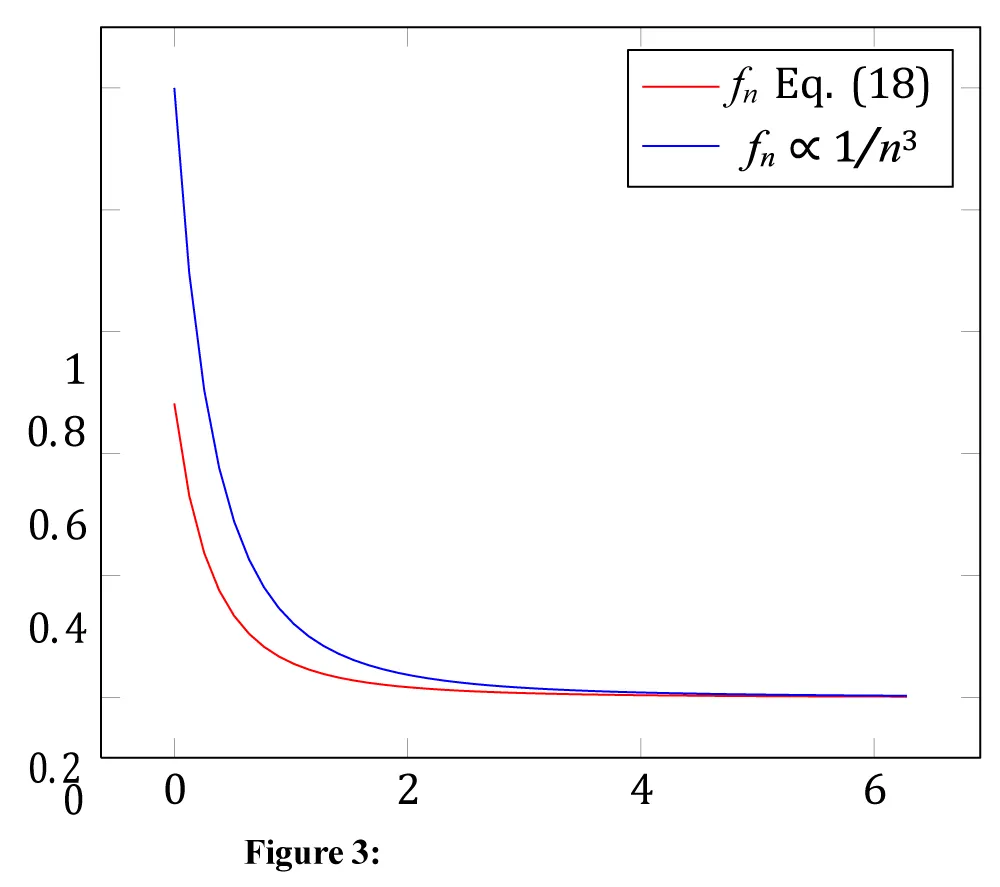
(18)
where a* is the exciton effective Bohr radius. As can be seen from figure 3, for large on the approximation fn00 ≈ 1/n3 can be used (the red curve calculated with r0 = 0.2 a*). From the formulas (14-16) we get
Figure 3: Oscillator strengths.
(19)
where
(20)
with the longitudinal-transversal energy ∆LT .
The above calculated quantities, inserted into equations (1,12) give the relations
(21)
The quantities An, Bn are related to nonlinear dissipative processes (for example [2,7]), and are defined as
(22)
where f0e ,f0h are the normalized Boltzmann distributions for electrons and holes, respectively. The expressions (21) are then used in Eq. (2), giving the formulas for the refraction indices
(23)
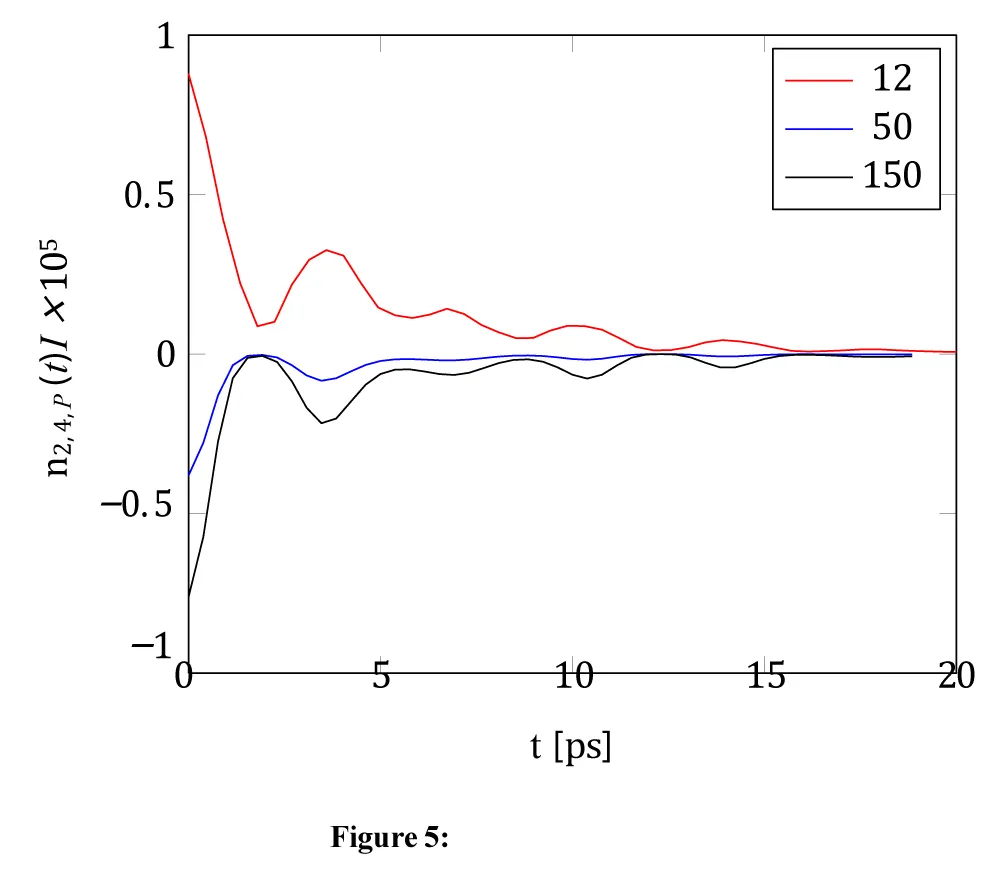
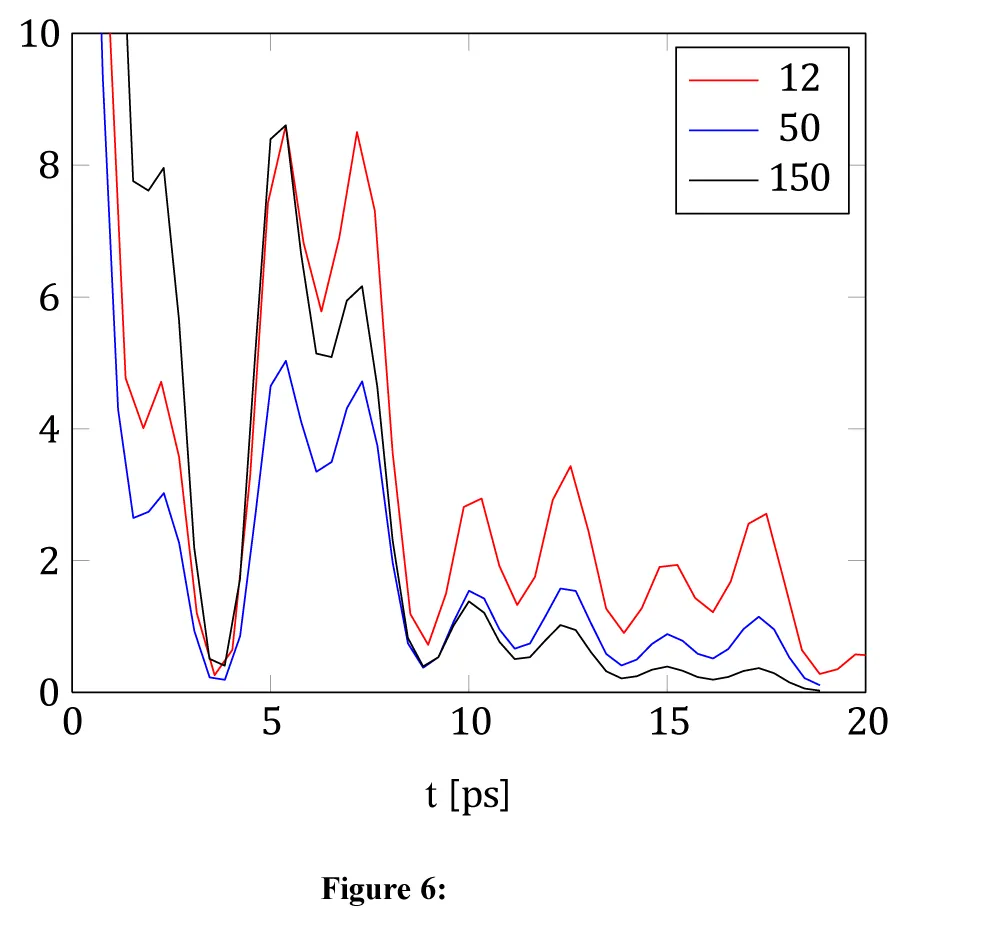
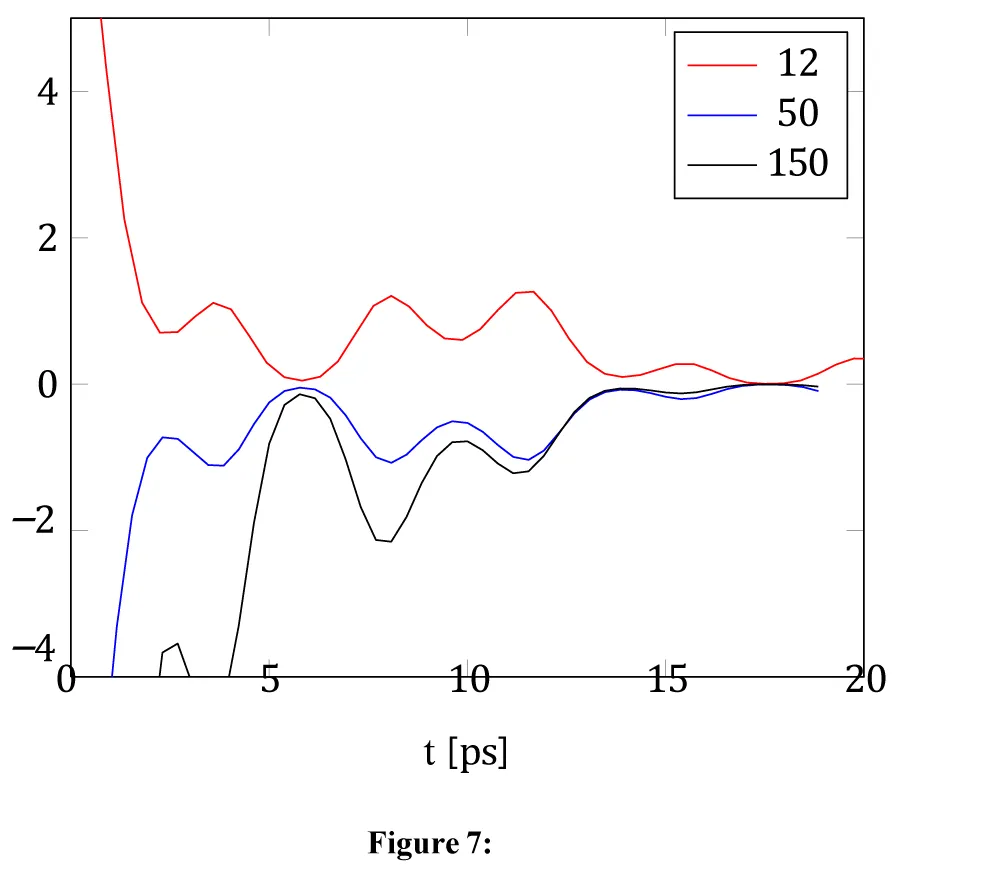
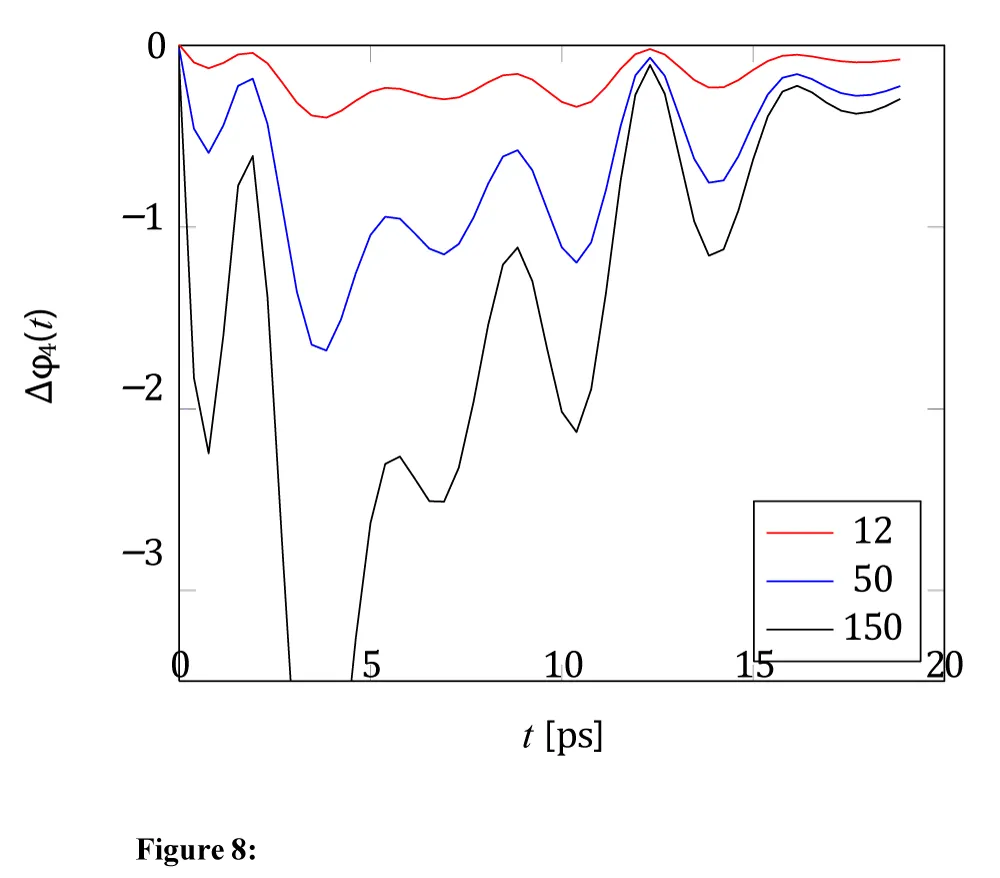
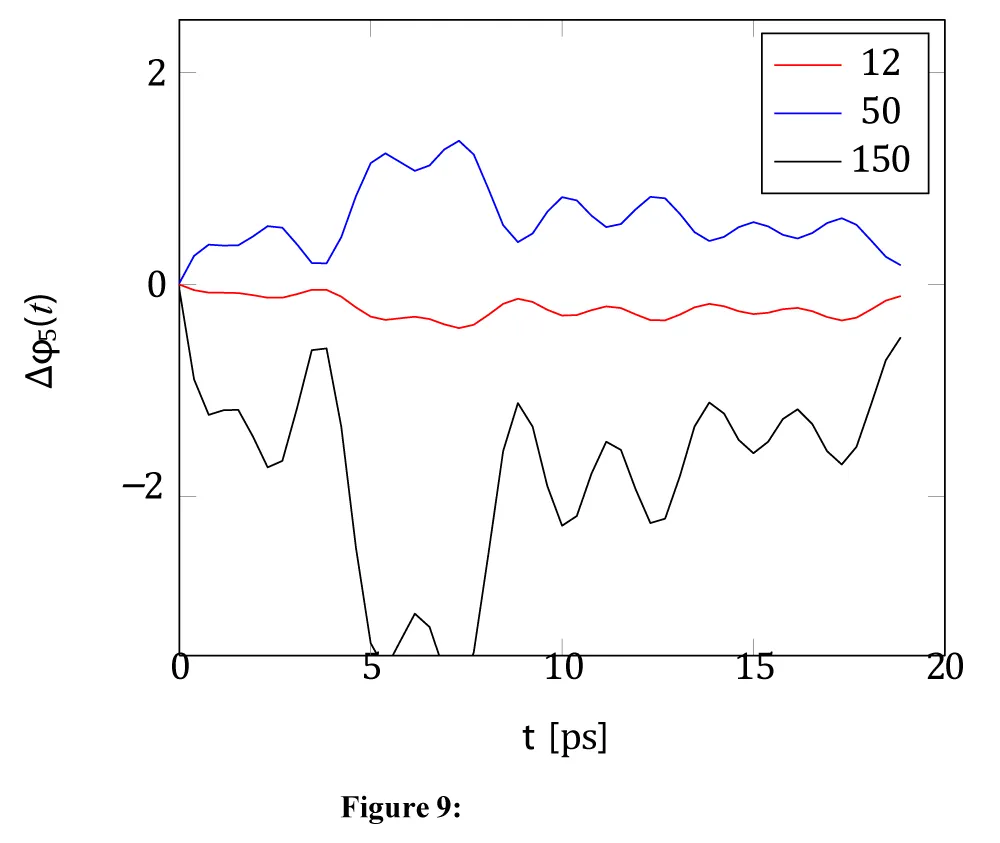
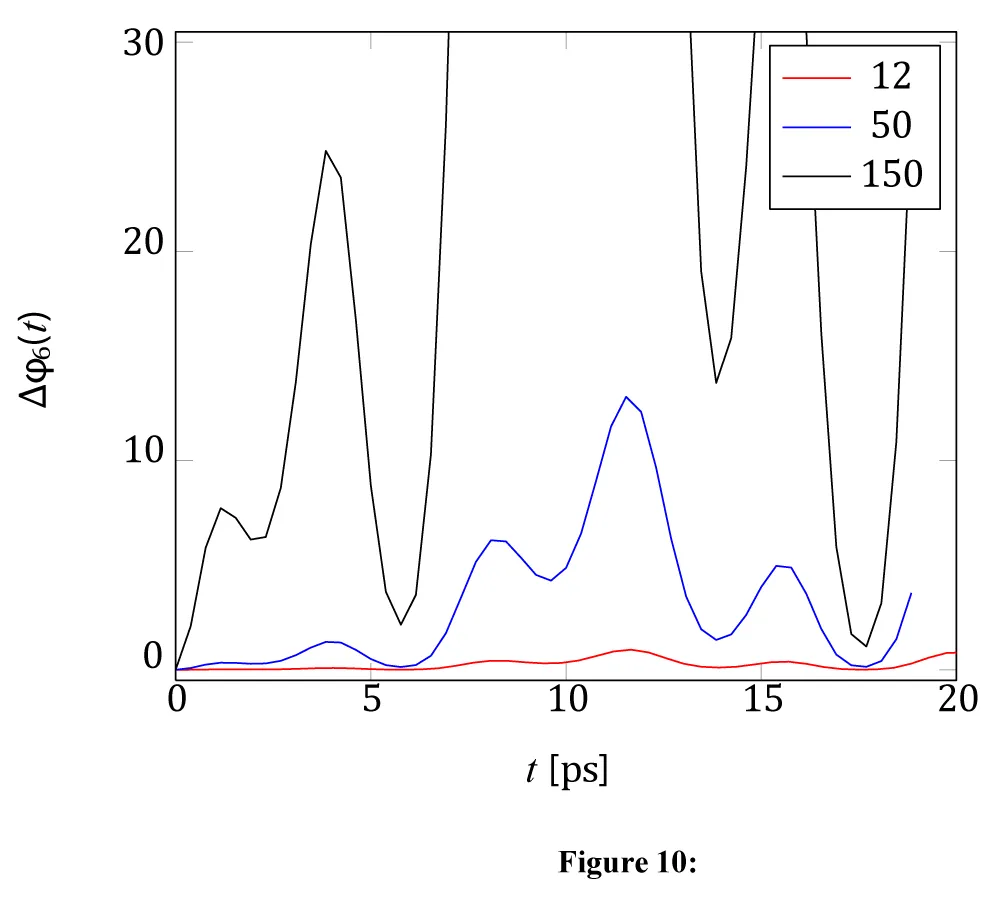
with the dimension [Cn(2)]=m2/W. The equations (23) define the refraction indices for given exciton state n, and in short-pulse excitation regime. As can be seen, they reveal oscillatory behavior (quantum beats), described by the time-dependent terms Fn(1) (t), Fn(2)(t). The quantities Cn(1) , Cn(2) define amplitudes of oscillations. Having calculated the refraction indices, one can determine the phase shift (5), which also will show oscillatory behavior at the given state [8-10].
Calculations of coefficients An, Bn
As follows from expressions (21), almost all ingredients are known, besides of the quantities An,Bn. Below we consider the exciton S states, thus the definitions (22) take the form
where we now denote n = (n,0,0) → n, and λth,e , λth,h are the so-called thermal lengths for electrons and holes, respectively [2,7],
(25)
kB being the Boltzmann constant, and T is the temperature, kB = 8.617 x 10⁻² meV/K. The coefficients An, Bn depend on the temperature by definitions of l’s (25), which can be written in the form
The exciton Rydberg energy R*, and the excitonic Bohr radius a*, were obtained by the formulas
(26)
Using the parameter values from table 1, we obtain
| Table 1: Band parameter values for Cu2O from [9], Energies in meV, masses in free electron mass m0, lengths in nm, ∆LT from [10]. |
| Parameter |
Value |
| Eg |
2172.08 |
| R* |
90.88 |
| ∆LT |
5x 10⁻² |
| me |
0.985 |
| mh |
0.575 |
| µ |
0.363 |
| εb |
7.37 |
| a* |
1.07 |
The above quantities are then used in the determination of An, Bn by equations (24). The results are given below in tables 2-4. As it can be seen from the data displayed in the tables, the coefficients An, Bn have alternative signs. It reflects the oscillatory behavior of the Lagrange polynomials, being constituents of the radial functions Rnl.
| Table 2: Quantities A4 , A4 j4(0), B4 , B4 j4(0), and (A4+B4)0 = (A4+B4) j4(0), for 5 values of temperature. |
| Temp. |
A4 |
A4 j4(0) |
B4 |
B4 j4(0 |
(A4+B4)0 |
| 4.2 |
- 10.33 |
- 2.58 |
-26.94 |
-6.73 |
-9.31 |
| 10 |
1.138 |
0.288 |
-3.48 |
-0.87 |
-0.59 |
| 20 |
0.905 |
0.248 |
1.5 |
0.38 |
1.38 |
| 30 |
0.20 |
0.05 |
1.3 |
0.33 |
0.38 |
| 40 |
-0.237 |
-0.0638 |
0.67 |
0.17 |
0.11 |
| Table 3: Quantities A5 , A5 j5(0), B5 , B5 j5(0), and (A5+B5)0 = (A5+B5) j5(0), for 5 values of temperature. |
| Temp. |
A5 |
A5 j5(0) |
B5 |
B5 j5(0 |
(A5+B4)0 |
| 4.2 |
- 19.36 |
- 2.88 |
-26.4 |
-3.933 |
-6.81 |
| 10 |
-5.57 |
-0.83 |
-13.13 |
-1.96 |
-2.79 |
| 20 |
-1.3 |
-0.194 |
-4.06 |
-0.6 |
-0.794 |
| 30 |
-0.712 |
-0.1 |
-1.8 |
-0.26 |
-0.36 |
| 40 |
-0.54 |
-0.0838 |
-1 |
-0.145 |
-0.225 |
| Table 4: Quantities A6 , A6 j6(0), B6 , B6 j6(0), and (A6+B6)0 = (A6+B6) j6(0), for 5 values of temperature. |
| Temp. |
A6 |
A6 j6(0) |
B6 |
B6 j6(0) |
(A6+B6)0 |
| 4.2 |
- 0.666 |
- -0.09 |
0.469 |
0.065 |
-0.025 |
| 10 |
0.225 |
0.03 |
-0.63 |
-1.96 |
-2.79 |
| 20 |
0.48 |
0.066 |
0.423 |
0.0588 |
0.125 |
| 30 |
0.187 |
0.026 |
0.55 |
0.076 |
0.1 |
| 40 |
-0.033 |
-0.004 |
0.372 |
0.052 |
0.048 |
Calculation of the nonlinear refraction index
Using Eqs. (23), we calculate the time dependence of the nonlinear refraction index for S exciton states in a Cu2O crystal. In calculations we use a Gaussian shaped normalized pulse
(28)
where tp is the pulse temporal duration. Using this shape, we calculate the expressions including the Green function G,
(29)
In the lowest approximation we obtain
(30)
The nonlinear refraction index for the state |n=n,0,0> → n has the form
(31)
where
(32)
with t1=10-3 T1, and Ψn will be defined below. The matrix elements XnP(3) are displayed in table 5. The total refraction index will be calculated by Eqs. (3). First we calculate the index n0
| Table 5: Matrix elements XnP(3) in units 10-6. |
| n/P |
12 |
50 |
150 |
| 4 |
1.55 |
-8.31 |
48 |
| 5 |
8.0 |
5.52 |
20 |
| 6 |
1.39 |
-14.8 |
-40 |
(33)
When using Eqs. (3), one must to insert the laser power per unit area. Having in mind the experiments in Ref. [4], where the laser with 20 µm spot diameter is focused on the sample, we obtain
(34)
Calculation of the phase shift
Using Eqs. (3) and (5) we calculate
(35)
The above result is now used to calculate
(36)
Thus the final expression for the phase shift in the exciton state n has the form
(37)


 |
|



 Research Article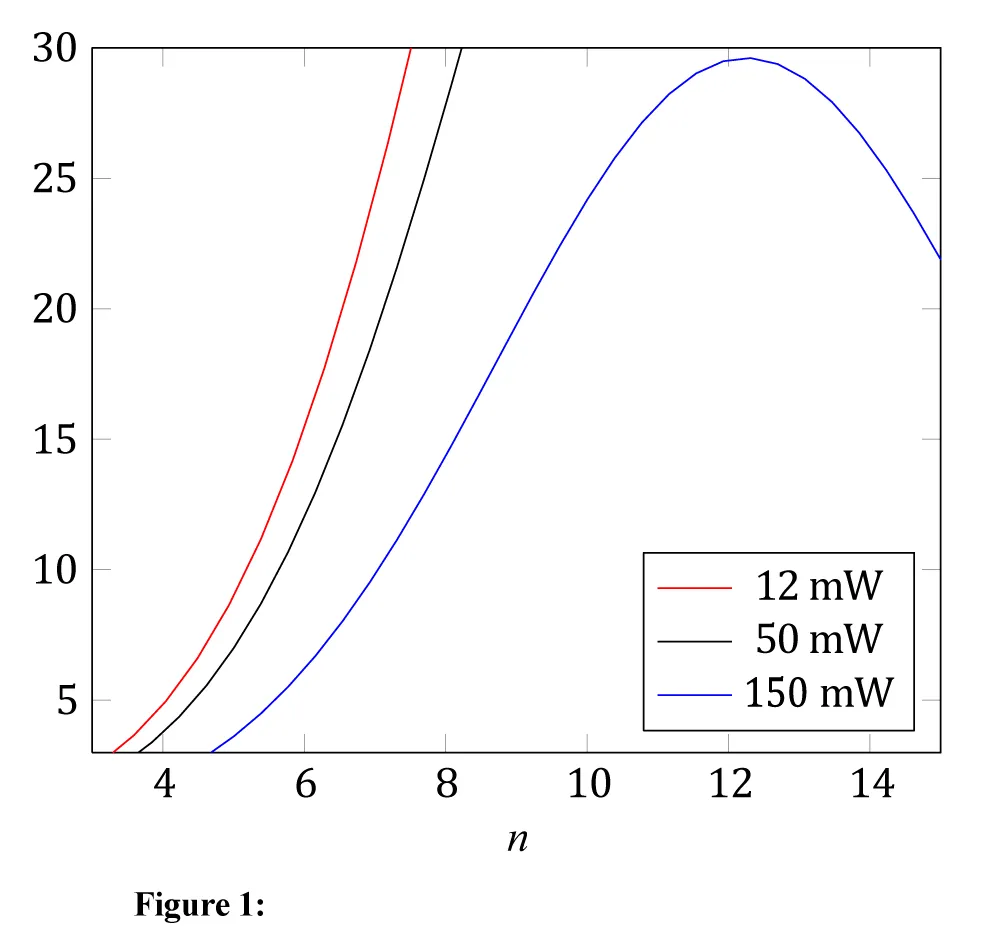





 This work is licensed under a Creative Commons Attribution 4.0 International License.
