
2025 August 14;6(8):1038-1058. doi: 10.37871/jbres2160.
-
Subject area(s):

 |
|
 |
|
 |
|

 Research Article
New Species of the Genus Papuacites Ingrisch, 2015 from the Solomon Islands and New Guinea (Orthoptera: Tettigoniidae: Agraeciini)
Sigfrid Ingrisch*
- Orthoptera
- Katydids
- Papua New Guinea
- Solomon Islands
- Conocephalinae
- Agraeciini
Abstract
Species of the genus Papuacites are micropterous and have strongly or very strongly reduced wings. They are rather narrow and small which is in contrast to the larger and robust species of the genus Anthracites Redtenbacher, 1891 from which they also differ by the narrow instead of wide lateral lobes of the pronotum and by the male titillators which are nearly uniform within Papuacites but differ markedly between species in Anthracites. Instead, in Papuacites the male cerci and the female subgenital plates vary significantly between species and are an important character for differentiation of species.
Studying a rich collection of short-winged Agraeciini from the Solomon Islands and New Guinea revealed 16 new species of the formerly insuffiently known genus Papuacites. which are described and illustrated below. Separate keys to males and to females for differentiation of the species of Papuacites are also given.
Introduction
The genus Papuacites Ingrisch S. [1], 2015 had been introduced for one species of orthopterous insects of the tettigoniid taxon Agraeciini living in the Solomon Islands and New Guinea. Typus generis is Anthracites nigrifrons Karny HH, et al. [2]. This species and a second species Anthracites nakanaiensis Naskrecki P, et al. [3] removed to Papuacites by Ingrisch S. [1] had been the unique members of the genus so far. The genus Papuacites differs markedly from Anthracites by its narrow appearance, the shape of the lateral lobes of pronotum and by large differences of the male titillators which are nearly uniform between species in Papuacites but of varying shape in Anthracites. Moreover, the genus Anthracites contains robust, stout species with largely prolonged lateral lobes of pronotum that have the posterior area conspicuously projecting below, and by short and stout cerci. The titillators, often narrow and greatly varying in shape between species, but, so far known, are never provided with a large oval apical area as in Papuacites. In contrast, Papuacites comprises rather delicate, narrow species with the lateral lobes of pronotum only slightly with the apical area prolonged below. The male cerci vary markedly between species; but the titillators are more uniform between species of Papuacites with a narrow stem and wide oval apical area and with a more or less transparent rim. These characters are only little varying in minor points between species.
The genus Papuacites had been characterized in the original description (Ingrisch S. [1]) by the following characters: Pronotum lateral lobes with ventral margin hardly descending posteriorly, substraight; pronotum hind margin in male and female truncate. Tegmina and hind wings if any strongly abbreviated. Male cercus with large bulgy internal and lobular apical processes. Male titillators separate with triangular or oval lateral extensions covered by short clinging hairs and provided with a long or short crest along margin. Female eight sternite enlarged, subgenital plates simple bilobate. Ovipositor falcate, highest in basal area.
The genus Anthracites Redtenbacher. [4] occurs mainly in the Philippines, type species Anthracites nitidus Redtenbacher. [4] by monotypy, while species of Papuacites have so far been reported from New Guinea and the Solomon Islands.
A study of formerly unworked specimens from the Bishop Museum in Honolulu and from the British Museum of Natural History in London G.B. revealed a wealth of new species that could be arranged with this genus.
Material and Methods
The specimens examined come from historical collections found in the Bishop Museum in Honolulu and The Natural History Museum in London GB. They were provided to me for identification in dried and pinned condition. Part of the specimens had to be relaxed for examining the male titillators and the stridulatory vein. The titillators were extracted from the dead specimen after relaxing. After examination, the titillators were clued to a piece of cardboard that was sticked to the same insect pin of the same specimen from which it had been extracted [3]. For examining and documenting the stridulatory vein, the specimens concerned were relaxed, the left wing spread and the stridulatory vein photographed. After examination the corresponding specimens were dried with the left for wings spread thus that the stridulatory vein could be easily examined.
Taxonomy
Diagnosis and description of the genus Papuacites: Pronotum lateral lobes rather narrow with ventral expansion little expressed and apical area of ventral margin only little descending posteriorly, in few species almost substraight; pronotum hind margin truncate [4]. Mesosternal lobes rounded without apical cone. Hind knee lobes bispinose. Male cercus with large bulgy internal and lobular apical processes. Male titillators consist of a pair of rather large, about oval plates with triangular or oval lateral extensions covered by clinging hairs, thus being setose and provided with a crest along margin. This kind of titillators with long and narrow basal lobes, with recurved and little widened base and with an oval apical area can be found in several other genera of Agraeciini but not in Anthracites [1].
Females have the eight sternite enlarged and the subgenital plate of variable shape and length between species; often with bilobate end. The ovipositor is falcate, highest in basal area. Differences to Anthracites and other genera are outlined in the key to the genera of the Axylus group [1], namely: pronotum lateral lobes little or only faintly descending posteriorly; pronotum ventral margin substraight and/or little widened near end; pronotum hind margin in both, male and female truncate; mesosternal lobes rounded without apical cone; hind knee lobes bi-spinose; male cercus with large bulgy internal and lobular apical process; prosternal spines falcate, highest in basal area. Although there is some variation in the shape of the pronotum, the ventral extension of the ventral margins is always in the apical area.
Specific characters to distinguish species of Papuacites from other short-winged Agraeciini genera found in Southeast Asia, in New Guinea or the Solomon Islands are: The lateral lobes of pronotum are rather narrow and have the ventral expansion low or little expressed and usually inserted distinctly behind mid-length or near end of the paranota. A black triangular mark at the face, if it occurs, is often split into a pair of diverging lateral stripes below the medial ocellus, rarely entire till near bottom of face, while in species of other genera with reduced tegmina the lateral lobes are often higher and occupy a larger area [1].
The populations from New Guinea are similar to those from the islands but differ from those and from each other by distinct modifications of the male cerci despite of a similar basic shape. The male cerci are thus an important diagnostic character for differentiation between species. In contrast, the male titillators appear to be basically uniform between the species studied so far with only weak modifications if any as e.g. in coloration and in size and shape of the lateral sclerites. The shapes of the rather uniform male titillators are thus of little help for identification between species of the genus [5].
Key to Species: A total number of 20 species are included in the genus Papuacites in the present publication of which four species are so far only known from males and three species only from females.
Males
- Tegmina short or very short, together wider than long or about as wide as long. ..... 2.
- Tegmina, although strongly shortened, longer than wide. ..... 6.
- Face of general coloration, roughly unicolored, without black stripes or marks. ..... 3.
- Face with a distinct, inverse V-shaped black mark. Cerci long and narrow, curved mediad behind mid-length; with short basal-internal projection that widens to a triangular structure with acute tip; end of cercus acute and with a narrow, pre-apical, ventral expansion that is hardly expressed. Titillators oval with wavy margin and a minute bump at tip. ..... P. waihoni sp. nov.
- Cerci conical, at end compressed and from internal margin with a short transverse hump; from about basal third with a stout and in-curved conical internal projection with narrow tip; between both projections with minute increments from internal margin. ..... P. vatu sp. nov.
- Cerci of different shape. ..... 4.
- Fastigium verticis and a small spot around median ocellus blackish. Cerci with moderately narrowing margins; at end in lateral view with a short conical dorsal lobe and a somewhat longer compressed ventral lobe; at base with a stout rounded process that has at both sides of tip a small spine. Titillators oval with hardly wavy, pale rim and dark surface; ventral-apical angle with a small rounded pad. ..... P. primus sp. nov.
- Fastigium verticis of general body color. Cerci and titillators of different shape. ..... 5.
- Cerci elongate conical, basal area compressed; just before end with a short curved dorso-internal projection slightly surpassing cercus tip. Titillators oval, rim pale with stripes, end obtuse with a distinct spinule, lateral sclerites indistinct. ..... P. jonapau sp. nov.
- Cerci short and wide, conical; at end narrowed into an in-curved, narrow projection, slightly widened at end, and from about mid-length with another internal projection that divides into a slightly widened central end and a pair of simple subapical projections, one at each side of the central projection. Titillators with rounded angles and a minute spine at lateral end. Tegmina very short but wide. ..... P. honiara sp. nov.
- Face of general color. ..... 7.
- Face with an inverse V-shaped black mark or with a more extended black area. ..... 8.
- Cerci conical with obtuse end and three ventral projections: the basal projection stout, faintly curved and with subobtuse tip; the central projection narrow, tiny, the third projection from sub-apical ventral surface of cercus running ventrad, then curved apicad and surpassing the end of the cercus stem and terminates into a slightly globular end. ..... P. callego sp. nov.
- Cerci at base stout and in roughly basal half conical, with an also stout subbasal internal projection which toward end is getting narrowed and curved mediad, terminating into a short acute spine; towards apical area the cercus is strongly narrowed and curved mediad as a thin, rounded projection with slightly widened obtuse end. ..... P. ulo sp. nov.
- Face with black mark strongly extended, almost covering the whole face. ..... 9.
- Face with a pair of narrow black lateral bands. ..... 10.
- Last abdominal tergite rather short with a pair of elongate, narrow projections with
- widened end. Cercus stem conical, short, with a wide, conical, internal extension and with an even larger subapical, ventral expansion with truncate end. ..... P. suckling sp. nov.
- Last abdominal tergite furrowed in midline and with a short angular excision at apical margin. Cerci with a large and stout, expanded internal projection in basal half; apical half narrow, curved and faintly widened at end. ..... P. nigrifrons [2].
- Cerci with widened or otherwise modified apical area. ..... 11.
- Cerci of different shape, but always terminating into a very narrow, incurved apical area. ..... 12.
- Tenth abdominal tergite with a medial furrow. Cerci with huge internal and apical projections. Basal projection running mediad and apicad, and is provided with a subapical, internal spine. Apical projection bents ventrad and apicad and terminates into a little widened, convex apical margin with a minute spinule at end. ..... P. secundus sp. nov.
- Male cercus in basal half with slightly converging margins and at base, from ventral surface with a rounded cone that carries at proximal margin a small lamella with convex proximal margin and acute end; apical half of cercus with strongly converging margins becoming subacute at end and carries on ventral surface a compressed lamella with rounded margin. ..... P. ravuraha sp. nov.
- Cercus conical, in subbasal area with a little swollen triangular internal projection with a minute granule at tip; end of cercus stem with a down-curved and slightly wavy narrow ventral projection with little swollen end. ..... P. extensa sp.nov.
- Cerci of different shape. ..... 13.
- Cercus stem forming together with a basal internal projection a wide triangular-conical structure that is at end curved mediad and narrowed to a tiny and narrow, incurved projection with obtuse tip; apical-internal margin before curvature with a minute spine. Titillators at apical angle with obtuse flaky end. ..... P. nakanaiensis (Nascrecki & Rentz 2010).
- Cerci of different shape. ..... 14.
- Cercus stem in basal half wide triangular with a wide internal projection with bilobate end: at proximal side with a basally triangular end with acute tip and at distal side with a roundly widened end that carries a rounded cone on underside. The narrow compressed apical part is laterally compressed with roundly widened end and carries a minute spinule. ..... P. busu sp. nov.
- Cercus stem conical; at internal base, on ventral side with a short & narrow rounded projection that carries at tip three minute spinules; from upper side of the basal internal angle the cercus forms a rounded, down-curved projection. The apical area of the cercus is narrow, little compressed with parallel margins, and forms a rounded angle at end. ..... P. malaita sp. nov.
Females
- Dorsal surface of head, all of pronotum, lobate tegmina, and dorsal abdominal tergites shining black. Subgenital plate short, wider than long with little projecting lateral angles; preceding sternite with apical area divided into four narrow apical lobes. ..... P. nigris sp. nov.
- Dorsal surface of pronotum, tegmina and abdomen of different color, not shining black. Subgenital plate and preceding sternite of different shape. ..... 2.
- Tegmina very narrow, little longer then wide but separate, not touching each other in midline. Subgenital plate semi-oval with lateral margins rimmed and with two short rounded apical lobes. Face unicolored pale without black marks. ..... P. jonapau sp. nov.
- Tegmina longer than wide or wider than long, overlapping in midline or nearly so. Subgenital plate of different shape. Face pale or with an inverse-V-shaped black mark. ..... 3.
- Tegmina short, wider than long. Face unicolored pale without black marks. ..... 4.
- Tegmina longer than wide or nearly so. Face either of uniform light color or with black marks. ..... 5.
- Tegmina with apical margin nearly straight or truncate. Subgenital plate terminating into a pair of obtuse cones. ..... P. vatu sp. nov.
- Subgenital plate short, wider than long with anterior and posterior margins running parallel. ..... P. honiara sp. nov.
- Face of uniformly light general color. ..... 6.
- Face with an inverse V-shaped black mark or with a more extended black area. ..... 8.
- Tegmina only little longer than wide, not touching each other in midline. Subgenital plate with a medial furrow and with apical margin rounded-bilobate . ..... P. ulo sp. nov.
- Tegmina markedly longer than wide; overlapping in midline. ..... 7.
- Subgenital plate with a strong medial furrow; apical margin obliquely truncate on both sides, interrupted in midline by the somewhat projecting medial furrow. On both sides of that furrow a styliform projection appears from below the apical margin of the subgenital plate. ..... P. suta sp. nov.
- Subgenital plate short triangular, carinate along midline. Last sternite membranous, somewhat elevated from the surface, with a furrow along midline, and with laterally expanding, flattened lobes, at end with a pair of long conical lobes arising from the apical dorsal surface of that structure. Ovipositor little longer than in other species of the genus. ..... P. secundus sp. nov.
- Subgenital plate with entire basal area rather short, subdivided by a narrow membranous furrow; apical half of plate divided into a pair of triangular plates with subacute tips. Pronotum with ventral expansion nearly at end of lateral lobes. ..... P. nigrifrons [2].
- Female subgenital plate of different shape. ..... 9.
- Subgenital plate simple, with convex surface, wider than long with wide concave apical margin and oblique straight lateral margins. Inverse V-shaped black marks on face rather broad dividing around mid-length of face. ..... P. suckling sp. nov.
- Subgenital plate more complex. Inverse V-shaped black marks on face usually dividing already around median ocellus. ..... 10.
- Subgenital plate with basal lateral angles rounded and flattened, central area elevated, divided at end into a pair of conical, still elevated and slightly curved projections and carries in basal half a large circular central depression. Face with a black medial band that widens but does not divide below median ocellus nor at about mid-length of face and ends little above labrum. ..... P. dumae sp. nov.
- Face with a pair of narrow black bands from fastigium verticis to clypeo-frontal suture. Subgenital plate of different shape. ..... 11.
- Subgenital plate with central area elevated and lateral areas flattened; apical area narrower, partly or fully divided into two lobes. ..... 12.
- Subgenital plate of different shape, less complex. ..... 13.
- Subgenital plate with central area elevated and lateral areas compressed: Central basal area in ventral view with an inverse V-shaped depression that appears in lateral view as an auricular structure; the central area is followed by a short area with upcurved lateral margins and a medial furrow. ..... P. extensa sp. nov.
- Subgenital plate with central area simply elevated and terminating into a pair of curved and projecting, narrow apical lobes; lateral areas forming simple compressed lobes. ..... P. malaita sp. nov.
- Subgenital plate with lateral margins upcurved; along ventral medial area with a narrow membranous furrow or seam; lateral area and lateral margins upcurved, along midline with a membranous seam. ..... P. busu sp. nov.
- Subgenital plate rather short, markedly wider than long, in middle with a deep medial furrow; lateral lobes strongly curved and laterally prolonged but short posteriorly. ..... P. nakanaiensis (Naskrecki P, et al. [3])
Description of species
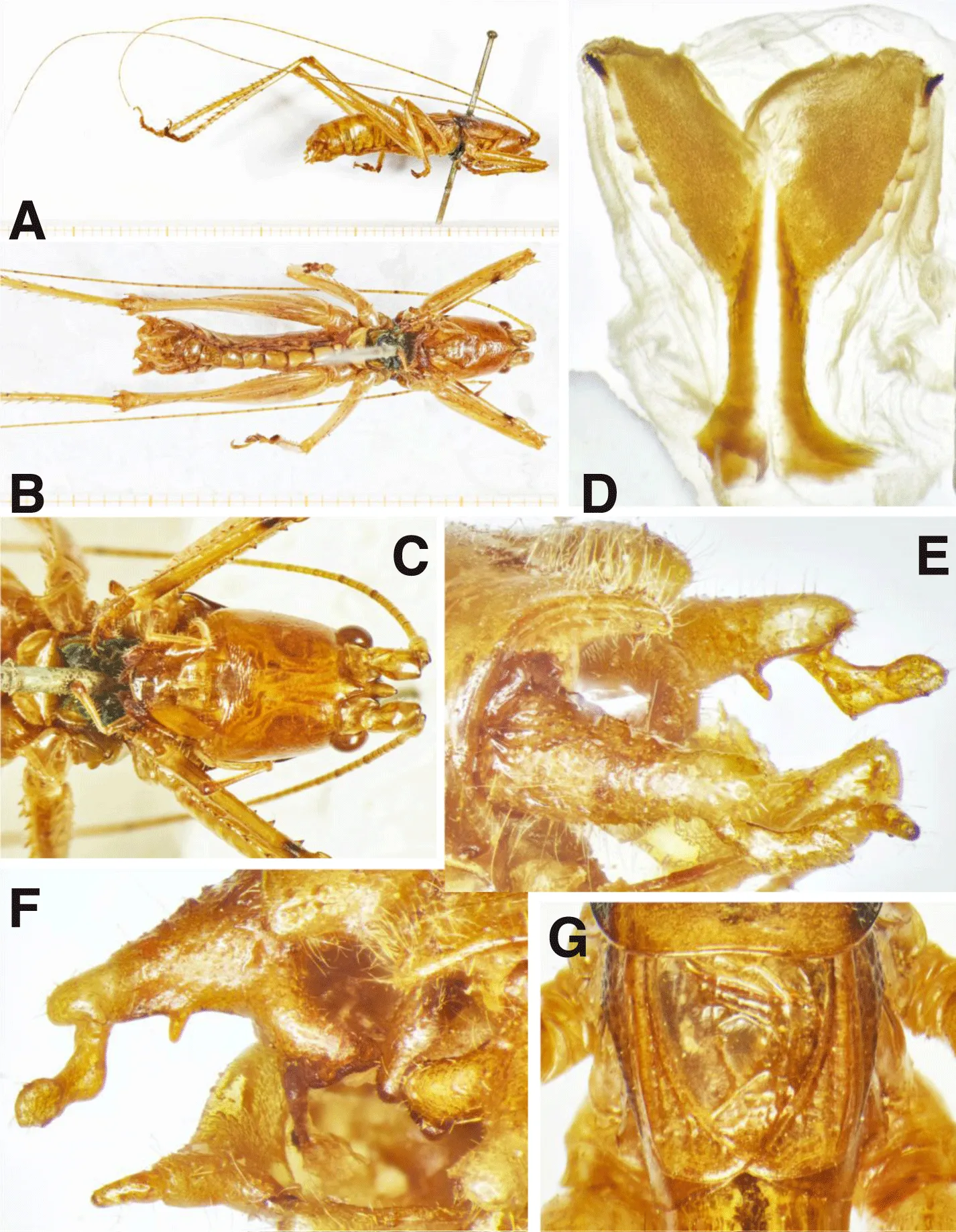
Specimens studied: Syntypes 2 males, 2 females: Papua New Guinea, West Sepik, Toricelli Mountains, 120 m NN, 1.-31. i.1910, leg. Dr. Schlaginhaufen, depository: Museum für Tierkunde Dresden [1,2] (Figure 1).
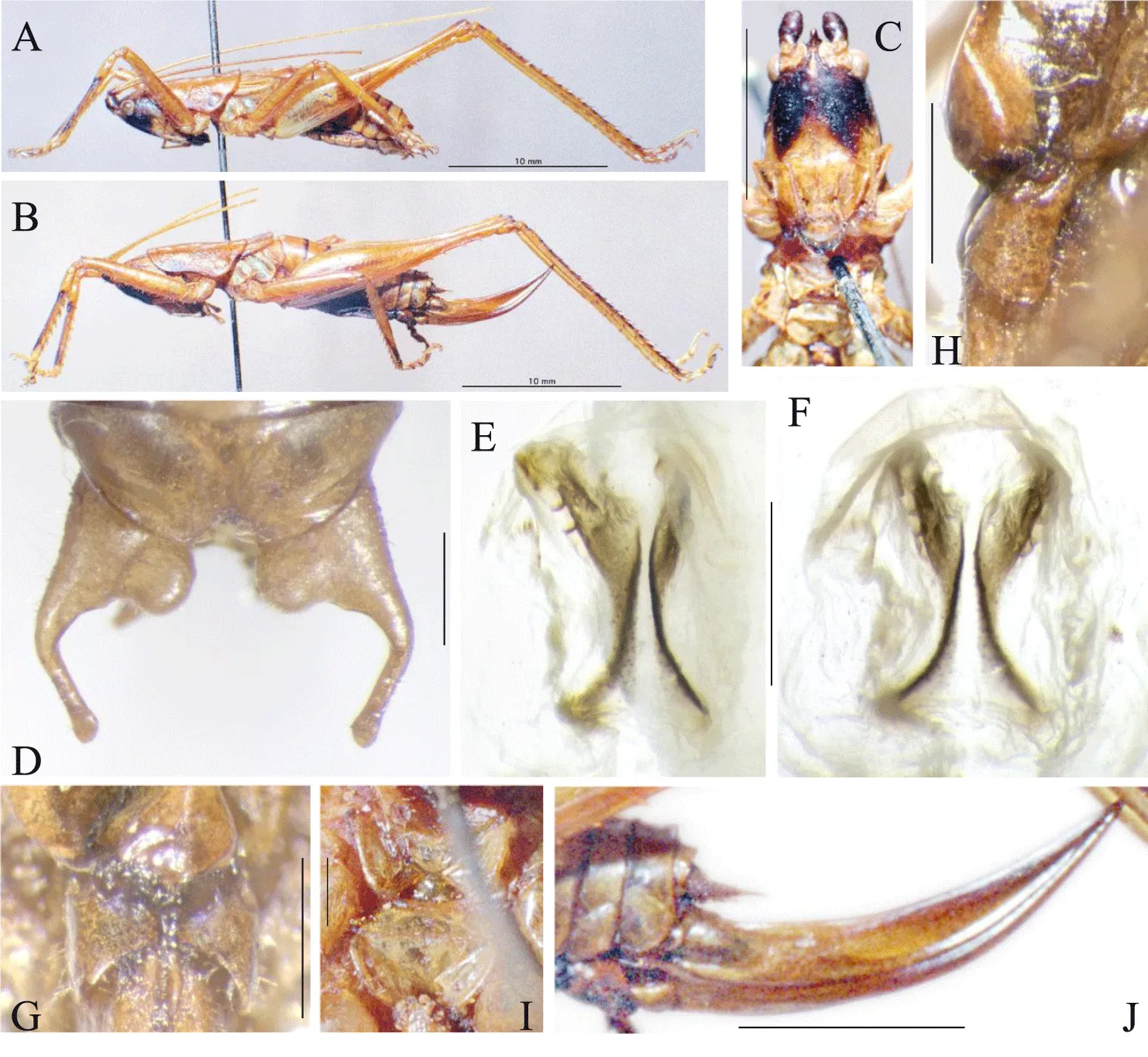
Etymology: This species had been named by Karny HH, [2] for the dark, blackish face.
Description
Fastigium verticis narrow, conical, apex obtuse; ventral surface compressed, separated by a shallow concavity from fastigium frontis. Frons shining, subsmooth. Pronotum gradually curved from one side to the other, only very apical area indistinctly shouldered; anterior margin broadly rounded but faintly concave in middle; posterior area slightly prolonged and covering about half of stridulatory area of tegmen in males; posterior margin subtruncate or very faintly concave; principle transverse sulcus weak and broadly interrupted in middle; a second transverse furrow restricted to paranota. Paranota much longer than high; ventral margin substraight in anterior half, ventro-posterior angle obtuse-angularly produced with angle rounded; auditory swelling small but distinctly swollen. Wings: strongly brachypterous; tegmen with apical area shorter than stridulatory area in males, reaching or little surpassing apex of first abdominal tergite, in females a little shorter. Mesocoxa with a small spinule. Prosternal spines small, much shorter than anterior coxa, tip acute. Mesosternal lobes angularly rounded; metasternal lobes rounded; medial plate with posterior angles spinose and projecting. Femora with the following number of spines on ventral margins: profemur 6-8 external, 6-7 internal; mesofemur 6 external, 1-3 internal near base; postfemur 9-11 external, 2-6 internal along the whole margin or only near base. Knee lobes of profemur obtuse on external, spinose on internal side; of mesofemur triangular on external, spinose on internal side; of postfemur bi-spinose on both sides. Posttibia with 1 dorsal and 2 ventral apical spurs on each side.
Male
Terminal tergite obtuse triangular in general outline; apex broad, obtuse triangularly excised with resulting lobes obtuse. Epiproct small. Paraproctes with a large, compressed, conical and slightly upcurved projection with obtuse apex. Cerci short, dorso-ventrally compressed with dorsal and external surfaces convex, ventro-internal surface concave; with a large internal projection of the shape of an oval spheroid with the ventral tip narrower than the dorsal tip, basal of this spheroid with a short, compressed, conical lobe; main branch of cercus behind spheroid strongly narrowed into a curved, band-shaped process with slightly club-shaped apex. Subgenital plate with lateral sloping areas not high; in middle with a transverse hump in basal third; behind hump with a lateral carina at each side running to and projecting behind apex of subgenital plate; apex broad-obtusely excised in middle; styli little longer than excised area or of equal length, sitting on the projections of the carinae. Titillators separate, simple, band-shaped, somewhat twisted in central area, base and apex widened; apex with internal angle subangular, external angle extended and broadly rounded, margin hyaline, in ventral area darkened. Apices of both titillators stuck in a membranous fold of phallus. In this fold a pair of weakly sclerotized, elongate sclerites are embedded.
Female
Terminal tergite divided in midline; apex obtuse triangularly excised in middle. Epiproct triangular with a median furrow, apex obtuse. Cerci conical with apex long, pointing. Subgenital plate semicircular in basal two thirds, separated from apical area by a transverse membranous furrow; apical area parallel-sided, terminating into triangular lateral angles and roundly excised in between. Ovipositor dagger-shaped (compressed elongo-falcate), almost straight in basal half, curved in apical half, apex acute.
Coloration
Medium reddish brown. Head with most of vertex or only tip of fastigium verticis as well as frons and antennal scrobae black or blackish brown; ventral third of genae, a triangular spot above clypeo-frontal suture and mouthparts brown. Antennae with flagellum brown. Pronotum with margin in ventro-anterior area and a spot on margin behind auditory swelling or almost all of ventral margin black. Abdominal tergites with apical margins darkened. Anterior tibiae with two black spots: below tympana and in subapical area. Dorsal area of hind knees and dorsal surface of posttibia more or less infumated; dorsal apical margin of hind knees black.
Measurements male (in mm): body 19.0-21.0, pronotum 5.9-6.4, tegmen 3.2, hind femur 14.0 mm.
Measurements female (in mm): body 20.0, pronotum 6.3, tegmen 2.5-3.2, hind femur 14.7-15.0, ovipositor 9.0-9.5 mm (Figure 2).
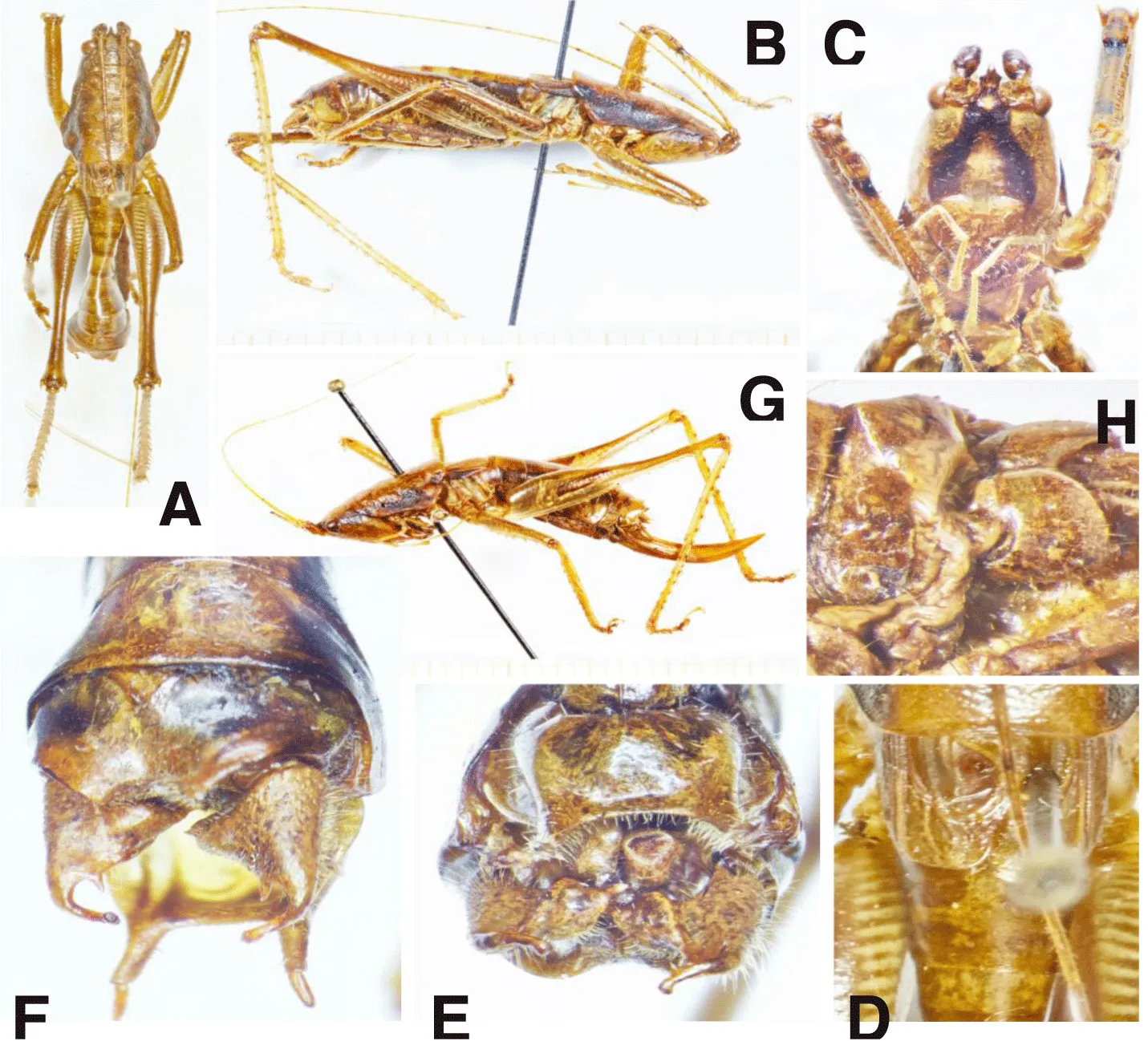
Holotype data according to Naskrecki P, et al. [3]: Papua New Guinea: East New Britain, Nakanai Mts., Vouvou (5°26'45.5''S, 151°27'48.7''E), 866 m, 10-18.iv.2009, coll. P. Naskrecki-male holotype Academy of Natural Sciences of Philadelphia (ANSP).
- Specimens studied
Male (3260987): East New Britain, Bismarck Archipelago, Gazelle Peninsula, Upper Warangoi, Illugi, 230 m NN, 8-11.xii.1962, J. Sedlacek (Honolulu BPBM).
Female (3260988): New Britain, Bismarck Archipelago, Gazelle Peninsula, Upper
Warangoi (Honolulu BPBM).
Female (3261044): New Britain, Bismarck Archipelago, Gazelle Peninsula, Upper Warangoi, Illugi 12.-15.XII.1962 (Honolulu BPBM).
Female (3261265): Solomon Islands, Guadalcanal, Visale, 6.1.1963, M. McQuillan, Stop 3304. (London BMNH).
Remark: The male cerci of the specimens at hand "3260987 from Illugi" are identical with those of Anthracites nakanaiensis as described in Nascrecki & Rentz (2010). They had been collected at roughly the same locality. The female had been described and figured in Ingrisch S. [1].
- Description
Face oval; frons with a pair of black bands from below fastigium verticis to clypeo-frontal suture. Lateral surface from below compound eyes, over lateral area of pronotum and to lateral area of abdominal tergites with a black band.
Male: Tegmina short, restricted to the stridulatory area, little overlapping in middle. Last abdominal tergite in basal half with convex margin bent ventrad, in apical half concavely excavated to give room for the base of the cercus, apical margin concave and also little down-bent at end. Cercus conical and strongly widened from basal, internal side giving it a conical, triangular appearance with strongly narrowing margins; at end the cercus is curved mediad into a narrow rounded end; shortly before curvature it gives rise to a short and narrow, subacute conical projection. Titillators with widened apical area as in figure 2, and with a pair of narrow lateral sclerites.
Female: Tegmina short, oval, slightly overlapping in middle. Subgenital plate with short and narrow transverse lobes separated in midline by a strong furrow. Ovipositor curved with acute tip.
Measurements: 2 males: Body 26-27, pronotum 7.0-7.5, tegmen 3.5-4.0, hind femur 16-17, antenna ca 40-50 mm.
Female (3260988): Body 20, pronotum 6.5, tegmen 3.5, hind femur 15, ovipositor 9.5 mm;
Female (3261265): Body 26, pronotum 8.2, tegmen 2.5, hind femur 20, ovipositor 12 mm (Figures 3,4).
- Specimens studied
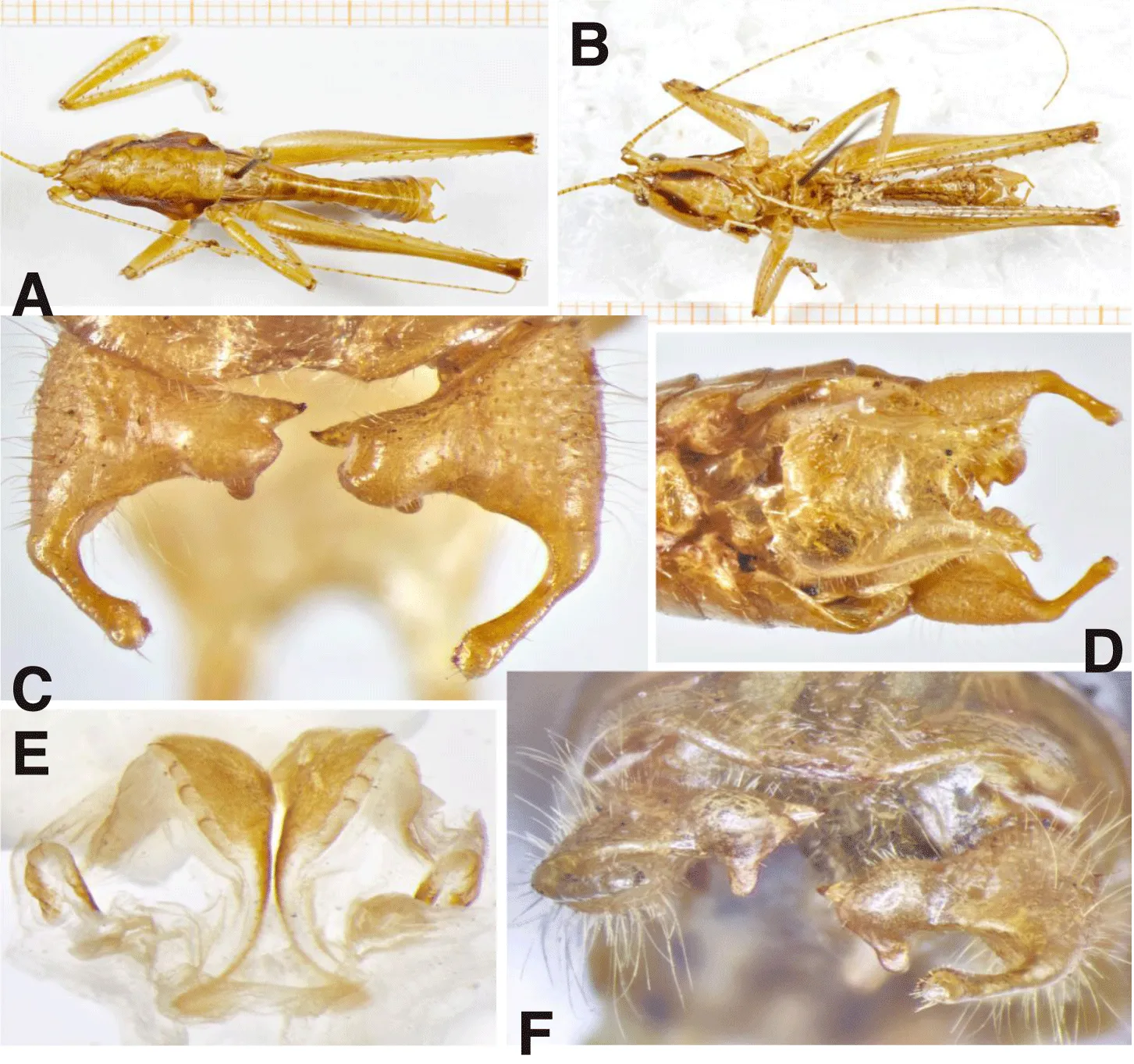
Holotype male (3260990): Papua New Guinea, New Guinea NE, Morobe, NE Lae, Singuawa River (6°4'S, 147°10'E), 8.iv.1966, leg. O.R. Wilkes. Depository: Honolulu (BPBM).
Para type: female (3261764) same data as holotype; female (3260989): PNG, Morobe, Busu River east of Lae (6°42'49''S, 147°2'21''E), 50-70 m, 7.v.1966, leg. J. & M. Sedlacek. Depository: Honolulu (BPBM).
- Description
Male: Tenth abdominal tergite with apical margin rounded but slightly roundly excised in middle. Cerci in dorsal view about triangular with a stout and wide internal projection from nearly base occupying half of the cercus length and dividing at internal end into a roughly triangular basal projection with a minute spine at tip and a bulging apical projection; distal area with rounded end that carries on ventral side a tubular process with obtuse end. End of the cercus bent mediad and compressed, linear but at tip widened club-shaped and carrying at proximal end a minute obtuse cone. Titillators with narrow basal area and roughly oval apical area that carry some short flaky projections from lateral margin and has the surface densely covered by brownish setae. Coloration brownish with darker areas on dorsal side. Face with a pair of black strokes from median ocellus to the ventral-apical areas of the face. Tegmina reduced to the stridulatory area, slightly overlapping in midline.
Female: Tegmina reduced to short ovoid lobes overlapping somewhat in midline. Ovipositor roughly sickle-shaped but in subbasal area rather straight, afterwards moderately upcurved especially from ventral area and narrowed towards acute tip. Subgenital plate funnel-shaped, upcurved towards both sides; along midline of ventral surface with a narrow fissure.
Coloration: brownish, face and legs of lighter color. Face with a pair of black strokes from median ocellus to the ventral-apical areas of the face in both sexes; additionally, on both sides, there is a blackish band from behind the compound eyes along the lateral margins of pronotum to the end of the tegmen.
Measurements: Males: body: 23; pronotum 7.5; tegmen 3.5; hind femur 17.5 mm. - Female: body: 24.4; pronotum 7.2; tegmen 2.7; hind femur 27.5; ovipositor 11.0 mm (Figure 5).
- Specimens studied
Holotype male (3261250): Solomon Islands, San Cristoval; Callego Camp 2, around campsite, 11.vii.1965, Roy. Soc. Exp., BM 1966-1. Depository: London BMNH.
Paratype male (3261264): Solomon Islands, Guadalcanal, Mt. Austen, 5.ix.1963, M. McQuillan. Depository: London BMNH.
The two males studied are from two different localities. They have identical abdominal appendages but differ markedly in size. No females had been available for study.
- Description
Male holotype: Coloration with different shades of brown. Face with dark brown lateral areas separated by a light brown medial band. Tenth abdominal tergite rim-like or band-shaped at both sides of base, then with converging margins but at end angularly excised forming a pair of short lobes; in midline of last tergite from excised end to base with a compressed rim. Titillators with out-curved basal area followed by a narrow restiform stem and an oval plate with setose brownish surface and whitish semi-transparent lateral margins with wave-like surface and a short, black spine.
Male from Mt Austen: Tenth abdominal tergite at base long but narrowly expanded on both sides; along mid-length with a narrow medial furrow separating two conical expansions with semi-oval, rounded ends; lateral margins forming oval holes from central projections to basal lateral expansions of tergite. Male tegmina reduced to stridulatory area, little longer than wide. Cerci conical with a stout and re-curved internal projection; subapical area of cercus stem with a subapical, ventral-internal projection; apical area of cercus rounded and with a small internal projection, while from ventral side with a compressed ventral process that is curved backwards and terminates into a wide rounded end. Roughly halfway between both of these projections the cercus is provided with a narrow and short, styliform projection from internal ventral margin. Titillators with oval apical areas that carry an acute black tooth just below tip and a few light cones along the whitish, apical lateral margin.
Measurements: body 21.0-24.0, pronotum 6.0-6.5, tegmen 2.4-3.5, hind femur 13.5-16.0, antenna 75.0-80.0 mm. The smaller values (except for antenna) belong to the holotype (Figure 6).
- Specimen studied
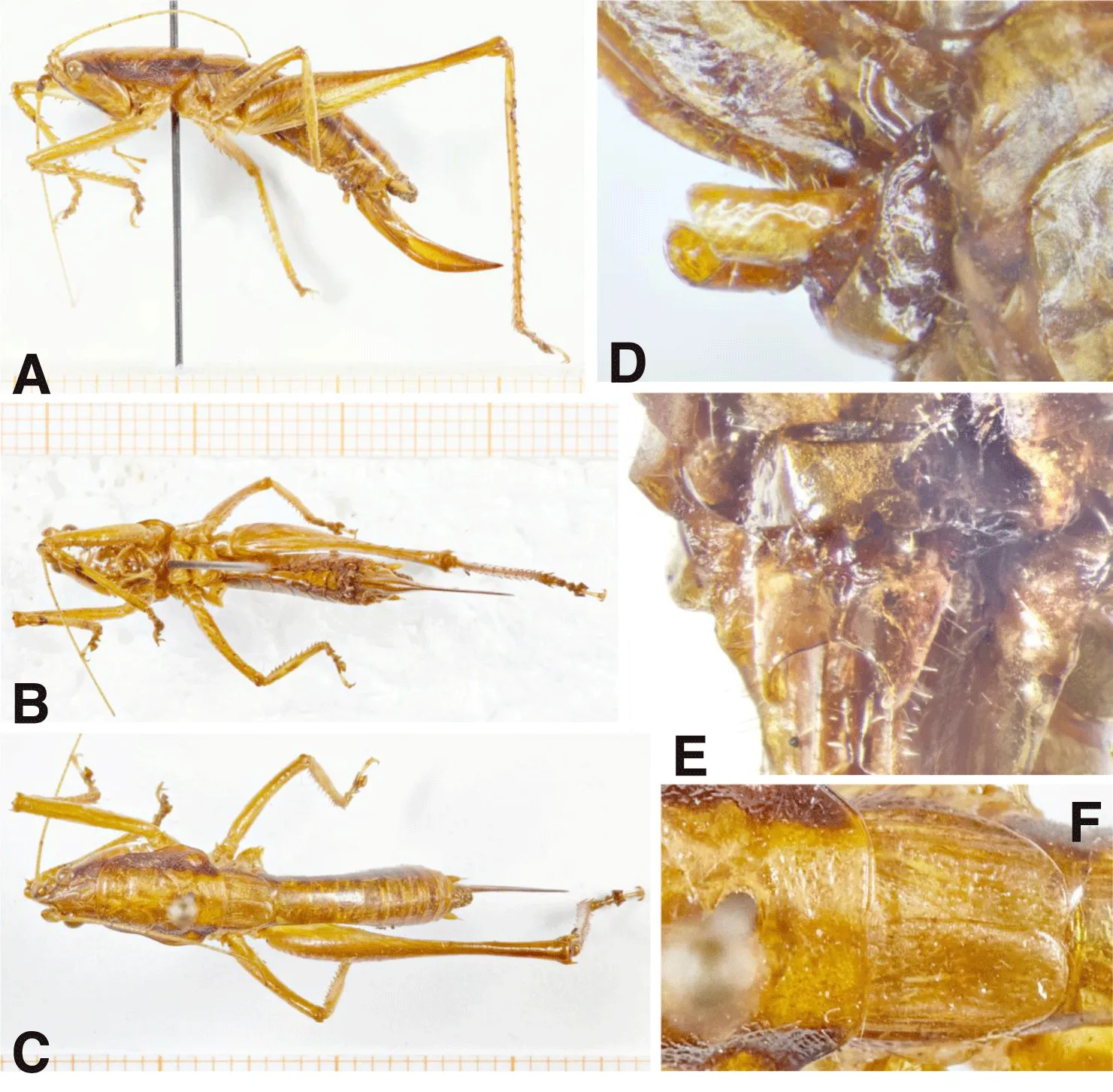
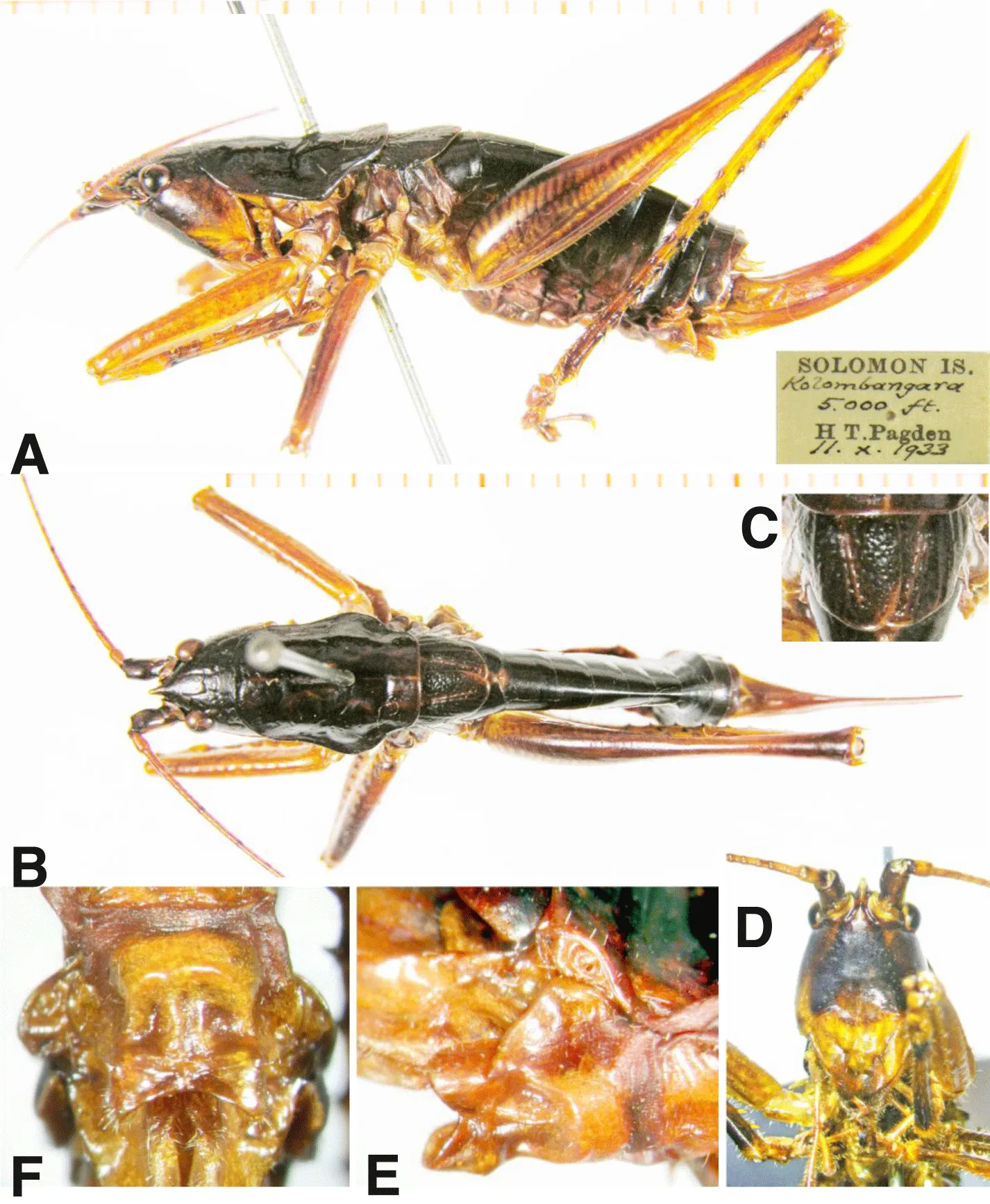
Holotype female (Lo025S001): Solomon Islands, Kolombangara 5000 ft. Depository: London BMNH. The type is unique.
- Description
Dorsal area of head, pronotum and abdomen shining black. Face and upper area of genae black but mat, with a faint but distinct light stroke between the black area of the frons and that of the genae; lower area of face and genae including mouthpart of more light color. Antennae with basal segment black, afterwards of light color with indistinct black rings between segments. Wing condition micropterous, wings about as long as wide, overlapping in midline; surface of tegmina with numerous impressed dots. Pronotum with lateral lobes rather narrow, deepest point behind midline. Legs of general color with blackish marks, especially on hind leg; spines along dorsal margins of hind tibia black.
Female: Subgenital plate divided into two parts that are obviously moveable against each other: basal area upcurved on both sides, after a fold bent sideways (might be an artefact due to drying) with truncate and little convex lateral margins; the central-basal area of the plate at end little upcurved and divided into four narrow apical projections, of which the lateral projections ending free, while the central projections forming a bridge to the apical area of the plate which has the proximal margin substraight, the lateral margins strongly upcurved and faintly widening while the central margin appears substraight in ventral view but rounded towards both sides in oblique lateral view.
Measurements: body 19 pronotum 7 tegmen 3.5 hind femur 17.5 ovipositor 12-13 mm (Figure 7).
- Specimens studied
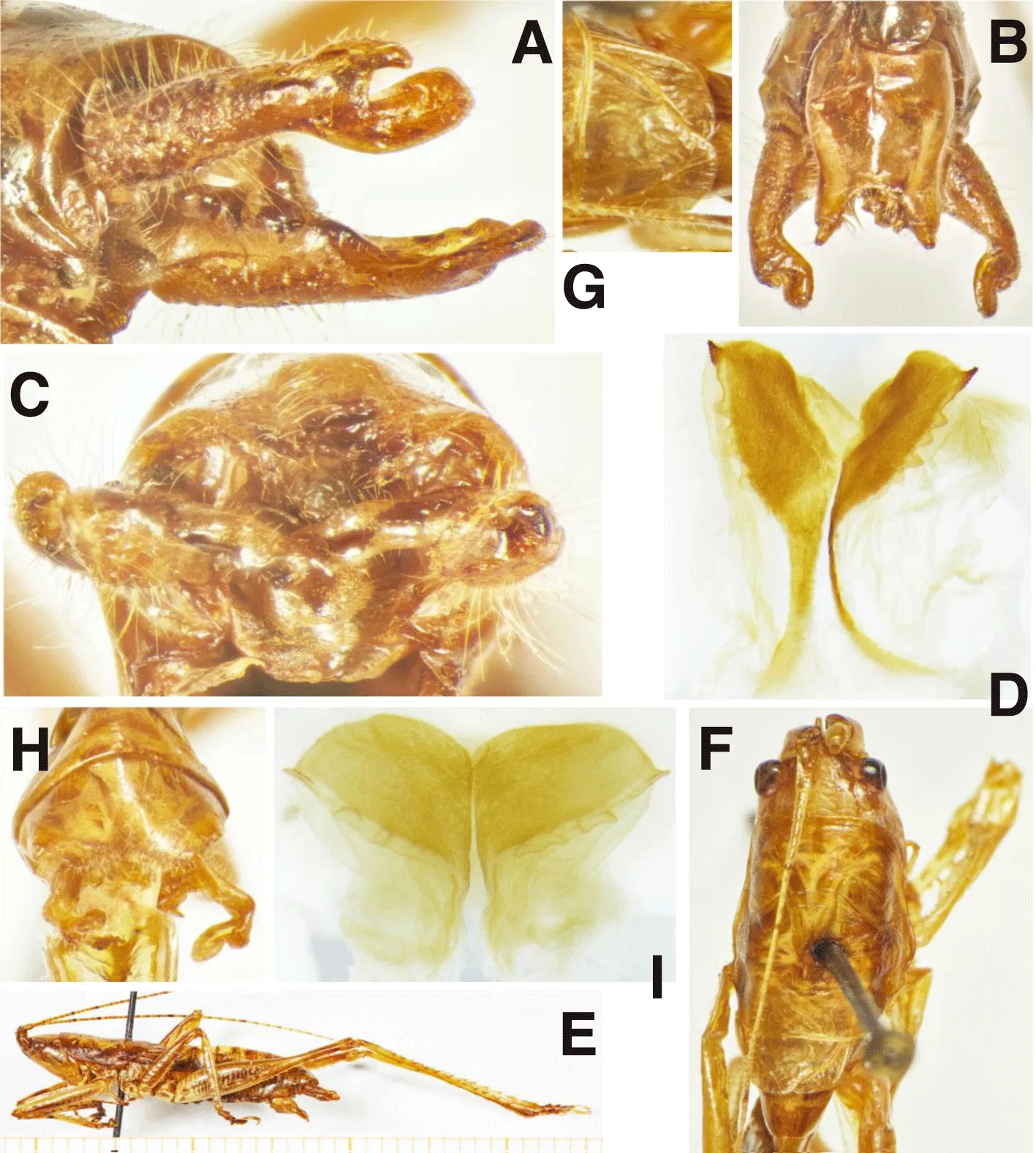
Holotype male (3261737): Solomon Islands, Guadalcanal, Suta (Suta-Gold Ridge), Mt. Jonapau. Depository: Honolulu BPBM.
- Paratypes and other specimens
Paratype male (3261743): Solomon Islands, Guadalcanal, Suta ñ (Suta-Gold Ridge), Mt. Jonapau. Depository: Honolulu BPBM.
Female (3261268): Solomon Islands, Guadalcanal, Mt. Jonapau, 4.9.1965, P. Greenslade. Depository: London BMNH (Figure 8).
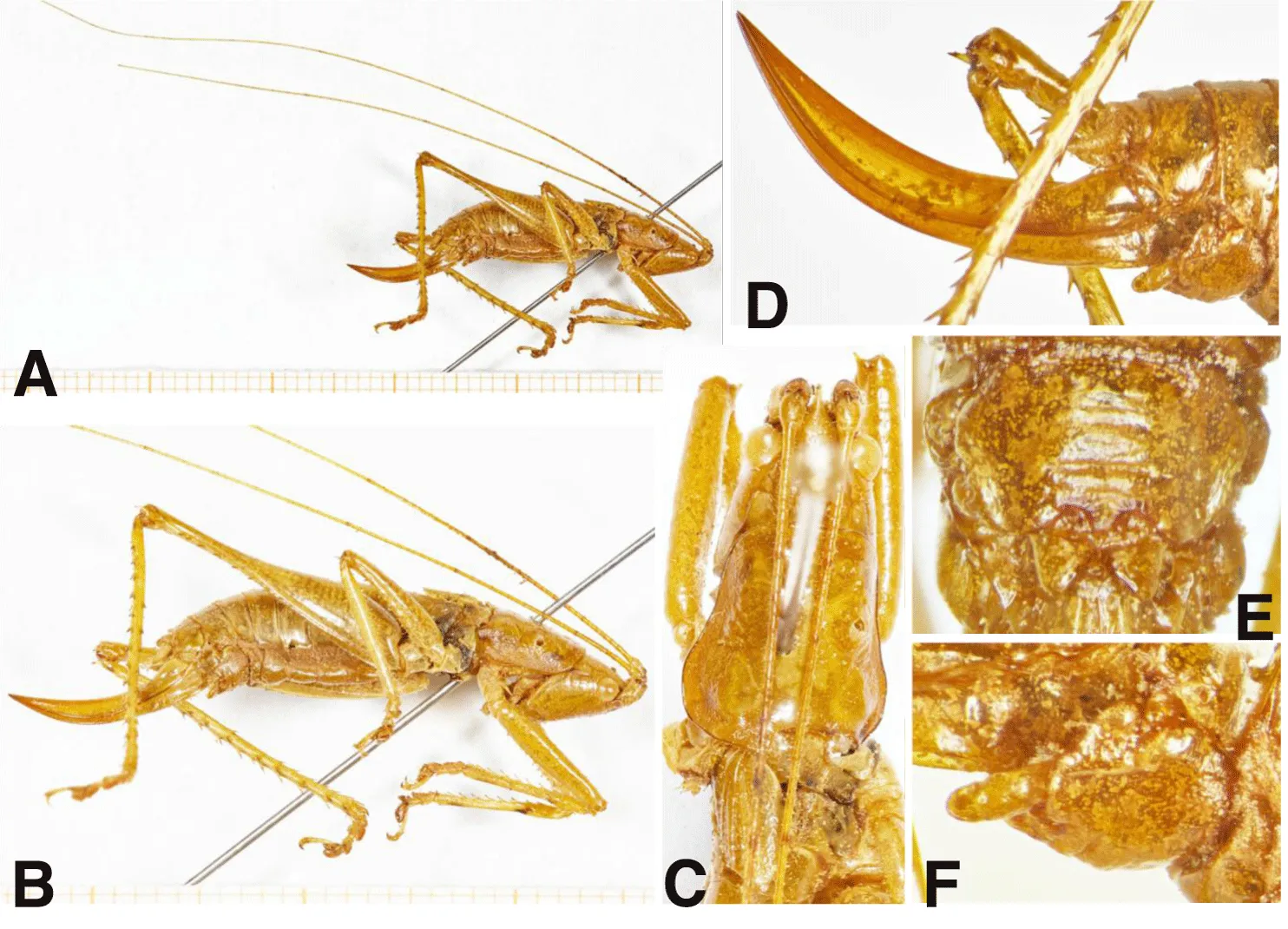
- Description
Male (3261737): Pronotum in about apical half widened laterally; in female more expressed than in male. Tenth abdominal tergite with a rounded bucket in middle of apical margin. Cerci stout, not very long, in apical area divided into a shorter dorsal-lateral and a longer ventral-medial branch, both stout and with obtuse end. Male subgenital plate longer than wide with convex lateral margins, at end roundly excised; with a pair of short styli. Titillators elongate oval with brownish surface and with a black tooth at ventral-apical angle and some pale angular teeth along ventral margin.
Variation: male 3261743 is similar but distorted since obviously it had not been fully hardened when collected; the titillators appear more rounded and with a shorter tooth than in the holotype. Cerci obviously identical but strongly shrunken.
Famale (3261268): Face oval, little rugulose and of red-brown color, contrasting against light colored legs. Pronotum in about apical half widened laterally, in female more expressed than in male. Subgenital plate about rhombic and with anterior margin curved: laterally, on both sides, curved into the little projecting lateral margins while the central area is nearly flat but provided with few transverse "ribs" at posterior end. Apical margin of central area divided into a pair of moderately long, obtuse, projecting lobes. Ovipositor curved and thereby gradually narrowing towards acute tip.
Measurements males: Body 13.5-19.0, pronotum 5.5, tegmen 2.0, hind femur 12.0-12.5 mm
Measurements female: Body 23.0, pronotum 5.0, tegmen 3.0, hind femur 15.0, ovipositor 10.5, antenna 70.0 mm (Figure 9).
- Specimens studied
Holotype: male (3261257); type locality Mount Popomanaseu. Depository: London BMNH.
- Description
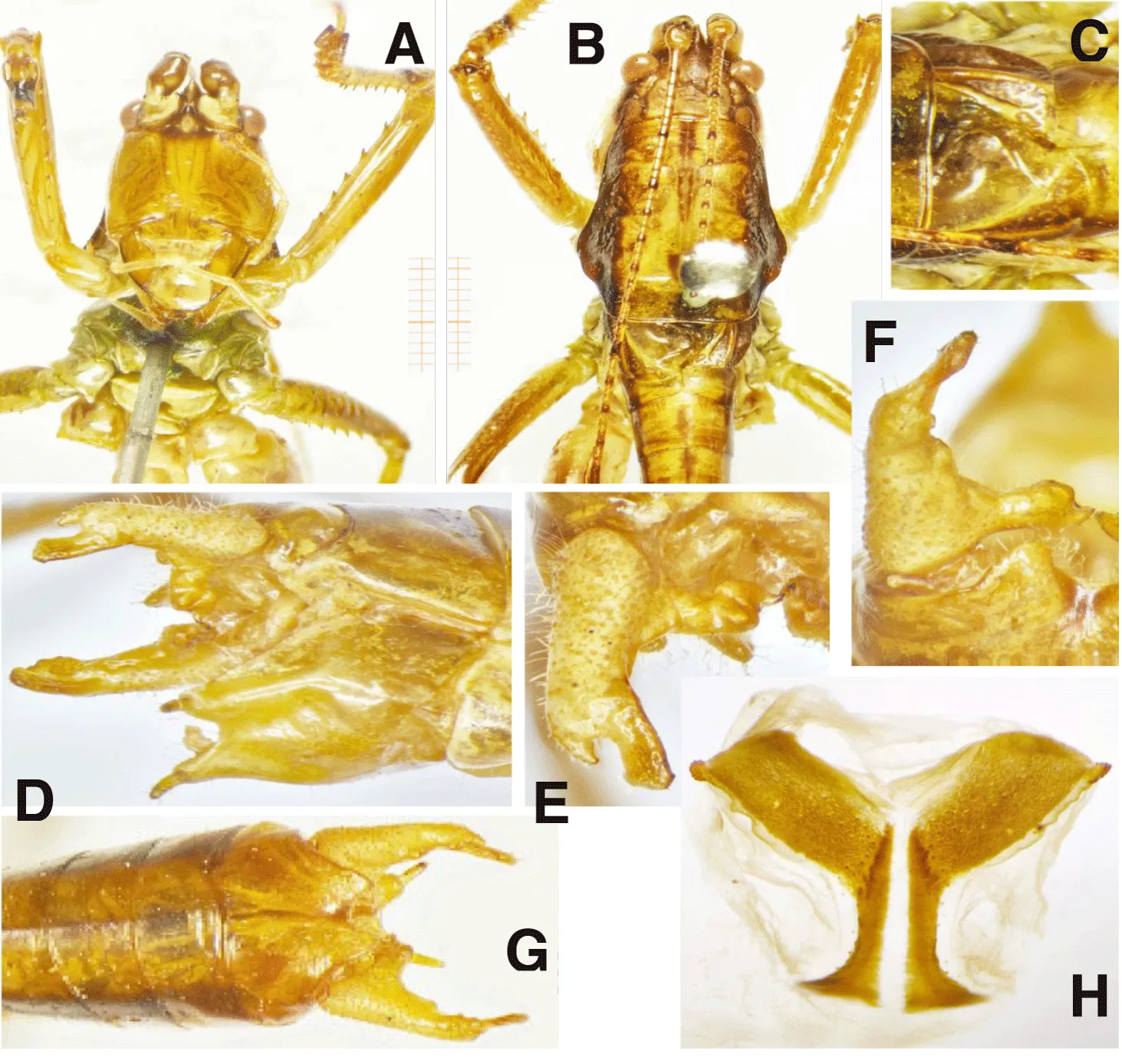
Male supra anal plate with a medial furrow and with converging lateral margins, at end triangularly excised. Cerci substraight with external surface convex, internal surface concave, at end with a pair of short apical lobes: a simple, short conical, dorsal-apical lobe and from ventral-apical angle with a markedly longer, laterally compressed projection with truncate end. From ventral basal area of cercus with a stout rounded internal projection which is at end incompletely divided into two indistinct halve-globes of which the proximal globe ends into a short and curved spine. Internal surface of cercus flattened or little concave in apical area, but from ventral basal area with a stout, rounded, roughly tube-shaped internal projection which terminates at end on internal side into a pair of semi-globes while on external side into a simply rounded end that carries at both sides a tiny projection with acute spine-like tip. Titillators simple, of general shape for the genus (Figure 9H), with a small rounded projection from apical-lateral angles. Female unknown.
Coloration: Medium brown on dorsal, light brown on ventral surface; face medium brown with a paler trace along midline; area around medium ocellus and fastigium verticis black; head with black stripes; lateral lobes of pronotum and lateral surface of tegmina also black. Subgenital plate with a medial furrow and converging lateral margins, at end terminating into a pair of angular lobes.
Measurements: Body 24-29, pronotum 6-7, tegmen 2.0-4.5, hind femur 13-14, antenna 65 mm (Figures 10, 11).
- Specimens studied
Holotype: Male (3261726), type locality Mount Popomanaseu, 23.X.1963, P.J.M. Greenslade. Depository: London BMNH.
Female allotype (3261728), Guadalcanal, Popomanaseu, 23.X.1963, P.J.M. Greenslade. Depository: London BMNH.
Other specimens: male (3261255), San Cristoval, Warahito River, Camp Site, 25.7.1965, Roy. Soc. Exp. BM 1966-1, P.J.M. Greenslade;
male (3261258), San Cristoval, Waihoni Ban, 22.6.1965, Roy. Soc. Exp. BM 1966-1, P.J.M. Greenslade;
male (3261721), Guadalcanal, Honiora District, 1.1.-31.12. 1954, E.S. Brown, B.M.1955-33. 53.21;
female (3261256), Guadalcanal, Popomanasiu, 9.-10.xi.1965, Hunuvalekama.
Depository for all: London BMNH.
- Description
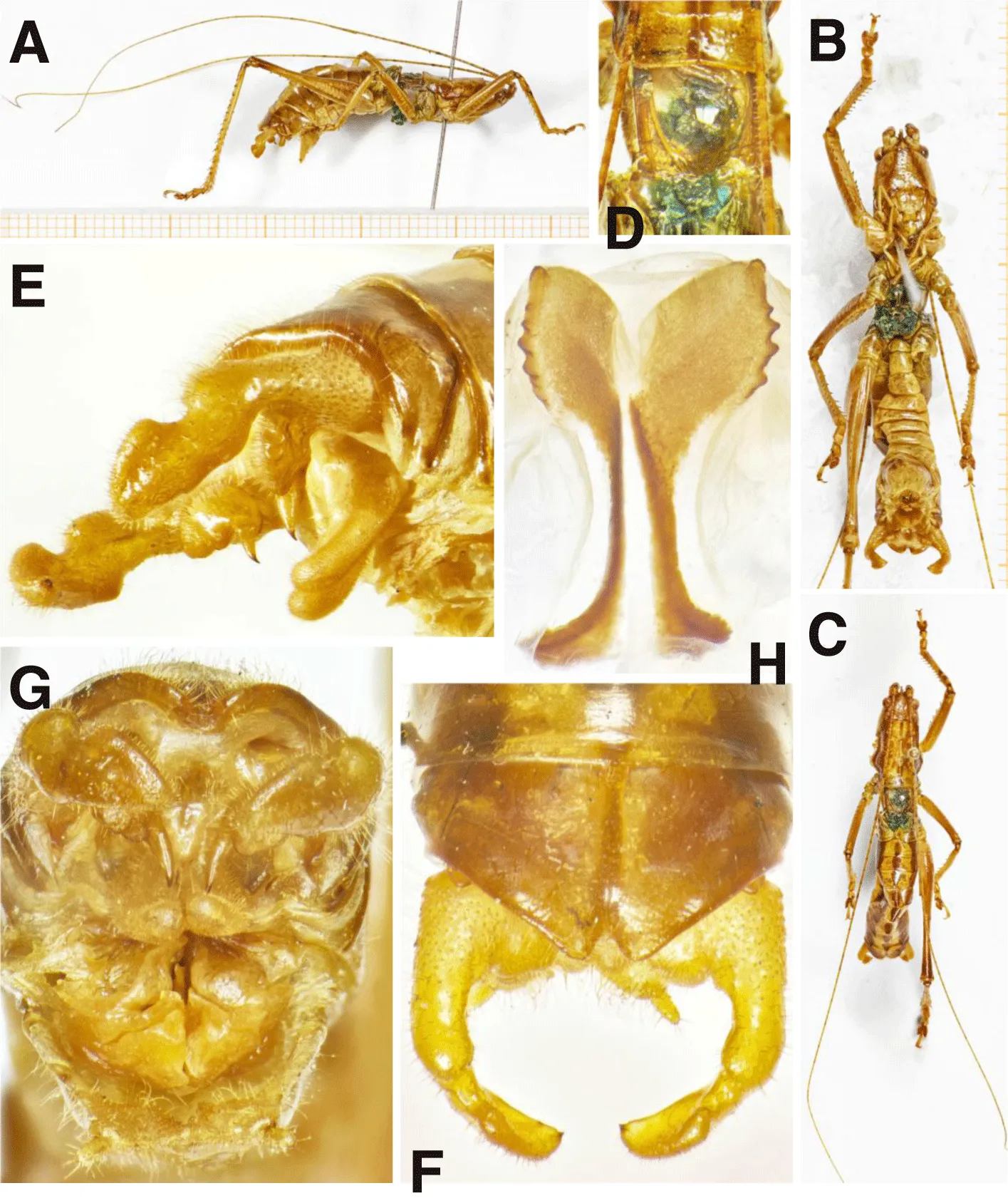
Male: Cerci with a hugh and long basal-internal projection pointing mediad and terminating into a curved, narrow, spinose tip; main cercus trunk afterwards substraight, conical, but irregularly narrowing towards end; at end bent mediad into a hugh apical, ventral projection that is widened at end and with convex apical margin; internal surface at ventral end little bulging and with a small projection with narrow conical end that carries a minute spinule at tip. Coloration brownish with ventral surface of lighter color than dorsal surface. Face medium brown with a pair of dark brown bands from fastigium verticis to clypeo-frontal suture; pronotum with lateral lobes darkened. Last abdominal tergite with a medial furrow and behind basal area with converging lateral margins terminating into a pair of short, rounded-angular ends. Titillators (Figure 10H) with a small rounded projection from apico-lateral angles and with some short obtuse angular projections along rim of widened apical area.
Tenth abdominal tergite with a medial furrow that widens at end into a short angular excision of the apex; apical margin short angularly excised, lateral margins only in basal area parallel. Cerci with huge internal and apical projections. Basal projection running mediad and apicad, and is provided with a subapical, internal spine. Apical projection bents ventrad and apicad and terminates into a little widened, convex apical margin with a minute spinule at end.
Measurements male holotype: Body 29.0, pronotum 7.0, tegmen 4.5, hind femur 14.0, antenna 65.0 mm.
Measurements all males: Body 25.0-33.0, pronotum 7.0-9.5, tegmen 3.0-4.5, hind femur 14.0-21.5, antenna 55.0-85.0 mm.
Remark: There had been two different species of the genus Papuacites from Mount Popomanaseu collected as males, but only one species as females. These females are arranged with P. secundus since they have black stripes on the face as in the male type of P. secundus while the male of P. primus collected from the same locality does not have black stripes on face. Black stripes on the face are obviously species specific characters in the genus Papuacites.
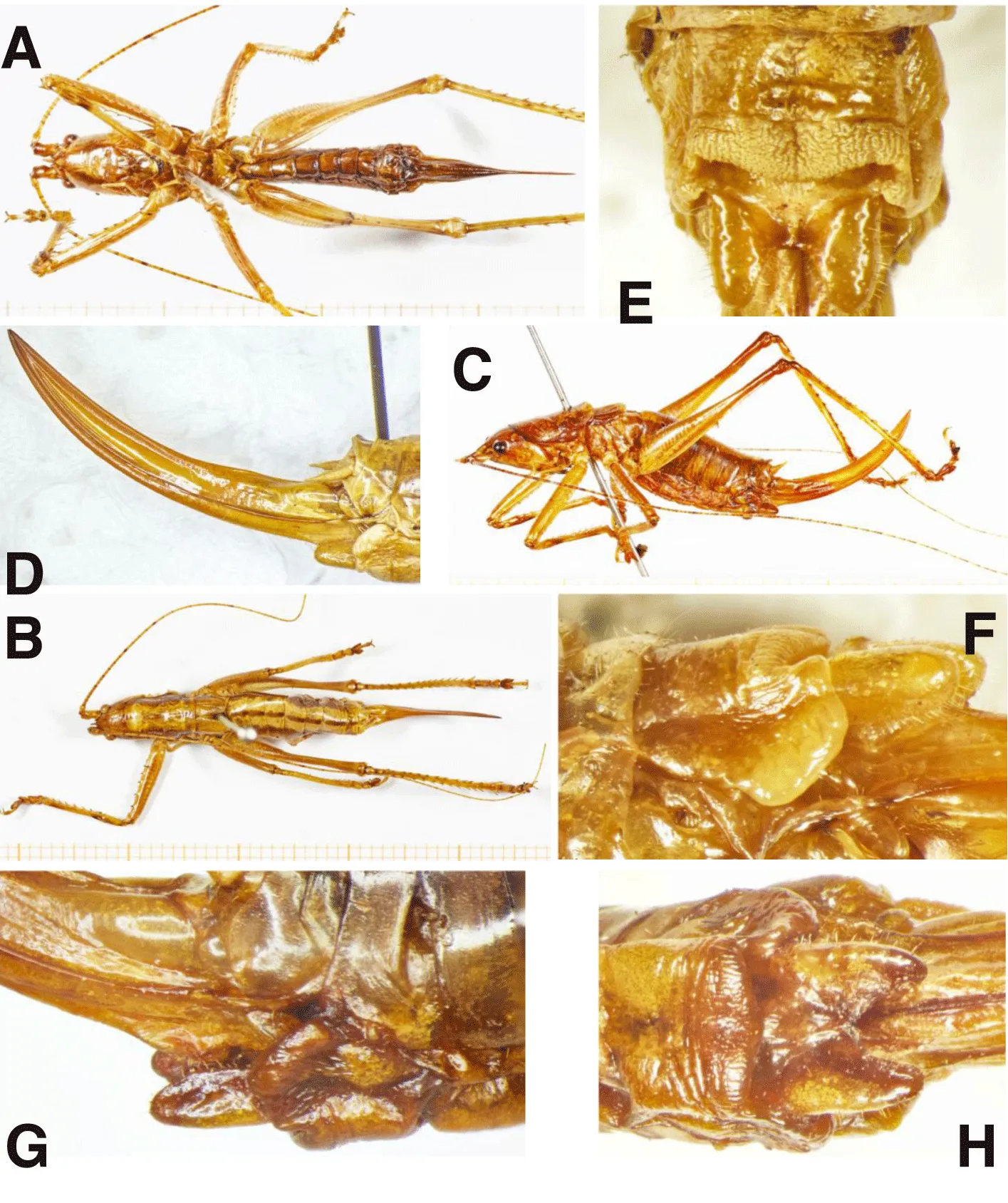
Female: Head oval, frons with a pair of more or less distinct black bands, diverging from fastigium verticis to labrum. Subgenital plate in basal half membranous with a medial furrow and the lateral areas somewhat upcurved (little varying between both specimens) and then more or less spread sidewards; the apical area forming a pair of hard cones projecting behind but obviously are moveable to some degree against the basal area. Between the cones, the ventral margin of the plate is roundly projecting; there is a hollow between dorsal and ventral margins which are both little projecting behind in middle; only the cones are sclerotized. Ovipositor slightly longer and little more regularly curved than in other species of the genus.
Measurements females: Body 23-25, pronotum 5.5-6.2, tegmen 2.2--3.5, hind femur 14.5-17.0, antenna 75-100, ovipositor 12-14 mm (Figure 12).
- Specimens studied
Holotype male (3261266): Solomon Islands, Guadalcanal, Rua Vatu, 5.iv.1955, E.S. Brown. Depository: London BMNH.
Paratype female (3261247), same data as holotype but 7.iv.1955, London (BMNH).
- Description
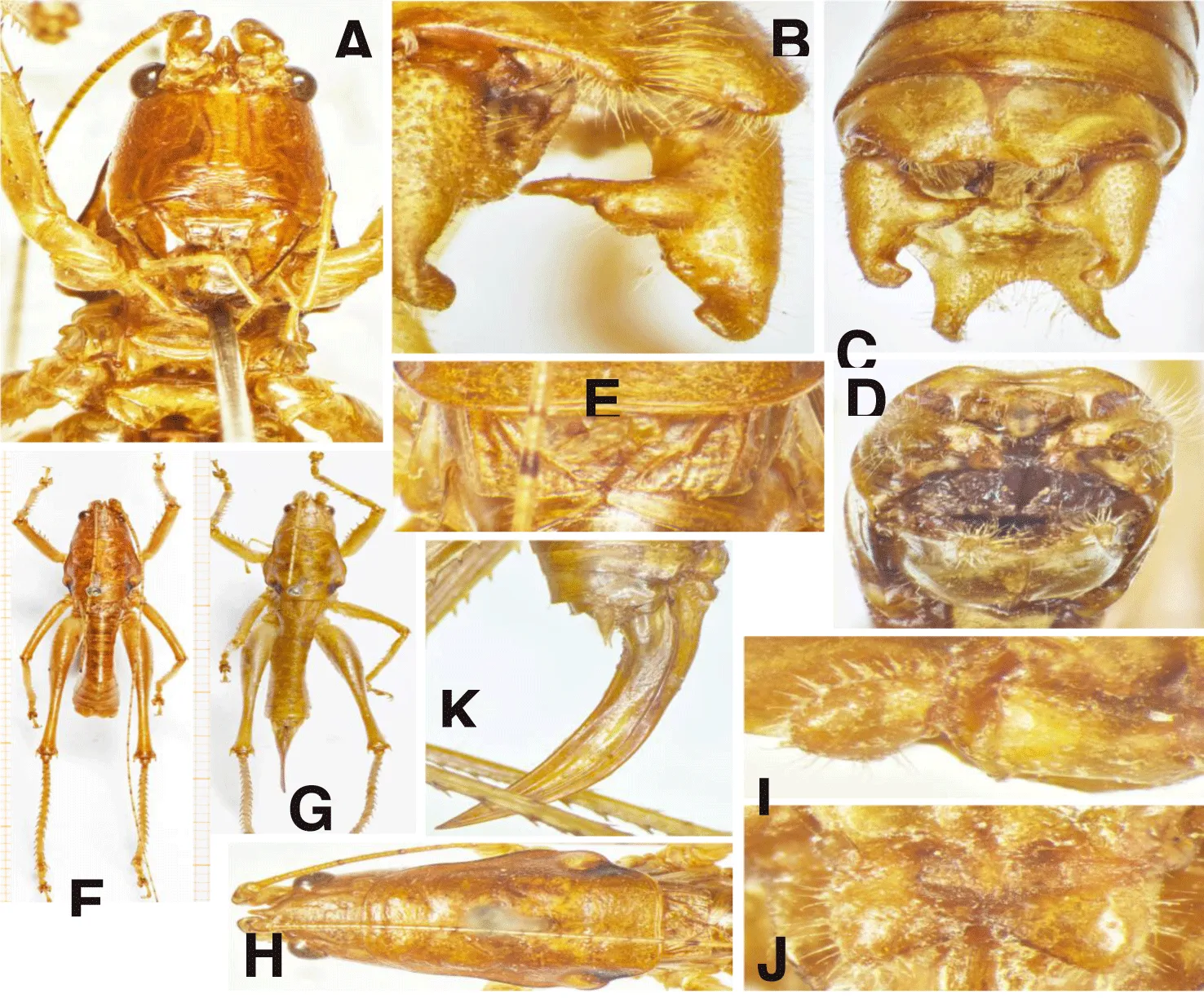
Male: Cerci substraight, rather short and stout, with short and slightly sinuate apical lobe; in apical area with the longitudinal axis compressed and at end curved mediad forming a transverse, external protrusion or ledge; between basal third and mid-length with a stout internal process that is conically narrowing in apical half. Last abdominal tergite with converging lateral margins terminating into a pair of short obtuse cones separated by a concave interspace that is bent, together with the interspace, into a broad and short pair of lamellae terminating each into an acute spine. Subgenital plate bowl-shaped with concave apical margin between the styli. Coloration reddish to yellowish brown, face somewhat paler along mid-line. Tegmina short with apical margin truncate.
Female: Coloration about brownish yellow. Tegmina short with rounded apical margins. Subgenital plate short with a medial furrow, terminating into a pair of conical and bulging triangular lobes with obtuse margins. Ovipositor sickle-shaped, moderately curved, terminating into an acute tip.
Measurements male: Body 26, pronotum 9, tegmen 2, hind femur 17, antenna 90 mm.
Measurements female: Body 26, pronotum 10.5, tegmen 2, hind femur 17, antenna broken, ovipositor 11 mm (Figure 13).
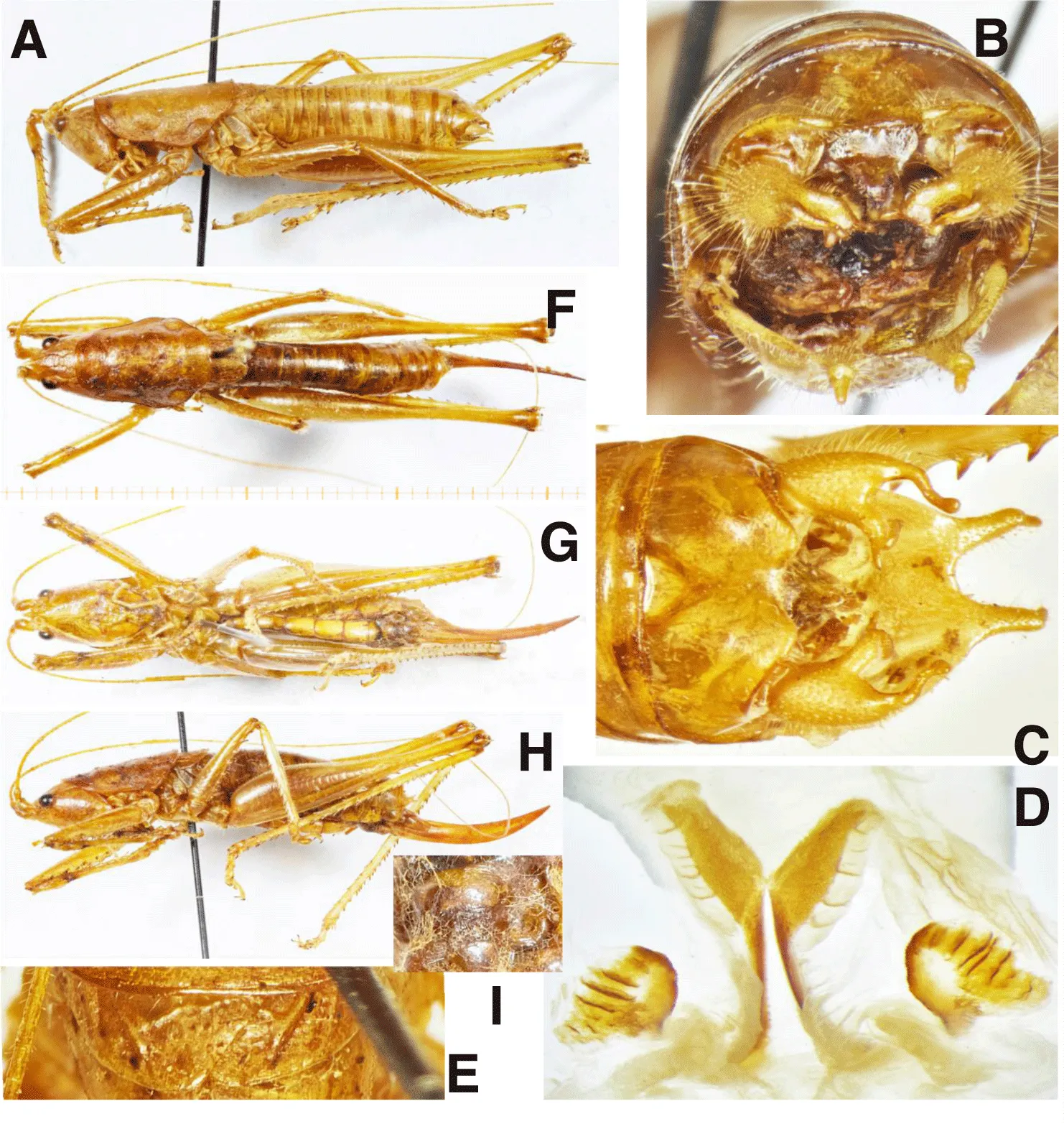
- Specimens studied
Holotype: Male (3261730); type locality: Solomon Islands, Guadalcanal, Honiara, 4.vii.1966, Y. Kondo. Depository: Honolulu (BPBM).
Allotype: Female (3261729): Guadalcanal, Honiara, 4.vii.1966, Y. Kondo (BPBM).
Other specimens: male paratype (3261731), same data as holotype; male (3261738): Guadalcanal, 18.ii.1921, J.A. Kusche: Female (3261742): Guadalcanal, Bialanikau River, 24.vi.1944, H. Milliron; depository for all: Honolulu (BPBM).
- Description
Male: Face and body of uniform, light brownish color; hind femur with a black longitudinal stripe and a series of short, dorso-ventral stripes below of it. Tegmina short-ovoid touching each other but hardly overlapping in midline. Male cerci short-conical, at end terminating into a narrow but rather long, slightly S-shaped projection with globular end; from sub-basal area of cercus, on internal side, with a stout internal projection that widens towards rounded end and in subapical area gives rise, from both sides, for a rounded, cone-shaped projection that carries a minute spine at tip. Apical margin of the basal projection wide and faintly convex (Figure 13C). Subgenital plate with rounded bottom and convex lateral margins that carry at end a pair of short, rounded projections that terminate each into a short rounded stylus. Knee lobes of legs with an acute spine.
Female: Face and body of uniform color, at end of pronotum lateral lobes with a small black mark at both sides. Face around middle pale with few light brown, vertical bands. Pronotum lateral margins with a narrow, roundish convexity or bulge in posterior area. Tegmina short, ovoid, separate or slightly overlapping in midline.
Female subgenital plate short triangular, with a medial carina; basal area widened dorsally, separated by a transverse furrow from apical area that has the apical margin roundly excised in middle. Ovipositor short, curved, little dorso-ventrally widened behind midline, then narrowing to acute tip.
Measurements males: Body 26.5-39.0, pronotum 7.5-8.5, tegmen 2.0-2.8, hind femur 17.5-19.0, antenna 60-80 mm.
Measurements females: Body 24.0-27.0, pronotum 6.5-8.0, tegmen 3.5-4.0, hind femur 17.0-19.5, ovipositor 11.0-12.0 mm (Figure 14).
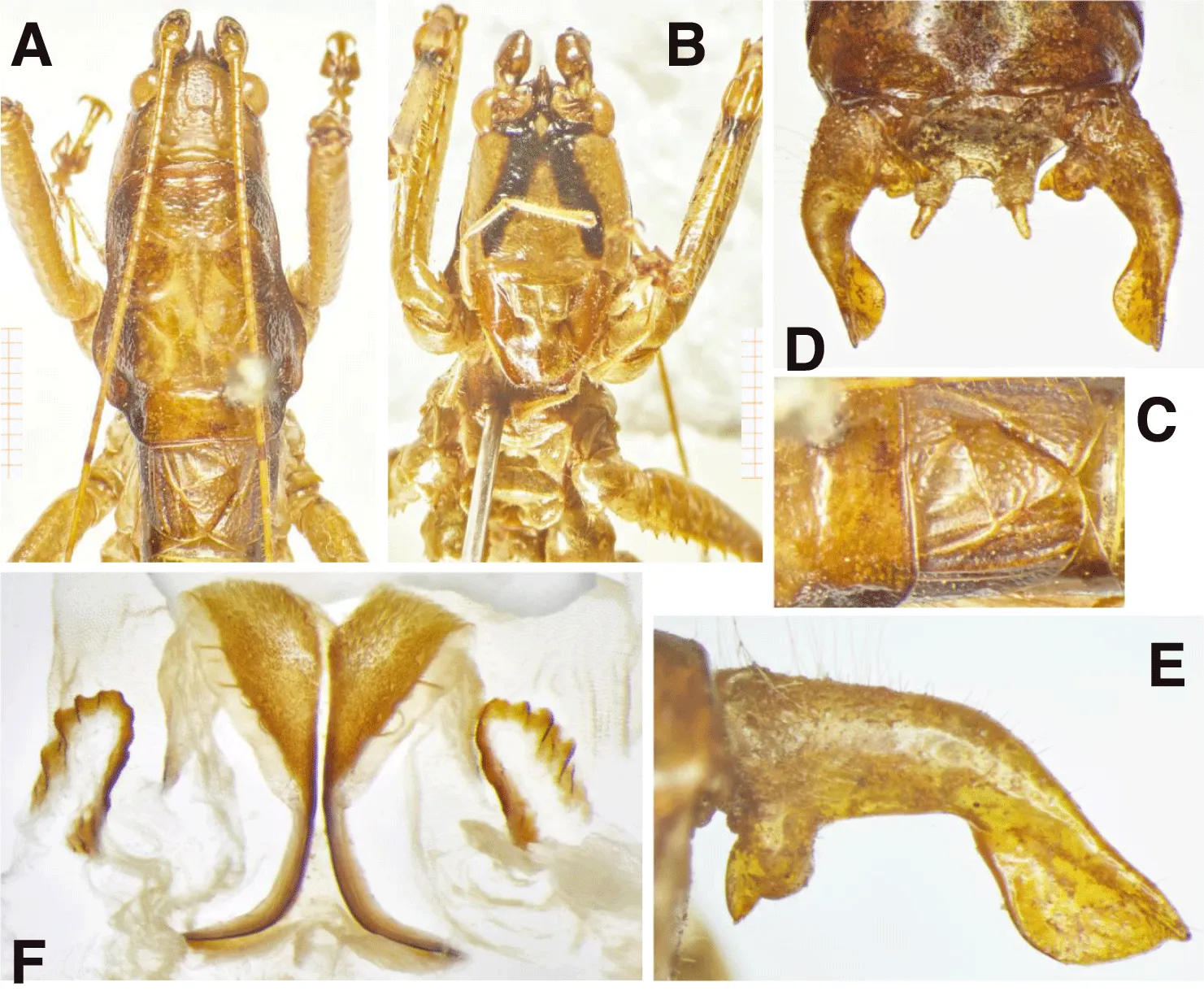
Holotype: Male (3261261): Solomon Islands, San Cristoval, Ravuraha, 4025, 15.x.1955, E.S. Brown, the type is unique. Depository: London (BMNH).
Diagnosis: Although of similar general shape, the new species has rather short cerci with unique expansions compared to all other males of the genus known so far.
The first expansion of the cercus is short and inserted at the underside of the very base of the cercus: consisting of a short rounded bulge ending into a short acute tip while the apical area forms an elongate, spine-like projection narrowing towards end and carries on underside a compressed, semi-oval lobe.
- Description
Male: Coloration yellowish brown to dark brown with lighter and darker elements. Head yellowish brown; face with a dark band from around base of fastigium verticis running around median ocellus and dividing from there into a pair of broad black bands running to the lateral angles of the frons; another pair of black but short and narrow bands running from the dividing area to the ventral margins of the compound eyes, but leaving a light spot in middle of the dividing area below the median ocellus. Face also with a less distinct dark band from behind the compound eyes. Pronotum with medium brown dorsal and black lateral areas; also area of body below tegmina with black bands. Tegmina reduced to stridulatory apparatus, but with distinct venation. Abdomen dorsally dark brown, apical segment with truncate apical margin. Cerci in little more than basal half elongate-conical with slightly converging margins; afterwards curved apico-ventrad and narrowing towards the narrow tip; from ventral margin with a semi ovoid and compressed projection; from base of the cercus stem with a rather short cone-like process that has, along the proximal margin, a compressed-conical process that terminates into a minute spinule. Titillators with a narrow, out-curved basal area that is widened distally into a pair of roughly elongate-oval, brown discs with setose surface; laterally of these discs they run parallel to rather broad and membranous, semi-transparent margins with a few transverse dark strokes. On both sides of the titillators with membranous structures with darkened rim that carries transverse plates along the margin.
Measurements: Body 28, pronotum 7.5, tegmen 2.5, hind femur 26.5, antenna 65 mm (Figure 15).
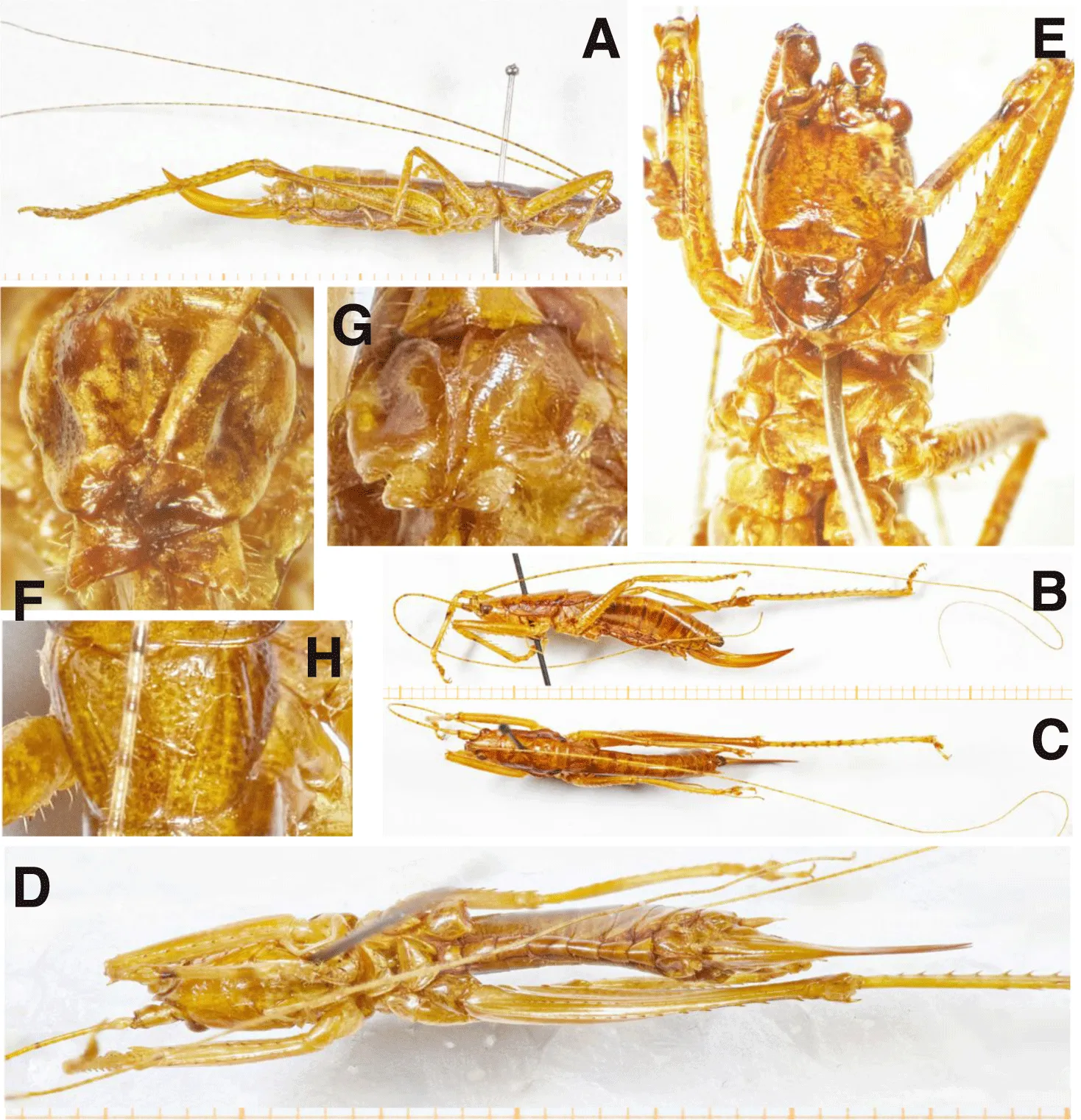
- Specimens studied
Holotype, female (3261740): Solomon Islands, Guadalcanal, Suta, 500-1200 m, 27.vi.1956, J.L. Gressitt. Depository: Honolulu (BPBM).
Paratype, female (3261246): Solomon Islands, Guadalcanal, Suta, 27.vi.1956, E.S. Brown. Depository: London (BMNH).
Diagnosis. P. suta differs markedly from other species of the genus by the shape of the subgenital plate that has a distinct medial furrow from the base to the end of the plate and a pair of styliform projections from the apical margin of the subgential plate that are so far unique in this genus of tettigoniids. Styli at the end of the subgenital plate occur normally only in males.
Description of female: Face of uniform light brown coloration. Pronotum and abdomen with little distinct light brown lateral bands. Tegmina oval, overlapping in midline, about halve as long as pronotum. Subgenital plate with a strong medial furrow over the whole length of the plate; apical margin obliquely truncate on both sides, interrupted in midline by the somewhat projecting medial furrow. On both sides of that furrow a styliform projection appears from the apical margin of the subgenital plate.
Males unknown.
Coloration: Light to medium brown; face, legs, and underside of abdomen of lighter color.
Measurements of females: body 21-25; pronotum 5.5-6.0; tegmen 2.5-3.0; hind femur 15.0-15.5; ovipositor 9.0-10.0; antenna 80-95 mm (Figure 16).
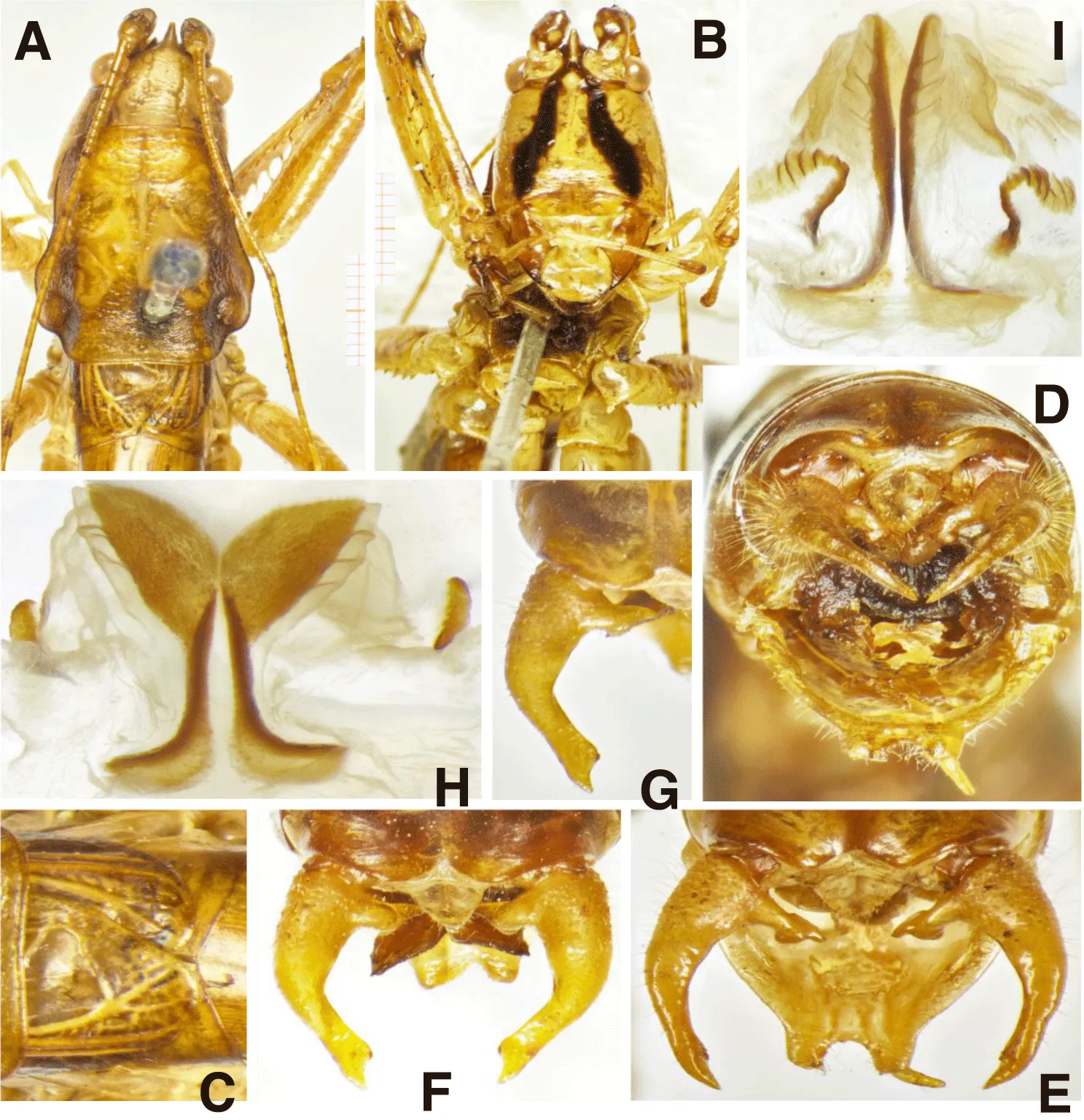
- Specimens studied
3261250: Holotype: Solomon Islands, San Cristoval, Callego camp 2, around campsite, 11.vii.1965, Roy. Soc. Exp., BM 1966-1.
3261252: Solomon Islands, San Cristoval, Camp 2, confluence of Warachito and Pagato Rivers, 6-7 miles inland, 3.viii.1965, Roy. Soc. Exp. BM 1966-1.
Diagnosis: Males of the new species are easily recognizable by the shape of the short but stout internal tooth of the male cerci that has the apical area basally widened and terminates into an acute end.
Description of male: Coloration yellowish brown with lighter and darker areas. Face with a pair of black bands from fastigium verticis to nearly ventral margin. Tegmina rather short with anterior area partly hidden under the straight end of pronotum hind margin. Last abdominal tergite rather short with convex surface, in basal area with convex lateral margins, afterwards narrowing and with slightly concave lateral-apical margins, at end with a short angular incision. Epiproct triangular with a depression in middle. Subgenital plate with convex latero-apical margins that carry at end a pair of short, narrow, rounded projections ending into short styli. Cerci in about basal half elongate with slightly narrowing margins; nearly at base with a short compressed projection that ends into a short subacute tip and carries a rounded, compressed lobe on both sides just before acute tip; apical half of cercus compressed, terminating into a long acute posterior angle and a weak proximal ventral-internal angle. Titillators without-curved basal area followed by a narrow shaft-like central area and a pair of oval plates with setose brownish surface and semi-transparent lateral margins with oblique, crossways arranged elevations.
Measurements: Body 21.0-23.5, pronotum 6.5-8.5, tegmen 2.4-3.0, hind femur 13.5-16.0, antenna 75 mm (Figure 17).
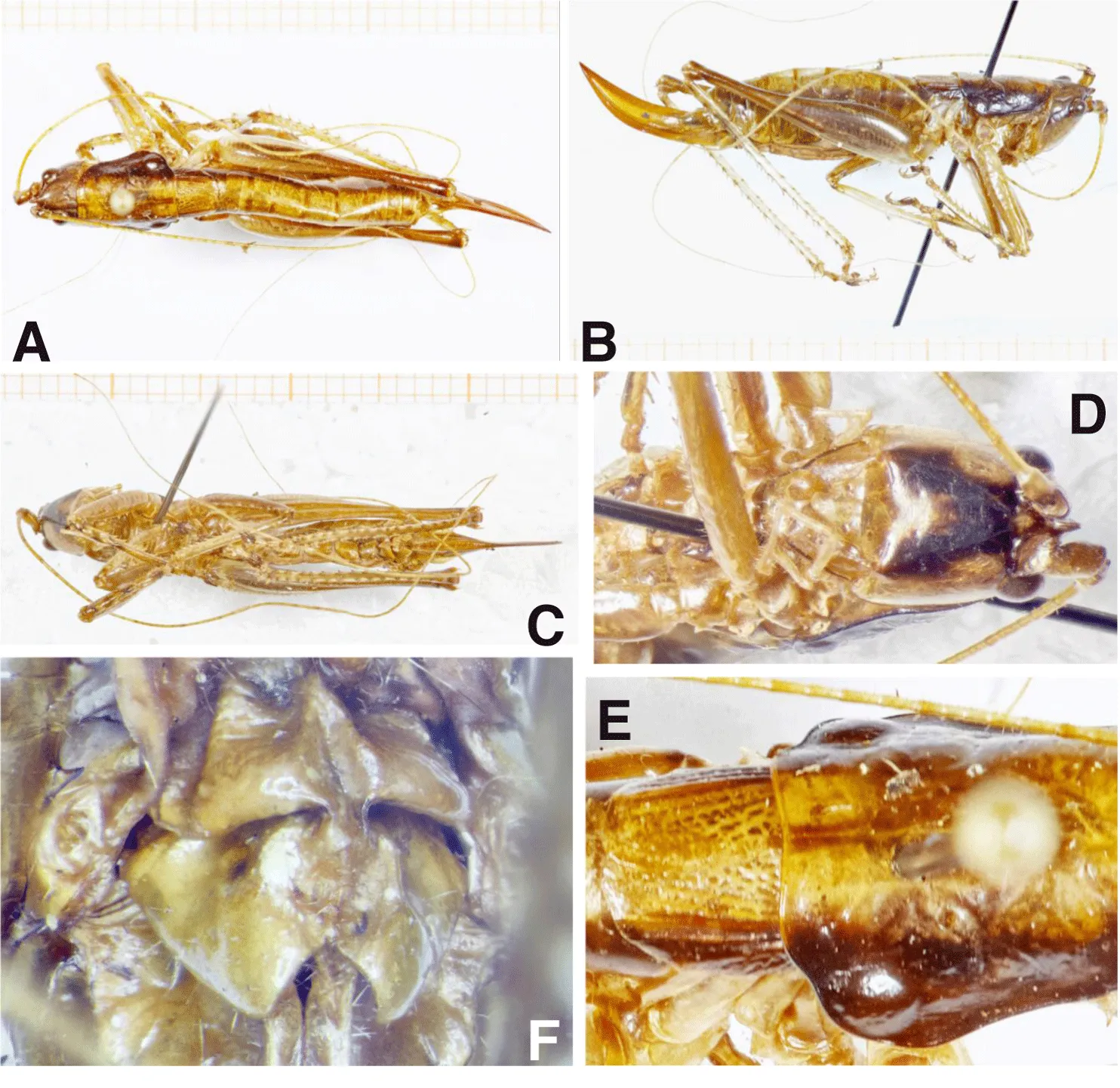
- Specimens studied
Holotype female (3260996): Papua New Guinea, Milne Bay, 2.3 km N and 0.4 km W of Agaun: Dumae Creek. Depository: BPBM Honolulu (the type is unique).
Description: Frons with a broad black band starting at fastigium verticis, widening below antennal sockets and a second time at about mid-length of face; lateral areas of pronotum, tegmen and abdomen also black. Tegmina short, slightly overlapping in midline. Last abdominal sternite bulging posteriorly and is provided with a medial furrow that is widening posteriorly. Subgenital plate with rounded anterior angles and converging lateral margins, central area elevated against the latero-anterior angles, with a rounded depression in middle; behind that depression the apical area forms a pair of rounded lobes divided by an angular section and is obtusely rounded at apical angles. Ovipositor curved with margins narrowing in apical halve to acute tip.
Measurements: Body 22, pronotum 5.5, tegmen 2.2, hind femur 13.8, antenna ca 50, ovipositor 9.5 mm (Figures 18,19).
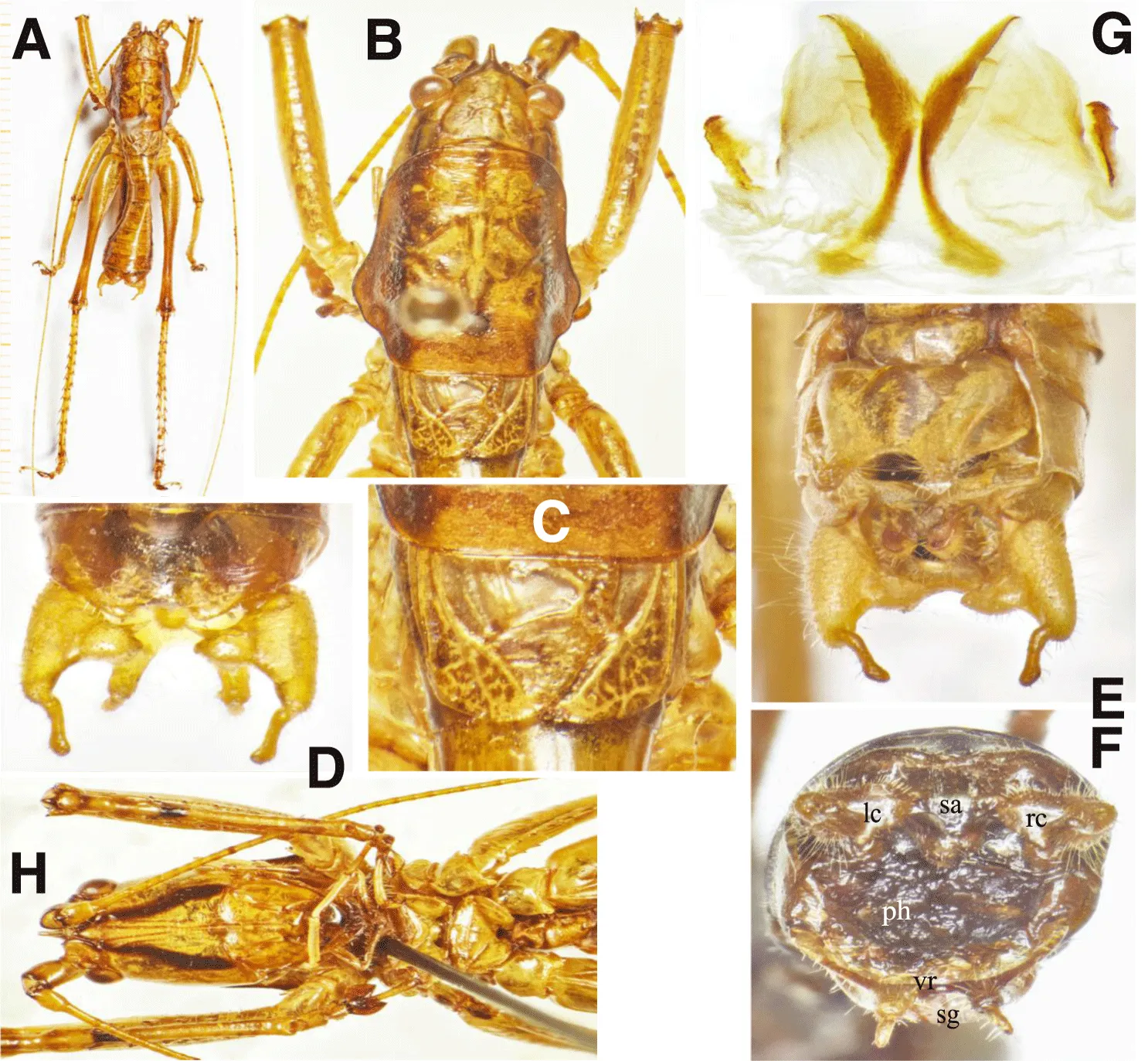
- Specimens studied
Holotype: Male 3261741, Solomon Islands, Kolombangara, 1-1000 m, 23.i.1964, P. Shanahan (BPBM).
Male 3261254: Solomon Islands, Kolombangara, 1524 m, 10.x.1933, H.T. Padgen (BMNH).
Females 3261249 and 3261251: Solomon Islands, Kolombangara, camp site, 762 xx2, 28.vii.1965, Roy. Soc. Exp. (BMNH).
Female 3261736: Solomon Islands, New Georgia Group, Kolombangara Island, 1-12 m, 11.vii.1959, J.L. Gressitt (BPBM).
- Description
Elongate and narrow species with tegmina that are reduced to little more than the stridulatory apparatus in male and of similar length in female. General coloration brownish. Face with two stripes from fastigium frontis to labial furrow. Genae, lateral lobes of pronotum and lateral lobes of tegmina with a black stroke. Pronotum with hind margin truncate. Tegmina reduced to little more than stridulatory area in male and to similar length in female; wings overlapping along mid-line in both sexes.
Male: Cerci conical with a stout semicircular internal process with rounded end that carries a minute extension at end; behind internal process, cercus with narrowing margins and rounded-conical end; from ventral margin, just before end of cercus, with a long, narrow and somewhat sinuately curved ventral projection with a weak oval expansion at end. Phallus with a pair of titillators with narrow basal and widened apical area that is elongate-triangular and has the brown surface bordered by a transparent rim with a few transverse brown strengthenings. There is also a pair of lateral sclerites.
Female: Tegmina consisting of a pair of elongate oval flaps slightly overlapping in midline. Subgenital plate complex, in ventral view in more than basal half flattened at both sides forming roughly obtuse triangular projections that are continued towards base on both sides; in middle with a stout elevated structure with a deep furrow in mid-length except at base; towards end with a second pair of elevated but smaller structures with free, sub-angular tips. The name pf the new species refers to the extended and modified female subgenital plate. Ovipositor rather regularly curved towards acute end.
Coloration (Both sexes): Frons with a black band from fastigium frontis, dividing into two bands around median ocellus running to base of mouthparts; between median ocellus and compound eyes eventually with short black bands too; from behind compound eyes, along upper area of compound eyes and along upper lateral area of abdomen also with black bands.
Measurements (Males): Body 22.5-24.0, pronotum 6.5-7.5, tegmen 3.0-3.5, hind femur 15.0-15.5, antenna 70 mm.
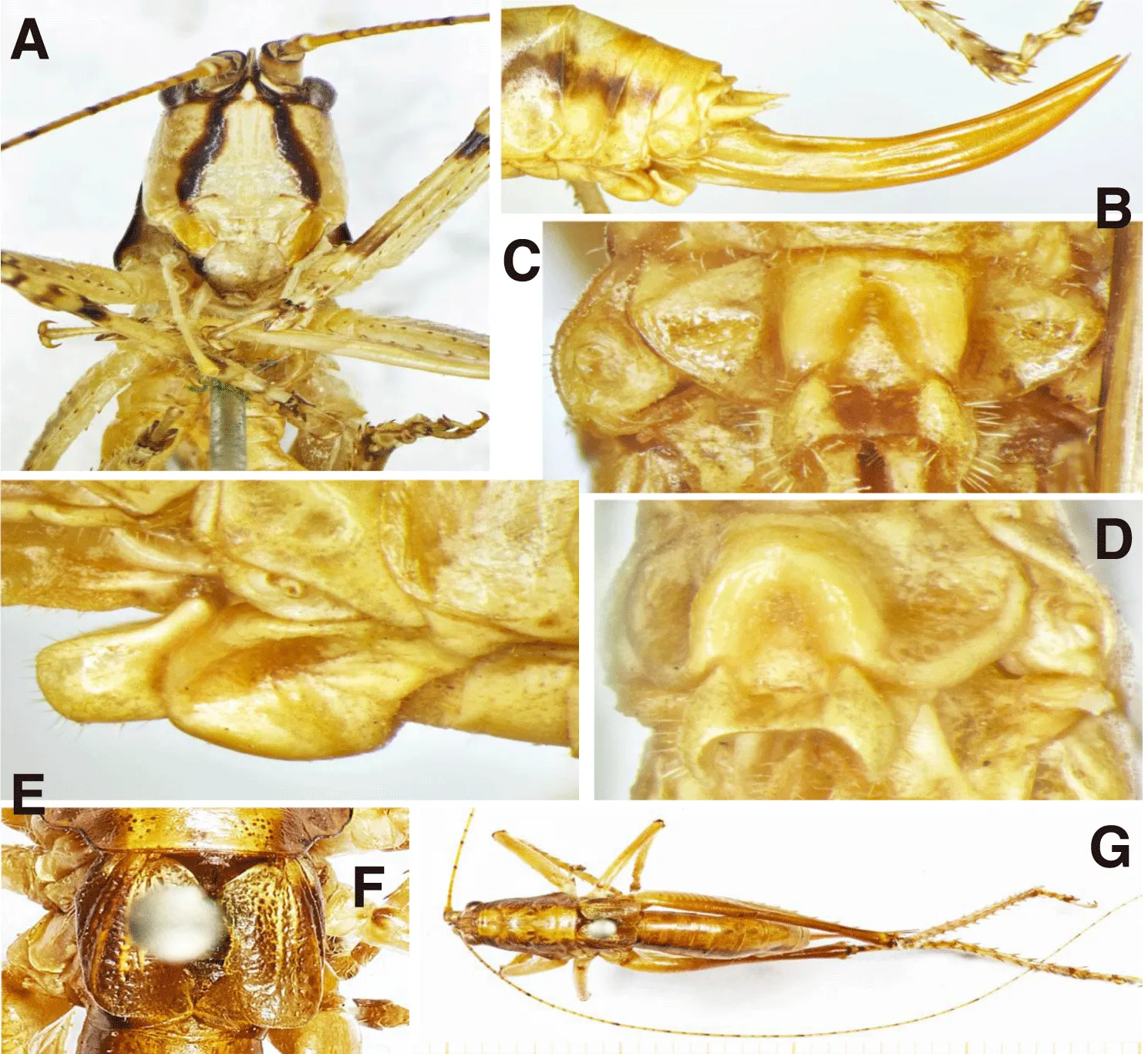
Measurements (Females): Body 22.0-25.0, pronotum 6.2-6.5, tegmen 2.2-3.5, hind femur 15.0-15.5, antenna ca 100-110, ovipositor 11.0-12.0 mm (Figures 20,21).

- Specimens studied
3261260: Holotype male: Solomon Islands, Malaita, Baunani, 6.ix.1954, leg. E.S. Brown.
3261253 and 3261259: Paratypes two females: Solomon Islands, Malaita, Baunani, 6.ix.1954, leg. E.S. Brown, (same data as holotype).
Comparison: The male of P. malaita sp. nov. is similar to the male of P. extensa sp. nov. in general habitus and coloration, but differs in details of the male cerci which have the basal internal projection stout and extended into a short styliform ventral projection with three short spines at end while in P. extensa the ventral internal projection is simply bulging with a minute narrow apical tip. Moreover, the narrow apical process of the cercus is simply bent from the end of the conical basal area in P. malaita while in P. extensa it arises from the underside of the conical basal area.
- Description
Elongate and narrow species with reduced wings. The tegmina are reduced to the stridulatory apparatus in male and of similar length in female, overlapping along mid-line. Body of brownish general coloration. Face with a pair of stripes from fastigium frontis to labial furrow. Genae, lateral lobes of pronotum and lateral lobes of tegmina with a black stroke. Pronotum with hind margin truncate. Wings overlapping in midline in both sexes.
Male: Cerci conical with a huge subbasal internal projection consisting of a conical and longer basal part pointing mediad-ventrad with two acute spines at tip and a wider but shorter distal area with plain, rounded end. Tip of cercus with an elongate and narrow internal projection with faintly widened, rounded end.
Female: Tegmina consisting of a pair of elongate oval flaps slightly overlapping in midline. Subgenital plate with central area little roundly elevated; in basal half with about semi-oval lateral projections that have the lateral surface slightly concave. The apical-ventral surface of the plate is divided into two curved lobes embracing an oval interspace. Ovipositor rather regularly curved towards acute end.
Coloration (Both sexes): Frons with a black band from fastigium frontis, dividing into two bands around median ocellus which are then running to the base of the mouthparts. From behind compound eyes, along upper area of compound eyes and along upper lateral area of abdomen also with black bands.
Measurements (Male): Body 24, pronotum 7, tegmen 3.7, hind femur 17, antenna 75 mm.
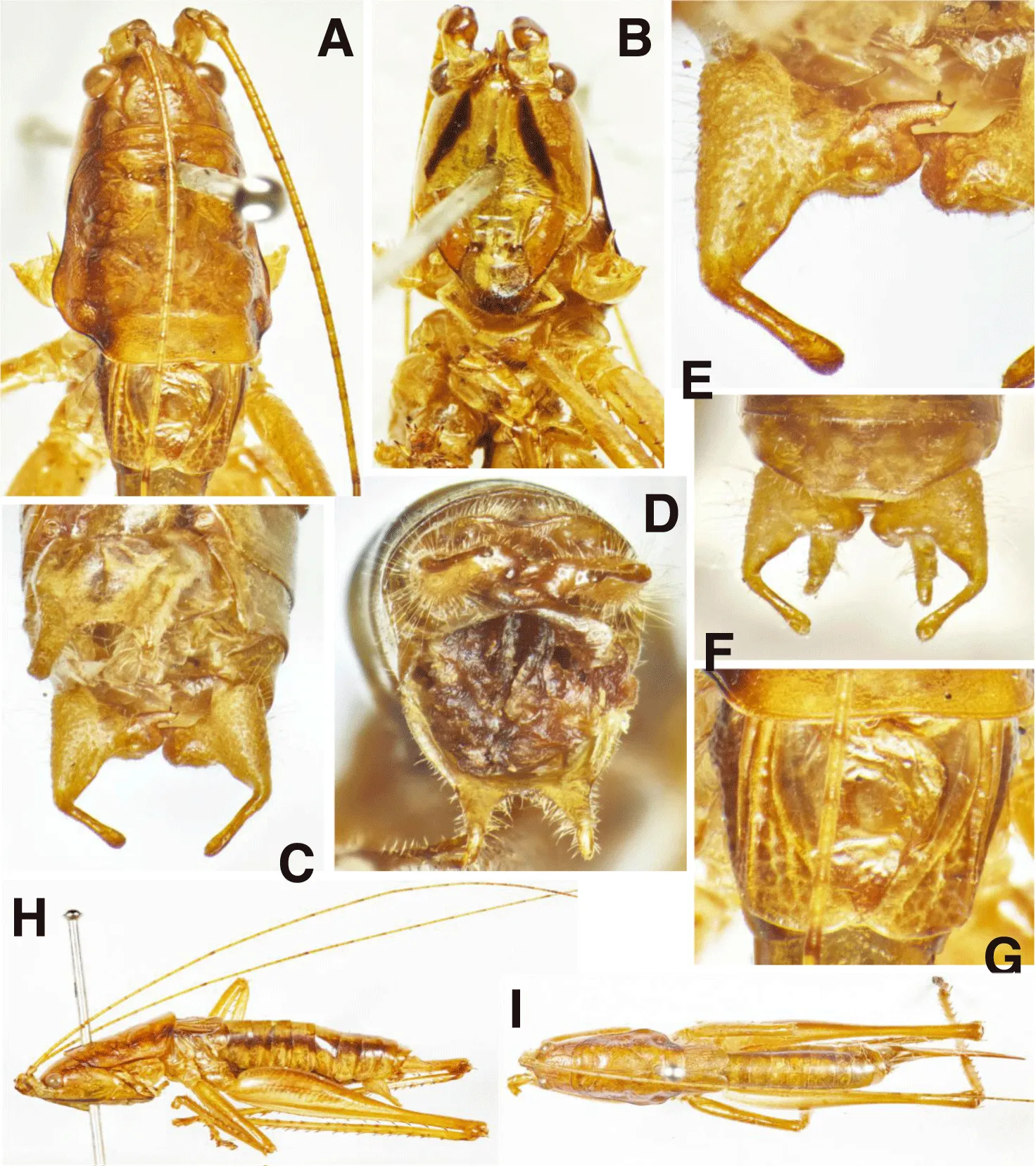
Measurements (Females): Body 21-22, pronotum 6.8-8.5, tegmen 2.1-2.5, hind femur 16.0-16.5, ovipositor 10.5-12.0, antenna 60 mm (Figure 22).

- Specimens studied
3261734: Holotype male: Solomon Islands, Vella Lavella, Ulo Crater, 7.xii.1963, P. Shanahan, depository BPBM
3261735: Solomon Islands, Vella Lavella, Pusisama, 17.xi.1963, P. Shanahan, depository BPBM
3261732: Paratype female: Solomon Islands, Vella Lavella, Ulo Crater, 13.xii.1963, P. Shanahan, depository BPBM
3261262: Solomon Islands, Santa Isabel, Tataba, 7.ii.1964, leg. M. McQuillan, stop 10575, depository BMNH.
3261263: Solomon Islands, Santa Isabel, Rasa, 2.iii.1963, leg. M. McQuillan, stop 3852, depository BMNH.
- Description
Body of rather uniform, yellowish brown color, without striking black marks. There is only a blackish stroke along the lateral margins of the male tegmina. Head in frontal view with substraight lateral margins, only little widening from tip to base. Pronotum elongate with anterior margin rounded, posterior margin subtruncate. Tegmina semi-oval, short, in male of less than half the length of the pronotum, overlapping in middle. Female tegmina markedly smaller, not touching each other in midline. Face pale, laterally only faintly darkened.
Male: Tenth abdominal tergite with roughly subparallel lateral margins in more than basal half, afterwards with converging lateral margins; central area of apical margin subtruncate, straight or slightly concave. Cerci with main basal-central area moderately wide and slightly dorso-ventrally compressed, with convex surface; in subbasal area with a narrow but rather long internal extension that at end is curved proximad and terminates into a short acute spine; apical area of cercus stem bent ventrad, strongly narrowed and curved into a ventral projection with obtuse tip. Titillators with narrow and at base out-curved basal area and ovally widened apical area with narrow tip. Lateral sclerites elongate, simple, with one lateral margin straight, the other slightly serrate.
Female: In general shape and coloration similar to male. Tegmina only little longer than wide, strongly reduced to semi-oval flaps not touching each other in midline. Last abdominal sternites subfused, forming an elongate structure with a membranous zone along mid-length that is separated from the subgenital plate by a transverse furrow. Subgenital plate with a medial furrow and apical margin rounded-bilobate.
Measurements (Males): Body 21-25, pronotum 6.5-7.5, tegmen 2.0-3.0, hind femur 16.0-16.5, antenna 55-70 mm.
Measurements (Females): Body 26-35, pronotum 6.5-7.2, tegmen 2.0-3.0, hind femur 17-19, ovipositor 10.0-10.5 mm (Figures 23,24).


- Specimens studied
3261104: Holotype male: New Guinea, Mt. Suckling, 1500-2200 m, 16.7.1972, J.L. Gressitt, depository BPBM
3261106: Allotype female: New Guinea, Mt. Suckling, 1500-2200m, 14.7.1972, J.L. Gressitt, depository BPBM
3261773: male, New Guinea, Mt Suckling, 1500-2200m, 14.7.1972, J.L. Gressitt, depository BPBM
- Description
Frons oval; fastigium frontis black with black area widening around median ocellus laterally and sends narrow black strokes towards both sides to below compound eyes; downwards the black area becomes rather wide and after half-length widens again laterally until above labrum into wide black bands. Basic segment of antennae, lateral lobes of pronotum and lateral area of tegmen black. Tegmina shortened in both sexes to semi-oval lobes, overlapping in middle; in male with stridulatory apparatus.
Male: Tenth abdominal tergite rather small and narrow, with a pair of rounded apical lobes. Cerci very wide in basal area (best seen from below), with a basal internal projection with wide and flattened basal area and rounded apical area; main lateral area also compressed, in basal area somewhat curved, then compressed and narrowing towards rounded end. Subgenital plate of normal shape, terminating into a pair of projections that carry a pair of styli like extensions at end.
Phallus provided with a pair of titillators with rounded end that has the ventral apical area little projecting and finely granular.
Female: Coloration as in male. Tegmina reduced to short lobes, overlapping in middle. Subgenital plate wider than long, with converging lateral margins, lateral angles rounded, apical margin concave. Ovipositor short and curved with acute tip.
Measurements (Males): body 19-25, pronotum 5.5-6.2, tegmen 2.0-2.5, hind femur 14-14.5 mm, antenna 50 mm.
Measurements (Female): body 21, pronotum 5.5, tegmen 2.0, hind femur 14.5, ovipositor 10.2 mm.
Acknowledgements
My severe thanks go to the former and current curaters of the Bishop Museum Honolulu and The Natural History Museum, London for the prolonged loan of the specimens studied.
References
- Ingrisch S. A revision of the Axylus group of Agraeciini (Orthoptera: Tettigoniidae: Conocephalinae) and of some other species formerly included in Nicsara or Anthracites Revision of the Indo-Australian Conocephalinae, Part 3. Zootaxa. 2015 Nov 23;4046:1-308. doi: 10.11646/zootaxa.4046.1.1. PMID: 26624732.
- Karny HH. Conocephaliden (Orthoptera Locustoidea) aus neuguinea hauptsächlich gesammelt von Dr. O. Schlaginhaufen. Abhandlungen und Berichte des zoologischen und anthropologisch-ethnographischen Museums zu Dresden. 1912;14:3-23.
- Naskrecki P, Rentz DCF. Studies in the orthopteran fauna of Melanesia: New katydids of the tribe Agraeciini from Papua New Guinea (Orthoptera: Tettigoniidae: Conocephalinae). Zootaxa. Auckland, New Zealand. 2010;2664:1-35. doi: 10.11646/zootaxa.2664.1.1.
- Redtenbacher. Monographie der conocephaliden. Verhandlungen der Zoologisch-Botanischen Gesellschaft in Wien. 1891;41:315-562:3-4.
- Sabang AMM, Bahoy DCM, Grumo KC, Gono AIIIA, Salvador JAG, Rivera RR, Nuñeza OM, Robillard T, Tan MK. A taxonomic review on the katydids of the genus Anthracites Redtenbacher, 1891 (Tettigoniidae: Conocephalinae: Agraeciini) from Mindanao, Philippines. Zootaxa. 2024;5507(2):313. doi: 10.11646/zootaxa.5507.2.5.0.




Content Alerts
SignUp to our
Content alerts.
 This work is licensed under a Creative Commons Attribution 4.0 International License.
