
Medicine Group 2024 October 07;5(10):1278-1287. doi: 10.37871/jbres2015.





 Observational Studies
Shroud of Turin: What Happened to Jesus Christ’s Human Body after Death?
Giulio Fanti*
- Turn Shroud
- Hemopericardium
- Rigor mortis
- Liquid blood
- Smearing
- Putrefaction
- Body image
Abstract
Based on the compatibility between what can be scientifically detected on the TS (Turin Shroud) - having recognized Jesus Christ in the double body image visible there - and what is reported in the CHB (Christian Holy Bible), an attempt was made to highlight the various events that followed death by heart attack and ensuing hemopericardium.
This description has been divided into five phases: rigor mortis of the body of Jesus, transport to the sepulcher and wrapping in the TS, deposition in the sepulcher and subsequent absence of movements, absence of putrefaction signs, and Jesus' exit from the TS.
These points proved to be critical because they seem unable to provide a scientifically plausible answer to the evidence found on the TS, namely, how to explain that a human body emerged from the TS without disturbing it.
The comments section therefore, attempts to explain the phenomena in question by providing a hypothesis that is for the moment, outside of science.
Introduction
A very recent paper Fanti G, et al. [1], has described the probable death of Jesus Christ by heart attack followed by hemopericardium based on the fusion of information from the TS with that contained in the CHB, in particular from the Gospels and the Psalms.
After more than twenty-five years of scientific studies on the most important Relic of Christianity, the author is personally certain that the double bloody image visible on the TS is that of Jesus Christ tortured, scourged, crowned with thorns and dead on the cross. The CHB, describes synthetically what one can observe from a scientific point of view on the TS with a greater number of details, but also adding that Jesus Christ resurrected.
In agreement with the current Catholic Christian tradition, the TS is the burial cloth which wrapped Jesus Christ before being placed in a tomb in Palestine almost 2000 years ago [1].
The TS is a handmade 3:1 twill linen cloth, 4.4 m long and 1.1 m wide, on which the front and back images of a human body are mysteriously imprinted in a way that has yet to be reproduced with all its notable characteristics [2-4].
The face of Christ on Byzantine coins demonstrates that the TS was seen during the Byzantine Empire from the seventh century [5]. Furthermore, there is evidence that the TS proceeded from Constantinople (after its sacking in 1204) to Lirey, France in 1353. In 1988, it was radiocarbon-dated to 1260-1390 A.D. [6], however the result is questionable and very controversial [7-10]. As the process that could form the body image on the TS with all its particular features is still unknown, it might quite possibly, be related to a neutron flux [11], which potentially varied the percentage of the TS’s carbon isotopes altering what should have been the normal radiocarbon dating result for the linen cloth. In particular, the nitrogen atoms of the TS would have transformed into carbon ones. A partial confirmation of the neutron flux comes from blood results of the TS that is poor in nitrogen [12] and radioactive [13].
In agreement with Heller JH, et al. [13,14] of STuRP (Shroud of Turin Research Project) and Baima Bollone PL. [15], the numerous red stains present on the HS are genuine blood, and [13,17] confirm this.
In Ref. [1] the authors studied the last twenty hours of the Passion of Christ to highlight what the most probable cause of Jesus’ death was and how it was etiology [1]. They subdivided these twenty hours of Passion into seven phases, each describes the particular pathological state of this Man harshly tortured in all his limbs: Last Supper, Gethsemane, Beatings, Scourging, Carrying the cross, Effects of tortures and heart attack with hemopericardium.
These fused aspects have highlighted various possible causes of death, such as orthostatic collapse, asphyxia, uremia, and hemothorax, accentuated by the insult that produced a heart disease from strong stress. Each of these contributing causes, if considered individually, would probably have led to the death of Jesus, and obviously, they severely weakened Him. Nevertheless, the results of these analyses indicate tamponade due to hemopericardium as the primary cause of the death of Jesus Christ.
This result was also supported by recent studies [13,17] that evidenced different types of blood on the TS, distinguished as Type A, B, and C. The author hypothesized post-mortem type A blood, poured onto the TS in fluid form and spread on the Relic in the sepulcher when Jesus' body was wrapped there, type B blood, consisting of coagulated blood crusts on the skin when Jesus was still alive, and type C blood which consists of single erythrocytes, not easy to evaluate due to their very limited number. In this paper, type A post-mortem blood has been considered to arrive at an important hypothesis of what happened to the body of Jesus Christ after his death on the cross.
Conditions of the human body of Jesus Christ after death
We know [1] that the pathology that led to the death of Jesus was not sudden but most likely developed slowly during the last twenty hours of His life prior to His heart attack. This was followed by hemopericardium.
We must not forget the continuous spiritual agony suffered by Jesus that increased His stress heart disease, accentuated by the innumerable insults received, for example: "Scorn has broken my heart and has left me helpless;" [Psalm 69, 20].
The TS confirms this when we see that [13] reports the presence of erythrocytes and creatinine in the blood samples - which is typical of a tortured person. In addition to this, the post-mortem blood of Jesus composed of microcytes (which are erythrocytes having a diameter of about 0.7 micrometers and which are about ten times smaller than normal human erythrocytes) is typical of human blood diluted with urea. The fact that Jesus of the TS suffered from acute uremia agrees with the endured hard flagellation, which would have likely resulted in renal failure.
With all the physical and spiritual torture, it is not difficult to reason that a heart attack could have occurred in a robust person, such as Jesus Christ. The very high frequency of heartbeats produced a heart attack that caused a significant effusion of blood into the pericardial layer, causing hemopericardium with consequent cardiac congestive tamponade and immediate death after a sharp pain in the chest. This is also in agreement with the Gospel of Mark, "With a loud cry, Jesus breathed his last." (Mark [15:37]).
A synthetic comparison between what we see on the TS and what is reported on the CHB regarding the conditions of Jesus Christ before death follows. From the CHB, we know that Jesus Christ, God Incarnate, was severely tortured. Found on the TS are the signs of severe beating and scourging along with bloodstains on the head, consistent with a crown of thorns. The CHB confirms that Jesus was crowned with thorns and that Jesus had a heavy cross carried to Mount Calvary, where He died crucified. The TS confirms this by the bloodstains and body image which indicate a man that was crucified (as indicated by the nail wounds visible on the hand and feet) and, as mentioned above, He died due to a cardiac tamponade.
Let us now see in more detail what happened to the human body of Jesus Christ after death. Rigor mortis: Fanti G, et al. [1] describes suffering Jesus Christ endured on the cross before dying. Hemopericardium with consequent cardiac congestive tamponade was the cause of the immediate death after a sharp pain in the chest.
The TS shows that the corpse of Jesus, when buried, was in rigor mortis [18] at the time of body image formation [19,20], but the rigor is not typical of a supine man. His head bowed forward, his knees partially bent, and his feet stretched forward at an angle greater than any movement permitted by the ankle (and therefore dislocated), following the insertion of the nail, are consistent with the vertical position of a crucified man. His arms, with the hands crossed on the pubic area, were evidently moved after death to allow entry into the narrow door of the tomb; it appears that [19] a dislocation weakened the assumed cadaveric rigidity.
Already more than a dozen years ago [18] the author verified the pronounced cadaveric stiffness of Jesus by superimposing a numerical copy of the double imprint of the TS body image with an anthropomorphic numerical manikin (Figure 1).
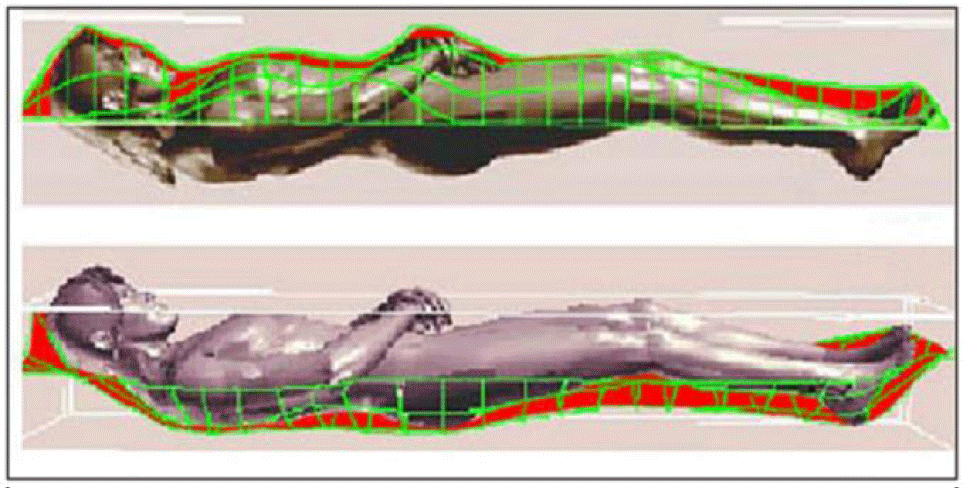
Recently Pappas T [20] confirmed such rigidity by making a detailed medical analysis. She states that immediately after death, a total relaxation of a cadaver’s muscles occurs in what is known as primary muscular flaccidity and, during this approximately 1-3-hour time period, the muscles remain soft, but then the process of rigor mortis commences with its progressive stiffening of the body through the contraction of both the voluntary and involuntary muscles.
Like the case of Jesus, the rigor can be accelerated by some factors like a violent death, death preceded by the violent spasms of muscles relative to limbs stretched on the cross and dehydration [1] and therefore it is easy to think that no more than one hour after death the body of Jesus, still hanging on the cross, reached its peak of rigor becoming almost rock-hard in that particular position.
This fixed state of rigidity will remain for a period of time, and then it will progressively diminish until it disappears completely due to the action of proteolytic enzymes and the body’s overall process of cellular breakdown which corresponds to the cadaver’s putrefaction. Rigor mortis can normally last 36-48 hours postmortem, but in some cases, it can reach up to 120 hours in the lower limbs [21].
The CHB confirms that, after death, the corpse was removed from the cross, wrapped in a shroud, and placed in a rock-hewn sepulcher from Friday evening to Sunday morning. This time period, 36-40 hours (John 19, 38-42), is coherent with medical reports.
Transport of Jesus' body to the sepulcher and wrapping in the TS: It is easy to think that the body of Jesus was taken down from the cross by two or three persons, probably Joseph of Arimathea, Nicodemus, and the apostle John (John 19:38-39). Then the body was placed on a first shroud used for transport to the sepulcher.
It was then placed on the preparation stone covered with powdered anti-putrid substances, such as aloe and myrrh, and half of the TS on top of them.
According to Jewish law, the body of Jesus was probably not cleaned of post-mortem blood, but only cleansed of pre-mortem blood, such as that produced by scourging. Instead, the rivulets corresponding to the arms and feet due to the unnailing procedure, and the leakage of blood and serum from the chest wound related to a spear thrust, are Type A [13] post-mortem blood left on the TS [22].
Jesus Christ's body was then most likely covered with an oily mixture of aloe and myrrh (manteca in Italian) (John 19:39) and rolls of linen bandages impregnated with anti-putrid substances. These were placed at its sides to better preserve the corpse from putrefaction. No traces of the body image or of blood drippings on the sides of Jesus' body on the TS suggests the presence of objects such as rolls of bandages.
Deposition in the sepulcher and subsequent absence of movements: After Jesus was placed on the sepulcher's preparation stone, there was no additional relative movement between the body and TS. This is demonstrated by the following two very important pieces of evidence.
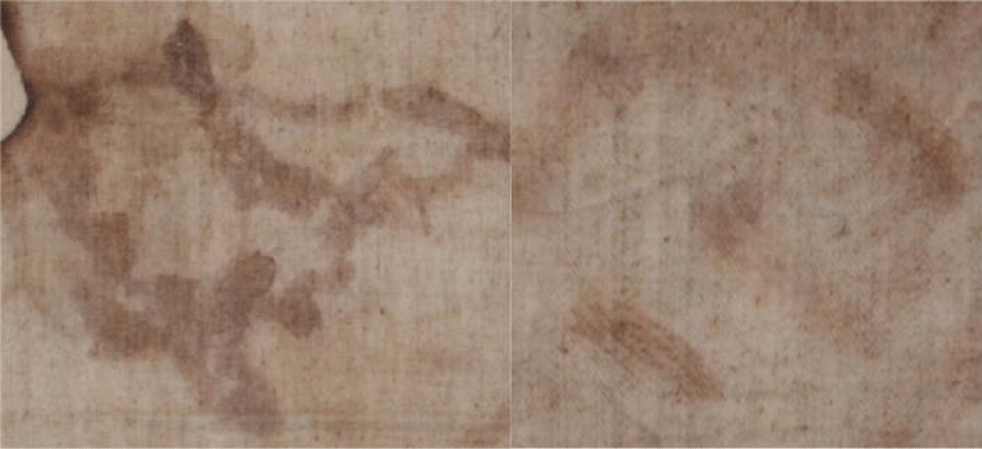
The first is that no bloodstain on the TS has any smearing (Figure 2); in other words, all the bloodstains are perfectly transferred onto the linen fabric [23].
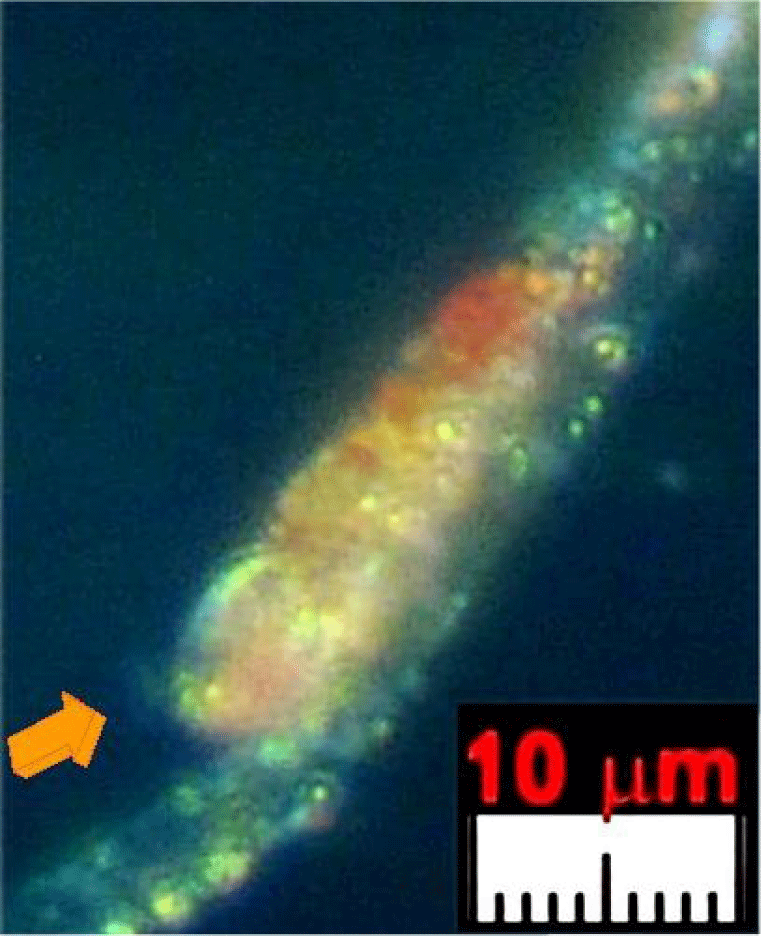
The second is that the Type A blood [16] soaked into the TS, at least partly in a liquid state (Figure 3) and this blood is still found today in crusts in a plastic state [24] (Figure 4).
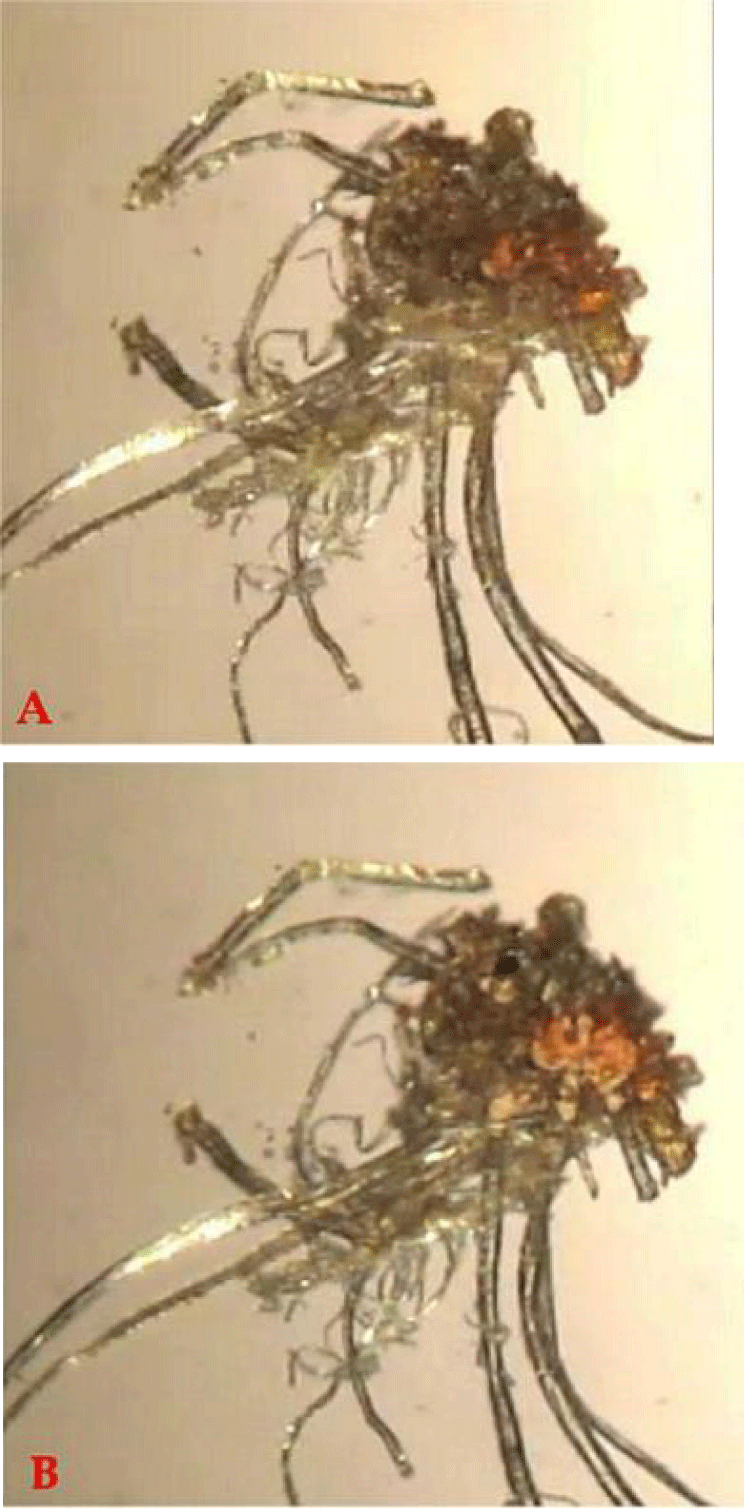
As mentioned above, these two features, the absence of smearing in correspondence with liquid blood, imply there was no relative movement between the linen fabric and the wounded skin in contact with the cloth. This important fact implies that once the TS was put in contact with the body, there was no further relative movement, and; therefore, the body remained in that position on the preparation stone.
This observation leads us to understand that with the evening of Good Friday approaching and knowing that during the Sabbath the Jewish religion forbade any burial operation, those in charge of Christ’s burial left the corpse wrapped in the TS, on the preparation stone, waiting for Sunday to place it in the burial niche of the sepulcher.
Absence of putrefaction signs for the body of Jesus: Observing the double body image of the TS, one can see the absence of signs of putrefaction. In fact, the beginning of putrefaction in a human body occurs with the release of gases through the orifices such as methane CH4, carbon dioxide CO2, phosphane (or phosphine) PH3 and hydrogen sulfide H2S [25], the last two of which are very aggressive.
If we observe the image of the face which has a very high resolution, in correspondence with orifices such as the mouth and nose, one should find stains caused by the gases of putrefaction. Instead, it is precisely in correspondence with these areas of the image that we find the maximum resolution of the image and the complete absence of stains.
Consequently, it can be deduced that the body of Jesus remained wrapped in the TS for a shorter time than that of the known release times of putrefactive gases (bloated stage), estimated between 48 and 72 hours with a temperate climate [26].
From the CHB we find two important confirmations:
-1) Jesus Christ died on Good Friday at about 3 pm and resurrected Easter Sunday morning; the 36-40 hour interval corresponds precisely to the time interval highlighted for the body of Jesus to remain wrapped in the TS and
-2) we read “because you will not abandon me to the realm of the dead, nor will you let your faithful one see decay.” (Psalm 16:10) confirming the absence of putrefaction for the human body wrapped into the TS.
Jesus' exit from the TS. A scientific problem: As previously discussed, the TS shows that the corpse of Jesus was in rigor mortis at the time of the formation of the body image and therefore during a period of less than 38-48 hours after death. Furthermore, the double body image of the TS was formed no more than 36-40 hours after death due to the lack of noticeable signs of putrefaction. Therefore, it results that Jesus remained wrapped in the TS for no more than about 40 hours.
We have also seen that the TS shows the complete immobility of Jesus' body in the sepulcher as evidenced by the lack of bloodstain smearing and therefore we deduce that the body was not tampered with or moved. In fact, we know that if the corpse had been stolen, or if by absurd hypothesis Jesus had woken up and left the TS, some minimal sliding of the blood clots on the fabric should certainly be detected, especially in the area of the back and glutei.
If one combines the evidence found on the TS regarding the wrapping for no more than about 40 hours with the subsequent disappearance and complete immobility of body of Jesus, one must arrive at a deduction that is, for the moment, scientifically absurd: the body of Jesus passed through the TS without compromising it materially. The physical body of Jesus became transparent compared to the linen fabric, the TS!
Jackson JP, et al. [27] arrived at this deduction in 1990 when he proposed the hypothesis of a collapsing TS due to gravity force, into a materially transparent human body.
A scientifically absurd deduction can be explained in two different ways: a) the deduction derives from erroneous observations, or b) the deduction goes beyond current scientific knowledge.
After having re-checked the observations discussed here several times and in accordance with what is reported in the CHB, the author believes that in the present case, everything can be explained according to way (b), that is, that the deduction goes beyond current scientific knowledge and encourages us to open new scientific horizons.
The scientific analysis of what happened to the human body of Christ after death must, therefore necessarily stop here. However, the author, also driven by the perfect congruence determined between what is read in the CHB and what is found in studying the TS, and also driven by the provocation of the scientific suggestion of the transparency of the matter compared to a linen sheet, tries to find some explanation, obviously not yet confirmed by science, of what may have actually happened in the sepulcher when Jesus came out of it.
The comments in the next section will discuss this hypothesis, apparently scientifically absurd, but in agreement with what is reported in the CHB where the Resurrection of Jesus Christ is widely explained (and mentioned 44 times). For example, Mark (9:30) (and Matthew 17:22-23) refers to Jesus saying to the Apostles, “The Son of Man is going to be delivered into the hands of men. They will kill him, and after three days he will rise.”
Conversely, it does not seem incongruous to reason that the hypothesis considered here is absurd. Simply, this assumes a phenomenon that is outside of science - the Resurrection. And that it is outside of science is abundantly clear when one deems that this is a non-reproducible phenomenon. Clearly science cannot deal with this type phenomena. Everything that will be discussed will necessarily have to be considered non-scientific even if logically plausible, and based on limited scientific knowledge.
Comments
As related earlier, the comments in this section treat a limited scientific knowledge. They try to explain in a reasonably plausible way what was found on the TS and what is reported in the CHB.
The author starts from the descriptions found in the CHB and then tries to formulate, also on the basis of what can be detected on the TS, a reasonable interpretation of the phenomena in question.
Jesus' Exit from the sepulcher: Reports from the CHB
Reported here are passages of the CHB that describe how Jesus Christ, after His death on the cross and His burial in the tomb, revealed Himself to the apostles while still alive.
1. When the apostle John (20:8-9) entered the tomb on Easter Sunday "He saw and believed. (They still did not understand from Scripture that Jesus had to rise from the dead.)" This very synthetic sentence indicates that the apostle upon entering the tomb saw it empty, but most likely, the arrangement of the TS on the preparation stone made him the first to believe in Jesus’ Resurrection (Figure 5).
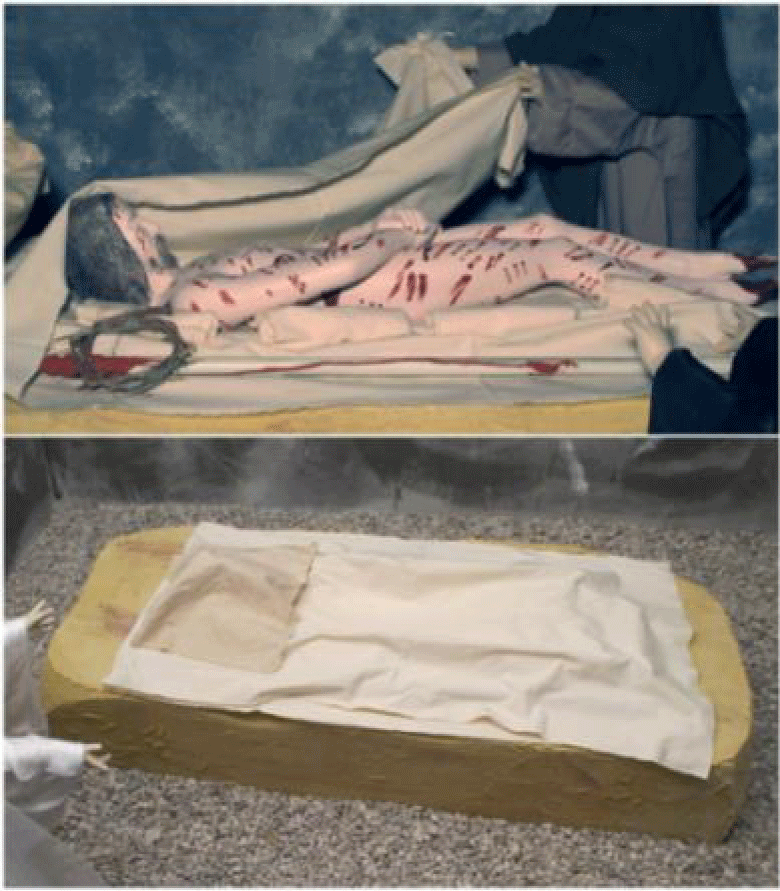
Jesus had previously tried to explain to the apostles that He would rise from the dead, but they did not understand (see Mark 9:31-32). Instead, it was the particular arrangement of the burial linens placed on the preparation stone that induced John to believe in the Resurrection. The next point confirms this.
2. John (20:6-7) reports that “[They] … went straight into the tomb. He saw … the cloth that had been wrapped around Jesus’ head. The cloth was still lying in its place, separate from the linen.”
John's observation focuses on the arrangement of the sudarium, which, although not clearly described due to its extreme synthesis, suggests that it appeared to be as it was left on Good Friday still wrapped around Jesus' dematerialized head while the TS was collapsed on the stone. The translation from the original Greek text comes to our aid, which states: “And the sudarium that was on his head was not with the linen cloths, but rolled up in one place”. [28]. The apostle dwells on this strange description of an object of secondary importance, the sudarium, to make us understand that Jesus had actually emerged from the burial linens, dematerializing Himself. In fact, the apostle emphasizes that the sudarium, probably stiffened by the aromatic substances such as aloe and myrrh, still remained wrapped around the disappeared head of Jesus Who had already dematerialized and had already caused the collapse of the TS.
3. The apostle Luke (24:30-31) relates that Jesus appeared first to two disciples from Emmaus, who ran to warn the apostles after His death.
4. On Easter Sunday and the following Sunday, Jesus appeared twice to the apostles in the closed-door cenacle - to prove that He was not a ghost, he dined with them.
From John (20:19) is read: “On the evening of that first day of the week, when the disciples were together, with the doors locked for fear of the Jewish leaders, Jesus came and stood among them and said, Peace be with you!”
From John (20:26) is read: “A week later his disciples were in the house again, and Thomas was with them. Though the doors were locked, Jesus came and stood among them and said, Peace be with you!”
Jesus' Exit from the sepulcher: Reports from the TS
The TS does not provide much evidence regarding Jesus' exit from the Sepulcher, but one can nevertheless find some indication of this fact.
First, as seen previously, the perfection of the bloodstain decals on the linen combined with the blood still in a liquid state suggests a dematerialization of the body during the exit from the TS.
The double body image then, which is not yet fully scientifically explainable but finds its best explanation if one thinks of the effects of the presence of an intense source of energy, even of the neutron type [29], refers to a possible concept of dematerialization that occurred during a phenomenon that is still scientifically inexplicable, but one can easily correlate to the Resurrection from the dead. As already seen, Jackson JP [27] had predicted all of this albeit with slightly different hypotheses.
A hypothesis out of science: transparency of the matter
From what has emerged above, one must here consider a hypothesis that goes beyond science, namely that the material Body of Christ passed through the TS in a "transparent" way and, according to the CHB, subsequently also passed through the walls of the cenacle.
To try to explain the phenomenon of transparency with respect to matter, one can think of an analogy between the very small and the very large, that is, between the model of atomic orbitals and the planetary model of our solar system.
To get an idea of the quantities involved, one must remember that the diameter of our solar system model is 150 billion meters, while the ratio between the diameter of the sun and this diameter is about 1 to 100. The diameter of the atomic orbital model is about 0.1 billionths of a meter, while the ratio between the diameter of the atomic nucleus and this diameter is about 1 to 10,000. This means that the practically empty space (if the electrons are excluded) between an atom is about 100 times larger than the practically empty space (if the planets are excluded) of the solar system.
One can now suppose that in an atom the protons and neutrons of the extremely small nucleus are similar to the sun; the electrons are similar to the planets, which rotate in gigantic orbits with respect to that of the nucleus.
Let's consider, for example, a finger resting on the surface of a table. Both are made of atoms, but the finger cannot penetrate the table because the forces that bind the nuclei to the electrons of our finger and the table are much greater than the pressure exerted by the finger on the table itself.
Similarly, if a solar system tried to pass through another one, the forces of attraction between the sun and the planet would produce substantial changes to the two solar systems. In both cases, the solar and the atomic one, we have examples of systems that are practically empty but interconnected by forces that prevent them from crossing with similar systems.
Now suppose, in the atomic orbital model, suppling the atoms of the finger with extremely intense energy in the form of photons and therefore light. This supplied energy could increase the kinetic energy of the individual particles to the point that their kinetic forces exceed those of the interatomic forces. In this particular case, one can think that the atoms can pass through each other, and one could also verify the interpenetration of the different materials such as, for example, the finger with the wood of the table. The same thing could be thought of for the solar system.
The impact probability among protons, neutrons, and electrons (or sun and planets), and therefore their probable destruction, during the crossing would be very, very small given their extremely small volumes compared to the volumes of the entire atom (or solar system) in question.
Therefore, in these highly energetic conditions, the interpenetration of matter would not be impossible if perhaps an extremely high light energy were supplied to the system in question.
It can therefore be thought that a physical body is not deprived of its material reality even when it reaches this particularly energetic state, but rather that this body becomes transparent with respect to the surrounding matter and that it can consequently penetrate it as long as it is rich in energy, but that it can then return to its initial state if this light energy fades over time.
Conclusive Remarks
Having found full compatibility between what can be scientifically detected from a detailed analysis of the TS and what is reported in the CHB, obviously having recognized Jesus Christ as the tortured and dead man on the cross and visible in the double body image on the TS, an attempt was made to highlight the various events that followed death by heart attack followed by hemopericardium.
In particular, the description was divided into the following 5 phases:
- rigor mortis of the body of Jesus,
- transport to the sepulcher and wrapping in the TS,
- deposition in the sepulcher and subsequent absence of movements,
- absence of putrefaction signs and
- Jesus' exit from the TS.
These points proved to be the most critical because, based on recent studies and also confirmed by previous analyses, they were unable to provide a scientifically plausible answer to the evidence found on the TS.
In fact, the rigor mortis coupled with the lack of signs of putrefaction on the double body image has demonstrated that the human body was wrapped in the TS for less than about forty hours. At the same time, however, the perfection of the bloodstain decals on the linen fabric of the TS, relative to blood still in a liquid state, has highlighted the absence of relative movement between the human body and the wrapping sheet.
Consequently, current science, in addition to not being able to explain how the double body image visible on the TS was formed, is not even able to explain how that human body came out of the TS without disturbing it in the slightest and without leaving the minimal smearing in the bloodstains.
Therefore, the comments section, also based on the information reported on the CHB, has attempted to explain the unexplainable phenomena in question by providing a hypothesis that is obviously, for the moment, still outside of science.
This hypothesis considers the possible transparency of matter when it is supplied with a very large amount of light energy, also frequently reported in the CHB, and interprets it in light of an analogy between our solar system and the atomic orbital model.
At this point, however, once the hypothesis of the possible transparency of matter has been accepted, one can also think of extending it to other scientifically inexplicable cases. For example, as Jesus came out of the TS without disturbing it, so very similarly He came out of the womb of his Mother, Mary, thus explaining the Marian Dogma of the "Virgin before, during and after the birth" [30].
Ethical Statements
The author, of the Christian Catholic religion, was able to significantly strengthen his faith after having carried out scientific studies on the TS. During these studies, also carried out in collaboration with scholars opposed to authenticity, the author has always favored maximum objectivity which has always confirmed what was suggested to him by faith.
Acknowledgement
Many thanks to Carol Gregorek of Shroud Science Group who furnished useful advice and improved the English language.
References
- Fanti G, Ascolese M. Turin shroud: Etiology of Jesus Christ’s death for infarction followed by hemopericardium. Int Clinc Med Case Rep Jour. 2024;3(9):1-12. doi: 10.5281/zenodo.13812478.
- Jackson J. The shroud: A critical summary of data, observations and hypotheses, turin shroud center of colorado, USA; 2017.
- Fanti G. Open issues regarding the turin shroud. Scientific Research and Essays. 2012;7(29):2504-2512. doi: 10.5897/SRE12.382.
- Fanti G. Hypotheses regarding the formation of the body image on the Turin Shroud. A critical compendium. J. of Imaging Sci. 2011;55(6):1-14. doi: 10.2352/J.ImagingSci.Technol.2011.55.6.060507.
- Fanti G. Byzantine coins influenced by the shroud of christ. Jenny Stanford Publishing Pte Ltd. Singapore; 2022.
- Damon P, Donahue DJ, Gore BH, Hatheway AL, Jull AJT, Linick TW, Sercel PJ, Toolin LJ, Bronk CR, Hall ET, Hedges REM, Housley R, Law IA, Perry C, Bonani G, Trumbore S, Woelfli W, Ambers JC, Bowman SGE, Leese MN, Tite MS. Radiocarbon dating of the shroud of turin. Nature. 1989;337:611-615. doi: 10.1038/337611a0.
- Rogers RN. Studies on the radiocarbon sample from the shroud of turin. Thermochimica Acta. 2005;425:189-194. doi: 10.1016/j.tca.2004.09.029.
- Thomas McAvoy. On radiocarbon dating of the shroud of turin. Int J of Archaeology. 2021;9(2):34-44. doi: 10.11648/j.ija.20210902.11.
- Schwalbe L, Walsh B. On cleaning methods and the raw radiocarbon data from the shroud of turin. Int J of Archaeology. 2021;9(1):10-16. doi: 10.11648/j.ija.20210901.12.
- Riani M, Atkinson A C, Fanti G, Crosilla F. Regression analysis with partially labelled regressors: carbon dating of the shroud of turin. J of Statistical Computing. 2013;23(4).doi:10.1007/s11222-012-9329-5.
- Phillips TJ. Shroud irradiated with neutrons? Nature. 1989;337. doi: 10.1038/337594a0.
- Fanti G. Could an anomaly in turin shroud blood reopen the 1988-radiocarbon-dating result? World Scientific News. 2021;162:102-119.
- Fanti G. New insights on blood evidence from the turin shroud consistent with jesus christ’s tortures. Arch Hematol Case Rep Rev. 2024;9(1):001-015. doi: 10.17352/ahcrr.000044.
- Heller J H, Adler A D. Blood on the shroud of turin. Applied Optics. 1980;19(16):2742-2744. doi: 10.1364/AO.19.002742.
- Heller JH, Adler AD. A chemical investigation of the shroud of turin. Canadian Society of Forensic Sciences Journal. 1981;14(3):81-103. doi: 10.1080/00085030.1981.10756882.
- Baima Bollone PL. Indagini identificative su fili della sindone. Giornale della Accademia di Medicina di Torino, nº. 1982;1-12:228-239.
- Fanti G. The last hour of Jesus Christ: A case study from recent new insights on the turin shroud. Medi Clin Case Rep J. 2024;2(3):420-422. doi: 10.51219/MCCRJ/Giulio-Fanti/115.
- Fanti G, Basso R, Bianchini G, Turin shroud: Compatibility between a digitized body image and a computerized anthropomorphous manikin. J of Imaging Sci Technol. 2010;54(5);050503-1/8. doi: 10.2352/J.ImagingSci.Technol.2010.54.5.050503.
- Bevilacqua M, Concheri G, Concheri S, Fanti G, Rodella S. Rigor mortis and news obtained by the body’s scientific reconstruction of the turin shroud man. Peertechz J Forensic Sci Technol 2018;4(1):001-008. doi: 10.17352/pjfst.000010.
- Theodora AP. Indicia of reliability: Evidence of rigor mortis and cadaveric spasm from the body image on the shroud of turin. Michael Kowalski, editor. British Society for the Turin Shroud Newsletter; 2024:99.
- Sugatha M, Venkata R. Assessment of time since death using forensic autopsies based on the presence of rigor mortis– a cross-sectional study. Int J Contemporary Medical Research. doi: 10.21276/ijcmr.2019.6.4.52.
- Bevilacqua M, Fanti G, D’Arienzo M New Light on the sufferings and the burial of the turin shroud man. Open J Trauma 2017;1(2):047-053. doi: 10.17352/ojt.000010
- Stevenson KE, Habermas GR. Verdict on the Shroud, Robert Hale Ltd. 1982.
- Fanti G. A Reexamination of the Pigment-Reinforcement Hypothesis of the Turin Shroud’s Bloodstains. World Scientific News. 2022.
- Glindemann D, Stottmeister U, Bergmann A. Free phosphine from the anaerobic biosphere. Environ Sci & Pollut Res. 1996;3:17-19. doi: 10.1007/BF02986806.
- Abdulaziz MA, Ritesh GM. Evaluation of post-mortem changes, national library of medicine. 2023.
- Jackson JP. Is the image on the Shroud due to a process heretofore unknown to modern science?. Shroud Spectrum International No. 1990;34:3-29.
- Stalley L. Divine Testimony -hidden references to the holy shroud in the bible. Jenny Stanford Pub. 2025.
- Fanti Giulio. Holy fire and body image of the holy shroud: Divine Photography Hypothesis. 2023.
- Catechism Of The Catholic Church - Latin text copyright. Libreria Editrice Vaticana. 1993.




Content Alerts
SignUp to our
Content alerts.
 This work is licensed under a Creative Commons Attribution 4.0 International License.
