
General Science Group 2024 October 15;5(10):1306-1312. doi: 10.37871/jbres2018.





 Research Article
An Overview of Long-Distance Optical Fiber Communication
Ramiz Salama1* and Fadi Al-Turjman2,3
2Artificial Intelligence, Software, and Information Systems Engineering Departments, AI and Robotics Institute, Near East University, Nicosia, Mersin10, Turkey
3Research Center for AI and IoT, Faculty of Engineering, University of Kyrenia, Kyrenia, Mersin10, Turkey
- Optical fiber
- Communication
- Light wave
- Multiplexing
- Wavelength
- Data rate
- Frequency
Abstract
Long-distance optical fiber communication is a crucial technology enabling high-speed data transmission over vast distances. Utilizing light waves to transmit information, this technology offers significant advantages, including high bandwidth, low attenuation, and minimal interference compared to traditional copper-based communication systems. Optical fibers can transmit data over thousands of kilometers with the help of signal amplification through repeaters and advanced modulation techniques. Innovations such as Wavelength-Division Multiplexing (WDM) allow multiple data channels to travel simultaneously over a single fiber, significantly increasing the data capacity. This paper discusses the fundamental principles of optical fiber communication, key technologies such as lasers, optical amplifiers, and photodetectors, and recent advancements in improving efficiency, speed, and distance. The challenges associated with long-distance optical communication, including signal degradation, dispersion, and noise, are also explored, along with emerging solutions to address these issues.
Introduction
The history of fiber optic communication dates back to the mid-19th century, when the British scientist John Tyndall demonstrated that light could be transmitted through a curved stream of water. However, it wasn't until the 1950s that the first practical application of fiber optic communication was developed. In the 1950s, researchers at Bell Labs developed a method for transmitting light through thin strands of glass, which they called "optical fibers." These fibers were able to transmit signals over long distances with minimal signal loss, making them a promising alter-native to traditional copper wires for telecommunications. In the 1970s, researchers began to develop ways to manufacture optical fibers on a large scale, and by the 1980s, fiber optic cables had become the standard for long-distance telecommunica-tions. In the 1990s, the development of high-speed internet and the proliferation of the World Wide Web led to a significant increase in the use of fiber optic communica-tion [1-5].Today, fiber optic cables are used in a wide range of applications, including tele-communications, cable television, and internet connectivity. They are also used in medical imaging, military communication, and industrial automation, among other fields. The use of fiber optic communication is expected to continue to grow in the coming years as demand for high-speed and reliable communication increases.Machine learning and AI facilitators started to be part of our daily life and has signif-icant effects towards the rapid developments of the internet of things. One of the leading attempts in this field is the AI learning facilitator, Prof. DUX [6]. It is a novel AI facilitator that aims at personalizing the education process for learners and pro-vide the fastest and best quality of education in numerous fields (Figure 1).
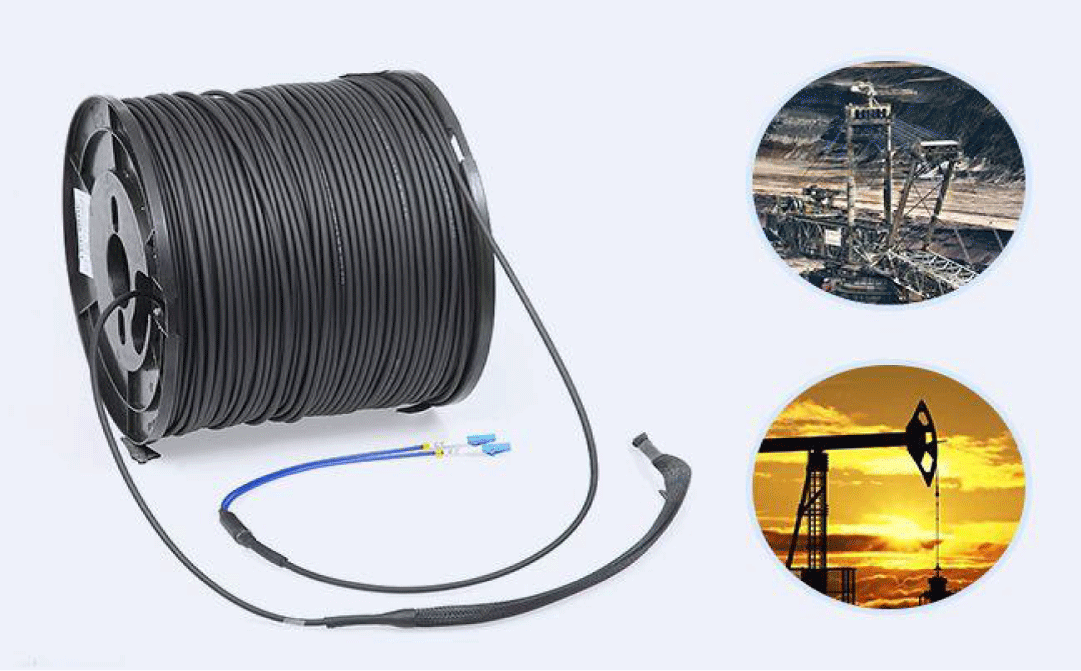
Ease of use extent of past work
The use of optic fiber isn’t limited to communication only. It has proven to be very advantageous to other fields such as the medical industry. Optical fibers are used in a variety of medical applications, including [6-13];
- Medical imaging: Optical fibers are used in medical imaging techniques, such as endoscopy and laparoscopy, which allow doctors to visualize the inside of the body using a fiber optic camera.
- Surgical instruments: Optical fibers are used in the design of surgical instruments, such as scalpels and forceps, to provide illumination during procedures.
- Phototherapy: Optical fibers are used in phototherapy, a treatment that involves exposing the skin to specific wavelengths of light to improve certain skin conditions, such as acne and psoriasis.
- Dental care: Optical fibers are used in dental care to provide illumination and to cure dental resins used in fillings and crowns.
- Rehabilitation: Optical fibers are used in rehabilitation devices, such as exoskeletons and prosthetics, to provide sensory feedback and improve mobility.
Overall, the use of optical fibers in the medical industry has greatly improved diagnostic and treatment capabilities, and has led to the development of innovative medical devices and techniques.
Communications across long distance via optical fiber
The main material used in optical fiber communication is glass or plastic. These materials are used to create thin strands of fiber that are capable of transmitting light signals over long distances [14-18]. The structure of an optical fiber is shown in the figure 2.
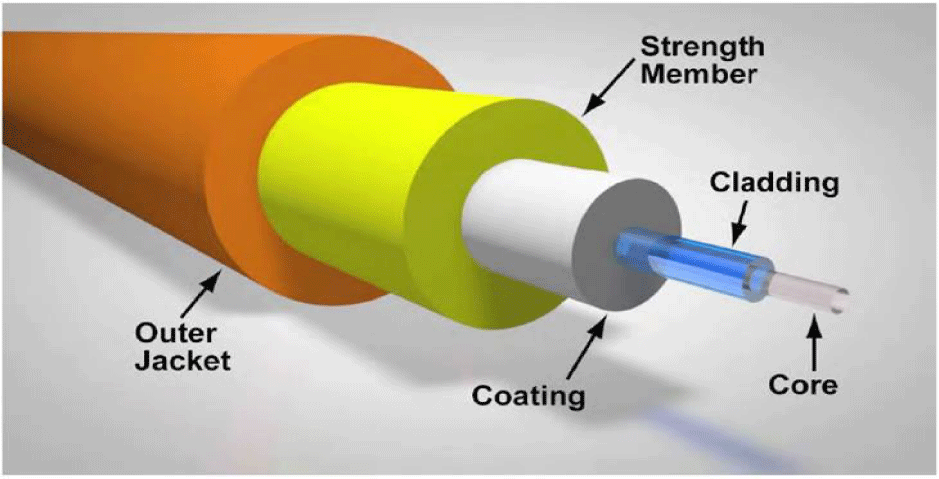
Optical fibers can be classified by the number of modes. There are two main types in that classification: single-mode fibers and multi-mode fibers.
- Single-mode fibers are made of pure glass or plastic and are capable of trans-mitting a single mode of light. They are used for long-distance communication and have a small diameter, typically between 8 and 10 micrometers.
- Multi-mode fibers are made of glass or plastic with a higher refractive index and are capable of transmitting multiple modes of light. They have a larger diameter, typically between 50 and 100 micrometers, and are used for shorter-distance communication.
The material used can classify the types of optic fiber used in communication: glass fiber or plastic fiber. The main difference between glass and plastic fibers in optical fiber communication is the material used to create the fiber. Glass fibers are made of silica, a type of glass, while plastic fibers are made of polymers, such as polyethylene or polycarbonate.
There are a few key differences between glass and plastic fibers in terms of their properties and applications;
- Refractive index: The refractive index of a material is a measure of how much it bends light. Glass fibers have a lower refractive index than plastic fibers, which means they are less efficient at bending light. This makes them more suitable for transmitting single modes of light over long distances with minimal dispersion. Plastic fibers, on the other hand, have a higher refractive index, which makes them more efficient at bending light. This makes them more suitable for transmitting multiple modes of light over shorter distances.
- Diameter: Glass fibers typically have a smaller diameter than plastic fibers, which makes them more flexible and easier to install in tight spaces. Plastic fibers, on the other hand, typically have a larger diameter, which makes them more rigid and less flexible.
- Transmission loss: Glass fibers typically have lower transmission loss than plastic fibers, which means they are able to transmit signals over longer distances with less signal degradation.
- Cost: Glass fibers are typically more expensive than plastic fibers due to the cost of the raw materials and the manufacturing process.
In addition to the fiber itself, there are a number of other materials that are used in optical fiber communication systems, including:
- Optical amplifiers: These devices use rare earth elements to amplify the strength of a signal, allowing it to be transmitted over longer distances. There are several types of optical amplifiers, including Erbium-Doped Fiber Amplifiers (EDFAs), which are used in long-haul communication systems, and Semiconductor Optical Amplifiers (SOAs), which are used in short-haul communication systems.
- Modulators: These devices modulate the intensity or phase of a light wave to encode information onto it. There are several types of modulators, including intensity modulators, which vary the intensity of the light wave to encode information, and phase modulators, which vary the phase of the light wave to encode information.
- Couplers: These devices combine or split optical signals. There are several types of couplers, including fiber optic couplers, which are used to combine or split signals on a single fiber, and waveguide couplers, which are used to combine or split signals on multiple fibers.
- Splitters: These devices divide an incoming optical signal into two or more outputs. There are several types of splitters, including star splitters, which divide an incoming signal into multiple outputs, and tree splitters, which divide an incoming signal into a tree-like structure.
- Connectors: These devices allow two optical fibers to be mechanically joined together. There are several types of connectors, including single-fiber connectors, which are used to connect a single fiber to a device, and multi-fiber connectors, which are used to connect multiple fibers to a device.
Installation
Optical fiber cables are installed by first determining the route that the cable will take, after the cable has been installed, it is tested to ensure that it is functioning properly (Figure 3).
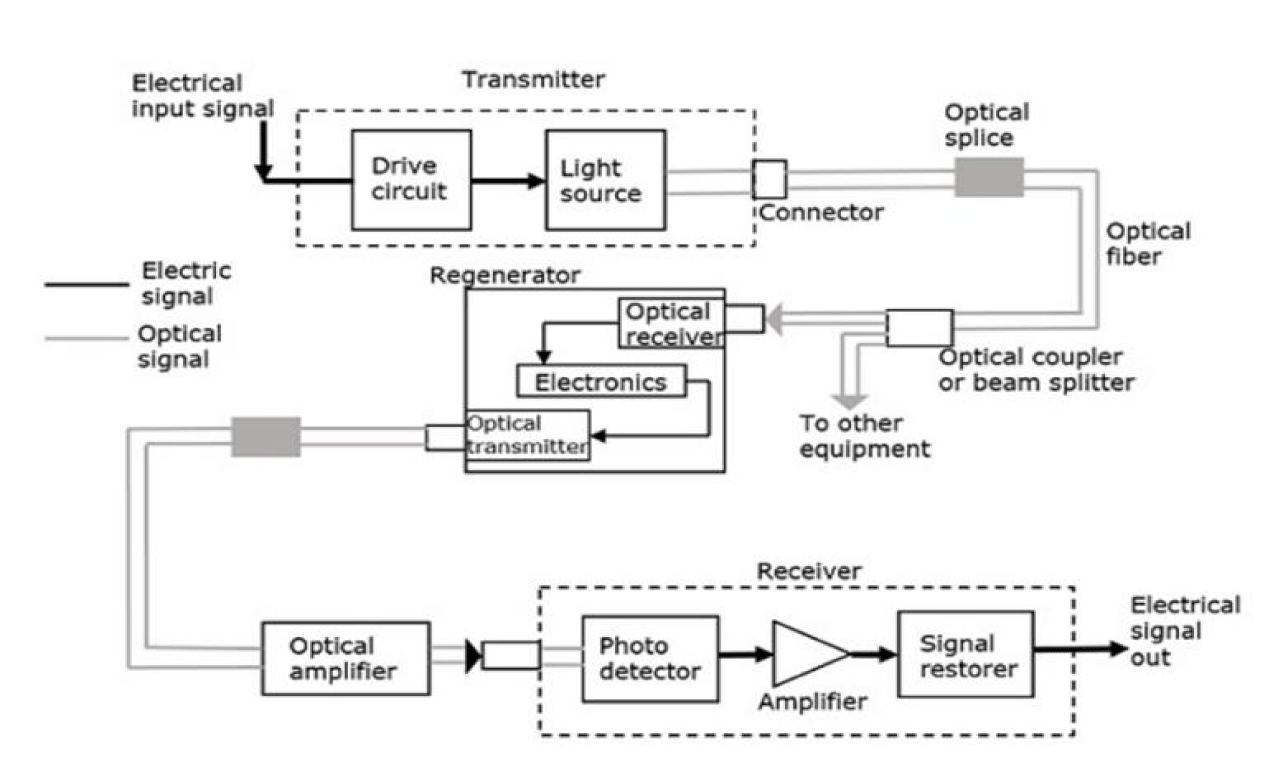
Generally, the installation follows this set of steps:
- Planning and route selection: Before the installation can begin, the route that the cable will take must be planned and chosen. This may involve determining the best path for the cable to follow based on factors such as geography, terrain, and the locations of other infrastructure.
- Prepping the cable: Once the route has been determined, the cable is prepared for installation. This may involve stripping the protective coating from the fiber strands and splicing the fibers, together if multiple cables are needed.
- Underground installation: If the cable is being installed underground, a trench must be dug along the planned route. The cable is then placed in the trench and covered with dirt or a protective conduit.
- Aerial installation: If the cable is being installed above ground, it must be attached to poles using special brackets. The cable is then strung between the poles and secured in place.
- Testing: After the cable has been installed, it is tested to ensure that it is functioning properly. This may involve sending a light signal through the fiber and measuring the signal strength at various points along the cable.
- Connection: Finally, the cable is connected to the necessary equipment, such as repeaters or switches, to complete the installation process. This allows the fiber optic cable to be used for transmitting data and other information.
Overall, the process of installing optical fiber cables requires careful planning, attention to detail to ensure that the cable is properly installed, and functioning correctly. The optic fiber cables installed may be used differently depending on the industry where it is installed. As seen previously, optic fiber communication is used in a wide range of fields. Here are some explanations on how it is used in each field.
- Telecommunications: In the telecommunications industry, optical fiber cables are used to transmit voice, data, and video signals over long distances. These cables are often used to connect telephone exchanges, cell phone towers, and other communication infrastructure. For example, an optical fiber cable may be used to transmit a phone call from one city to another, or to connect a cell phone tower to a central office.
- Internet service providers: Optical fiber cables are used by Internet Service Providers (ISPs) to provide high-speed internet access to homes and businesses. These cables are often used to connect central offices to neighborhood hubs, and can transmit data at much faster speeds than traditional copper cables. For example, an optical fiber cable may be used to connect a central office to a neighborhood hub, which in turn provides internet access to homes and businesses in that area.
- Cable television: Optical fiber cables are also used in the cable television industry to transmit television signals and other video content. These cables are typically used to connect cable head ends to distribution hubs, and can transmit multiple channels of high-definition video simultaneously. For example, an optical fiber cable may be used to transmit a television program from a cable headend to a distribution hub, which in turn sends the signal to individual homes via coaxial cables.
- Medical: Optical fibers are used in the medical field for a variety of purposes, such as illuminating body cavities during surgery and transmitting medical images. For example, an optical fiber may be used to transmit light into a body cavity during surgery, or to transmit an image from an endoscope to a monitor.
- Military: Optical fiber cables are used by the military for secure communication and data transmission, as they are resistant to interference and difficult to tap. For example, an optical fiber cable may be used to transmit sensitive information between military bases or to connect military equipment on the battlefield.
There are a number of challenges that can be encountered when using optical fiber cables in different industries. Some specific examples of these challenges include:
- Telecommunications: One challenge faced by the telecommunications industry is the cost of installing and maintaining optical fiber cables. These cables are more expensive to install than traditional copper cables, and can be difficult to repair if damaged. Additionally, telecommunications companies must continually upgrade their networks to keep up with demand for higher speeds and more data.
- Internet service providers: Internet Service Providers (ISPs) also face the challenge of maintaining and upgrading their networks to keep up with demand for higher speeds and more data. They must also deal with issues such as interference and signal degradation over long distances, as well as the cost of installing and maintaining optical fiber cables.
- Cable television: The cable television industry faces similar challenges in maintaining and upgrading their networks to keep up with demand for higher-quality video and more channels. They must also deal with issues such as signal degradation over long distances and the cost of installing and maintaining optical fiber cables.
- Medical: In the medical field, one challenge faced when using optical fibers is the cost of the equipment and materials needed. Optical fibers and related equipment can be expensive, and replacing damaged fibers or equipment can be costly. Additionally, there are strict regulations and guidelines that must be followed when using optical fibers in medical applications.
- Military: The military faces challenges such as maintaining secure communication and data transmission over long distances, as well as the cost of installing and maintaining optical fiber cables. Additionally, military equipment and infrastructure may be deployed in harsh or remote locations, which can make installation and maintenance more difficult.
Overall, the challenges faced when using optical fiber cables in different industries can vary depending on the specific application and industry. However, the high cost and difficulty of installing and maintaining these cables is a common challenge faced by many industries.
Results and Discussion
There are several advantages of using optical fiber communication, including:
- High data transmission rate: Optical fibers have a high data transmission rate, allowing for the transmission of large amounts of data in a short period of time.
- Immunity to electromagnetic interference: Optical fibers are immune to electromagnetic interference, making them a suitable choice for transmitting sensitive data.
- Low signal loss: Optical fibers have low signal loss, allowing for the trans-mission of signals over long distances with minimal degradation.
- Small size: Optical fibers are thin and flexible, making them easy to install and route through tight spaces.
- Lightweight: Optical fibers are lightweight, making them easy to transport and handle.
- Durability: Optical fibers are resistant to physical damage and can last for many years.
- Versatility: Optical fibers can be used in a variety of applications, including telecommunications, cable television, and internet connectivity. They are al-so used in medical imaging, military communication, and industrial automation, among other fields.
- Energy efficiency: Optical fibers require less power to transmit signals com-pared to traditional copper wire communication systems.
- Cost: In the long term, optical fiber communication systems can be more cost-effective than traditional copper wire systems due to their low maintenance and replacement costs.
- Security: Optical fibers are difficult to tap or intercept, making them a secure option for transmitting sensitive data.
- Ease of installation: Optical fibers are easy to install and route through tight spaces, making them a suitable choice for challenging environments.
- High capacity: Optical fibers have a high capacity for transmitting data, al-lowing for the simultaneous transmission of multiple signals.
- Long lifespan: Optical fibers have a long lifespan and are resistant to physical damage, making them a reliable choice for long-term use.
- Ability to transmit over long distances: Optical fibers are capable of trans-mitting signals over long distances with minimal signal loss, making them a suitable choice for transmitting data over long distances.
- Environmental benefits: Optical fibers do not emit electromagnetic radiation, making them a safer and more environmentally friendly option for communication.
Overall, the use of optical fibers for communication offers a number of ad-vantages over traditional copper wire systems, including cost-effectiveness, security, ease of installation, high capacity, long lifespan, high data transmission rates, immunity to interference, low signal loss, durability, and the ability to transmit over long distances.
Nevertheless, optic fiber communication has some inconveniences or challenges associated with it. Here are some examples of it:
- Initial cost: The initial cost of installing an optical fiber communication system can be high, as it requires specialized equipment and trained personnel.
- Fragility: Optical fibers are thin and fragile, and can be damaged if they are bent or twisted too sharply.
- Splicing: If an optical fiber needs to be repaired or a connection needs to be made, it must be spliced, which requires specialized equipment and trained personnel.
- Limited flexibility: Optical fibers are not as flexible as traditional copper wire systems, and cannot be easily bent or shaped.
- Limited availability: Optical fibers are not as widely available as traditional copper wire systems, and may not be a feasible option in some areas.
- Maintenance: Optical fiber communication systems require regular maintenance to ensure they are functioning properly. This can be time-consuming and may require specialized equipment and trained personnel.
- Distance limitations: While optical fibers are capable of transmitting signals over long distances, they can be affected by dispersion, which can limit the distance over which a signal can be transmitted.
- Signal degradation: Optical fibers can experience signal degradation over time due to factors such as temperature fluctuations, humidity, and physical damage.
- Compatibility issues: Optical fiber communication systems may not be compatible with older equipment or devices that are not equipped to handle optical signals.
- Limited options for connector types: There are fewer options for connector types in optical fiber communication systems compared to traditional copper wire systems.
Conclusion
Long-distance optical fiber communication has revolutionized the way data is transmitted across the globe, providing a robust and efficient solution for high-speed communication over vast distances. The use of light signals enables minimal signal loss, high bandwidth, and low interference, making optical fibers the backbone of modern telecommunications networks. Advancements in technologies such as wavelength-division multiplexing (WDM), optical amplifiers, and advanced modulation techniques have significantly enhanced the capacity and reach of these systems, allowing for the simultaneous transmission of massive amounts of data. Despite its advantages, challenges such as signal degradation, dispersion, and nonlinear effects still need to be addressed to further improve performance and reliability. Ongoing research focuses on developing new materials, enhancing signal processing, and leveraging artificial intelligence to optimize network management. With continuous innovation, long-distance optical fiber communication is set to meet the growing demands for faster and more reliable data transmission, supporting the future of global connectivity and the expansion of emerging technologies like 5G, IoT, and cloud computing.
References
- Altuna R, Jung Y, Petropoulos P, Vázquez C. Power over fiber and analog radio over fiber simultaneous transmission over long distance in single mode, multicore, and hollow core fibers. Laser & Photonics Reviews. 2024;18(8):2400157. doi: 10.1002/lpor.202400157.
- Patle N, Raj AB, Joseph C, Sharma N. Review of fibreless optical communication technology: History, evolution, and emerging trends. Journal of Optical Communications. 2024;45(3):679-702. doi: 10.1515/joc-2021-0190.
- Wu Z, Wu Z, Sun A. Long distance distributed optical fiber vibration sensing and positioning technology based on loop transmission polarization detection. Measurement.2024;25:114029. doi: 10.1016/j.measurement.2023.114029.
- Makwana M, Khant S, Patel A. Advancements in long-distance pon connectivity using WDM and EDFA. In 2024 11th International Conference on Reliability. Infocom Technologies and Optimization (Trends and Future Directions) (ICRITO). IEEE. 2024;1-6.
- Rao X, Dai S, Chen M, Zhu R, Lu D, Chen GY, Wang Y. Multi-point vibration positioning method for long-distance forward transmission distributed vibration sensing. Optics Express. 2024;32(17):30775-30786. doi: 10.1364/OE.530885.
- Sahoo PK, Yadav AK. A comprehensive road map of modern communication through free-space optics. Journal of optical communications. 2024;44(s1):s1497-s1513. doi: 10.1515/joc-2020-0238.
- Matsui T, Sagae Y, Yamada Y, Nakajima K, Matsuo Y, Inoue T, Inada Y. High figure–of–merit multi–core fiber with standard cladding diameter for long–haul and wide–band transmission. Journal of Lightwave Technology. 2024. doi: 10.1109/JLT.2024.3352596.
- Sakthivel S, Mansoor Alam M, Abu Bakar Sajak A, Mohd Su'ud M, Riyaz Belgaum M. Review of Compensation and Dispersion Techniques for Fiber Optic Lightpath Networks. International Journal of Computing and Digital Systems. 2024;16(1). 10.12785/ijcds/160155.
- Liu J, Cai C, Wang S, Wang J. Rayleigh length extension in long-distance free-space optical communications based on lens group optimization. Opt Express. 2024 May 6;32(10):16891-16900. doi: 10.1364/OE.519522. PMID: 38858885.
- Yu S, Zhao W, Wang X, Zhang S. Long-distance and high-precision fiber microwave frequency transmission. In Advanced Fiber Laser Conference (AFL2023). SPIE. 2024;13104:443-447. doi: 10.1117/12.3022651.
- Agrell E, Karlsson M, Poletti F, Namiki S, Chen XV, Rusch LA, Uysal M. Roadmap on optical communications. Journal of Optics. 2024;26(9):093001. doi: 10.1088/2040-8986/ad261f.
- Long Z, Wakamatsu H, Iwata Y. Remote shape prediction of submarine cables using fiber-optic distributed sensors. In 2024 IEEE/SICE International Symposium on System Integration (SII). IEEE. 2024;333-338. doi: 10.1109/SII58957.2024.10417289.
- Matsuura M. High-power optical fiber transmission technologies for radio-over-fiber networks. IEICE Transactions on Communications. 2024. doi: 10.23919/transcom.2024CEI0001.
- Yu Z, Zhong T, Li H, Li H, Man Woo C, Cheng S, Lai P. Long distance all-optical logic operations through a single multimode fiber empowered by wavefront shaping. Photonics Research. 2024;12(3):587-597. doi: 10.1364/PRJ.499523.
- Soumitra RD, Zacharias J. Enhancing long-haul radio over fiber systems through chromatic dispersion mitigation using cascaded IDCF and apodized fiber bragg grating. Optical and Quantum Electronics. 2024;56(2):157. doi: 10.1007/s11082-023-05773-x.
- Jain V, Bhatia R. Review on nonlinearity effect in radio over fiber system and its mitigation. Journal of Optical Communications. 2024;44(s1):s1661-s1669. doi: 10.1515/joc-2021-0044.
- Rao X, Wang Y, Chen M, Liu K, Chen GY, Wang Y. 150 km single-span distributed vibration sensor based on compensated self-interference forward transmission. Journal of Lightwave Technology. 2024. doi: 10.1109/JLT.2024.3397782.
- Liu F, Huang Z, Gu T. Advanced Various Fault Detection Scheme for Long-Reach Mode Division Multiplexing Transmission. In Photonics. MDPI. 2024;11(6):523. doi: 10.3390/photonics11060523.





Content Alerts
SignUp to our
Content alerts.
 This work is licensed under a Creative Commons Attribution 4.0 International License.
