
General Group. 2024 August 12;5(8):969-976. doi: 10.37871/jbres1975.





 Review Article
How to Teach our story: A BANdaid for Politics in Schools
Chateé Omísadé Richardson*
Summary
“History is a clock that people use to tell their political and cultural time of day. It is a compass they use to find themselves on the map of human geography. It tells them where they are but, more importantly, what they must be.”
-John Henrik Clarke
Introduction
If John Henrik Clarke’s quote is taken as fact, or simply considered in depth and implication, what happens to a people when they are not recorded on the clock? What happens to their cultural record or sense of identity? How do they know who they are or how to function in the present? Where do they turn for identity, knowledge, and guidance? What does this mean for their ability to persist and move into the future?
The Akan people of Ghana have a concept called Sankofa which literally translates into English as “return and fetch it.” It is represented by an Adinkra symbol of a beautiful bird whose body is facing west with its head facing back towards the east with an egg in its mouth. The Akan proverb connected to the symbol states “se wo were fi na wosan kofa a yenkyiri,” in the (Put the Figure here Sir)

Twi language, or in English, it is not taboo to go bacak and get what you have forgotten [1]. The cultural meaning and significance of this symbol and concept is that we have to know where we come from in order to know where we are going. If we do not know, study with a critical eye, analyze, and understand the past at a deep level, we will repeat it either presently or in the future. History and how we transmit it are important. Growth and change flow from learning from historical mistakes so we can choose differently to garner a different result and move humanity forward. Knowledge of the past determines the development of the future [2].
The people of Mali have a similar reverence and understanding of history. They have taken measures to ensure that knowledge of the past is never altered or lost as griots have always been employed as the memory of the people and vessels of truth. Griots are not simply storytellers; they are the purveyors of truth and the keepers/transmitters of accurate historical records. They pass down the exact same information, the same words they received, through generations from griot to griot to ensure that knowledge is accurately transferred and can serve as an example of what to do and what not to repeat [3]. The point here in these two examples provide a full reverence for and rendering of the past that does not alter it to create a certain mind frame, narrative, or view. Truth is the foundation for understanding the human condition and future development.
History in the West has unfortunately been treated much differently. Education in the United States in general has been a focus of inquiry, scrutiny, research, and debate for over a century. It represents a place within, and an engagement with, the dominant society as humans engage a struggle for both meaning and power in the identification of societal place or hierarchy. This has become the determination of how and where people fit due to the cultural and psychological impact of the transmission of the origin of knowledge. As such, education is both a microcosm and producer of the structure, the promise, and the ills of larger society [2,4,5].
The mainstage for cultural transmission within schools is history class as it provides a blueprint for who people have been and gives them an idea of who they can become. The problem here is that history in this space has historically been taught from one perspective. A perspective that teaches a particularly basic narrative of triumphalism and benevolence with decisions being made for the good of the people without a critical examination of the consequences of those decisions. Education in the U.S. has been monoculturally focused in a European perspective erasing much of the accurate historical record [5-7].
Historical Background
The education system since its inception in the 17th century has been structured for White children as it was first created to teach Judeo Christian tenets, then later adapted into a grammar school system. This was during a time when Black children were not allowed to learn, and Indigenous children were being sent to boarding schools with the purpose of “civilizing” and “Europeanizing” them as opposed to educating them [8]. Children of color were added to the system centuries later with the passing of the Brown vs. the Board of Education (1954) decision and only after significant social unrest. This decision allowed them to share classroom space with White children, but they were never fully integrated into the system as the teaching force remained the same and their perspectives were never included in the curriculum [5].
Legal integration set the stage for how history has been taught over the past 69 years [5,9]. This is where discrimination and erasure became formally ingrained in the educative process. Even outside of the classroom, children of color began to be tracked towards special education and remedial courses. These children have experienced disproportionate disciplinary practices and have been unfairly placed into the juvenile justice system because of who they are. They have been labeled as deficient and inherently problematic. These labels follow them out into society and lead to further marginalization.
Since this time period, all children in the United States education system have pointedly been taught from a White centered lens as it pertains to major modes of thought [5]. The transmission of history has provided a portrait of White philosophers, theoreticians, inventors, artists, explorers, etc. making all of the major contributions that have helped humanity to evolve and thrive. It is taught that major civilizations were European. It is taught that all major complex thought derived from Europeans. It is taught that the history of Black Americans begins with enslavement with no previous connections provided. It is taught that Europeans civilized Indigenous, Latinx, Asian, and African peoples and spaces around the world.
This has caused a lot of harm beginning with students of color feeling marginalized and ignored in curriculum and disconnected from history and society [5]. For instance, being taught that one’s only contribution was through enslavement not only sets the stage for disenfranchisement, it also hinders healthy identity development. The damage is to both personal identity development for Black people, and the idea that others hold about the identity and ability of Black people. These ideas are firmly implanted in K-12 education and permeate society as children grow and go out into the world and continue to hold these views. This is how structures of inequity are perpetuated and upheld.
There is no surprise that many scholars of color are calling for a more balanced and equitable history curriculum that includes perspectives that have been excluded. The thought is that this will serve to begin shifting how children of color are seen and treated by others, and how they see themselves. Miles J [6] discusses the unique positionality and crucial role educators have in helping students and the public come to terms with the harm committed in the past and the way it shapes our present functioning in various sectors. It is argued that teachers have a responsibility to provide voice to all who have been silenced through traditional history lessons by presenting OURstory.
In response there has been a push to ban a plethora of books, authors, and the teaching of certain aspects of history that would present a different perspective. PEN America (2024) has a list of 363 state sanctioned “Educational Gag Orders” that it has been tracking since 2021 [10]. A recent American Bar Association (2024) report noted the following regarding this trend:
The freedom to read is under assault in the United States-particularly in public schools-curtailing students’ freedom to explore words, ideas, and books, as well as to engage in a full and accurate civics education in the classroom. In the 2022–23 school year, from July 1, 2022, to June 30, 2023, PEN America recorded 3,362 instances of book bans in US public school classrooms and libraries. These bans removed student access to 1,557 unique book titles, the works of over 1,480 authors, illustrators, and translators. Authors whose books are targeted for banning are disproportionately female, LGBTQ+, and/or Black, Indigenous or of color [11].
This push is born from a place of fear. Fear of the potential fallout and fear of change. Even though thousands of studies and think pieces have dissected and reported on the racist underpinnings of the education structure, people become enraged in response to a critical race analysis of the education system. Why? Because of fear of the unknown. As of now, there are no surprises because when it is known what you have been taught, then it is known how you think. Once a magnifying glass has been held up to the past how will it dismantle the present and shift the future? What will happen to the life of the mind? What would happen in an absence of privilege? Will people be less inclined to align to American values? What really are American values? The questions, the unknown, create roadblocks to the possibility of enacting change.
Although research has shown that it is not taught in K-12 schools, since June of 2021 at least 28 states in America have either proposed or passed legislation to ban the use of Critical Race Theory (CRT), to ban certain books, and to limit/control how teachers can discuss racism, sexism, or any other topic that is viewed as divisive [12]. Fines have been imposed on teachers who are reported and found to have violated these measures. There is fear that teaching an inclusive and true accounting of history will cause mindsets and power dynamics to shift, that all children will be indoctrinated to hate the government, while white children will feel guilt and discomfort [4,5,12].
Critical Race Theory is actually a valuable educational resource, though it has been given a bad rap and labeled the weapon that will harm children and create division. CRT, originating from the field of law, simply acknowledges that racism is endemic to American society as it has been built and maintained, and that race is a created social construct that has been used to oppress people of color [9,12,13]. Both assertions are true and exist in historical record. In the educational sphere, the lens of CRT acknowledges that racism is the normal mode of functioning in America, it is a common daily occurrence, and it is permanent and endemic in American education at all levels and has disenfranchised children of color in the process of “educating” them.
The reality is that when taking an authentic and critical look at history, as it actually took place, all conversations look like they are filtered through a critical race theory lens to people who are nervous about the impact of the truth on society. Simply because a true accounting would have to acknowledge the entirety of what happened and the consequences of these past actions, both positive and negative. Ladson-Billings G [13] discusses three additional underlying principles of CRT; interest convergence or material determinism; intersectionality and anti-essentialism; and voice or counter-narrative.
First, interest convergence purports that White people will only seek racial justice to the extent that they will benefit from it. There would have to be a means to this monumental end for them to assist. If the current structure is more profitable, justice will not be sought. Second, intersectionality and anti-essentialism acknowledge that people have multiple identities that can be dominant or oppressed and that all people are different. For example, a gay, White, man is dominant in is gender and racial identities but can be oppressed in relation to his sexuality. In relation to this idea, anti-essentialism acknowledges that group identification does not equate to a single mode of thought or being. Lastly, voice or counter-narrative provides a different perspective to the same subject or event. It is about amplifying all voices and not just going with one version that may be harmful or limiting [13].
Once these principles are understood, it should be clear that CRT does not teach students to feel guilt. How could it when it provides for everyone’s perspective to be amplified? It teaches the multilayered truth about the construction of societal structures from all sides. Also connecting back to anti-essentialism, a person who has no personal hand in committing a wrong act, will not feel guilty simply because they share a category of identification with the original perpetrator. Intersectionality allows for self-separation. As Freire P, Kaplan LS and Owing WA, and Richardson CO. [5,12,14], point out, a true accounting of history will reveal that people of color have been denied their full humanity through educational, social, financial, and societal exclusion. The feelings of guilt arise because of how the information is taught and because people approach these discussions with defensiveness. Defensiveness that is born of fear. The idea and foundation of this fear is that once historical truth is fully and widely known things would have to change. Change then is the basis of the fear.
Change would bring a reckoning to those who have knowingly upheld structures of inequity and to those who have turned a blind eye, even if that reckoning might exist in their own minds. Freire P [14] discusses this societal angst and historical or social amnesia stating that being on the right side of history and manifest destiny allows the masses to turn a blind eye to injustice and the erosion of human rights and civil liberties. He explains that we hide behind the fear of any pedagogy “that unbolts the door of doubt, squaring our shoulders against unquestioned orthodoxy.” People cannot hold a candle up to their own wrongdoings and/or inaction in the face of wrong. This would mean acknowledging a personal role or complicity in inequity; an extension of the fear of guilt.
Teaching altered and filtered versions of history, though, do not change the harm that has occurred nor the societal structures that the harm has created. Because the structures are not erased along with the history, it only serves to blame the harmed for the current reality of their circumstances. Nelson S [7] discusses the role of history as both a witness to key events and knowledge and as a cultivator of identity of individuals, groups, nations, and generations. This connects back to the Clarke quote at the beginning of the article. McCully A [15] also discusses the intricacies of the way different ethnic groups identify themselves and define societal belonging by how they have been treated in both historical record and societal structures. In this view, people come to understand who other people were, because of what they were told they were [16]. People also then come to define themselves by what those who look like them have been. This is the harm couched in the enslavement or ignorant savage narratives. They provide no other origin stories or explanations.
The BANdaid
As Richardson CO and McCully A [5,15] point out, there needs to be foundational change in curriculum and teacher preparation at all levels of pre-service teaching development. History Teachers through the spectrum of K-12 education must be trained to act as griots passing down a full and complete accounting of accurate historical record telling all sides of the story from multiple vantage points. They must resist the urge to gloss over uncomfortable topics and tell half-truths. They must tell the past as fact, as it happened, presenting multiple sides and perspectives. It will take a lot of work and guidance for the country to get to this space of curricular and educational freedom.
The BANdaid or guide for teaching history, 360-degree true history, can be partly translated through intentional application of the core values and goals of multicultural education presented by Gollnick DM and Chinn PC [17] or through the similar inquiry-based multi-perspective approach presented by McCully A [15]. The latter is almost an abbreviated version of the former that promotes critically engaging content by acknowledging the existence and reality of multiple perspectives with pointed empathy, also connecting back to the aforementioned CRT tenets.
As the function of history teaching in most countries has been to foster patriotic attachment to and enmesh a sense of unique identification with the nation, curriculum has been tailored to that perspective. In fact, the panic around CRT is that it is racist, and it will engender divisiveness and disidentification with the country and government [12]. There is however no meaningful conversation happening, in relation to CRT dissent, about the divisiveness of the current structure and content of history lessons and how many children of color are experiencing this very disidentification as a result. The it must follow that the panic is really centered around White children losing their sense of comfort and safety, since children of color do not have this luxury.
When done intentionally and carefully this does not have to be the outcome. Particular care must be taken to the approach and methods of teaching this content. First teachers will have to understand how to lead difficult discussions in a balanced and empathetic manner. They will have to go through their own training first to be able to lead the cause. This training will have to prepare them for understanding the discomfort and defensiveness that conversations around politics, racism, and sexism can engender. They must face their own discomfort before helping to guide others through theirs. To mitigate some of this, the focus must first be on relationship building. Once there is a positive relationship in place people can actively listen to and fully hear one another. The relationships must be built with the students and, just as important, with their parents.
One of the most difficult aspects of parenting is deciding who will teach your children and trusting those individuals to accurately guide them the way you want them to be taught. With this in mind, teachers must build healthy relationships with parents by first opening communication and building trust. Parents must understand who the teacher is as a person and as an educator. They must trust them to guide their children appropriately through conversations. Beyond trust, the next biggest issue is parents wanting to have a say in what their children are being taught. This will be the biggest struggle as the national battle around the content of history lessons is being fought. Connection and trust act as a buffer to dissonance.
Once connections have been established with both parents and students, teachers will need to create a classroom community amongst the students that lends itself to a culture of care and self-government. A group that feels a sense of connection are more likely to help each other through difficult content or conversations. The teacher should set discussion and conversation norms with the class as a part of this community building. Students will need to be introduced to the concepts of brave space (engaging even in the face of defensive feelings and discomfort) and safe space (where issues are discussed and debriefed within the classroom before anyone leaves and confidential information is not shared beyond the group).
This is the beginning of mitigating feelings of guilt and blame. This is taken further by helping them to understand that this class teaches a full accounting of history. They will understand that teaching 360-degree historical perspective will require the inclusion of multiple voices and narratives [5,12,13,16]. The teacher will preface the conversation with a conversation about the validity and historical accuracy of all perspectives that will be offered, as well as a discussion about the fact that no one present is a direct agent of historical actions. Questions and further research should be welcomed and encouraged. The norms will dictate how issues are addressed as they arise.
This brings us full circle to reach back around to Gollnick DM and Chinn PC [17]. The work of Dr. Asa G. Hilliard, III consistently served to remind educators that education can be either subjugating or freeing. How the American education system has been operating for the past 270+ years has been subjugating for a majority of the students who have filtered through. As the two perspectives are merged, educational freedom for ALL children can be achieved through the core values of multicultural education (as enacted through the goals) if it is fully applied as it should be [17]. If the focus of what is taught were filtered through the conceptual model found below, with pointed empathy, there would be no need for fear or questioning of what is being taught nor the negative outcomes of student thought and feeling (Figure 1).
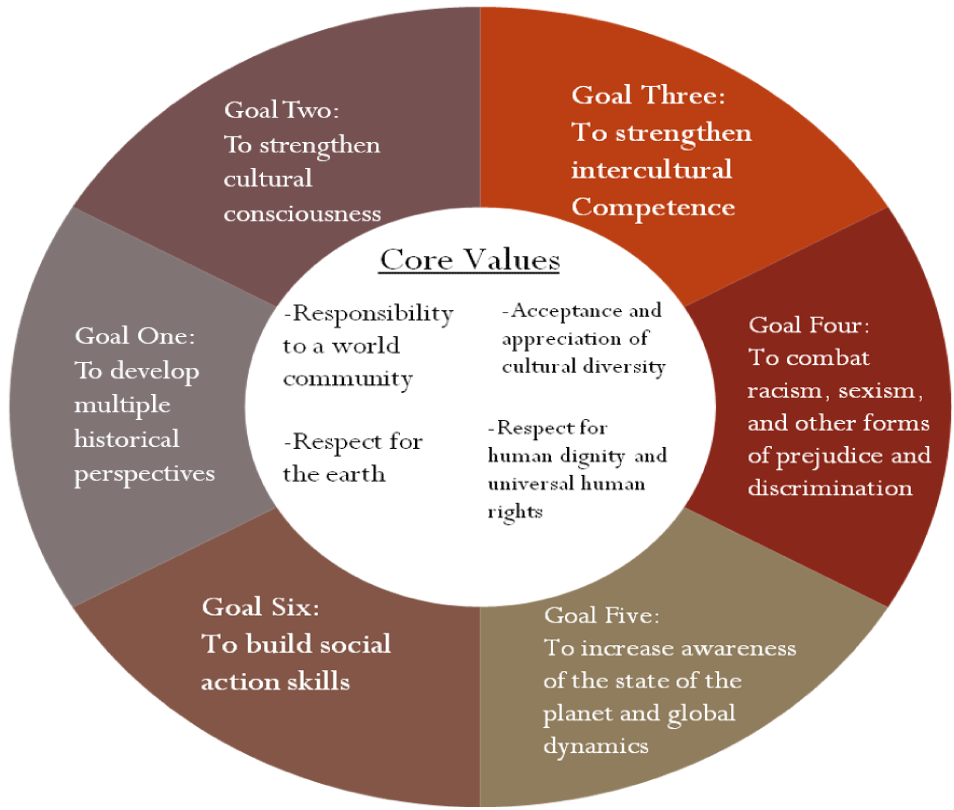
The core values are fourfold and connected in practicality of application regardless of the subject. Beginning with a foundation in (1) responsibility to a world community, leads to (2) acceptance and appreciation of cultural diversity and (3) a respect for human dignity and universal human rights which also connects to (4) respect for the earth, which would no longer be seen as a commodity, but something that sustains humanity and must be taken care of in the process of that sustenance. These core values lead to a vision of the entire world as a full space of consideration (physically, intellectually, and empathetically), care, concern, inquiry, and validity. They would first lend attention to how people treat each other at home in this country, then eventually lead to different relations internationally/globally as xenophobia is erased.
To actualize the core values attention must be paid to each of goals. The first goal also connects back to McCully A [15]. It is to develop multiple historical perspectives and create a space where all stories are told [15,17]. There is an African proverb that states, “until lions have historians, the tale of the hunt will always glorify the hunter.” All sides of history must be told and analyzed to ensure credit lands where it is due without bias in the spirit and vein of a griot. As was previously stated, traditional curriculum emphasizes the political development and growth of European civilization. Thus, the white perspective is always correct, victorious, and the only way.
Goal two is vitally important to curricular change and it is even important to achieving the first goal. It is to strengthen cultural consciousness. This is the recognition or awareness that one’s view of the world is not universally shared. This is the admission that difference does not equate to deficiency. It includes awareness of diversity of ideas and practices found throughout the world and it is an admission and embracing of pluralism. After acknowledging differing perspectives, one must develop the third goal; to strengthen intercultural competence.
This is the ability to interpret intentional and unintentional verbal and nonverbal communications, unconscious cues, and customs/cultural styles that are different from how they are used to communicating. The emphasis here is on leading with empathy and engaging in healthy communication. The fourth goal is needed to achieve this, and also connected to all the other goals [17]. To combat racism, sexism, and other forms of prejudice and discrimination. The focus is on lessening and eventually eliminating gender bias and internal misconceptions limiting beliefs about the inferiority of different races and cultures. This also comes with rendering true accounts of history.
The final two goals are also linked. Goal five is to increase awareness of the state of the planet and global dynamics. It is focused on reducing American-centeredness and developing a global perspective. When concern moves beyond American boundaries, the idea is that students will begin viewing the world as an interrelated ecosystem where all spaces must be protected. Thus, care will be applied globally to the treatment of the earth. Leading into goal number six, to build social action skills. Developing the knowledge, attitudes, and behaviors (as that is a stagewise process) needed to help find creative solutions to the problems that threaten the future of the planet and thus the well-being and future of humanity [17], including the monocultural treatment of history in schools. It must be acknowledged that this is the real self-perpetuating threat.
The Curricular Example
The following is a sample lesson from the Georgia performance social studies Standards of Excellence (2016) in teaching United States history. The front material and first standard are presented here as currently posted [18]. The introduction states:
“The high school United States history course provides students with a survey of major events and themes in United States history. The course begins with English settlement and concludes with significant developments in the early 21st Century.”
SSUSH1 Compare and contrast the development of English settlement and colonization during the 17th Century. Investigate how mercantilism and trans-Atlantic trade led to the development of colonies. b. Explain the development of the Southern Colonies, including but not limited to reasons established, impact of location and place, relations with American Indians, and economic development. c. Explain the development of the New England Colonies, including but not limited to reasons established, impact of location and place, relations with American Indians, and economic development. d. Explain the development of the Mid-Atlantic Colonies, including but not limited to reasons established, impact of location and place, relations with American Indians, and economic development.
The standard itself is very basic and the elements do not lead to an in depth or critical inquiry of historical record. There are so many things that happened leading up to the standard (English settlement of what would become America and colonization as it existed here and throughout the world) however students are required to only explore these four elements to “master” the standard. In element A, mercantilism has been defined as advocating for the control of international trade to generate wealth and strengthen national power. The trans-Atlantic trade has problematically been reduced to being defined as the shipping of natural resources, goods, and people across the Atlantic Ocean. The concept of enslavement has been superficially glossed over and disjointedly discussed without going into detail as to not cause discomfort. Humans, the ancestors of many students who must endure these lessons, have been thingified and reduced to trade material.
Enslavement is listed throughout the performance standards, but as a means to describe other terms and situations. It is not a destination for discussion or inquiry on its own. This is a negligent treatment of a significant historical phenomenon. As much as it is listed, students continue to exit the K-12 system underinformed about what actually took place during enslavement (the impetus of how African people ended up being enslaved and details surrounding it). However, they are taught that this is where their history on the world scene begins.
Then the last three elements of the standard go on to focus on the same circumstances surrounding Southern, New England, and Mid-Atlantic Colonies. Simply explaining them in relation to “reasons established, impact of location and place, relations with American Indians, and economic development.” Most of these concepts are defined with a basic comparison of the circumstances offered (often through the employ of a Venn diagram to highlight juxtaposition). Again, there is a lot of information missing and explaining the concepts does not mean students understand the context of what lead to the establishment of the colonies.
A look at required processing skills listed in the performance standards highlights the need for students to draw conclusions and make generalizations, determine adequacy and/or relevancy of information, and to check for consistency of information. For each of these skills they are introduced in one grade and mastered in the next. There is not time for development in between introduction and mastery as there is for other listed elements. The way information is presented in lessons also does not lend to critical analysis nor deep discussion. All to often, students are taught what to think rather than how to think about the information they are receiving because of the basic treatment of concepts. Specifically, through the presentation of a single perspective.
Filtered through Gollnick and Chinn’s (2017) model, this lesson would look much different. It would discuss the events leading up to English settlement from the English perspective and the perspective of the indigenous people who were here when Europeans arrived. It would present firsthand accounts of the experiences of indigenous peoples as a matter of historical record. It would present the roles and perspectives of women as well. It would discuss how humans fit into mercantilism as commodities and also delve into the impetus and conditions of enslavement and the middle passage. It would discuss what happened to indigenous people in terms of the Great Dying as well as forced removal and atrocities committed against them. It would provide a full context of the historical concept and create dialogue surrounding the multiple perspectives.
This is a brief and abbreviated example of how the approach to American education needs to be shifted to include multiple perspectives and tell a full accounting of OURstory. The goal is to develop a critical consciousness in all students who will hopefully no longer stand for the inequity that exists in current societal structures. There are so many people from multiple backgrounds who do not see themselves reflected in historical record and in response they feel lost and at times inadequate. Social amnesia and exclusion can no longer be tolerated. The conversation in schools must shift to engender critical thinking and honest engagement with history. The curriculum and teachers must provide a voice and consider the perspective for all participants. It is well past time for the historical clock to represent the full 24 hour geography of all humanity rather than the ten minute perspective of a few.
References
- Willis WB. The Adinkra dictionary: A visual primer on the language of Adinkra. Washington, D.C.: Pyramid Complex; 1998.
- Bourne SC. John Henrik Clarke: A great and mighty walk [Film]. Black Dot Media; 1996.
- Niane DT. Sundiata: An epic of old mali. Edinburgh: Pearson Education Limited; 2006.
- Freire P. The politics of education: culture, power, and liberation. Hartford, CT: Bergin & Garvey Publishers; 1985.
- Richardson CO. Tomorrow’s super teacher: Changing teacher education to nurture culturally sustaining educators. Rowman & Littlefield. 2021.
- Miles J. Teaching history for truth and reconciliation: The challenges and opportunities of narrativity, temporality, and identity. McGill Journal of Education/Revue des sciences de l’éducation de McGill. 2018;53(2). doi: 10.7202/1058399ar.
- Nelson S. Historical amnesia and its consequences: The need to build histories of practice. Texto Contexto Enferm, Florianópolis. 2009;18(4):781-787. doi: 10.1590/S0104-07072009000400021.
- Little B. How boarding schools tried to ‘kill the Indian’ through assimilation. 2017.
- Saddler CA. The impact of brown on African American students: A critical race theoretical perspective. Educational Studies. 2005;37(1):41-55. doi: 10.1207/s15326993es3701_5.
- America’s censored classrooms. PEN America. 2024.
- Exposing the impact of curriculum and book bans: Education for the public and not the few. American Bar Association. 2024.
- Kaplan LS, Owings WA. Countering the furor around critical race theory. Sage Publications. 2021; 105(1):019263652110454. doi: 10.1177/01926365211045457.
- Ladson-Billings G. Critical race theory - What it is not! In: Lynn M, Dixson, editors. Handbook of critical race theory in education. Taylor & Francis Group; 2013.
- Freire P. Teachers as cultural workers: Letters to those who dare teach. Cambridge: Westview Press; 2005. doi: 10.4324/9780429496974.
- McCully A. History teaching, conflict, and the legacy of the past. Education, Citizenship and Social Justice. 2012;7(2):145-159. doi: 10.1177/1746197912440854.
- Akbar N. Know thy self. Tallahassee FL. Mind Productions & Associates; 1998. doi: 10.1007/978-94-6300-441-1_4.
- Gollnick DM, Chinn PC. Multicultural education in a pluralistic society 11th Edition. Boston, MA: Pearson; 2017.
- United States history. Georgia Performance Standards. 2016.




Content Alerts
SignUp to our
Content alerts.
 This work is licensed under a Creative Commons Attribution 4.0 International License.
