
Environmental Sciences Group. 2024 July 20;5(7):793-796. doi: 10.37871/jbres1957.





 Research Article
The Struggle for Water in Doñana
Juan Antonio Marquez Dominguez*
Introduction
The Doñana region covers 290,600 hectares, of which 255,000 have been designated as a UNESCO World Heritage Biosphere Reserve, as well as a Ramsar wetland. Its exceptional location, between Europe and Africa, and between the Atlantic Ocean and the Mediterranean Sea, makes it the largest ecological reserve in Europe. Despite this, it has not been spared from conflict because prolonged drought has endangered the natural ecosystem and economic development (Figure 1).
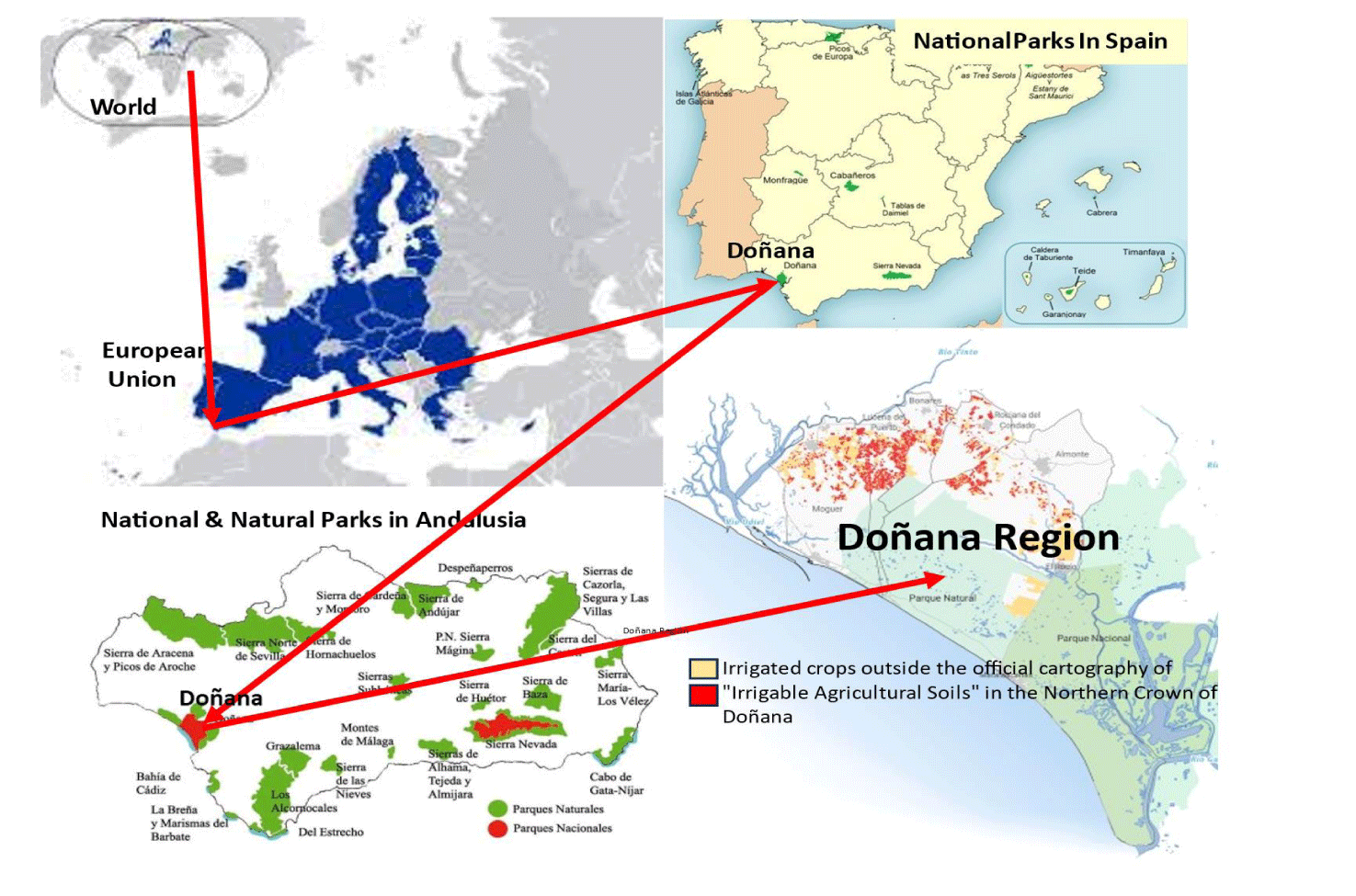
Indeed, Doñana sits on a reservoir of underground water that supplies the needs of animal and plant life, but also agricultural, industrial, tourist and urban activity. Agriculture, in particular, collects water from wells, many of which are illegal. Overexploitation of the aquifer, drought and possible climate change threaten the continuity of Doñana's ecosystems. Despite the efforts of different administrations, which have tried to attenuate the tensions between the conservation and development of the territory, the resistance to change is great, since although Doñana is an important environmental asset, the export of strawberries to Europe maintains an agriculture with a strong economic and social nerve.
In this context, the permissiveness in the use of water has placed the natural space in a very critical situation, to such an extent that there is talk of Ecocide [1].
It has been estimated that, as of 2020, more than 50% of farms were irrigating with illegal wells. More than a thousand of these wells deplete the aquifer 27. The depth of the wells to access water from the aquifer is about 4 to 40 meters. From the wells, the water is pumped into pipes that can travel several kilometers, until they are deposited in impermeable ponds, from where localized irrigation is carried out.
The overexploitation of the aquifer has been such that it has been declared in a state of caution, danger and alert. The water table decreases reach up to 18 meters and the recharge by rainfall does not reach the extractions. The situation of alarm has been accentuated by the drying of lagoons, especially that of Santa Olaya, the largest permanent lagoon in Doñana and which dried up completely in 2023 and 2024 (Table 1).
| Table 1: Profile of the Doñana region. | |||||
| Municipios Doñana | Extensión Km2 | Población | Alta S.S | %Alta.Ss.Agr | L. Cesante Euros |
| Almonte | 861 | 25,488 | 16,495 | 58.07 | 8,000,000 |
| Bollullos Par del Condado | 50 | 14,293 | 5,370 | 45.68 | 4,100,000 |
| Bonares | 66 | 6,093 | 2,648 | 48.75 | 4,100,000 |
| Hinojos | 321 | 3,951 | 1,296 | 34.34 | 5,900,000 |
| Lucena del Puerto | 69 | 3,213 | 4,034* | 75.93 | 4,100,000 |
| Moguer | 204 | 22,643 | 14,046 | 67.41 | 5,600,000 |
| Palos de la Frontera | 50 | 12,483 | 12,450 | 42.74 | 4,100,000 |
| Rociana del Condado | 72 | 7,866 | 3,766 | 71.77 | 4,100,000 |
| Aznalcázar | 450 | 4,664 | 1,319 | 25.85 | 5,900,000 |
| Pilas | 46 | 13,964 | 4,205 | 28.61 | 4,100,000 |
| Puebla del Río | 374 | 11,855 | 1,907 | 17.51 | 5,900,000 |
| Villamanrique de la Condesa | 58 | 4,580 | 1,461 | 59.55 | 4,100,000 |
| Isla Mayor | 114 | 5,767 | 1,951 | 46.08 | 4,100,000 |
| Sanlucar Barrameda | 171 | 69,727 | 22,774 | 21.91 | 5,900,000 |
| TOTAL DOÑANA | 2,906 | 206,587 | 93,722 | 45.84 | 70,000,000 |
| ANDALUCÍA | 87,599 | 8,494,155 | 3,351,596 | 11.56 | - |
| ESPAÑA | 505,990 | 47,435,597 | 20,715,284 | 3.42 | - |
| Extensión, population, workers registered with Social Security, % of agricultural workers in Social Security and Subsidy for loss of earnings. Sources: Ine (2023) [2] Miteco (2023) [3] and Miteco (2024) [4] Own elaboration. *The relationship between the resident population and workers registered with Social Security is altered by the presence of the immigrant population which, as in the case of Lucena del Puerto, exceeds the resident population. | |||||
This has been a cause for concern in local, Andalusian, Spanish, European and international contexts. The climate crisis, with decreased rainfall and rising temperatures, along with intensive agriculture have pushed this wetland to the brink of collapse.
The European Commission took Spain to the European Court of Justice for its inaction in protecting this protected area. It is ruled that the "excessive extractions of groundwater" in the Doñana Natural Area do not comply with community law [5], and manifests the lack of information on the state of groundwater, mainly due to the Administration's lack of knowledge about illegal abstractions.
National Aeronautics and Space Administration, NASA, denounced that Doñana is drying up due to the climate change that southern Spain is suffering. Development, outside the protected area, has depleted the shared aquifer and endangered the Doñana ecosystem. The Nasa highlights the change of cultivation from drought-tolerant species, such as cereals, vines or olives, to others such as strawberries, blueberries, blackberries or more water-intensive franbuesa [6]. In addition, in Spain, the scientific community and the Spanish National Research Council (CSIC) have warned about the impact of excessive groundwater extraction in Doñana. The CSIC, with a team of 22 researchers, has pointed out the serious impacts that the decline of the aquifer has on water quality and aquatic and terrestrial habitats [7].
In this context, several solutions have been proposed to address the exploitation of the Doñana aquifer:
- Closure of illegal wells and halting of hydraulic infrastructures. The Guadalquivir Hydrographic Confederation, under the Ministry for Ecological Transition and the Demographic Challenge, is closing illegal catchments and paralyzing hydraulic infrastructures north of Doñana
- Limit water consumption. Especially, in the years 2023 and 24, the intense drought forced the restriction of water use. At the local level, the Irrigation Communities were forced to reduce and regulate the amount of water used, between 25 and 50% to avoid overexploitation of the aquifer, deal with drought and ensure sustainable use.
- Expansion of the Doñana natural area, with the incorporation of non-agricultural farms. In 2024, the Andalusian government has bought the 7,500-hectare Veta La Palma estate in La Puebla del Río, Seville to conserve a 3,500-hectare wetland, artificially flooded for fish farms and which had closed. This large wetland can be a breeding ground for birds in times of drought [8]. Thus, the 'Veta La Palma' will help to cushion the effect on fauna in years of low rainfall and is key to the Doñana Natural Area and its biodiversity.
- Search for new sources of water, including the implementation of aquifer recharges, starting with the completion of the Alcolea dam. However, this dam has generated controversy because the project does not adequately address the problem of the quality of the reservoir waters. These waters have a high acidity and a high content of heavy metals, which limits their current use. Despite the criticism, the Junta de Andalucía has offered to finance the completion of the works on the dam, considered key to the water future of the province of Huelva and the northern crown of Doñana.
- Compensation to municipalities for loss of profits, which are considered as the affectation of lost income due to the drought and restrictions on economic activity in Doñana. Along these lines and as a pact to save Doñana, the Junta de Andalucía and the Government of Spain signed an agreement, which contemplates investments of 1,400 million euros for the 14 towns that make up the area of influence of the National Park. The investments will be aimed at good practices, agricultural diversification, innovation and industrial diversification projects, social and labor insertion, living conditions and monitoring work [9]. The first contribution that has reached the municipalities is 70 million euros [10]. On the other hand, a subsidy of 100,000 euros per hectare is contemplated for farmers who renaturalize their farms in the northern forest crown of Doñana [11-17].
Conclusion
Interest in what is happening in the Doñana region has become universal and has generated opposing positions: among those who defend drastic measures to allow the continuity of its natural ecosystems, in the face of the danger of aquifer depletion 27; as opposed to those who support economic and social development and agriculture based on export agriculture, which consumes water netly.
Various conflicts have maintained and revived the old dilemma between conservation and development. However, the last years of drought and the dangers of climate change have brought together the interests of various administrations to address the problem of Doñana as a common task, implementing water control measures and renaturalization of landscapes. Saving the park and the Doñana region, boosting their resilience, is urgent for sustainable development.
References
- Ecologists in action. Ecocide in Doñana. 2023.
- Ine. Population of Spain. National Institute of Statistics. 2023.
- Miteco. Statistics on social security affiliates. Ministry of Labour and Social Security. 2023.
- Miteco. It signs with the municipalities of the Doñana area the distribution of the 70 million for the sustainable development of the National Park. 2024.
- Wwf. Historic condemnation of the E.U. to Spain-for-destroying Donaña. 2021.
- Izquierdo J. NASA denounces that Doñana dries up due to tourism, strawberry cultivation and drought. 2023.
- The exploitation of the aquifer in Doñana. EFE Agency. 2024.
- Martín Javier. The andalusian junta buys 7,500 hectares for the birds to stay in Doñana. 2023.
- Pilar SA. The closure of illegal irrigation and 1,400 million in aid: Keys to the agreement between the Junta and the government for Doñana. 2023.
- Carrasco A, Sáez C. Conflict over irrigation in the Doñana area. The Guardia Civil and the CHG seal 17 of the 77 illegal wells in Lucena del Puerto. 2019.
- Custodio E, Manzano M. Groundwater in Doñana. Ecological and Social Aspects. Andalusian Water Agency. Seville DL. 2009.
- Diario de Sevilla. The Junta is ready to finance the completion of the works on the Alcolea dam. 2023.
- Supermarkets aldi and lidl are committed to huelva strawberries. The Economist. 2023.
- Jurado, José M. Study of water and its uses in the province of Huelva. Economic and Social Council of the Province of Huelva. 2023.
- Márquez JA. Threats and initiatives for resilience in Doñana. Forest Crown and Water Ring. Revista Científica Monfragüe. 2013;nº2:91-117.
- Márquez, Juan A. Water and fire in Doñana (Spain), in spatial planning: Smart cities, tourism and logistics. Aranzadi, editor;2018;455-465.
- Márquez, Jurado y Díaz. The last attempt at land reform in Spain: Application and scope of the andalusian agrarian reform. 2023;1984-2011.




Content Alerts
SignUp to our
Content alerts.
 This work is licensed under a Creative Commons Attribution 4.0 International License.
