
2025 August 25;6(8):1088-1095. doi: 10.37871/jbres2163.
-
Subject area(s):

 |
|
 |
|
 |
|

 Research Article
Development of a Fluorescence Isothermal Recombinase Polymerase Amplification Assay for Rapid Detection of Feline Calicivirus
Yujun Zhu1#, Shuzhou Huang2#, Bihong Huang1, Yuexiao Lian1, Tongyuan Zhang3, Feng Cong1*, and Miaoli Wu1*
2Nancheng Agricultural Technology Service Center, Dongguan, China
3Center for Animal Disease Control and Prevention of Fushun, Fushun, China
#The authors contributed equally to this research
- Feline calicivirus
- Isothermal amplification
- Real-time RPA
- Clinical diagnosis
Abstract
Feline Calicivirus (FCV) is responsible for a highly contagious disease in domestic cats. FCV may cause multiple symptoms and even death to the infected cats. A simple and cost-effective real-time RPA assay was developed for rapid detection of FCV in clinical samples. In this study, specific primers and probe were designed from the genome of FCV that prevalent in south China. The real-time RPA assay was carried out at 39℃ for 20min before signal analysis by the fluorescence detector. The specificity and sensitivity were thoroughly validated and the results showed that no cross-reaction with irrelevant pathogens were found during the amplification, indicating the good specificity of the new developed real-time RPA assay. RNA standards were constructed and diluted to evaluate the limit of detection. The results showed that the detection limit of the real-time RPA assay could achieve 100 copies/μl, suggesting the high sensitivity of the assay. Additionally, the real-time RPA assay showed excellent performance in clinical sample detection, when compared with a TaqMan qPCR assay. The detection rate of FCV was 38.5% (57/148) for real-time RPA assay and it was a little higher than 37.2% (55/148) of the qPCR assay. Taking all together, the real-time RPA assay had potential application of FCV detection in clinical diagnosis. In conclusion, the new developed real-time RPA assay has provided an alternative strategy for rapid and sensitive detection of FCV in laboratories and animal clinics, especially those with limited facilities.
Introduction
Feline Calicivirus (FCV) is the major cause of upper respiratory tract disease in felines, cats, tigers and other wild felines that are susceptible. The widely distributed FCV is highly contagious with atypical symptoms including oral ulcers, rhinitis, chronic stomatitis, pneumonia and lameness [1]. The virus is easily spreading through the infected cats, making it possible for the substantial transmission of FCV [2]. FCV is classified as a Vesivirus in the family Caliciviridae. It’s a small non-enveloped virus with single-stranded, positive-sense RNA genome. As expected, FCV has high degree of genomic plasticity and genetic diversity, making it difficult for primer design used for nucleic detection even in vaccine development [3]. On the other hand, the administration of FCV vaccines would protect cats from developing into serve disease, but fail to get rid of infection [4]. As a result, the prevalence of FCV in cats remains high, especially those cats living in colonies or shelters [5]. Therefore, laboratory diagnostic technologies such as virus isolation, polymerase chain reaction (PCR) assay, serological tests and immunofluorescence tests are important for accurate diagnosis of FCV.
Reverse transcription PCR and real-time PCR are already available for FCV diagnosis [6]. Rapid and sensitive point-of-care testing was contributed to effective treatment as well as virus control of FCV. Recombinase Polymerase Amplification (RPA) assay developed by TwistDx shows excellent amplification efficiency in limited time when compared to conventional PCR methods. During the RPA assay, amplification of the target would be achieved without running through any temperature cycling processes. In that case, RPA would be an appropriate versatile isothermal replacement to conventional PCR. Since its development, RPA has been widely used in human disease testing as well as animal and plant pathogen diagnosis [7,8]. It is a promising solution to molecular diagnosis in labs with limited equipment and offers a new choice for on-site diagnosis in animal clinics.
Recently, RPA assays have been successfully developed for rapid detection of feline herpesvirus type 1 (FHV-1), Feline Parvovirus (FPV) and feline coronavirus [9,10]. Yet, no reports on rapid detection of FCV with RPA assay have been published. In this study, a real-time RPA assay for FCV detection was developed and evaluate, it showed high specificity and sensitivity, which would be an effective tool for FCV diagnosis in the field.
Viruses and samples
Feline Calicivirus (FCV), Feline Herpesvirus (FHV), Feline Infectious Peritonitis Virus (FIPV), Feline Parvovirus (FPV) and Feline Coronavirus (FCoV) were isolated and preserved in our laboratory. The nucleic acid of Feline Leukemia Virus (FeLV), Mycoplasma felis (Mp.f) and Toxoplasma gondii (Tox) were preserved in our laboratory.
A number of 148 clinical samples (including oral swab and abdominal dropsy) from 8 animal hospitals in Guangzhou were collected from July 2020 to May 2022. Nucleic acid extraction was carried out by using the DNA/RNA isolation kit (TIANGEN, Beijing, China), all the nucleic acid samples were stored at -80℃ before used.
Primers and probe design
The genome of feline calicivirus strain GD (sequence ID: GU214989.1) was downloaded from NCBI, the primers and probe were designed following the guidelines of the manufacturer (TwistDX, Cambridege, UK). The specific probe was designed from the highly conservative region of the FCV genome and five different primer sets were designed according to the desired probe. The specificity of the primers and probe was confirmed by using the online Primer-BLAST program (BLAST: Basic Local Alignment Search Tool) before further synthesized by Sangong Biotech (Shanghai, China). The sequences of the primers and probe are listed in table 1.
Generation of RNA standard
A 500bp fragment of the FCV genome was amplified by the primer pair F/R (Table 1) using a PrimerScript RT-PCR kit (Takara, Dalian, China) according to the manufacturer’s instruction. Target amplicons were cloned into the pMD 19-T vector (Takara, Dalian, China) and further transformed into Escherichia coli. The recombinant plasmids were screen by PCR and the positive clone was further sequenced. In vitro transcription was carried out using the T7 RNA polymerase (Promega, Shanghai, China) following the manufacturer’s instruction. RNA standard was quantitated using the NanoDrop 2000c (NanoDrop, Wilmington, USA) and stored at -80℃ before used.
| Table 1: The sequences of primers and probe. | |
| Name | Sequence |
| FCV-P | YGTTAATTCRGTGTTTGATTTGGCCTGGGC/i6FAMdT//idSp//iBHQ1dT/TC GCCGDCAYCTGACWYT |
| F | GGTGCACCGCTCATGTGTTGACGCC |
| R | GACGCCTCCAGCACGGATCACGTT |
| F1 | TGGATGAACTACCCGCCAATCAACATGTGGTAAC |
| R1 | GGGRCAGTAAGCACATCATATGCGGCTCTGAT |
| F2 | AACTACCCGCCAATCAACATGTGGTAACTGTTAAT |
| R2 | CATATGCGGCTCTGATTGCTTGAAACTGCCCTG |
| F3 | TAGACTGGATGAACTACCCGCCAATCAACATGTG |
| R3 | AAGCACATCATATGCGGCTCTGATTGCTTGAAACT |
| F4 | CAATGTTAGACTGGATGAACTACCCGCCAATCAACA |
| R4 | TTCATCCATCCAGTGCCGTAGCATGGCAGGTA |
| F5 | GAACTACCCGCCAATCAACATGTGGTAACTG |
| R5 | GCAGGGCAGTTTCAAGCAATCAGAGCCGCA |
Real-time RPA assay development
The real-time RPA assay was performed using a TwistAmp exo kit (TwistDX, Cambridge, UK). A reaction tube containing the dried enzyme pellets was successively added 29.5μl rehydration buffer, 2μl of each primer (10μM), 1μl probe (10μM), 2μl genome template, 2.5μl of 280mM magnesium acetate (MgAc) and 11μl nuclease-free water. The reaction mixture was gently mixed and centrifuged before further incubated at 39℃ for 30 min. The fluorescence signal was monitored in real time with the fluorescence detector Deaou-308C (DEAOU Biotechnology, Guangzhou, China). The detected sample with obvious exponential amplification curve was considered positive, meanwhile, the negative sample should present as a flat straight line under the threshold line. Five different primers were screened for better amplification efficiency of the RPA assay. Besides, different incubation temperatures and incubation time were performed to determine the optimal reaction conditions of the RPA assay.
Performance assessment of the real-time RPA assay
The 10-fold serial dilutions of RNA standards ranging from 106copies/μl to 101 copies/μl were used as templates to analyze the detection limit of the real-time RPA assay. Each RNA standard dilution was tested in duplicate and the limit of detection was determined by the last positive dilution. Meanwhile, the specificity of the real-time RPA assay was evaluated by testing nucleic acid of irrelevant pathogens including FHV, FCoV, FIPV, FPV, FeLV, Tox and My.f that infect cats. Besides, the nucleic acid of FCV genome was run as positive control.
Application of real-time RPA assay in clinical sample detection
To further evaluate the detection ability of the new developed real-time RPA assay in clinical samples, 148 clinical samples collected from animal hospitals were tested by real-time RPA assay in parallel with quantitative real-time PCR (qPCR) [11].
Results
Construction and optimization of the real-time RPA assay
Nucleic acid of FCV was used as template for real-time RPA assay development. The fluorescence signal was monitored in real-time with the help of a fluorescence detector. As displayed through the detector, FCV had obvious exponential amplification curve compared with the flat amplification curve of negative control (Figure 1). In this study, five different primer pairs were used to evaluate the amplification efficiency of the RPA assay. According to the result, five primer pairs showed quite different amplification curves and primer pair 1 showed the best amplification efficiency during FCV detection in the RPA assay (Figure 2). Though the incubation temperature is recommended by the reagent manufacturer, different incubation temperature including 37℃, 39℃ and 41℃ were detected to find out any differences. Yet, no obvious difference was ever found.
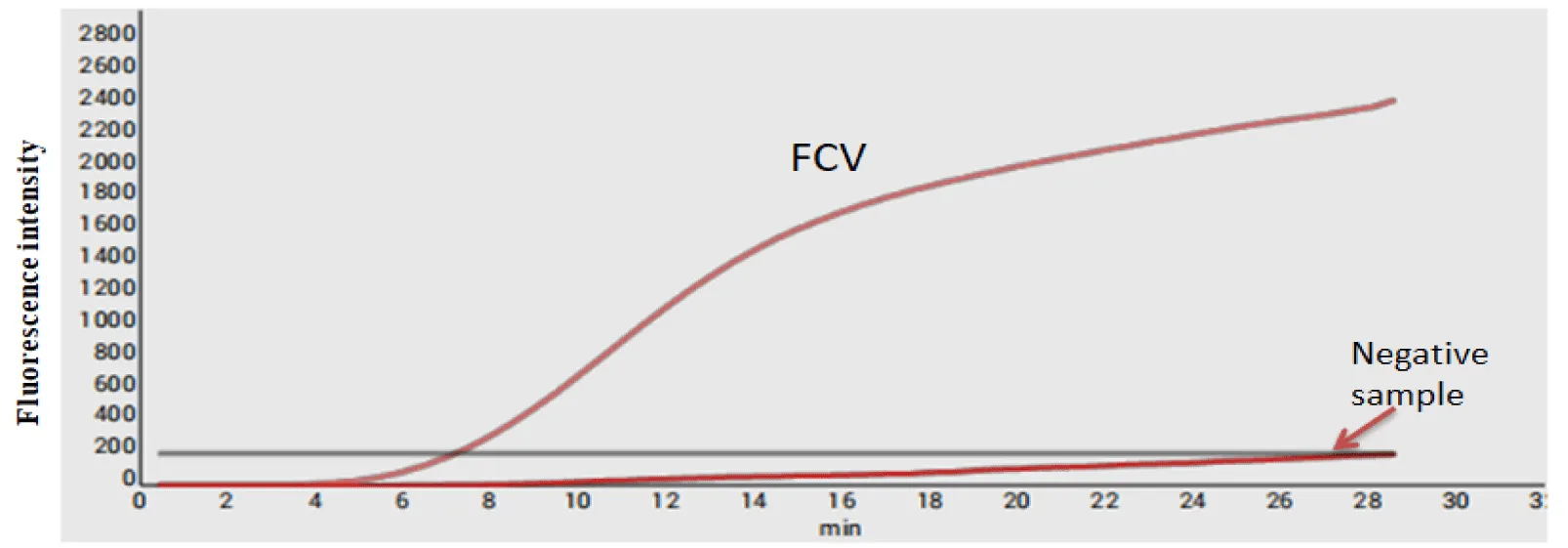
FCV: Feline Calicivirus; Negative samples: Sterilization water. The X-axis was reaction time and the Y-axis was fluorescence intensity.
The RPA assay with different reaction time (10min, 15min, 20min, 25min, 30min) was carried out to figure out the optimal incubation time. According to the results, all the 14 positive samples would be identified in 17 minutes (Table 2). As showed in the previous results, taking Figure 2 for example, the increase of the incubation time would trigger another climb up of the amplification curves but had no effect on the detection results. Considering that, in most cases, the amplification would finish in the first 20 minutes right after the reaction was initiated. Therefore, the incubation time had been reduced to 25 minutes to achieve the optimal amplification curves as well as the highest detection rate.
| Table 2: The results of detected samples with different incubation time. | ||||||
| ample name | ample type | Incubation time | ||||
| 10 min | 15 min | 20 min | 25 min | 30min | ||
| A1 | + | 5:00 | 5:00 | 5:00 | 5:00 | 5:00 |
| A2 | + | 6:30 | 6:30 | 6:30 | 6:30 | 6:30 |
| A3 | + | 5:30 | 5:30 | 5:30 | 5:30 | 5:30 |
| A4 | + | 7:30 | 7:30 | 7:30 | 7:30 | 7:30 |
| A5 | + | 8:30 | 8:30 | 8:30 | 8:30 | 8:30 |
| A6 | + | / | 12:30 | 12:30 | 12:30 | 12:30 |
| A7 | + | 9:00 | 9:00 | 9:00 | 9:00 | 9:00 |
| A8 | + | 8:30 | 8:30 | 8:30 | 8:30 | 8:30 |
| B1 | + | / | 10:30 | 10:30 | 10:30 | 10:30 |
| B2 | + | / | / | 15:30 | 15:30 | 15:30 |
| B3 | + | / | 12:00 | 12:00 | 12:00 | 12:00 |
| B4 | + | / | / | 15:00 | 15:00 | 15:00 |
| B5 | + | / | 13:30 | 13:30 | 13:30 | 13:30 |
| B6 | + | / | / | 16:30 | 16:30 | 16:30 |
| B7 | - | / | / | / | / | / |
| B8 | - | / | / | / | / | / |
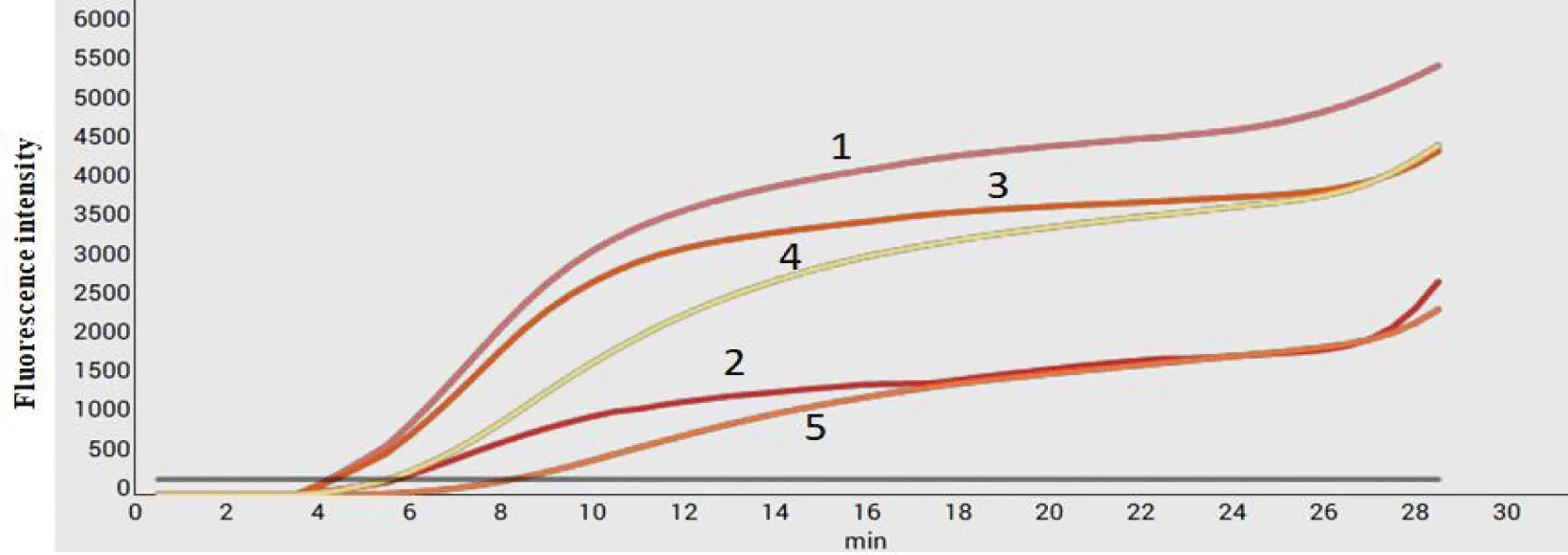
Five different amplification curves represented five different primers used to amplify FCV in the RPA assay. The X-axis was reaction time and the Y-axis represented the fluorescence intensity. 1~5 represents primer pairs 1 to 5.
Specificity and sensitivity analysis of RPA assay
Common pathogens that infect cats were used for specificity validation. The results showed that fluorescence signals representing specific amplification was obtained only from the positive control, indicating that the RPA assay was highly specific to FCV and showed no cross-reactivity with other pathogens in cats (Figure 3).
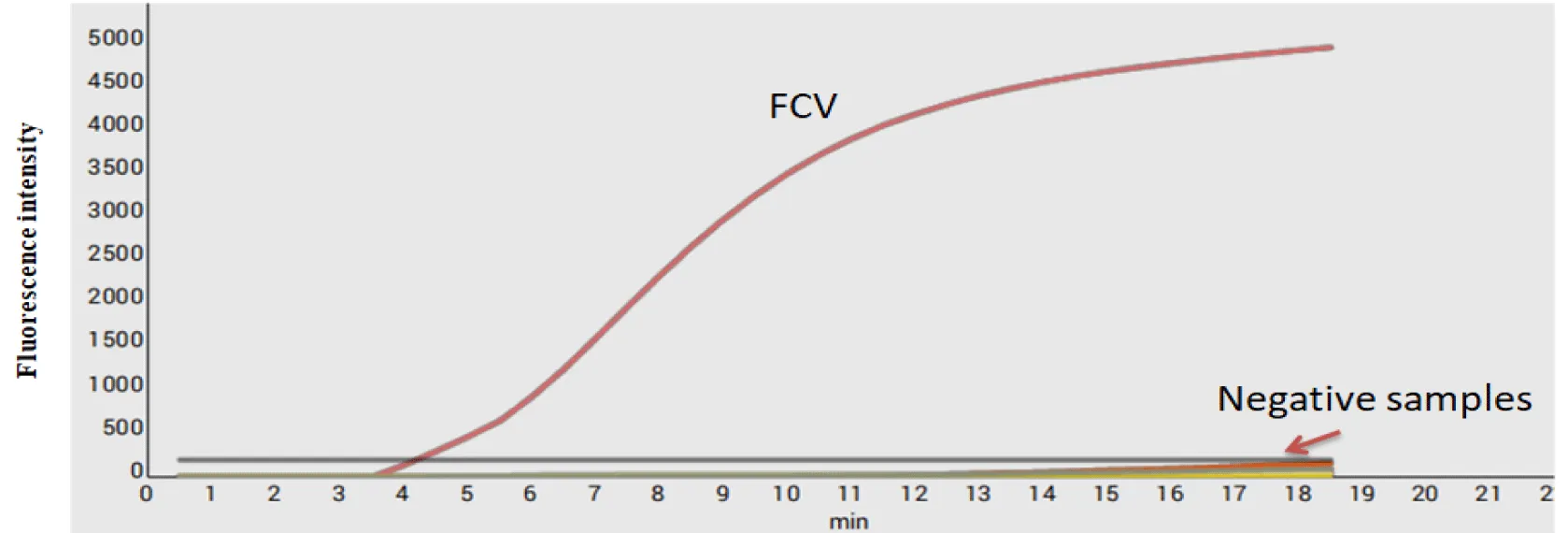
FCV: Feline Calicivirus; Negative samples including FHV, FCoV, FIPV, FPV. The X-axis was reaction time and the Y-axis represented the fluorescence intensity.
The sensitivity of the RPA assay was analyzed by 10-fold diluted RNA standard in 2 parallels. According to the results, the 106 copies/μl -102 copies/μl RNA standards had produced exponential amplification curves, while the 101 RNA standard only showed a straight line lay below the threshold together with the negative control. As showed in figure 4, the limit of detection of the RPA assay was102 copies/μl, illustrating the ideal sensitivity of the assay.
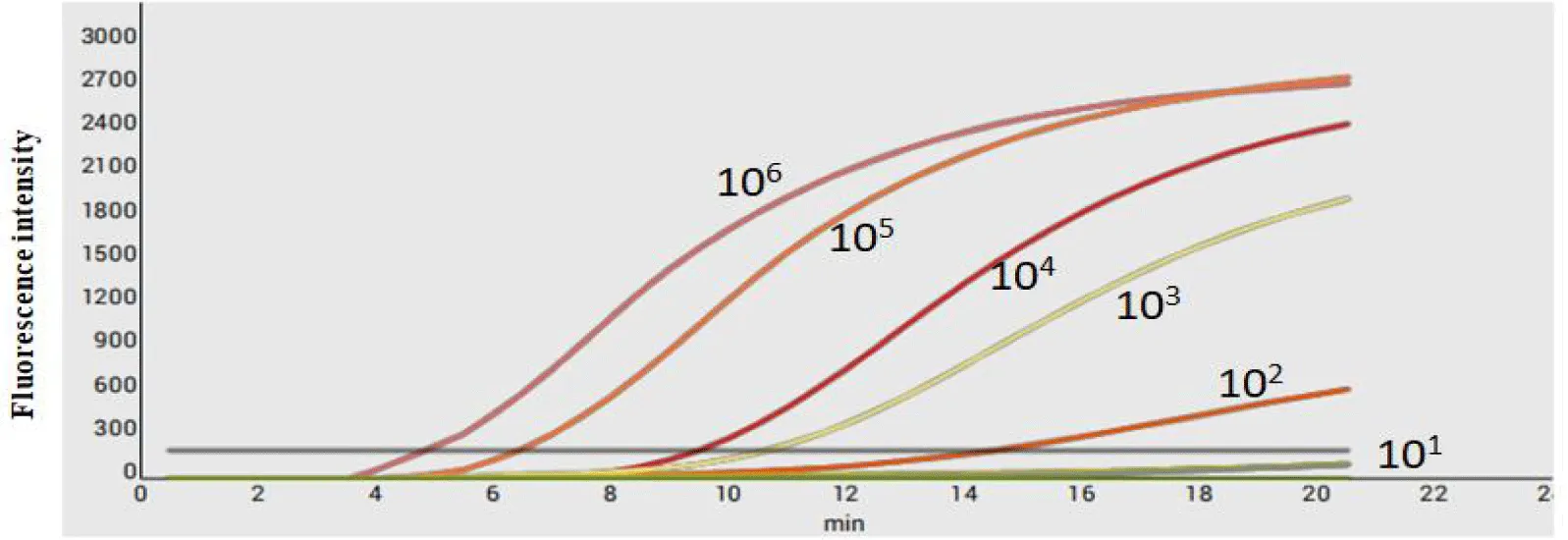
10-fold serial dilution of DNA standard ranging from 106 copies/μl to 101 copies/μl were used as template to determinant the limit of detection. The X-axis is time and the Y-axis is fluorescence intensity. As revealed by the result, the LOD was 102 copies/μl.
Diagnostic performance of the RPA assay
To ascertain the diagnostic capacity of the RPA assay, 148 clinical samples were simultaneously tested by real-time RPA and quantitative real-time PCR (qPCR). According to the results, the detection rate of RPA and qPCR for FCV was 38.5% (57/148) and 37.2% (55/148) respectively (Table 3). Among which, 2 samples were tested positive by RPA while negative by qPCR. The suspicious samples were finally confirmed FCV positive by sequencing, suggesting that the real-time RPA assay could be used for rapid and sensitive FCV detection in clinical samples.
| Table 3: The detection results of the real-time RPA and qPCR. | |||
| Method | Result | Positive rate | |
| Positive (+) | Negative (-) | ||
| Real-time RPA | 57 | 91 | 38.51% |
| qPCR | 55 | 93 | 37.16% |
Discussion
As we know, more and more families prefer raising cats as pets, especially the young peoples. With the increasing number of cats, the contagious diseases in cats have attracted the public’s attention. Rapid and sensitive methods for disease diagnosis and control are important, especially in equipment-limited pet clinics [12]. In the last decades, the development of molecular biology has leading to the widely use of molecular diagnostic techniques such as conventional PCR, quantitative real-time PCR in the whole diagnostic industry. However, the requirement of well-trained technicians and expensive facilities has restricted their applications, making them only available in research institutes, universities and hospitals [13,14]. As a result, most of the animal hospitals and pet clinics do not possess the capability of independent diagnosis with molecular techniques [15]. To overcome this awkward situation, isothermal amplification technology such as Loop-Mediated Isothermal Amplification (LAMP), Nicking Enzyme-Assisted Amplification (NEAA), Nucleic Acid Sequence-Based Amplification (NASBA), Rolling Circle Amplification (RCA) and RPA were gradually developed for different purposes [16-18].
As known to all, LAMP is believed to be the most convenient on-site diagnostic methods, since no specific equipment is needed to perform the assay [18]. However, up to 6 pairs of primer are needed for performing LAMP and unfortunately, the highly diverse of FCV genomic has restricted the possibility of primer design for LAMP. Though much less primers were required for RPA development, primer and probe design still remained challenge.
In this study, a real-time RPA assay was developed for rapid detection of FCV. According to the TwistAmp manual, RPA primers are usually 30 to 35 nucleotides long, so that to guarantee the amplification efficiency [19]. As mentioned before, the genomic of FCV strains are highly variable, barely no conserved regions can be located for primer and probe design, so that degenerate bases were introduced for higher detection rate of FCV when designing the primers and probe. The specificity of the assay was fully verified through detecting some other important pathogens in cats. The results showed no cross-reactions with FHV, FCoV, FIPV, Tox, My.f, FeLV and FPV, indicating that the use of degenerate bases in the primers and probe would not cause any mismatches during the amplification. On the other hand, the real-time RPA assay showed better detection performance on clinical samples when compared with a TaqMan real-time PCR assay. It’s believed that the use of degenerate bases in primers and probe was helpful in FCV detection, since there was more than one virus strain prevalent in south China.
The advantageous of RPA assay are including reaction time-saving, cost-effective and the potential application of Point of Care Testing (POCT). It’s may be a versatile qPCR replacement in research institutes. Though the new development real-time RPA assay had showed excellent performance in clinical sample detection, the reliance on fluorescence detector prohibits its widely use in POCT for FCV detection. The combination with Lateral Flow (LF) strips may be a good solution. Besides, the RPA technique requires high quality of the sample nucleic acid, therefore, break throughs in nucleic acid extraction technology will facilitate the promotion and application of RPA assay. Anyway, more works should be done to make RPA a useful tool in POCT diagnosis.
In conclusion, a real-time RPA assay for faster and cheaper detection of FCV was developed and validated, it has provided an alternative method for FCV detection in laboratories and pet clinics with simple fluorescence detectors.
Funding
The corresponding author has received grant from the National Key R&D Program of China (Grant Number: 2021YFF0703300).
Conflicts of Interest
The authors declare that they have no known competing financial interests or personal relationships that could have appeared to influence the work reported in this paper.
Author contributions
M. W: original draft writing and supervision; Y. Z: method development; S. H: clinical sample collection and detection; B. H, T. Z and L. L: method validation; F C: funding acquisition and project administration. All authors have read and agreed to the published version of the manuscript.
References
- Pedersen NC, Elliott JB, Glasgow A, Poland A, Keel K. An isolated epizootic of hemorrhagic-like fever in cats caused by a novel and highly virulent strain of feline calicivirus. Vet Microbiol. 2000 May 11;73(4):281-300. doi: 10.1016/s0378-1135(00)00183-8. PMID: 10781727; PMCID: PMC7117377.
- Reubel GH, Hoffmann DE, Pedersen NC. Acute and chronic faucitis of domestic cats. A feline calicivirus-induced disease. Vet Clin North Am Small Anim Pract. 1992 Nov;22(6):1347-60. doi: 10.1016/s0195-5616(92)50131-0. PMID: 1333664.
- Domingo E, Menéndez-Arias L, Holland JJ. RNA virus fitness. Rev Med Virol. 1997 Jul;7(2):87-96. doi: 10.1002/(sici)1099-1654(199707)7:2<87::aid-rmv188>3.0.co;2-0. PMID: 10398474.
- Spiri AM, Riond B, Stirn M, Novacco M, Meli ML, Boretti FS, Herbert I, Hosie MJ, Hofmann-Lehmann R. Modified-Live Feline Calicivirus Vaccination Reduces Viral RNA Loads, Duration of RNAemia, and the Severity of Clinical Signs after Heterologous Feline Calicivirus Challenge. Viruses. 2021 Jul 30;13(8):1505. doi: 10.3390/v13081505. PMID: 34452370; PMCID: PMC8402717.
- Helps CR, Lait P, Damhuis A, Björnehammar U, Bolta D, Brovida C, Chabanne L, Egberink H, Ferrand G, Fontbonne A, Pennisi MG, Gruffydd-Jones T, Gunn-Moore D, Hartmann K, Lutz H, Malandain E, Möstl K, Stengel C, Harbour DA, Graat EA. Factors associated with upper respiratory tract disease caused by feline herpesvirus, feline calicivirus, Chlamydophila felis and Bordetella bronchiseptica in cats: experience from 218 European catteries. Vet Rec. 2005 May 21;156(21):669-73. doi: 10.1136/vr.156.21.669. PMID: 15908495.
- Kim SJ, Park YH, Park KT. Development of a novel reverse transcription PCR and its application to field sample testing for feline calicivirus prevalence in healthy stray cats in Korea. J Vet Sci. 2020 Sep;21(5):e71. doi: 10.4142/jvs.2020.21.e71. PMID: 33016018; PMCID: PMC7533393.
- Nelson MM, Waldron CL, Bracht JR. Rapid molecular detection of macrolide resistance. BMC Infect Dis. 2019 Feb 12;19(1):144. doi: 10.1186/s12879-019-3762-4. PMID: 30755177; PMCID: PMC6373131.
- Babujee L, Witherell RA, Mikami K, Aiuchi D, Charkowski AO, Rakotondrafara AM. Optimization of an isothermal recombinase polymerase amplification method for real-time detection of Potato virus Y O and N types in potato. J Virol Methods. 2019 May;267:16-21. doi: 10.1016/j.jviromet.2019.02.006. Epub 2019 Feb 20. PMID: 30796947.
- Hu X, Xiao L, Cong X, Zhu Y, Huang B, Cong F. Development of a recombinase polymerase amplification fluorescence assay to detect feline coronavirus. Mol Cell Probes. 2020 Dec;54:101669. doi: 10.1016/j.mcp.2020.101669. Epub 2020 Oct 22. PMID: 33203619; PMCID: PMC7581357.
- Liu MZ, Han XH, Yao LQ, Zhang WK, Liu BS, Chen ZL. Development and application of a simple recombinase polymerase amplification assay for rapid point-of-care detection of feline herpesvirus type 1. Arch Virol. 2019 Jan;164(1):195-200. doi: 10.1007/s00705-018-4064-7. Epub 2018 Oct 9. PMID: 30302584; PMCID: PMC7086775.
- Abd-Eldaim MM, Wilkes RP, Thomas KV, Kennedy MA. Development and validation of a TaqMan real-time reverse transcription-PCR for rapid detection of feline calicivirus. Arch Virol. 2009;154(4):555-60. doi: 10.1007/s00705-009-0337-5. Epub 2009 Mar 1. PMID: 19253013; PMCID: PMC7086925.
- Shang J, Yan M, Zhang X, Liu W, Wu S, Wang Z, Yi L, Wang C, Feng E, Cheng Y, Luo G. Preparation and preliminary application of fluorescent microsphere test strips for feline parvovirus antibodies. BMC Biotechnol. 2024 Sep 27;24(1):65. doi: 10.1186/s12896-024-00900-2. PMID: 39333983; PMCID: PMC11429854.
- Song J, Zhao S, Li Y, Wang H, Zhang L, Wang J, Ning C, Peng Y. Duplex TaqMan real-time PCR assay for simultaneous detection and quantification of Anaplasma capra and Anaplasma phagocytophilum infection. Mol Cell Probes. 2020 Feb;49:101487. doi: 10.1016/j.mcp.2019.101487. Epub 2019 Nov 12. PMID: 31731011.
- Shofa M, Ohkawa A, Okabayashi T, Kaneko Y, Saito A. Development of a direct duplex real-time PCR assay for rapid detection of domestic cat hepadnavirus. J Vet Diagn Invest. 2023 Mar;35(2):139-144. doi: 10.1177/10406387231154610. Epub 2023 Feb 14. PMID: 36786316; PMCID: PMC9999387.
- Mugasa CM, Laurent T, Schoone GJ, Kager PA, Lubega GW, Schallig HD. Nucleic acid sequence-based amplification with oligochromatography for detection of Trypanosoma brucei in clinical samples. J Clin Microbiol. 2009 Mar;47(3):630-5. doi: 10.1128/JCM.01430-08. Epub 2008 Dec 30. PMID: 19116352; PMCID: PMC2650916.
- Mugasa, C.M., et al., Detection of Trypanosoma brucei parasites in blood samples using real-time nucleic acid sequence-based amplification. Diagn Microbiol Infect Dis, 2008. 61(4): p. 440-5.
- Xia Y, Lei X, Ma X, Wang S, Yang Z, Wu Y, Ren X. Combination of RCA and DNAzyme for Dual-Signal Isothermal Amplification of Exosome RNA. Molecules. 2023 Jul 20;28(14):5528. doi: 10.3390/molecules28145528. PMID: 37513400; PMCID: PMC10384651.
- Cao S, Tang X, Chen T, Chen G. Types and Applications of Nicking Enzyme-Combined Isothermal Amplification. Int J Mol Sci. 2022 Apr 21;23(9):4620. doi: 10.3390/ijms23094620. PMID: 35563012; PMCID: PMC9100243.
- Rani A, Ravindran VB, Surapaneni A, Shahsavari E, Haleyur N, Mantri N, Ball AS. Evaluation and comparison of recombinase polymerase amplification coupled with lateral-flow bioassay for Escherichia coli O157:H7 detection using diifeerent genes. Sci Rep. 2021 Jan 21;11(1):1881. doi: 10.1038/s41598-021-81312-6. PMID: 33479307; PMCID: PMC7820579.



Content Alerts
SignUp to our
Content alerts.
 This work is licensed under a Creative Commons Attribution 4.0 International License.
