
General Science Group 2024 October 25;5(10):1355-1357. doi: 10.37871/jbres2023.





 Mini Review
Multi-Spurline based Bandstop Filter Design for Fixed Wireless Communication System
Bhanu Shrestha*
- Spurline bandstop filter
- PET-based filter
- Microstrip BSF
- PET bandstop filter
Abstract
A multi-spurline bandstop filter designed based on Teflon substrate to have a high-performance bandstop filter for fixed wireless system operation. The multi-spurlines are arranged symmetrically and simulated by using Sonnet Lite electromagnetic simulation tools. It achieved the insertion loss (S21) of 43.6 dB and return loss of 0.034 dB at 7.0 GHz. The wide fractional bandwidth of this designed bandstop filter was 4 GHz. It is compact and can be easily handled. The total designed layout of the purposed bandstop filter is 8.3 x 5 mm2.
Introduction
Bandstop filters are essential Radio Frequency (RF) devices, particularly useful for eliminating selected harmonics and noise in fixed wireless communication systems according to the International Telecommunication Union Recommendation (ITU-R), Radiocommunication Sector of ITU [1]. With devices becoming increasingly compact, multi-spurlines have emerged as promising structures for realizing high-performance bandstop filters [2]. To suppress harmonics and channel noise, researchers have explored various techniques for bandstop filters, such as Stepped Impedance Resonator (SIR) filters, hairpin filters, parallel line filters, spiral-shaped filters, Defected Ground Structure (DGS) filters, ring-type filters and flexible devices [3-6]. Despite the variety of types and materials available for filter design, the spurline type is chosen for its inherently compact design and superior performance, allowing the entire system to be built on a single substrate. Therefore, in this work, the multi-spurline based bandstop filter is designed and simulated using Sonnet Lite Electromagnetic (EM) simulation tool. The simulated pattern was built on Teflon substrate to have excellent device performance.
Design and Simulation
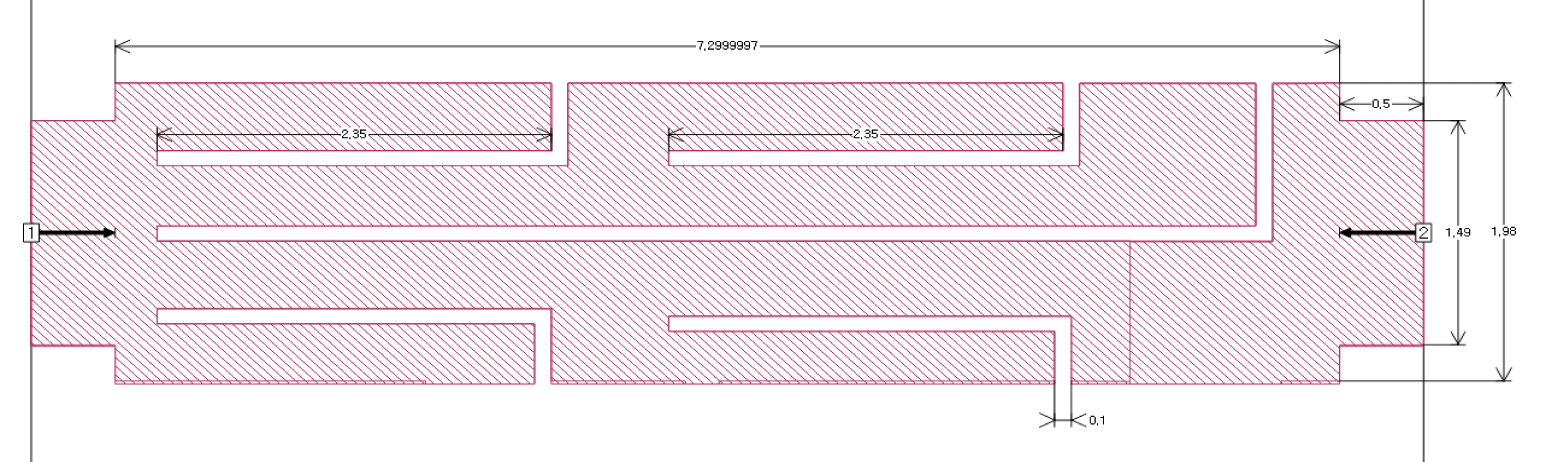
A multi-spurline resonator with a meandered slot line was designed and simulated to achieve a high-performance bandstop filter with favorable S-parameter frequency responses, using the SONNET Lite Electromagnetic (EM) simulator. This miniaturized bandstop filter was designed on a Teflon substrate with a thickness of 0.54 mm and a dielectric constant of 2.54. The slotted line of the spurline contributes to the capacitive effect, while the remaining parts provide the inductive effect. The schematic of the multi-spurline with a meandered slot line bandstop filter is shown in figure 1. The slot gap of the meandered spurline is 0.1 mm, with other dimensions provided in the figure. Each slot line is responsible for adjusting the filter's frequencies, and both ports of the filter are terminated at 50 Ohms for system applications. The 3D representation of the filter is shown in figure 2a, and the S-parameters, after simulation and dimension optimization, are presented in figure 2b.
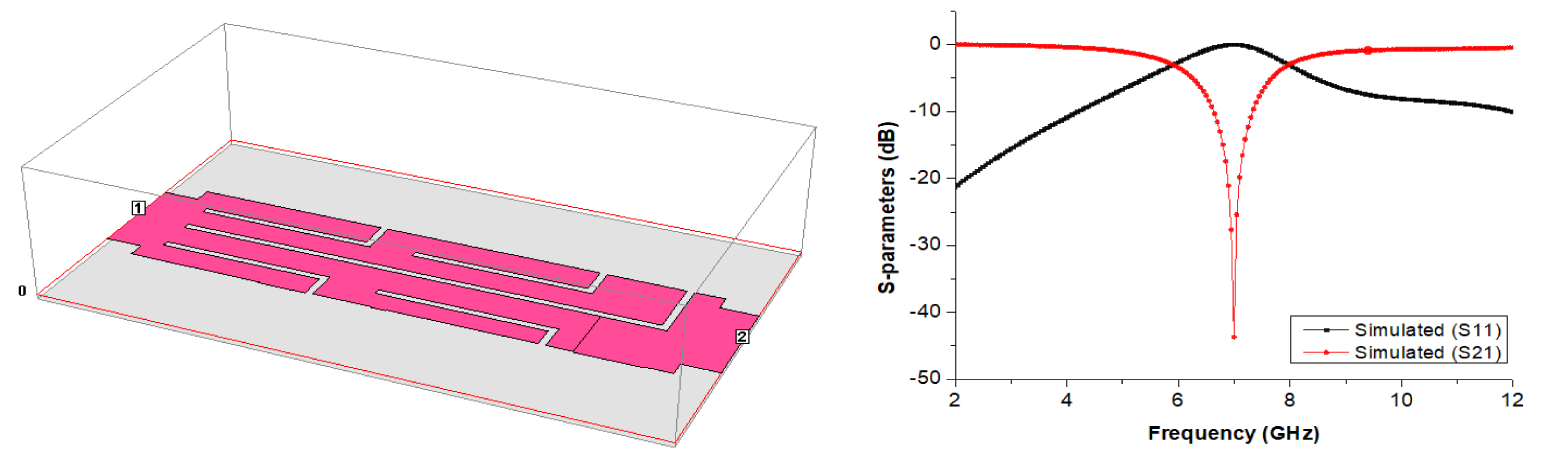
The simulation results show the S-parameters which are very important characteristics for the RF devices. The insertion loss (S21) and return loss (S11) are achieved as 43.6 dB and 0.035 dB respectively at 7 GHz frequency. The results of shows how much signals are passed and reflected back through the device respectively. The 3dB bandwidth is determined to be 2 GHz, which is significantly wider and ideal for fixed wireless communication systems. The overall device performance is summarized in table 1.
| Table 1: Overall performance of the device. | |||
| Parameters | Units | Simulation Results | Remarks |
| Center Frequency | GHz | 7 | Operating frequency |
| Insertion Loss (S21) | dB | 43.6 | Very low value |
| Return Loss (S11) | dB | 0.035 | Very low value |
| 3dB bandwidth | dB | 2 | (7.9 - 5.9GHz) = 2GHz |
| BPF Size | mm2 | (8 x 3) | |
Conclusion
The bandstop filter was designed using multi-spurlines and characterized with Sonnet Lite simulation tools on a Teflon substrate with a dielectric constant of 2.54. The filter achieved a return loss (S11) of 0.35 dB and an insertion loss (S21) of 43.6 dB at a frequency of 7 GHz, demonstrating excellent performance in blocking and allowing signals to pass through the device. These characteristics make it suitable for use in fixed wireless communication systems. The design is highly compact due to the use of multi-spurlines, and further size reduction is possible at different frequencies.
References
- Radio communication sector of ITU, Recommendation ITU-R F. International Telecommunication Union Recommendation (ITU-R). 2012;385-10.
- Shrestha B, Shrestha S. Miniaturized multi-spurline bandstop filter design with a meandered slot lines. Journal of the Institute of Engineering. 2015;11(1). doi: 10.3126/jie.v11i1.14712.
- Shrestha B, Yi JH, Cho S. Wideband open stub BPF for cognitive radio system applications. International Journal of Sensor Networks. 2017;25(3):198-205. doi: 10.1504/IJSNET.2017.087725.
- Zhu M. A split-ring-resonator-based polarization-insensitive ultra-broadband filter in the terahertz range. Proceedings of the Nature Research Society. 2017;1(1).
- Zhai D, Yang Y, Geng Z, Cui B, Zhao R. A high-selectivity THz filter based on a flexible polyimide film. IEEE Transactions on Terahertz Science and Technology. 2018;8(6):719-24. doi: 10.1109/TTHZ.2018.2872414.
- Ayyoub El Berbri, Hassna Agoumi, Seddik Bri, Youssef El Amraoui, Adil Saadi. A novel compact dual-band bandstop filter with enhanced rejection bands. Telkomnika. 2023;21(5). doi: 10.12928/telkomnika.v21i5.24825.





Content Alerts
SignUp to our
Content alerts.
 This work is licensed under a Creative Commons Attribution 4.0 International License.
