
Medicine Group. 2022 January 04;3(1):001-004. doi: 10.37871/jbres1391.





 Case Report
Extension-Distraction Spine Injury at Lumbosacral Junction: A Case Report
Chaisiri Chaichankul1*, Teerawat Pansrestee2, Chaiyos Chaichankul2 and Pawin Gajaseni1
2Department of Orthopaedics, Veterans General Hospital, Bangkok, Thailand
- Extension-distraction injury
- Lumbosacral junction
- Lumbosacral transitional vertebra
- Damage control spine concept
- Minimally invasive spine surgery
Abstract
Case: We presented a case of extension-distraction spine injury at lumbosacral junction in a patient with fused spine concomitant with a lumbosacral transitional vertebra. Detail of an exceedingly rare case of traumatic lumbosacral hyperextension-distraction fracture in the individual was described and reviewed.
Conclusion: Although the occurrence of extension-distraction spine injury at lumbosacral junction is extremely rare, it can occur in some circumstances. Application of damage control spine concept including early definitive stabilization of spine fractures and minimally invasive spine surgery can give satisfactory outcomes in the polytraumatized patient.
Introduction
As we know that, the spine can be injured by several mechanisms which is a single or combination of axial force, shear force, bending moment and axial torque [1]. Distraction-shear type was specified as anterior disruption through the disc (B3), according to the classification of thoracic and lumbar fracture scheme established by Magerl and colleague [2]. This type is the least type among the others (0.2%) [3]. Generally, most traumatic extension-distraction injuries were described in adults with rigid spines resulting from diffuse idiopathic skeletal hyperostosis (DISH) and ankylosing spondylitis (AS) [4-7]. The extension-distraction injury was more common located at cervical and thoracolumbar level than the lumbar area, because of the unique characteristics of anatomy and local alignment [6,7]. Combination of the secure spinal location and rare mechanism of injury, this present case report described in detail of an exceedingly rare case of a traumatic lumbosacral hyperextension-distraction fracture in the individual.
The patient was informed that data concerning the case would be submitted for publication, and he provided consent.
Case Report
A 68-year-old male slipped and fell backward in supine position from a two-storey height above the ground (7 to 8 m) while he was repairing the roof. Before touching the ground, his back was hit by a branch of tree on the way to ground. The patient was transferred to the hospital by the relatives promptly.
After complete clearing of primary survey and proper resuscitated according to the principle of advanced trauma life support protocol, he was diagnosed as multiple trauma injuries including lung contusion, traumatic subdural hematoma with fracture base of skull, closed fracture of right zygoma, multiple ribs fracture associated with bilateral hemothorax, traumatic left optic nerve injury and splenic rupture. The orthopaedic problems were secondary evaluated and diagnosed as closed fracture of left radial and ulnar shafts, closed fracture of 1st metacarpal bone of left hand and the multiple spinal fractures including complete flexion-burst fracture at T12 vertebral body (A3.3.2) and hyperextension-shear type at L4/5 interspace (B3.1.1) according to the classification scheme described by Magerl and colleague[2] (Figure 1). There were other related spinal pathologies that were noticed in the patient. Firstly, the fused spine was observed at the mid-thoracic region which may be referred to DISH (Figure 2). Secondly, there was a Lumbosacral Transitional Vertebra (LSTV) - sacralized L5 (Figure 3). To define sacralized L5, we used diligent manual counting of the vertebral segments from Multidetector CT (MDCT), beginning from C2 and further used the iliac crest tangent sign described by Farshad-Amacker, et al. to differentiate [8,9]. In our case, the iliac crest tangent sign was “negative” therefore the last vertebra was sacralized L5. His neurological examination was revealed as grade 3 weakness of left lower extremity and grade 4 weakness of right lower extremity. His sphincter tone was intact. However, according to his multiple severe concomitants of injury, the thoroughly evaluation of neurological function was not able to be performed. His back revealed large contusion and subcutaneous hematoma at right frank and buttock.


The multidisciplinary team approach was consulted and managed harmoniously and systematically. We managed the spine problem by following the damage control spine concept[10] after the patient’s condition was stabilized. Posterior percutaneous screw fixation under fluoroscopic guidance was performed to stabilize the extension-distraction injury at lumbosacral junction and the flexion-burst injury at thoracolumbar junction, consecutively. No decompression was performed because no compromised spinal canal was seen by CT and MRI images. We used a special pedicular screw design as dual lead thread to reduce the risks of poor bone quality [11,12] (Figure 4).

Postoperatively, there was no further neurologic deterioration. The other conditions were corrected and proper managed by the team-specialist care. Early ambulation program was encouraged after surgery. The patient was able to maintain sitting posture and start ambulation with thoracolumbosacral orthosis application. At 6 weeks after the surgery, the patient was able to walk with gait-assistance and motor function improved one grade of both lower extremities. At 1 year postoperatively, the patient was noted to have maintained corrected spinal alignment [13] (Figure 5) and fully recovered from the multiple injuries.
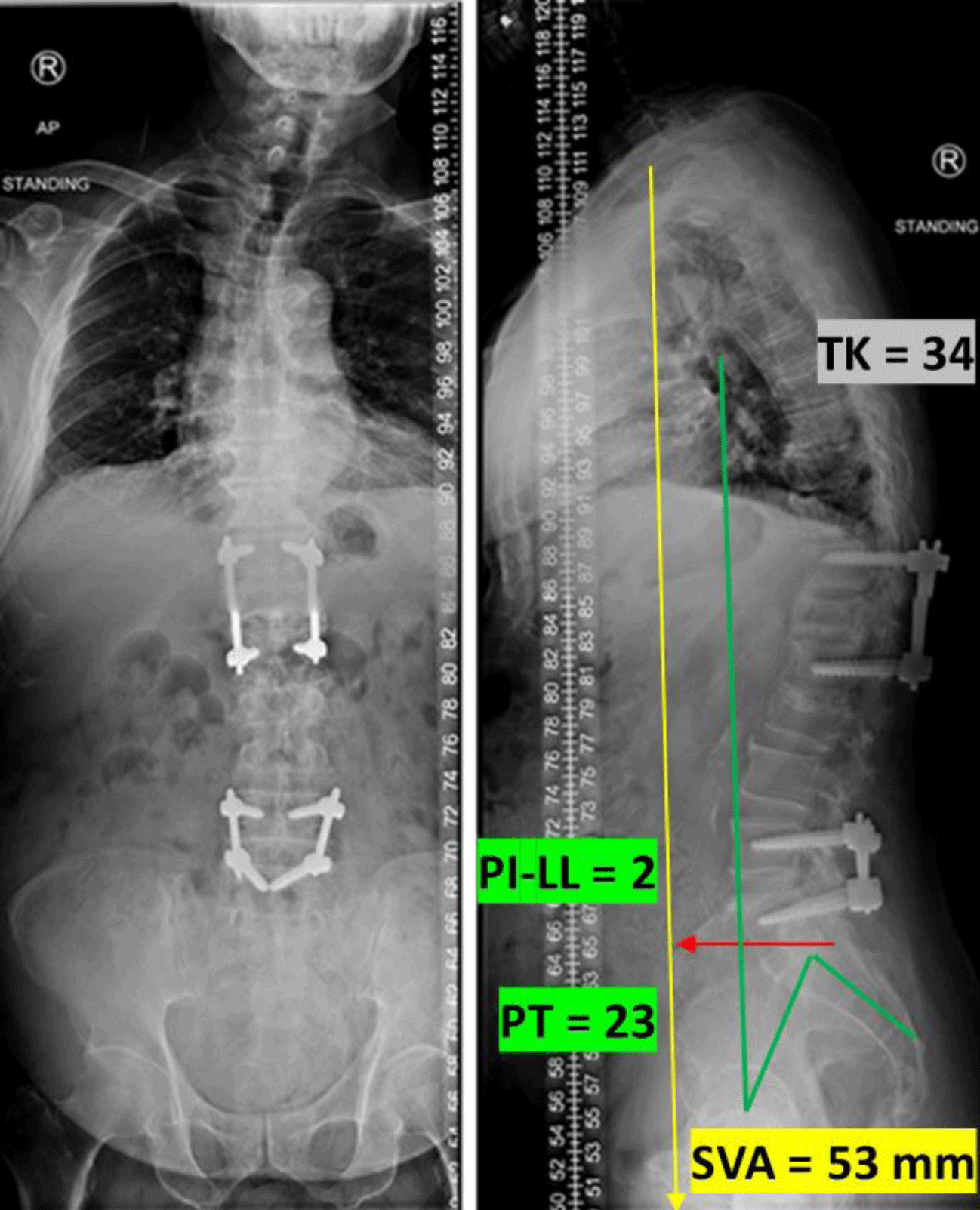
LL: Lumbar lordosis; PI: Pelvic Incidence; PT: Pelvic Tilt; SVA: Sagittal Vertical Axis; TK: Thoracic Kyphosis
Discussion
The extension-distraction spine injury at thoracolumbar spine is rare, accounting only 3% of thoracolumbar spine injuries [14,15]. This traumatic injury type at the lumbosacral junction is consequently extremely rare occurring in the individual. This is because of the unique characteristics of anatomy and local alignment of the lower lumbar spines[16,17]. In the other hand, these unique features may increase the tendency for some types of traumatic spinal injuries.
Generally, the deep-seated of L5 vertebra below pelvic brim and lumbo-iliosacral ligaments provide a stability for this infrequently injured vertebra. In some circumstances, like our patient, the presentation of fused spine, make lower lumbar area of non-fused segment more susceptible to injury after the accident. Additionally, the sacralized L5 (Castellvi 3B) seen in our patient made this L5 had a very stable foundation but made L4/5 intervertebral disc weaker [18,19]. This can be explained by the study of Aihara and colleague in a clinical and anatomical study. They discovered that the iliolumbar ligament at the level immediately above the transitional vertebra was thinner and weaker than it was in cadavers without a lumbosacral transitional vertebra[17]. Further supported by the study of Elster[19] he stated that movement between the transitional vertebra and the sacrum was very limited, whereas the disc space above the transitional vertebra was more mobile. All these mentions, it could be implied that the junction immediately above the lumbosacral transitional vertebra and below the fused spine according to DISH was more susceptible to injure by the extension-shear traumatic force [6].
Extension-distraction spine injury is commonly created by high energy trauma [20,21]. According to Magerl [2] this type of spine injury is hierarchically ranked according to progressive severity as the most severity of type B. In our patient, when complete flexion-burst fracture at T12 and extension-distraction spine injury at lumbosacral junction were marked as unstable features (TL AOSIS = 9 points and 11 points, respectively) [22] and involved multiple injuries especially the life-threatening conditions, the damage control spine concept should be done [6,10,23].
Early definitive stabilization of unstable spine fractures is one of the concepts [10]. Methods of MIS range from fluoroscopic-assisted percutaneous trans-pedicular screw-rod fixation to Computerized Tomography (CT) based 3D navigated systems and robotic-assisted surgery. We selected minimally invasive spine surgery as posterior percutaneous screw fixation under fluoroscopic guidance for our patient according to the simplicity and the familiarity to our team. It is important to note that the development of Minimally Invasive Surgical (MIS) techniques for polytraumatized patient as ours has led to a reduction in intraoperative blood loss, tissue trauma, post-operative pain, and length of stay [10,23]. The posterior percutaneous pedicular screw fixation at lumbosacral region, the more unstable region, was performed first and then at thoracolumbar region. Because of the patient’s age, various techniques to minimize the risks of implant failure from the poor bone quality were used in our patient. Undertapping of screws, larger screws, convergent direction, and special design as dual lead thread were applied in our patient to improve pull-out strength [24-26]. Although the intervertebral disc is usually damaged in all B3 injuries [2,27], which means that the spinal segment losses the anterior column integrity, it did not occur in our patient. We supposed that the direction of injury was not disrupted through the entire intervertebral disc because an avulsion fracture of the antero-superior part of the L5 vertebral body was detected from sagittal CT image (Figure 1). Therefore, there was a remaining sufficient uninjured disc to support the anterior vertebral column. To close the gap between the interspace of L4/5 and to reattach the avulsed fragment of the superior endplate of L5, the less lordotic pre-bent rods should secure the spinal segment integrity.
Conclusion
The occurrence of extension-distraction spine injury at lumbosacral junction is extremely rare. But it can occur in some circumstances, such as in patient who has fused spine at the proximal spinal segment combined with the lumbosacral transitional vertebra which can create the intervening area at lumbosacral junction vulnerable to this type of injury. Application of damage control spine concept including early definitive stabilization of spine fractures and minimally invasive spine surgery can give satisfactory outcomes in the polytraumatized patient.
References
- White AA, Panjabi MM. Clinical Biomechanics of the Spine. 2nd Ed. Philadelphia: JB Lippincott; 1990. https://bit.ly/3zlhi0N
- Magerl F, Aebi M, Gertzbein SD, Harms J, Nazarian S. A comprehensive classification of thoracic and lumbar injuries. Eur Spine J. 1994;3(4):184-201. doi: 10.1007/BF02221591. PMID: 7866834.
- Mirza SK, Mirza AJ, Chapman JR, Anderson PA. Classifications of thoracic and lumbar fractures: rationale and supporting data. J Am Acad Orthop Surg. 2002 Sep-Oct;10(5):364-77. doi: 10.5435/00124635-200209000-00008. PMID: 12374487.
- Burkus JK, Denis F. Hyperextension injuries of the thoracic spine in diffuse idiopathic skeletal hyperostosis. Report of four cases. J Bone Joint Surg Am. 1994 Feb;76(2):237-43. doi: 10.2106/00004623-199402000-00010. PMID: 8113258.
- McKenzie MK, Bartal E, Pay NT. A hyperextension injury of the thoracic spine in association with diffuse idiopathic skeletal hyperostosis. Orthopedics. 1991 Aug;14(8):895-8. PMID: 1923970.
- Leone A, Marino M, Dell'Atti C, Zecchi V, Magarelli N, Colosimo C. Spinal fractures in patients with ankylosing spondylitis. Rheumatol Int. 2016 Oct;36(10):1335-46. doi: 10.1007/s00296-016-3524-1. Epub 2016 Jul 5. PMID: 27379763.
- Okuda A, Konishi H, Maegawa N, Masuda K, Shigematsu H, Kawamura K, Fukushima H, Tanaka Y. Intercostal artery rupture associated with thoracic spinal hyperextension injury caused by a minor trauma: A case report. Trauma Case Rep. 2021 Apr 21;33:100487. doi: 10.1016/j.tcr.2021.100487. PMID: 33997230; PMCID: PMC8102801.
- Farshad-Amacker NA, Aichmair A, Herzog RJ, Farshad M. Merits of different anatomical landmarks for correct numbering of the lumbar vertebrae in lumbosacral transitional anomalies. Eur Spine J. 2015 Mar;24(3):600-8. doi: 10.1007/s00586-014-3573-7. Epub 2014 Sep 16. PMID: 25223429.
- Lian J, Levine N, Cho W. A review of lumbosacral transitional vertebrae and associated vertebral numeration. Eur Spine J. 2018 May;27(5):995-1004. doi: 10.1007/s00586-018-5554-8. Epub 2018 Mar 21. PMID: 29564611.
- Banagan K, Ludwig SC. Thoracolumbar spine Trauma: When damage control minimally invasive spine surgery is an option. Semin Spine Surg. 2012;24:221-225.
- Bianco RJ, Arnoux PJ, Wagnac E, Mac-Thiong JM, Aubin CÉ. Minimizing Pedicle Screw Pullout Risks: A Detailed Biomechanical Analysis of Screw Design and Placement. Clin Spine Surg. 2017 Apr;30(3):E226-E232. doi: 10.1097/BSD.0000000000000151. PMID: 28323704.
- Mehta H, Santos E, Ledonio C, Sembrano J, Ellingson A, Pare P, Murrell B, Nuckley DJ. Biomechanical analysis of pedicle screw thread differential design in an osteoporotic cadaver model. Clin Biomech (Bristol, Avon). 2012 Mar;27(3):234-40. doi: 10.1016/j.clinbiomech.2011.10.004. Epub 2011 Nov 8. PMID: 22071427.
- Holdsworth F. Fractures, dislocations, and fracture-dislocations of the spine. J Bone Joint Surg Am. 1970 Dec;52(8):1534-51. PMID: 5483077.
- Burke DC. Hyperextension injuries of the spine. J Bone Joint Surg Br. 1971 Feb;53(1):3-12. PMID: 5578765.
- Schouten R, Fisher C. Fusion for lower lumbar (L3-L5) fractures: Surgical indications and techniques. Semin Spine Surg. 2011;23:249-256.
- Finn CA, Stauffer ES. Burst fracture of the fifth lumbar vertebra. J Bone Joint Surg Am. 1992 Mar;74(3):398-403. PMID: 1548267.
- Aihara T, Takahashi K, Ogasawara A, Itadera E, Ono Y, Moriya H. Intervertebral disc degeneration associated with lumbosacral transitional vertebrae: a clinical and anatomical study. J Bone Joint Surg Br. 2005 May;87(5):687-91. doi: 10.1302/0301-620X.87B5.15727. PMID: 15855373.
- Vergauwen S, Parizel PM, van Breusegem L, Van Goethem JW, Nackaerts Y, Van den Hauwe L, De Schepper AM. Distribution and incidence of degenerative spine changes in patients with a lumbo-sacral transitional vertebra. Eur Spine J. 1997;6(3):168-72. doi: 10.1007/BF01301431. PMID: 9258634; PMCID: PMC3454625.
- Elster AD. Bertolotti's syndrome revisited. Transitional vertebrae of the lumbar spine. Spine (Phila Pa 1976). 1989 Dec;14(12):1373-7. PMID: 2533403.
- De Oliveira JC. A new type of fracture-dislocation of the thoracolumbar spine. J Bone Joint Surg Am. 1978 Jun;60(4):481-8. PMID: 670270.
- Weiss W, Bardana D, Yen D. Anterior surgical treatment for an extension-distraction spine injury: a case report. J Trauma. 2009 Feb;66(2):E17-9. doi: 10.1097/01.ta.0000222720.59829.04. PMID: 18288011.
- Vaccaro AR, Schroeder GD, Kepler CK, Cumhur Oner F, Vialle LR, Kandziora F, Koerner JD, Kurd MF, Reinhold M, Schnake KJ, Chapman J, Aarabi B, Fehlings MG, Dvorak MF. The surgical algorithm for the AOSpine thoracolumbar spine injury classification system. Eur Spine J. 2016 Apr;25(4):1087-94. doi: 10.1007/s00586-015-3982-2. Epub 2015 May 8. PMID: 25953527.
- Alkosha HM, Omar SA, Albayar A, Awad BI. Candidates for Percutaneous Screw Fixation Without Fusion in Thoracolumbar Fractures: A Retrospective Matched Cohort Study. Global Spine J. 2020 Dec;10(8):982-991. doi: 10.1177/2192568219886320. Epub 2019 Nov 14. PMID: 32875856; PMCID: PMC7645079.
- Dodwad SM, Khan SN. Surgical stabilization of the spine in the osteoporotic patient. Orthop Clin North Am. 2013 Apr;44(2):243-9. doi: 10.1016/j.ocl.2013.01.008. Epub 2013 Feb 12. PMID: 23544827.
- Kuhns CA, Reiter M, Pfeiffer F, Choma TJ. Surgical strategies to improve fixation in the osteoporotic spine: the effects of tapping, cement augmentation, and screw trajectory. Global Spine J. 2014 Feb;4(1):47-54. doi: 10.1055/s-0033-1361588. Epub 2013 Nov 22. PMID: 24494181; PMCID: PMC3908976.
- Goldstein CL, Brodke DS, Choma TJ. Surgical Management of Spinal Conditions in the Elderly Osteoporotic Spine. Neurosurgery. 2015 Oct;77 Suppl 4:S98-107. doi: 10.1227/NEU.0000000000000948. PMID: 26378363.
- Curfs I, Schotanus M, VAN Hemert WLW, Heijmans M, DE Bie RA, VAN Rhijn LW, Willems PCPH. Reliability and Clinical Usefulness of Current Classifications in Traumatic Thoracolumbar Fractures: A Systematic Review of the Literature. Int J Spine Surg. 2020 Dec;14(6):956-969. doi: 10.14444/7145. Epub 2020 Dec 29. PMID: 33560256; PMCID: PMC7872412.




Content Alerts
SignUp to our
Content alerts.
 This work is licensed under a Creative Commons Attribution 4.0 International License.
